 Volkswagen Touran
All generations, specs and history
Published Sources (1) Report an error
By Felix Hartmann, Automotive Technology & EV Contributor
- Built
- 2003–2026
- Generations
- 2
Timeline
Touran generations
Click a generation for its own page


Newest first · 2 generations since 2003
All generations by year: Touran II (2015–2026) · Touran 1T (2003–2015)
Which one is mine?
Pick the year of first registration to see which generation it is.
Check by VINThe Volkswagen Touran is a front-wheel-drive compact people carrier with five or seven seats, aimed mainly at families with children. Volkswagen announced it in August 2002 as a smaller alternative to the Sharan, production began in December 2002 and sales started in 2003. The first generation was facelifted in 2006 and again in 2010; the second generation, on the MQB platform, was unveiled at the Geneva motor show in March 2015 and built in Wolfsburg until April 2026. The name combines "Tour" with the last syllable of "Sharan".
In short
- Two generations: 1T (2003–2015, facelifted in 2006 and 2010) and 5T (2015–2026).
- First generation on the PQ35 (Golf) platform; second generation on MQB, about 62 kg lighter despite being larger.
- Second-generation engines: TSI petrol units from 81 to 110 kW (110–150 PS) and TDI diesels from 81 to 140 kW (110–190 PS).
- Up to 1,980 litres of luggage space and 47 storage compartments.
Volkswagen Touran at a glance
Every Touran is a monocoque MPV with a transverse engine and front-wheel drive; all-wheel drive was never offered. More Volkswagen models are listed in our Volkswagen catalogue, and the larger people carrier is covered in our Volkswagen Sharan section.
First generation: 1T (2003–2015)
The first Touran was based on the Golf's PQ35 platform and offered five or seven seats, the third row being best for children. Petrol engines included a 1.6 with 75 kW (102 PS), 1.6 FSI and 2.0 FSI units, a 1.2 TSI with 77 kW (105 PS) and a 1.4 TSI with 103 kW (140 PS), later 125 kW (170 PS). Diesels ranged from a 1.6 TDI with 66 kW (90 PS) and a 1.9 TDI with 74 kW (101 PS) to a 2.0 TDI with up to 130 kW (177 PS) from 2012. Natural-gas EcoFuel versions were offered (2.0 EcoFuel with 80 kW (109 PS) and later a 1.4 TSI EcoFuel with 110 kW (150 PS)), and the CrossTouran of December 2006 had 17-inch wheels and 15 mm higher suspension. Gearboxes were a six-speed manual, a six-speed automatic and six- and seven-speed DSG units. In 2003 Euro NCAP awarded it four stars, upgraded to five stars for adult protection after a retest. The facelifts of 2006 and 2010 refreshed the styling, improved the interior and added new equipment.
Second generation: 5T (2015–2026)
Exterior
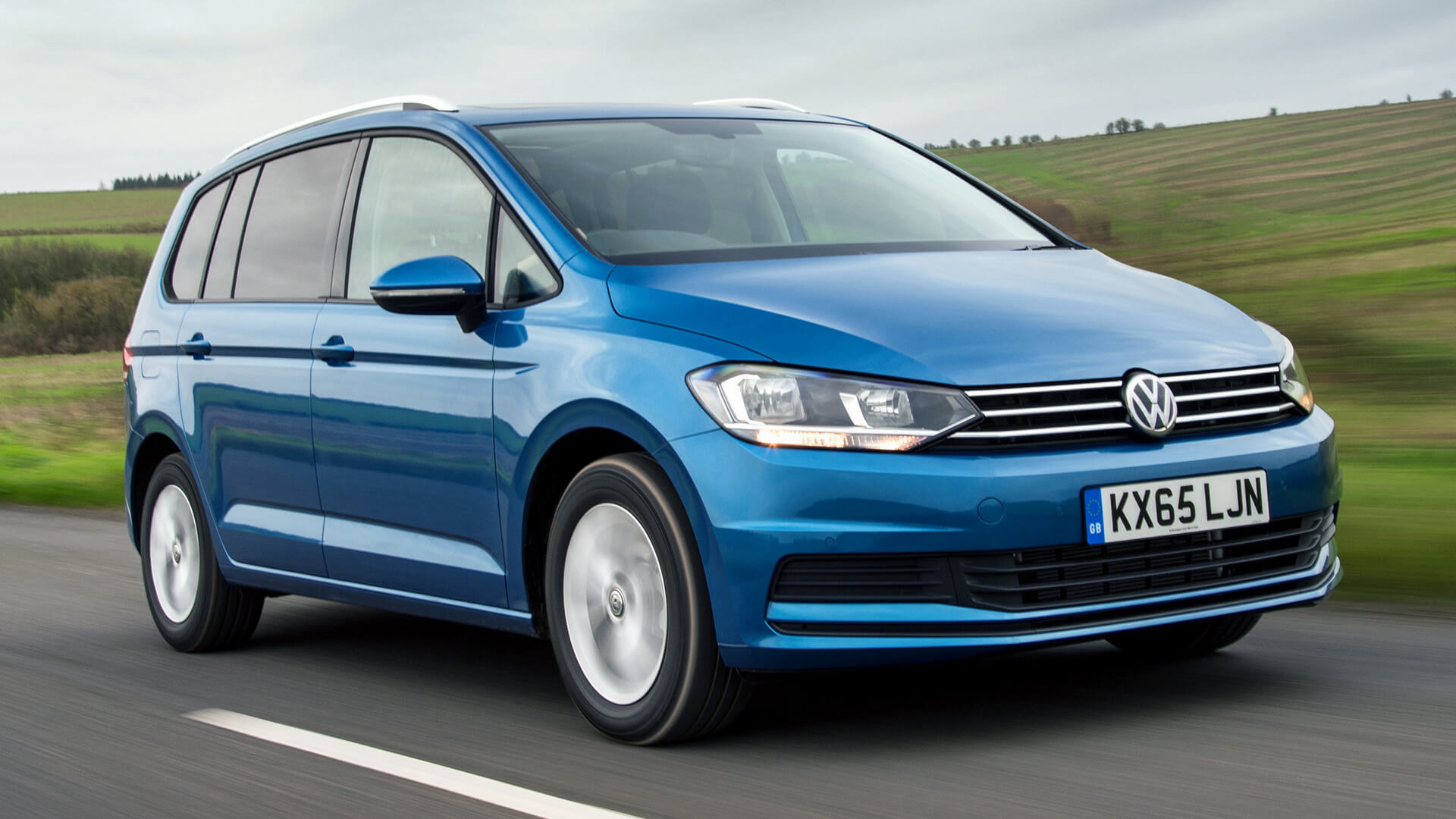
The second Touran carries many Volkswagen design cues and is instantly recognisable. Gentle stepped and wavy surfaces, a few chrome or gloss-black details, sharp headlights and intakes make it look less like a typical family car. The short, steeply raked front improves visibility. The bonnet has wavy surfacing and slightly raised ridges, leading to a slim chrome grille with the VW badge. Xenon headlights were standard in many versions, with a horizontal LED daytime running-light strip. The lower bumper has a wide slot intake and fog lamps. The R-Line package adds sportier bumpers, sill trims and a unique strip on the front wings.
In profile, a long glasshouse with thin chrome trim and gloss-black pillars, chrome roof rails and triangular mirrors with indicators on gloss-black stalks stand out, along with flared wheel arches and prominent sills. Ground clearance is about 145 mm, and wheels are 16 or 17 inches. The almost square, upright rear looks almost crossover-like, with a large rectangular window, a short spoiler with a brake light, large tail lights (optionally LED), a black diffuser, fog lamps and a single exhaust.
Interior
Moving to the MQB platform and a longer wheelbase made the cabin 63 mm longer, so all occupants have more space, although the thick front pillars limit side visibility. A panoramic roof with 1.34 m² of glass is optional. The driver faces a flat-bottomed three-spoke multifunction steering wheel (leather on more expensive versions) and clear twin-dial instruments with a trip-computer display between them. The front seats are well shaped with a wide range of adjustment. A 5- to 8-inch infotainment screen with Android Auto and Apple CarPlay sits in the centre, with two air vents and the hazard switch above it and climate controls below; three-zone climate control is available. Materials are of high quality, including textured plastics and leather, and a two-tone interior is optional. There are 47 storage compartments.
The second-row seats slide by 200 mm (previously 160 mm), and the optional third row gained 54 mm of knee room, though it is less comfortable than the first two rows. All three rows can be moved, folded or removed independently. Luggage space increased by 48 litres: up to 1,040 litres in five-seat form when loaded to the roof and up to 1,980 litres with all rear seats folded (1,857 litres in the seven-seater). A power tailgate with hands-free opening is optional.
Engines and transmissions (second generation)
| Engine | Fuel | Power (kW / PS) |
|---|---|---|
| 1.0 TSI | Petrol | 85 kW / 115 PS |
| 1.2 TSI | Petrol | 81 kW / 110 PS |
| 1.4 TSI / 1.5 TSI | Petrol | 110 kW / 150 PS |
| 1.8 TSI (China) | Petrol | 132 kW / 180 PS |
| 1.6 TDI | Diesel | 81–85 kW / 110–115 PS |
| 2.0 TDI | Diesel | 85–110 kW / 116–150 PS |
| 2.0 TDI (twin-turbo) | Diesel | 140 kW / 190 PS |
All engines have turbocharging, direct injection and start/stop. Published figures give 5.5–6.5 l/100 km, 0–100 km/h in 8.5–11.5 seconds and 189–218 km/h for the petrol versions, and 4.4–4.8 l/100 km, 8.2–11.9 seconds and 187–220 km/h for the diesels. Gearboxes are a six-speed manual or six- and seven-speed DSG dual-clutch automatics; all versions are front-wheel drive.
Chassis
The MQB-based Touran uses MacPherson struts at the front and a multi-link rear, electric power steering and disc brakes all round with a range of electronic aids. Optional DCC adaptive dampers are available.
Safety and equipment
Equipment includes LED headlights, adaptive lighting, lane keeping, adaptive cruise control with traffic-jam assist, Front Assist with City Emergency Braking, post-collision braking, blind-spot monitoring, trailer assist, airbags and curtain airbags, parallel and perpendicular parking assistance, three-zone climate control, a power tailgate, an electric parking brake with hold function, leather upholstery and electric, heated and ventilated front seats. When European sales began in September 2015, prices started at €23,925. Euro NCAP retested the 1.5 TSI in 2022, with 77% for adult occupants and 81% for children.
Key specifications by generation
| Parameter | 1T | 5T |
|---|---|---|
| Years | 2003–2015 | 2015–2026 |
| Platform | PQ35 | MQB |
| Seats | 5 or 7 | 5 or 7 |
| Power range (kW / PS) | 66–130 kW / 90–177 PS | 81–140 kW / 110–190 PS |
| Ground clearance | - | about 145 mm |
| Max luggage space | - | 1,980 l (5 seats) |
Strengths and weaknesses
Owners praise the Touran's looks, space, economy and strong engines, its well-thought-out interior with many storage compartments, quick-release rear seats, precise handling and confident suspension, good equipment, sound insulation, high seating position and quality materials. Drawbacks include light interiors that soil easily, expensive diesel and DSG repairs on older cars, costly original parts, a suspension best suited to town driving, delicate paint, modest ground clearance and no all-wheel drive. Rivals over its life included the Opel Zafira, Renault Scénic, Ford C-Max and Citroën Berlingo.
Image credits · Photos from Wikimedia Commons under free licences
- Volkswagen Touran 1T · Photo: M 93 / Wikimedia Commons, Public domain
- Volkswagen Touran II · Photo: Vauxford / Wikimedia Commons, CC BY-SA 4.0
Volkswagen Touran in our rankings
- No. 134 of 912 · Longest-running car nameplates (23 years · top 15%)
- No. 272 of 345 · Cars with the most generations (2 generations)
In production longer than 85% of ranked nameplates in the 1CARS catalog (No. 134 of 912).
FAQ
How many generations of the Volkswagen Touran are there?
Two: the first (1T) from 2003 to 2015, facelifted in 2006 and 2010, and the second (5T) from 2015 to 2026.
Does the Volkswagen Touran have seven seats?
Yes, a third row is optional; it is best suited to children.
Does the Volkswagen Touran have all-wheel drive?
No, every Touran is front-wheel drive.
When did Volkswagen Touran production end?
Production ended in Wolfsburg in April 2026 after 11 years of the second generation.
Data sources
Data checked by an editor against the sources below.