 BMW M2
All generations, specs and history
Published Sources (1) Report an error
By Felix Hartmann, Automotive Technology & EV Contributor
- Built
- 2016–present
- Generations
- 2 · F87 to G87
Timeline
M2 generations
Click a generation for its own page


Newest first · 2 generations since 2016
All generations by year: M2 G87 (2023–now) · M2 F87 (2016–2021)
Which one is mine?
Pick the year of first registration to see which generation it is.
- G87 2023–present
- F87 2016–2021
Verdict
Our verdict · Felix Hartmann
BMW keeps improving cars that are already good. It seemed impossible to make the M2 any better, yet the CS improves on it in many ways: it is more striking, faster and better equipped, and it delivers real driving pleasure both on the road and on the track. It is not a car for a large family, but for one or two people it is just right. Only the price is daunting — but those who value pure driving and speed will appreciate it.
The BMW M2 is a compact high-performance coupé from BMW's M division, built on the two-door 2 Series. The first-generation M2 (F87) was revealed in late 2015 and premiered at the Detroit motor show in January 2016, with its European debut at the Geneva motor show that March. Compared with the regular 2 Series Coupé, it gained a more aggressive body kit, a high-performance six-cylinder engine and all the other M attributes. BMW later introduced the more powerful M2 Competition, and in November 2019 it revealed the most extreme version of the family: the M2 CS.
In short
- The M2 CS is the top-spec version of the first-generation M2 (F87), revealed in November 2019 and built from March 2020; about 2,200 were planned.
- 3.0-litre twin-turbo straight-six with 331 kW (450 PS) and 550 Nm — as much power as the M4 Competition of the time.
- Six-speed manual or seven-speed M DCT; 0–100 km/h in 4.2 or 4.0 seconds and a top speed of 280 km/h.
- Carbon-fibre bonnet, roof and aero parts, Adaptive M suspension and an Active M differential as standard.
BMW M2 CS at a glance
More BMW models are listed in our BMW catalogue, and the M division's larger coupé is covered in our BMW M4 article.
| Version | Years | Engine | Power (kW / PS) | Torque |
|---|---|---|---|---|
| M2 | 2016–2018 | 3.0 turbo straight-six (N55) | 272 kW / 370 PS | 465 Nm (500 Nm with overboost) |
| M2 Competition | 2018–2021 | 3.0 twin-turbo straight-six (S55) | 302 kW / 410 PS | 550 Nm |
| M2 CS | 2020–2021 | 3.0 twin-turbo straight-six (S55) | 331 kW / 450 PS | 550 Nm |
Exterior
The M2 already had an aerodynamic body kit, advanced technology and a generous list of standard equipment, but BMW wanted more and created the CS, a sharper and more focused version. The M2 Competition differs from the original M2 in its trim and revised technology.
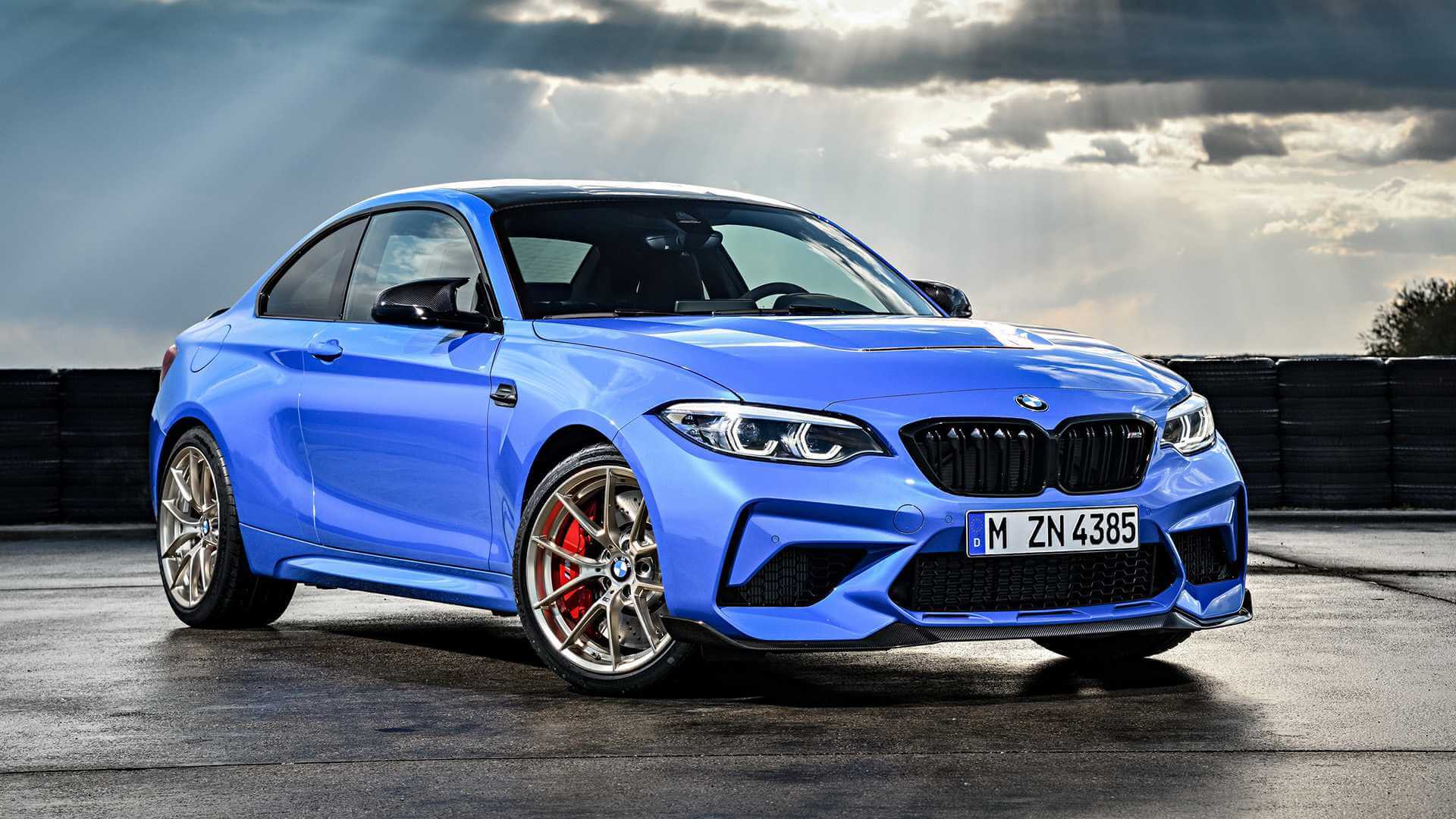
The CS has a bright, dynamic look. The front has purposeful headlights, BMW's signature kidney grille and a more aggressive aerodynamic kit than the base M2, and the carbon-fibre bonnet has air vents. The Competition already had an all-black grille and a bumper with larger air intakes.
From the side, the coupé has classic proportions — a long bonnet, a domed roof and a taut rear — along with striking sculpting on the flanks and exclusive 19-inch wheels shod with Michelin Pilot Sport Cup 2 tyres; Michelin Pilot Super Sport tyres are an alternative. Ground clearance is a sporty 123 mm, which helps high-speed stability, and special aero elements improve aerodynamics. The mirror shape was also slightly revised.
The rear has stylish lights, a compact boot lid with a small spoiler and a massive bumper with a sports diffuser and four exhaust tips. Many body parts, including the roof, are made of carbon-fibre reinforced plastic. An exclusive Misano Blue metallic paint was created for the CS, and it looks spectacular.
Interior
The cabin is concise, with high-quality materials and typically well-judged German ergonomics. The driver faces an easy-to-read instrument panel and a three-spoke M steering wheel trimmed in Alcantara. The Competition introduced revised instruments, M1 and M2 buttons on the wheel for storing personal driving set-ups and a red start button.
At the top of the dashboard is a compact infotainment touchscreen, with air vents and the audio and climate controls below. On the passenger side there is a large glovebox and a decorative Alcantara strip with the car's name. The CS logo is embroidered on the centre console and door panels, and the brand's emblem on the head restraints.
The front seats are excellent sports seats with integrated head restraints, a wide range of adjustment and strong side and lumbar support. The centre console between them — made of carbon fibre and Alcantara — carries the mechanical parking brake, the infotainment controller, the gear selector and other buttons. The rear seat is designed for two adults but is realistically for children. The boot holds 390 litres — not a great figure, but enough for the class. As with the exterior, buyers can personalise the interior extensively, at a price.
Engine and transmission
The CS is powered by a 3.0-litre twin-turbo petrol straight-six, raised from the Competition's 302 kW (410 PS) to 331 kW (450 PS), with 550 Nm. That puts it level in power with the larger M4 Competition of the time. Fuel consumption is about 8–8.5 l/100 km, depending on the gearbox.
The engine is paired with a six-speed manual or a seven-speed M DCT dual-clutch gearbox. With the manual, the CS reaches 100 km/h in 4.2 seconds; with the M DCT, in 4.0 seconds. Top speed is 280 km/h in both cases.
Chassis
The CS is built on the platform of the regular M2. It has MacPherson struts at the front and a five-link rear axle. Adaptive M suspension is standard and gives excellent handling on any kind of road, as is the Active M differential at the rear, which can vary its locking effect from 0 to 100%. Forged aluminium wheel hubs and control arms and stiff ball joints sharpen the chassis further.
Dynamic Stability Control is fitted, and the electric power steering with variable characteristics makes the coupé easy to drive. The brakes have six-piston calipers at the front and four-piston calipers at the rear, with 400 mm front and 380 mm rear discs; carbon-ceramic brakes are optional.
Price and equipment
The CS went on sale in the first half of 2020 at prices starting from about €95,000. Standard equipment includes 19-inch alloy wheels with high-performance tyres, the M aerodynamic kit, a boot-lid spoiler, the vented bonnet, a multifunction steering wheel, leather, Alcantara and carbon-fibre interior trim, an infotainment system with a touchscreen, a premium sound system, a range of driver assistance systems, sports seats, climate control, cruise control, metal sill plates and pedals, high-performance brakes and a surround-view camera.
Rivals
Even die-hard BMW fans may look at alternatives from Stuttgart and Ingolstadt at this price. The CS's main rivals are the Mercedes-AMG CLA 45, Audi RS 3, Audi TT RS and Alfa Romeo Giulia Quadrifoglio.
Image credits · Photos from Wikimedia Commons under free licences
- BMW M2 F87 · Photo: Vauxford / Wikimedia Commons, CC BY-SA 4.0
- BMW M2 G87 · Photo: Alexander-93 / Wikimedia Commons, CC BY-SA 4.0
BMW M2 in our rankings
- No. 382 of 912 · Longest-running car nameplates (10 years · top 43%)
- No. 159 of 305 · Oldest car models still on sale (10 years · top 55%)
- No. 321 of 345 · Cars with the most generations (2 generations)
In production longer than 57% of ranked nameplates in the 1CARS catalog (No. 382 of 912).
FAQ
How powerful is the BMW M2 CS?
Its 3.0-litre twin-turbo straight-six produces 331 kW (450 PS) and 550 Nm.
How fast is the BMW M2 CS?
It reaches 100 km/h in 4.2 seconds with the manual gearbox or 4.0 seconds with the M DCT, and its top speed is 280 km/h.
How many BMW M2 CS were built?
Production began in March 2020, and about 2,200 cars were planned.
What is the difference between the M2 Competition and the M2 CS?
The CS has 29 kW (40 PS) more, carbon-fibre body parts including the bonnet and roof, and Adaptive M suspension as standard.
Data sources
Data checked by an editor against the sources below.