 Audi RS7
All generations, specs and history
Published Sources (5) Report an error
By Felix Hartmann, Automotive Technology & EV Contributor
- Built
- 2013–2025
- Generations
- 2 · C7 to C8
Timeline
RS7 generations
Click a generation for its own page


Newest first · 2 generations since 2013
All generations by year: RS7 C8 (2019–2025) · RS7 C7 (2013–2018)
Which one is mine?
Pick the year of first registration to see which generation it is.
Check by VINThe Audi RS7 Sportback is a high-performance five-door fastback in the Gran Turismo mould, built by Audi Sport GmbH on the basis of the Audi A7. It was first shown on 16 January 2013 at the North American International Auto Show in Detroit. Two generations have been produced so far; the second was unveiled at the Frankfurt motor show in September 2019.
In short
- First generation (2013–2019), facelifted in 2014, with an even stronger "performance" version from October 2015.
- 4.0 TFSI twin-turbo V8: 412 kW (560 PS) in the first generation, 445 kW (605 PS) in the performance, and 441 kW (600 PS) with 800 Nm and mild-hybrid support in the second.
- quattro with a 40:60 front-rear torque split, 0–100 km/h in as little as 3.6 seconds, up to 305 km/h with the Dynamic plus package.
- A practical 535-litre boot (1,390 litres with the rear seats folded).
Running cost
Fuel · RS7 C8 4 L 8 cyl Automatic (S8) · 2023 (EPA)
about 3,600 EUR fuel a year at 15,000 km
13.8 l/100 km · petrol at 1.75 EUR/l · change mileage, fuel price or version
Specs by version
Engines
| Version | Engine | Gearbox | Drive | Production years |
|---|---|---|---|---|
| C7 · 2013–2018 | ||||
| C7 · 4 L 8 cyl Automatic (S8) · 2018 (EPA) | 4.0 l · 8 cyl 4,000 cc | 8-sp Automatic | All-wheel drive | 2018 |
| C8 · 2019–2025 | ||||
| C8 · 4 L 8 cyl Automatic (S8) · 2025 (EPA) | 4.0 l · 8 cyl · Hybrid 4,000 cc | 8-sp Automatic | All-wheel drive | 2025 |
| C8 · 4 L 8 cyl Automatic (S8) · 2024 (EPA) | 4.0 l · 8 cyl · Hybrid 4,000 cc | 8-sp Automatic | All-wheel drive | 2024 |
| C8 · 4 L 8 cyl Automatic (S8) · 2023 (EPA) | 4.0 l · 8 cyl · Hybrid 4,000 cc | 8-sp Automatic | All-wheel drive | 2023 |
| C8 · 4 L 8 cyl Automatic (S8) · 2022 (EPA) | 4.0 l · 8 cyl · Hybrid 4,000 cc | 8-sp Automatic | All-wheel drive | 2022 |
| C8 · 4 L 8 cyl Automatic (S8) · 2021 (EPA) | 4.0 l · 8 cyl · Hybrid 4,000 cc | 8-sp Automatic | All-wheel drive | 2021 |
Performance
Show all 6 versions
| Version | Fuel consumption |
|---|---|
| C7 · 2013–2018 | |
| C7 · 4 L 8 cyl Automatic (S8) · 2018 (EPA) | 13.8 l/100 km17.0 mpg US · 20.5 mpg UK |
| C8 · 2019–2025 | |
| C8 · 4 L 8 cyl Automatic (S8) · 2025 (EPA) | 13.8 l/100 km17.0 mpg US · 20.5 mpg UK |
| C8 · 4 L 8 cyl Automatic (S8) · 2024 (EPA) | 13.8 l/100 km17.0 mpg US · 20.5 mpg UK |
| C8 · 4 L 8 cyl Automatic (S8) · 2023 (EPA) | 13.8 l/100 km17.0 mpg US · 20.5 mpg UK |
| C8 · 4 L 8 cyl Automatic (S8) · 2022 (EPA) | 13.8 l/100 km17.0 mpg US · 20.5 mpg UK |
| C8 · 4 L 8 cyl Automatic (S8) · 2021 (EPA) | 13.8 l/100 km17.0 mpg US · 20.5 mpg UK |
Verified Manufacturer and type-approval data from our catalog · Sources and methodology
Audi RS7 Sportback at a glance
The RS7 adds sporty styling, a more focused interior and far more powerful hardware to the A7 Sportback. Audi developed it to take on the Mercedes-Benz CLS 63 AMG and the BMW M6 Gran Coupé. More of the range is in our Audi catalogue, and the brand's history is told in the history of Audi. Related high-performance Audis on our site include the Audi S6.
Audi RS7 generations
First generation (2013–2019)
The RS7 Sportback debuted on 16 January 2013 and was updated in 2014 together with the regular A7, gaining cosmetic changes and extra features. From October 2015 a more aggressive RS7 Sportback performance was offered with a more powerful engine and upgraded technology.
The facelift gave it a more aggressive bumper, a large grille and slim LED headlights, standard on every version. Experts welcomed Audi's move away from chrome: the grille and the extra air intakes merge into one large area of black mesh that cools both the engine and the brakes. Huge wheel arches hold 20-inch wheels (21-inch on the performance), and the mirrors have a chrome-look finish. A spoiler extends automatically at 120 km/h. The rear has a new bumper, new lights and sportier exhaust tailpipes with an impressive sound.
The interior uses premium leather, soft-touch plastics and aluminium inserts, with typically excellent German ergonomics. The round steering wheel is flattened at the bottom and carries audio, navigation and cruise controls. A configurable display presents virtual round dials, and the centre console mixes physical buttons with a large central screen; "RS" badges appear throughout. The seats are closer in feel to an executive car than a sports car: soft but supportive, ventilated, heated and widely adjustable. There is plenty of room in the back, even for larger passengers, who also get their own climate zones. The boot holds 535 litres, rising to 1,390 litres; the car runs on run-flat tyres, so there is no spare wheel.
Second generation (2019 onwards)
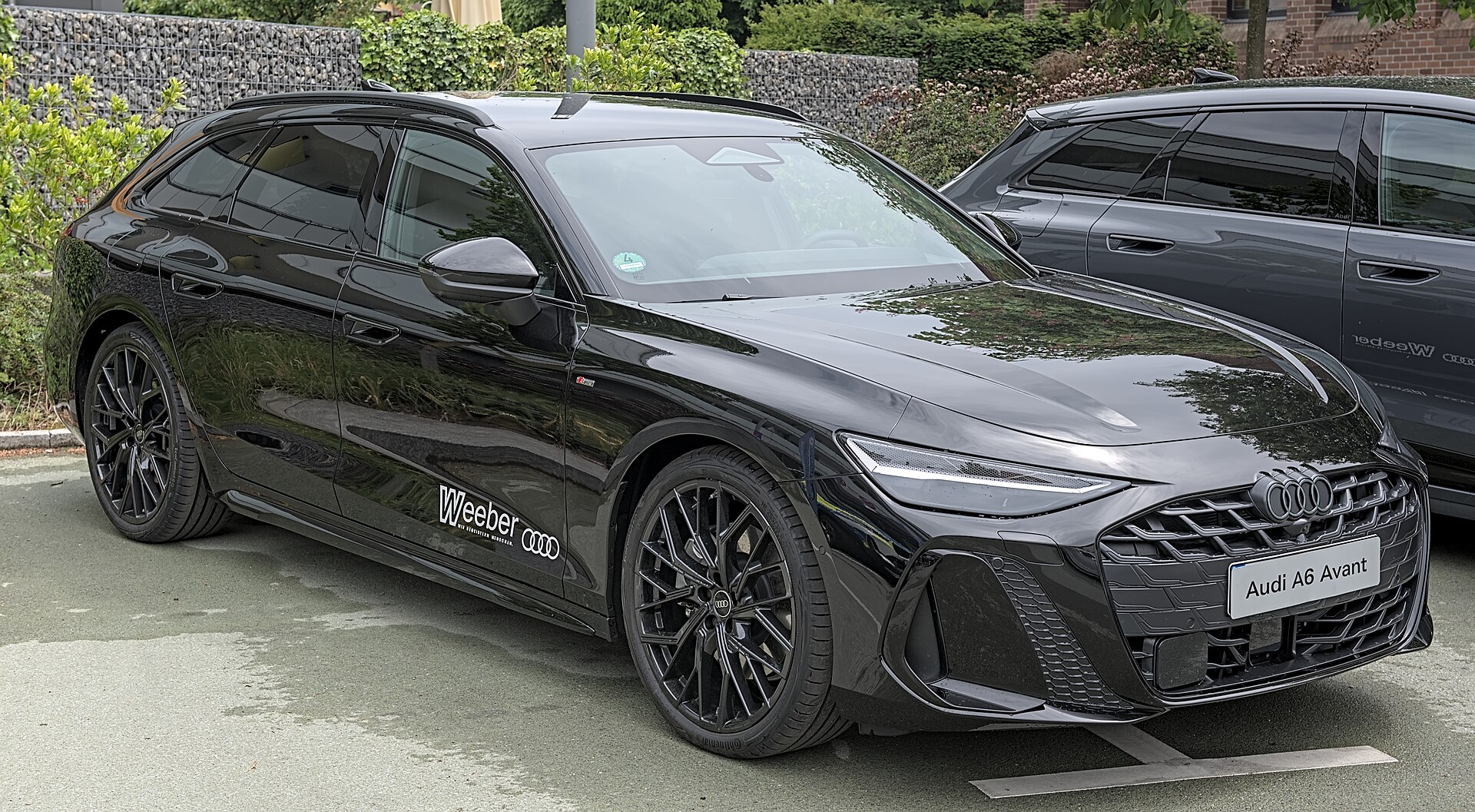
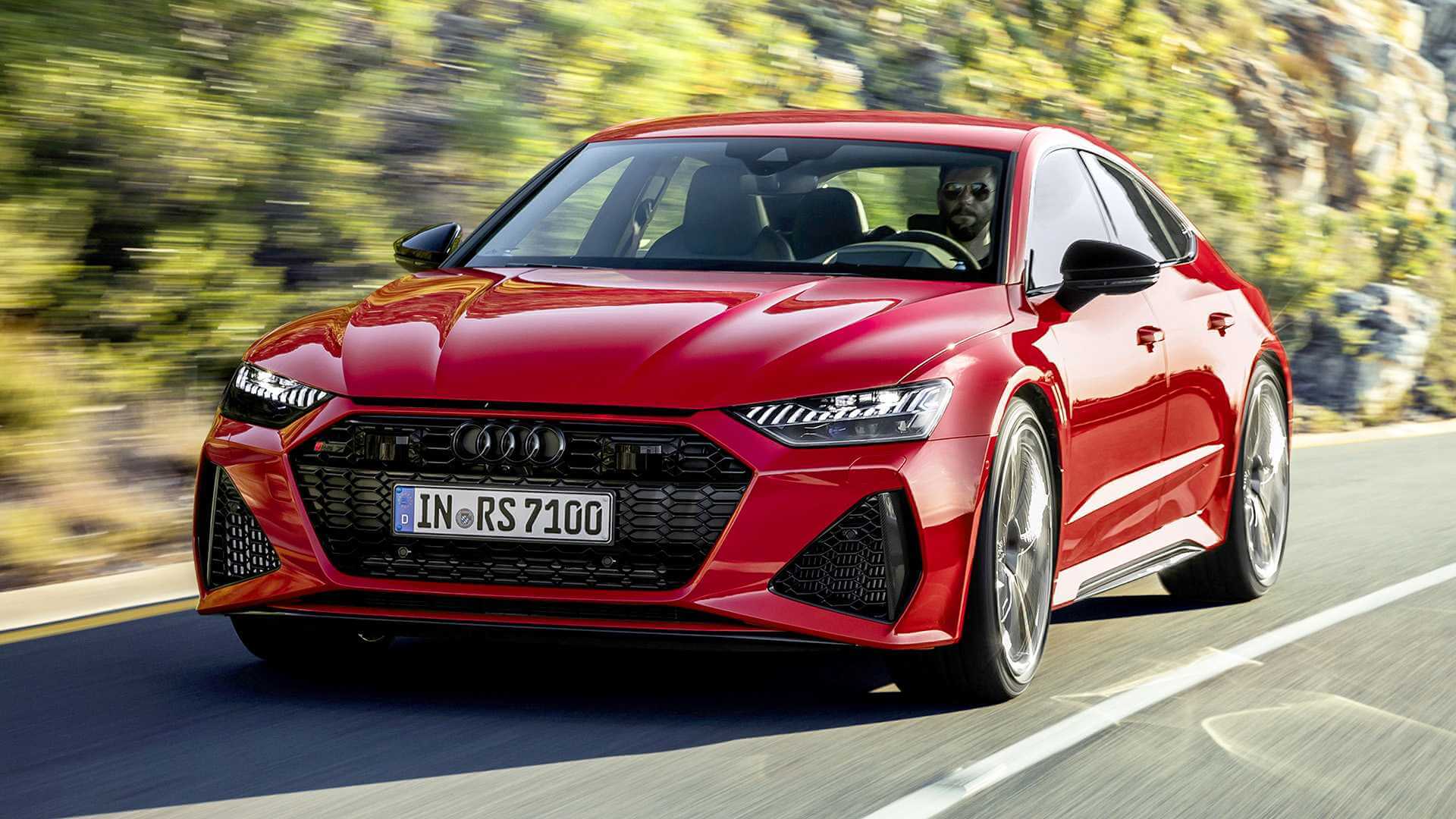
Audi announced the new RS7 about two years before its debut and revealed the RS7 Sportback at the Frankfurt motor show in September 2019, shortly after the new RS6 Avant. It is lower, wider-looking and more aggressive than the A7, with a frameless, recessed hexagonal grille in black mesh, sharp headlights, triangular intakes that cool the brakes and pronounced wheel arches. The windows are framed in gloss black, the mirrors integrate indicators, and wheels are 21-inch ten-spoke alloys as standard or 22-inch with 285/30 R22 tyres. Brake callipers are black or red, or grey, red or blue with carbon-ceramic brakes. A spoiler extends at 100 km/h, and at the rear a full-width light strip, a large diffuser and big exhaust tailpipes complete the look.
The cabin is trimmed in several types of leather, aluminium, Alcantara, carbon and wood, with honeycomb-stitched Valcona leather sports seats. The flat-bottomed steering wheel has buttons for the RS1 and RS2 modes. The Audi virtual cockpit shows data such as torque, tyre pressures and boost, together with a shift indicator and the status of the mild-hybrid system, and two large touchscreens are angled towards the driver. The rear can seat two or three, the armrest houses a cooled compartment, and the 535-litre boot (1,390 litres folded) has an electric tailgate with foot-gesture opening.
Engine and transmission
| Version | Engine | Power (kW / PS) | Torque | 0–100 km/h |
|---|---|---|---|---|
| RS7 (2013–2019) | 4.0 TFSI V8, twin turbo | 412 kW / 560 PS | 700 Nm | 3.9 s |
| RS7 performance (from 2015) | 4.0 TFSI V8, twin turbo | 445 kW / 605 PS | — | 3.7 s |
| RS7 (2019–) | 4.0 TFSI V8, twin turbo, 48-volt mild hybrid | 441 kW / 600 PS | 800 Nm | 3.6 s |
The V8 has two twin-scroll turbochargers mounted, with the intercooler, inside the cylinder vee, an aluminium-silicon block, direct injection and cylinder deactivation at light loads. In the performance version, the engine was remapped and the turbochargers' geometry changed. Despite its output, the first-generation RS7 was rated at 9.5 l/100 km combined. The second generation adds a belt-driven starter-generator on a 48-volt network that produces about 12 kW (16 PS), assists the engine when pulling away and runs the start/stop system, switching the engine off when braking or coasting.
Power goes through an eight-speed tiptronic automatic (from ZF in the second generation) to quattro all-wheel drive. The mechanical centre differential normally splits torque 40:60 front to rear but can send up to 70% to the front or up to 85% to the rear when a wheel slips. Top speed is limited to 250 km/h, raised to 280 km/h with the Dynamic package and 305 km/h with Dynamic plus. In the second generation, a rear sport differential comes with the Dynamic packages, and Audi drive select offers six modes: Comfort, Auto, Dynamic, Efficiency, RS1 and RS2.
Chassis and brakes
The first generation uses Audi's MLB platform with four-link front and multi-link rear suspension. It had standard air suspension with five modes and adjustable ride height; steel springs with three-mode dampers were optional. Brakes were ventilated discs all round with six-piston front callipers, four-piston rear callipers and 390 mm cast-iron front discs, or optional 420 mm carbon-ceramic discs.
In the second generation, standard adaptive air suspension lowers the body by 20 mm compared with the A7; above 120 km/h it drops another 10 mm automatically, and it can be raised by 20 mm at the touch of a button. Dynamic Ride Control and all-wheel steering are optional: at low speeds the rear wheels turn up to 5 degrees opposite to the fronts, and at higher speeds up to 2 degrees in the same direction. Standard perforated discs measure 420 mm at the front and 370 mm at the rear; the optional carbon-ceramic brakes (440 mm front, 370 mm rear) save 34 kg.
Key specifications
| Parameter | 1st generation | 2nd generation |
|---|---|---|
| Years | 2013–2019 | 2019 onwards |
| Engine | 4.0 TFSI V8 twin turbo | 4.0 TFSI V8 twin turbo, MHEV |
| Power | 412 kW / 560 PS (performance 445 kW / 605 PS) | 441 kW / 600 PS |
| Torque | 700 Nm | 800 Nm |
| 0–100 km/h | 3.9 s (performance 3.7 s) | 3.6 s |
| Top speed | 250 / 280 / 305 km/h | 250 / 280 / 305 km/h |
| Wheels | 20–21 in | 21–22 in |
| Boot | 535 / 1,390 l | 535 / 1,390 l |
Equipment
First-generation cars came with leather, 20-inch wheels, heated electric front seats, LED headlights and tail lights, RS sports seats, four-zone climate control, quattro, an infotainment system with an NVIDIA processor, cruise control and an electrically adjustable steering wheel. The second generation is standard with the 441 kW (600 PS) V8, LED lights, an active spoiler, air suspension, three large screens, 21-inch alloys and perforated brake discs; options include matrix LED headlights with dark bezels, the Dynamic packages, all-wheel steering, carbon-ceramic brakes and 22-inch RS wheels. Its main rivals are the BMW M8 Gran Coupé and the Mercedes-AMG GT 63 4-door Coupé. In 2023 Audi added the RS7 Sportback performance, with 463 kW (630 PS) and 850 Nm.
Image credits · Photos from Wikimedia Commons under free licences
- Audi RS7 C7 · Photo: Sarah Larson from Ann Arbor, MI, USA / Wikimedia Commons, CC BY 2.0
- Audi RS7 C8 · Photo: © M 93 / Wikimedia Commons, CC BY-SA 3.0 de
Audi RS7 in our rankings
- No. 3 of 70 · Biggest engines: hatchbacks (4,000 cc)
- No. 312 of 912 · Longest-running car nameplates (12 years · top 35%)
- No. 186 of 557 · Biggest engines: cars (4,000 cc · top 35%)
- No. 216 of 256 · Most economical cars (13.8 l/100 km · top 86%)
- No. 42 of 42 · Most economical hatchbacks (13.8 l/100 km)
- No. 307 of 345 · Cars with the most generations (2 generations)
Bigger engine than 95% of ranked hatchbacks in the 1CARS catalog (No. 3 of 70).
FAQ
When was the Audi RS7 launched?
The first RS7 Sportback was revealed on 16 January 2013 in Detroit; the second generation debuted at Frankfurt in September 2019.
How powerful is the Audi RS7?
The first generation had 412 kW (560 PS), the performance version 445 kW (605 PS), and the second generation 441 kW (600 PS) with 800 Nm.
How fast is the Audi RS7?
The second generation reaches 100 km/h in 3.6 seconds. Top speed is limited to 250 km/h, or 280 km/h and 305 km/h with the Dynamic and Dynamic plus packages.
Is the Audi RS7 a hybrid?
The second generation is a mild hybrid: a 48-volt belt-driven starter-generator assists the V8 when pulling away and enables extended start/stop.
How big is the Audi RS7 boot?
535 litres, or 1,390 litres with the rear seats folded.
Data sources
Data checked by an editor against the sources below.
- Wikipedia — Audi A7
- Wikipedia — Audi RS 7
- US EPA fueleconomy.gov — 39427.shtml
- US EPA fueleconomy.gov — 48007.shtml
- US EPA fueleconomy.gov — 47063.shtml