
Land Rover Discovery vs Volvo XC90: seven-seat SUVs
Updated Report an error By Sarah Whitmore
Land Rover · 2017–present
Discovery L462
- Power
- 221 kW300 PS
- Kerb mass
- 2,517 kg

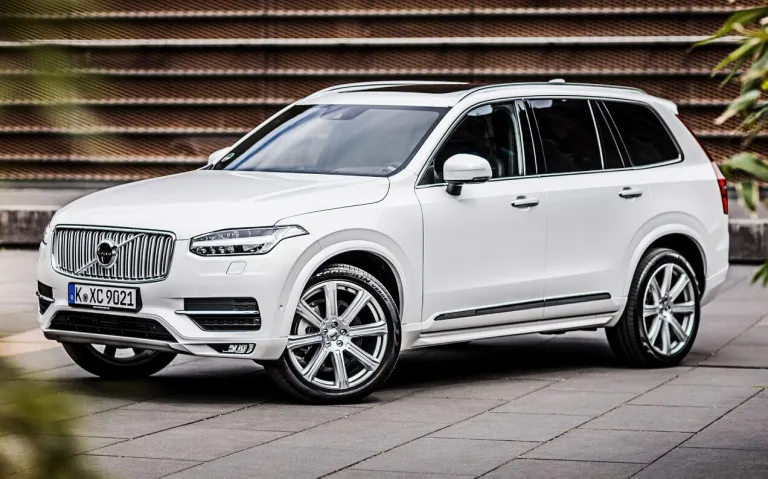
Volvo · 2015–present
XC90 II
- Power
- 221 kW300 PS
- Kerb mass
- -
At a glance
Who suits what, worked out from the catalog figures of the versions above.
Categories won: Discovery L462 1 XC90 II 0
- City Too close to call Length: 4,970 mm vs 4,950 mm
- Off-road Discovery L462 Drive and body: Four-wheel drive (4×4) · SUV vs All-wheel drive · SUV
Verdict Opinion
The Discovery is the choice for buyers who leave the tarmac. Its straight-six diesels give up to 257 kW, the D300 matches the XC90 B6 for power with far more torque, and it can wade through 900 mm of water.
The XC90 is the better family car on the road. It is lighter in most versions, its T8 plug-in hybrid has 335 kW and 709 Nm, and its 2015 Euro NCAP result, with 97% for adult occupants and 100% for safety assist, is the stronger of the two.
- Sarah Whitmore
The Volvo XC90 and the Land Rover Discovery are two of the most popular large seven-seat SUVs in Europe, and both have been on sale for a decade in their current form. Volvo unveiled the second-generation XC90 in Stockholm on 26 August 2014 as the first car on its Scalable Product Architecture (SPA). It is built in Torslanda, Sweden, and was facelifted in February 2019 and again in September 2024. The fifth-generation Discovery was unveiled on 28 September 2016 and went on sale in the UK in February 2017; production moved from the UK to Nitra, Slovakia, in 2019.
In short: the Discovery is the genuine off-roader with six-cylinder engines and 900 mm of wading depth. The XC90 is the road-focused family car, with a plug-in hybrid and a 100% safety assist score in its Euro NCAP test. Both are in our catalogue: Land Rover Discovery and Volvo XC90.
Land Rover Discovery vs Volvo XC90: engines, seats and safety
Construction
The fifth Discovery is the first to use a unibody instead of a separate chassis. It shares an aluminium-intensive platform with the Range Rover and Range Rover Sport, which saved up to 480 kg over its predecessor; the diesel weighs 2,230 kg. Every version has an eight-speed automatic. The XC90 rides on Volvo's own SPA platform, shared with the XC60, S90 and V90, and weighs 2,050–2,130 kg in most petrol and diesel versions and 2,319–2,394 kg as the T8.
Engines: four cylinders against six
Volvo uses only 2.0-litre four-cylinder engines with an eight-speed Aisin automatic. The B5 mild hybrid has 175 kW and 480 Nm, the B6 mild hybrid 221 kW (300 PS) and 420 Nm, and the T8 plug-in hybrid 335 kW (455 PS) and 709 Nm. In March 2024 the XC90 became the last Volvo built with a diesel engine. Land Rover replaced its 2.0-litre diesels with a 3.0-litre straight-six diesel in the 2021 update. Our catalogue lists the D250 at 183 kW, the D300 at 221 kW and 649 Nm and the D350 at 257 kW; the petrol P360 has 265 kW and 500 Nm.
- Discovery D300 MHEV: 221 kW, 649 Nm
- Discovery D350 MHEV: 257 kW
- Discovery P360 MHEV: 265 kW, 500 Nm
- XC90 B6: 221 kW, 420 Nm
- XC90 T8 Recharge: 335 kW, 709 Nm
Plug-in hybrid only at Volvo
The XC90 T8 launched with a 9.2 kWh battery, enlarged to 18.8 kWh in 2021. At launch its electric range was 43 km on the NEDC cycle. Land Rover offers no plug-in Discovery.
Off-road ability
The Discovery can wade through water up to 900 mm deep. Our sources give no wading figure for the XC90, which shares its platform with Volvo's saloons and estates.
Seats, size and boot
The XC90 has seven seats as standard, with optional six-seat captain's chairs since 2020. It is 4,950 mm long, 1,923 mm wide and 1,775 mm tall on a 2,984 mm wheelbase, with 451 litres of luggage space behind the second row according to Wikipedia; our catalogue lists 613 litres. The Discovery is offered with five or seven seats and as a commercial van.
Euro NCAP
Both have five stars. The XC90 scored 97% for adult occupants, 87% for children, 72% for vulnerable road users and 100% for safety assist in 2015. The Discovery scored 90%, 80%, 75% and 73% in 2017.
Size and weight
Side view to scale, all cars from the front bumper.
| Discovery L462 | XC90 II | |
|---|---|---|
| Length | 4,970 mm195.7 in † | 4,950 mm194.9 in −20 mm −0.8 in −0.4% |
| Height | 1,846 mm72.7 in † | 1,775 mm69.9 in −71 mm −2.8 in −3.8% |
| Wheelbase | 2,923 mm115.1 in † | 2,984 mm117.5 in +61 mm +2.4 in +2.1% |
| Fits a standard garage? | No data | Too wide |
Difference vs Discovery L462 (±). Garage check: a standard single garage takes a car up to about 5.0 m (16 ft 5 in) long and 1.9 m (6 ft 3 in) wide (width as listed in the catalog; some makers include the mirrors). Leave about 0.6 m (2 ft) to open the doors. † from another version of this generation.
Full specifications
| Land Rover Discovery | Volvo XC90 | |
|---|---|---|
| General | ||
| Version | Discovery L462 · D300 MHEV · diesel · 221 kW (300 PS) | XC90 II · B6 AWD (mild hybrid) · petrol · 221 kW (300 PS) |
| Production years | 2017–present | 2015–present |
| Body | SUV | SUV |
| Class | No data | SUV / crossover |
| Country | United Kingdom | Sweden |
| Performance | ||
| Power Why it matters: More power means stronger acceleration and easier overtaking, especially with a full load. | 221 kW (300 PS) 296 hp | 221 kW (300 PS) 296 hp |
| Power, all versions | 83–276 kW (113–375 PS) 111–370 hp | 140–335 kW (190–455 PS) 188–449 hp |
| Torque Why it matters: Torque is the pulling force you feel when accelerating from low revs, towing or climbing hills. | 649 Nm 479 lb-ft | No data |
| Power per tonne | 88 kW/t 107 hp/ton calculated | No data |
| Engine and transmission | ||
| Fuel | Diesel | Petrol |
| Engine | No data | 4 cyl |
| Gearbox | 8-speed automatic | No data |
| Drive | Four-wheel drive (4×4) | All-wheel drive |
| Dimensions and weight | ||
| Length | 4,970 mm 195.7 in † | 4,950 mm 194.9 in |
| Width | No data | 1,923 mm 75.7 in |
| Height | 1,846 mm 72.7 in † | 1,775 mm 69.9 in |
| Wheelbase | 2,923 mm 115.1 in † | 2,984 mm 117.5 in |
| Kerb weight Why it matters: A lighter car is usually more agile and uses less energy. | 2,517 kg 5,549 lb | No data |
| Boot Why it matters: A bigger boot fits more luggage, shopping or a pram. | No data | 613 l 21.6 cu ft † |
| Economy and running costs | ||
| Fuel consumption Why it matters: Lower consumption cuts running costs and CO₂ emissions on every trip. | 8.6 l/100 km 27.4 mpg US | No data |
| CO₂ | 224 g/km | No data |
| Fuel cost per year | €2,130/year estimated | No data |
| Safety | ||
| Euro NCAP | ★★★★★ (2017) | ★★★★★ (2015) |
These cars do not differ in the data we have.
Equal rows hidden (2): Body, Power.
Estimated at 15,000 km a year with fuel at €1.65/l diesel. † from another version of this generation.
In plain words
Land Rover Discovery is 20 mm longer than Volvo XC90 (4,970 mm vs 4,950 mm). Land Rover Discovery is the older design (from 1989); Volvo XC90 arrived in 2002. On the catalog figures, the Land Rover Discovery is the pick for off-road. Our catalog has no kerb mass for the Volvo XC90 yet, so some checks above leave it out.
Which one to choose
Choose the Land Rover Discovery if you need real off-road ability or a six-cylinder diesel with 649 Nm in the D300.
Choose the Volvo XC90 if most of your driving is on the road, you want a plug-in hybrid, or you value Volvo's safety record and standard seven seats.
The XC90 also meets German rivals in Audi Q7 vs Volvo XC90, and the Land Rover range is compared in Jeep Wrangler vs Land Rover Defender.
Frequently asked questions
Which is better off-road, the Discovery or the XC90?
The Discovery. It shares its platform with the Range Rover, is rated for a wading depth of 900 mm and is offered with straight-six diesels. The XC90 uses Volvo's SPA platform, shared with the S90 and V90.
Do both have seven seats?
Yes. The XC90 has seven seats as standard, with six-seat captain's chairs optional since 2020. The Discovery is available with five or seven seats.
Is there a plug-in hybrid Discovery?
No. The plug-in hybrid of the pair is the XC90 T8 with 335 kW (455 PS), 709 Nm and an 18.8 kWh battery since 2021.
Can you still buy a diesel XC90?
No. In March 2024 the XC90 became the last Volvo car built with a diesel engine. The Discovery still offers 3.0-litre straight-six diesels.
Where are they built?
The XC90 in Torslanda, Sweden. Discovery production moved from the UK to Nitra, Slovakia, in 2019.