
Audi Q7 vs Volvo XC90: seven-seat luxury SUVs compared
Updated Report an error By Oleksandr Hnatiuk

Audi · 2015
Q7 4M
- Power
- 274 kW373 PS
- Kerb mass
- —

Volvo · 2015–present
XC90 II
- Power
- 165 kW224 PS
- Kerb mass
- 2,170 kg
At a glance
Who suits what, worked out from the catalog figures of the versions above.
Categories won: Q7 4M 2 XC90 II 0
- Family Q7 4M Boot: 890 l vs 613 l
- City Too close to call Length: 5,050 mm vs 4,950 mm
- Running costs Q7 4M Fuel per year: €450 vs €1,660 (estimated)
- Off-road Too close to call Drive and body: All-wheel drive · SUV vs All-wheel drive · SUV
Verdict Opinion
The Q7 is the better choice for drivers who tow, cover long distances with heavy loads or simply want the effortless pull of a V6 diesel. The SQ7 adds genuine performance that Volvo does not try to match.
The XC90 wins on safety reputation and on calm, Scandinavian design inside. Its four-cylinder engines are less charismatic, but the T8 plug-in gives the same 335 kW as the Audi plug-in and suits buyers who do most of their driving within electric range.
— Oleksandr Hnatiuk
Both of these large SUVs arrived in the first half of the 2000s and both are on their second generation. Volvo moved first: the XC90 was unveiled at the North American International Auto Show in January 2002, and production started that August at Torslanda in Sweden. The Audi Q7 followed at the Frankfurt Motor Show in September 2005 and was built in Bratislava, Slovakia.
The current Volvo XC90 was revealed in Stockholm on 26 August 2014 on Volvo's Scalable Product Architecture. Audi presented the second Q7 (Typ 4M) at Detroit in January 2015, built on the Volkswagen Group MLB platform. Both cars have since been facelifted twice, and Volvo has added the all-electric EX90, which it says will be sold alongside the XC90 for the foreseeable future.
Audi Q7 vs Volvo XC90: engines, plug-ins and safety
Six and eight cylinders against four
Audi still uses larger engines. The 4M Q7 has been offered as the 45 TDI with 170 kW (231 PS), the 50 TDI with 210 kW (286 PS) and the 55 TFSI petrol with 250 kW (340 PS); the SQ7 tops the range at 373 kW (507 PS). Volvo took a radical decision with the second XC90: every engine is a 2.0-litre four-cylinder. The mild-hybrid B5 AWD makes 175 kW and the B6 AWD 221 kW (300 PS).
Plug-in hybrids at the same output
Here the two meet exactly. The Q7 60 TFSI e quattro produces 335 kW (456 PS), and the XC90 T8 Recharge 335 kW (455 PS). Volvo's battery grew to 18.8 kWh with the 2021 update. For comparison, the SQ7 delivers 38 kW more than either plug-in, but without any electric driving.
Earlier generations
The first XC90 used five- and six-cylinder petrol engines: the 2.5 T with 155 kW and the twin-turbo T6 with 200 kW. In 2005 Volvo added a 4.4-litre V8 developed with Yamaha, rated at 232 kW (315 PS). Audi's first Q7 went much further with the V12 TDI, whose 368 kW (500 PS) and 1,000 N·m were 136 kW more than even the V8 Volvo could offer.
Size and seats
The XC90 is 4,950 mm long, 1,923 mm wide and 1,775 mm tall, with a 2,984 mm wheelbase, and is offered with five or seven seats. The Q7 is a two- or three-row SUV depending on market. Check the specification of a used car carefully if you need the third row.
Safety
Euro NCAP called the 2015 XC90 best in class: it scored 97% for adult occupants and 100% for safety assistance. A Q7 50 TDI tested in 2019 reached 92% for adults and 72% for safety assistance.
Size and weight
Side view to scale, all cars from the front bumper.
| Q7 4M | XC90 II | |
|---|---|---|
| Length | 5,050 mm198.8 in | 4,950 mm194.9 in −100 mm −3.9 in −2.0% |
| Width | 1,970 mm77.6 in | 1,923 mm75.7 in −47 mm −1.9 in −2.4% |
| Height | 1,741 mm68.5 in | 1,775 mm69.9 in +34 mm +1.3 in +2.0% |
| Wheelbase | 2,994 mm117.9 in | 2,984 mm117.5 in −10 mm −0.4 in −0.3% |
| Boot | 890 l31.4 cu ft | 613 l21.6 cu ft −277 l −9.8 cu ft −31.1% |
| Fits a standard garage? | Too long and too wide | Too wide |
Difference vs Q7 4M (±). Garage check: a standard single garage takes a car up to about 5.0 m (16 ft 5 in) long and 1.9 m (6 ft 3 in) wide (width as listed in the catalog; some makers include the mirrors). Leave about 0.6 m (2 ft) to open the doors.
Full specifications
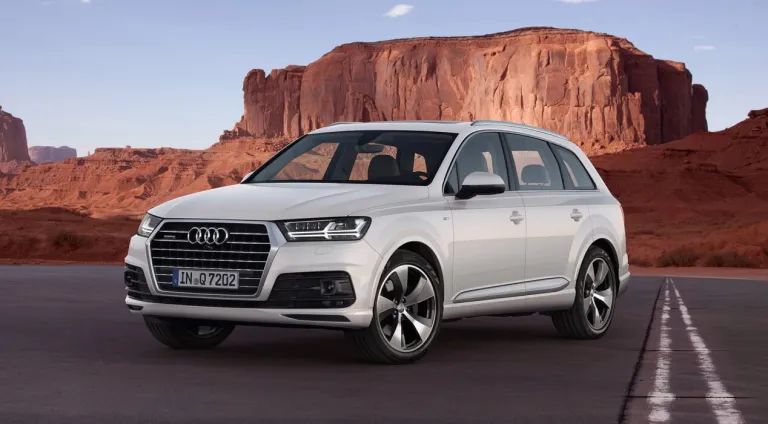
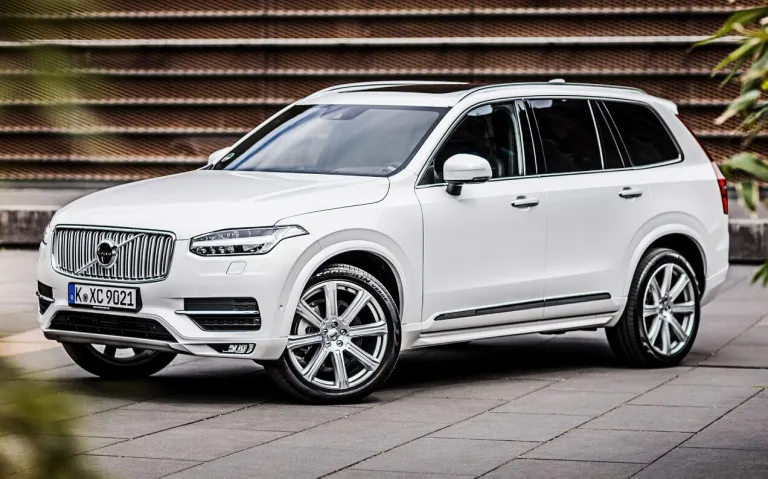
| Audi Q7 | Volvo XC90 | |
|---|---|---|
| General | ||
| Version | plug-in hybrid · 274 kW (373 PS) | XC90 II · D5 · diesel · 165 kW (224 PS) |
| Production years | 2015 | 2015–present |
| Body | SUV | SUV |
| Class | SUV / crossover | SUV / crossover |
| Country | Germany | Sweden |
| Performance | ||
| Power Why it matters: More power means stronger acceleration and easier overtaking, especially with a full load. | 274 kW (373 PS) 367 hp Better | 165 kW (224 PS) 221 hp |
| Power, all versions | 160–373 kW (218–507 PS) 215–500 hp | 140–335 kW (190–455 PS) 188–449 hp |
| Power per tonne | No data | 76 kW/t 92 hp/ton calculated |
| Engine and transmission | ||
| Fuel | Plug-in hybrid | Diesel |
| Engine code | No data | D5 |
| Drive | All-wheel drive | All-wheel drive |
| Dimensions and weight | ||
| Length | 5,050 mm 198.8 in | 4,950 mm 194.9 in |
| Width | 1,970 mm 77.6 in | 1,923 mm 75.7 in |
| Height | 1,741 mm 68.5 in | 1,775 mm 69.9 in |
| Wheelbase | 2,994 mm 117.9 in | 2,984 mm 117.5 in |
| Kerb weight Why it matters: A lighter car is usually more agile and uses less energy. | No data | 2,170 kg 4,784 lb |
| Boot Why it matters: A bigger boot fits more luggage, shopping or a pram. | 890 l 31.4 cu ft Better | 613 l 21.6 cu ft |
| Economy and running costs | ||
| Fuel consumption Why it matters: Lower consumption cuts running costs and CO₂ emissions on every trip. | 1.7 l/100 km 138.4 mpg US Better | 6.7 l/100 km 35.1 mpg US |
| CO₂ | No data | 179 g/km |
| Fuel cost per year | €450/year estimated Better | €1,660/year estimated |
| Safety | ||
| Euro NCAP | ★★★★★ (2019) | ★★★★★ (2015) |
These cars do not differ in the data we have.
Equal rows hidden (3): Body, Class, Drive.
Better marks the stronger figure — only for measurable specs (power, torque, 0–100 km/h, consumption, boot, weight).
Estimated at 15,000 km a year with fuel at €1.75/l petrol, €1.65/l diesel.
In plain words
Audi Q7 has more power: 274 kW (373 PS) against 165 kW (224 PS) for Volvo XC90. Audi Q7 is 100 mm longer than Volvo XC90 (5,050 mm vs 4,950 mm). Audi Q7 has the bigger boot: 890 l against 613 l. At 15,000 km a year, fuel would cost about €450 (Audi Q7), €1,660 (Volvo XC90) (estimated). Volvo XC90 is the older design (from 2002); Audi Q7 arrived in 2005. On the catalog figures, the Audi Q7 is the pick for family and running costs. Our catalog has no kerb mass for the Audi Q7 yet, so some checks above leave it out.
Which one to choose
Choose the Audi Q7 if you want a six-cylinder diesel, plan to tow a caravan or horse trailer, or are looking at the fast SQ7.
Choose the Volvo XC90 if crash protection and driver assistance matter most, if you need a five- or seven-seat layout, or if you can charge a T8 Recharge at home.
Buying used: a first-generation XC90 V8 or Q7 V12 TDI is a characterful but thirsty car; budget for maintenance accordingly.
Frequently asked questions
Does the Volvo XC90 have a six-cylinder engine?
Not the current one. Since the second generation arrived in 2014, every XC90 engine is a 2.0-litre four-cylinder. The first XC90 offered a straight-six T6 and a Yamaha-developed 4.4-litre V8.
Which plug-in hybrid is more powerful?
They are effectively equal: the Q7 60 TFSI e has 335 kW (456 PS) and the XC90 T8 Recharge 335 kW (455 PS).
Is the XC90 safer than the Q7?
In their Euro NCAP tests the XC90 (2015) scored 97% for adult occupants and the Q7 (2019) 92%. Both are well-equipped with driver assistance, but Volvo's result was rated best in class.
Where are the Q7 and XC90 built?
The Q7 is built in Bratislava, Slovakia. The XC90 is built at Torslanda near Gothenburg in Sweden.