
Great Wall Hover H5 vs SsangYong Kyron: budget 4x4s
Updated Report an error By Sarah Whitmore

Great Wall · 2010–2020
Hover H5
- Power
- 100 kW136 PS

SsangYong · 2005–2011
Kyron
- Power
- 104 kW141 PS
At a glance
Who suits what, worked out from the catalog figures of the versions above.
Categories won: Hover H5 2 Kyron 0
- Family Hover H5 Boot: 810 l vs 620 l
- City Hover H5 Width: 1,810 mm vs 1,880 mm
Verdict Opinion
The Kyron is the more complete package for European use: stronger diesel engines, a higher towing limit, an automatic gearbox option from Mercedes-Benz and, on European versions, stability control as standard. The Hover H5 counters with a bigger quoted boot, more ground clearance and a dual-range manual four-wheel-drive system.
Both are value-led vehicles with simple, rugged engineering rather than polish, and condition matters more than badge.
— Sarah Whitmore
The Great Wall Hover H5 and the SsangYong Kyron are two frame-based SUVs that reviewers judged largely on value. The Kyron came first, making its debut at the Frankfurt Motor Show in 2005 as SsangYong's replacement for the Musso. The Hover H5 went into production in China in June 2010 as a restyled, slightly lower development of the Hover H3.
Both are five-door, body-on-frame SUVs with rear-wheel drive and selectable or part-time four-wheel drive, and both are about 4.65 m long. Their production overlapped from 2010, which makes them natural rivals on the used market.
Engineering, design and everyday use
Engineering
The Kyron is a diesel-first car. Its Mercedes-Benz-derived 2.0 diesel produces 104 kW (141 PS) and 310 Nm, and a 2.7 five-cylinder with about 120 kW (163 PS) followed in 2007. Petrol engines were offered only in some markets. Transmissions were a five-speed manual or a Mercedes-sourced five-speed automatic, with a low-range transfer case.
The Hover H5 offered a Mitsubishi-derived 2.4 petrol, rated at 100 kW (136 PS) and 200 Nm in Australian specification, and from October 2010 a 2.0 turbodiesel with 110 kW (150 PS) and 310 Nm. The petrol has a five-speed manual, the diesel a six-speed manual or an automatic. The manual H5 has high and low ranges in four-wheel drive; the automatic diesel does not.
Size and practicality
The two are close in size: the Kyron is 4,660 mm (183.5 in) long and 1,880 mm (74.0 in) wide on a 2,740 mm (107.9 in) wheelbase; the H5 is 4,649 mm (183.0 in) long and 1,810 mm (71.3 in) wide on a 2,700 mm (106.3 in) wheelbase. The H5 quotes 810 L (28.6 cu ft) of boot space and 240 mm (9.4 in) of ground clearance; the Kyron quotes 625 L (22.1 cu ft). The Kyron tows more: 2,300 kg (5,071 lb) braked, against 1,700 kg (3,748 lb) for the H5.
Safety and equipment
Neither has a Euro NCAP rating. European Kyron 270 models came with front and curtain airbags, ESP and traction control as standard. The Australian Hover H5 had dual front airbags, ABS and EBD but no stability control.
Size and weight
Side view to scale, all cars from the front bumper.
| Hover H5 | Kyron | |
|---|---|---|
| Length | 4,649 mm183.0 in | 4,660 mm183.5 in +11 mm +0.4 in +0.2% |
| Width | 1,810 mm71.3 in | 1,880 mm74.0 in +70 mm +2.8 in +3.9% |
| Height | 1,735 mm68.3 in | 1,755 mm69.1 in +20 mm +0.8 in +1.2% |
| Boot | 810 l28.6 cu ft | 620 l21.9 cu ft −190 l −6.7 cu ft −23.5% |
| Fits a standard garage? | Yes | Tight |
Difference vs Hover H5 (±). Garage check: a standard single garage takes a car up to about 5.0 m (16 ft 5 in) long and 1.9 m (6 ft 3 in) wide (width as listed in the catalog; some makers include the mirrors). Leave about 0.6 m (2 ft) to open the doors.
Full specifications
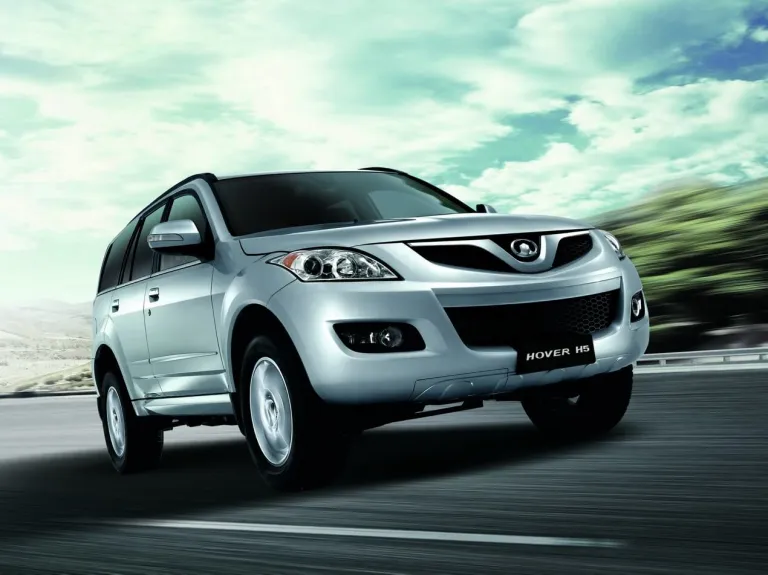
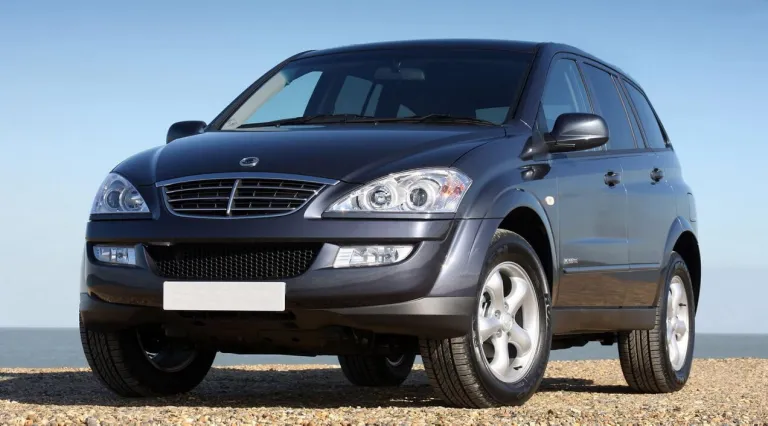
| Great Wall Hover H5 | SsangYong Kyron | |
|---|---|---|
| General | ||
| Version | 2.4 · petrol · 100 kW (136 PS) | diesel · 104 kW (141 PS) |
| Production years | 2010–2020 | 2005–2011 |
| Body | SUV | SUV |
| Class | SUV / crossover | SUV / crossover |
| Country | China | South Korea |
| Performance | ||
| Power Why it matters: More power means stronger acceleration and easier overtaking, especially with a full load. | 100 kW (136 PS) 134 hp | 104 kW (141 PS) 139 hp Better |
| Power, all versions | 100–105 kW (136–143 PS) 134–141 hp | 104–110 kW (141–150 PS) 139–148 hp |
| Engine and transmission | ||
| Fuel | Petrol | Diesel |
| Engine | 2,400 cc 2.4 l | No data |
| Dimensions and weight | ||
| Length | 4,649 mm 183.0 in | 4,660 mm 183.5 in |
| Width | 1,810 mm 71.3 in | 1,880 mm 74.0 in |
| Height | 1,735 mm 68.3 in | 1,755 mm 69.1 in |
| Wheelbase | No data | 2,740 mm 107.9 in |
| Boot Why it matters: A bigger boot fits more luggage, shopping or a pram. | 810 l 28.6 cu ft Better | 620 l 21.9 cu ft |
| Fuel tank Why it matters: A larger tank means more distance between fuel stops. | No data | 75 l 19.8 gal US |
These cars do not differ in the data we have.
Equal rows hidden (2): Body, Class.
Better marks the stronger figure — only for measurable specs (power, torque, 0–100 km/h, consumption, boot, weight).
In plain words
SsangYong Kyron has more power: 104 kW (141 PS) against 100 kW (136 PS) for Great Wall Hover H5. SsangYong Kyron is 11 mm longer than Great Wall Hover H5 (4,660 mm vs 4,649 mm). Great Wall Hover H5 has the bigger boot: 810 l against 620 l. SsangYong Kyron is the older design (from 2005); Great Wall Hover H5 arrived in 2010. On the catalog figures, the Great Wall Hover H5 is the pick for family and city.
Which one to choose
Choose the SsangYong Kyron if you want a diesel, plan to tow up to 2.3 tonnes or need the reassurance of standard ESP on European cars.
Choose the Great Wall Hover H5 if you want a frame SUV with a large boot and good ground clearance, and you prefer the manual gearbox with high and low ranges. Check parts availability before buying.
Frequently asked questions
Are the Hover H5 and Kyron both body-on-frame?
Yes. Both are five-door body-on-frame SUVs with rear-wheel drive and selectable or part-time four-wheel drive.
Which tows more?
The Kyron, with a braked towing limit of 2,300 kg. The Hover H5 is rated at 1,700 kg braked.
Does the Hover H5 automatic have a low range?
No. The automatic diesel version has no high or low range in four-wheel drive; the manual versions have both.