
Mitsubishi Pajero vs SsangYong Kyron: diesel 4x4s compared
Updated Report an error By Sarah Whitmore

Mitsubishi · 2006–2021
Pajero V80/V90
- Power
- 118 kW160 PS
- Kerb mass
- 2,355 kg

SsangYong · 2005–2011
Kyron
- Power
- 104 kW141 PS
- Kerb mass
- —
At a glance
Who suits what, worked out from the catalog figures of the versions above.
Categories won: Pajero V80/V90 1 Kyron 1
- Family Pajero V80/V90 Boot: 663 l vs 620 l
- City Kyron Length: 4,660 mm vs 4,900 mm
Verdict Opinion
The Pajero is the more capable and better-proven 4x4: bigger, stronger, rated to tow more and backed by decades of development and motorsport. The Kyron offers much of the same layout in a smaller package, with a frame chassis, low range and a roomy boot, and it was reviewed as a useful workhorse at a competitive price.
Neither is a modern crossover; both suit owners who value towing and rough-road ability over refinement.
— Sarah Whitmore
When the SsangYong Kyron made its debut at the Frankfurt Motor Show in 2005, contemporary coverage named the Nissan Terrano and the Mitsubishi Pajero among its rivals. A year later Mitsubishi launched the fourth-generation Pajero (sold as the Shogun in the UK and Montero in some markets), which stayed in European showrooms until 2018.
The two share the same broad recipe: five-door bodies, diesel engines with Mercedes-Benz or in-house roots, and four-wheel drive with a low range. They differ in pedigree, size and how far their engineering goes. The Pajero has a racing record few SUVs can match; the Kyron replaced the SsangYong Musso and was reviewed as a workhorse at a competitive price.
Engineering, design and everyday use
Engineering
The Kyron is a body-on-frame SUV with rear-wheel drive or part-time four-wheel drive and a low-range transfer case. Its diesels are a Mercedes-Benz-derived 2.0 with 104 kW (141 PS) and 310 Nm and, from 2007, a 2.7 five-cylinder with about 120 kW (163 PS); a five-speed manual or a Mercedes-sourced five-speed automatic was fitted.
The Pajero has used a monocoque with an integrated ladder frame and fully independent suspension since its third generation. The fourth generation adds Super Select 4WD-II and stability control, and its 3.2 DI-D diesel delivered up to 147 kW (200 PS) and 441 Nm between 2009 and 2015.
Size and capability
The five-door Pajero is the bigger vehicle: 4,900 mm (192.9 in) long on a 2,780 mm (109.4 in) wheelbase, with seven seats, up to 235 mm (9.3 in) of ground clearance and a braked towing limit of 3,500 kg (7,716 lb). The Kyron is 4,660 mm (183.5 in) long on a 2,740 mm (107.9 in) wheelbase, with a 625 L (22.1 cu ft) boot and a 2,300 kg (5,071 lb) braked towing limit.
Pedigree and safety
The Pajero won the Dakar Rally overall 12 times, including seven in a row from 2001 to 2007. Neither model has a Euro NCAP rating. In Australia, ANCAP gave the Pajero four stars for 2006 to early 2013 builds and five stars from April 2013. No independent crash-test result was found for the Kyron.
Size and weight
Side view to scale, all cars from the front bumper.
| Pajero V80/V90 | Kyron | |
|---|---|---|
| Length | 4,900 mm192.9 in | 4,660 mm183.5 in −240 mm −9.4 in −4.9% |
| Width | 1,875 mm73.8 in | 1,880 mm74.0 in +5 mm +0.2 in +0.3% |
| Height | 1,890 mm74.4 in | 1,755 mm69.1 in −135 mm −5.3 in −7.1% |
| Wheelbase | 2,780 mm109.4 in | 2,740 mm107.9 in −40 mm −1.6 in −1.4% |
| Boot | 663 l23.4 cu ft | 620 l21.9 cu ft −43 l −1.5 cu ft −6.5% |
| Fits a standard garage? | Tight | Tight |
Difference vs Pajero V80/V90 (±). Garage check: a standard single garage takes a car up to about 5.0 m (16 ft 5 in) long and 1.9 m (6 ft 3 in) wide (width as listed in the catalog; some makers include the mirrors). Leave about 0.6 m (2 ft) to open the doors.
Full specifications
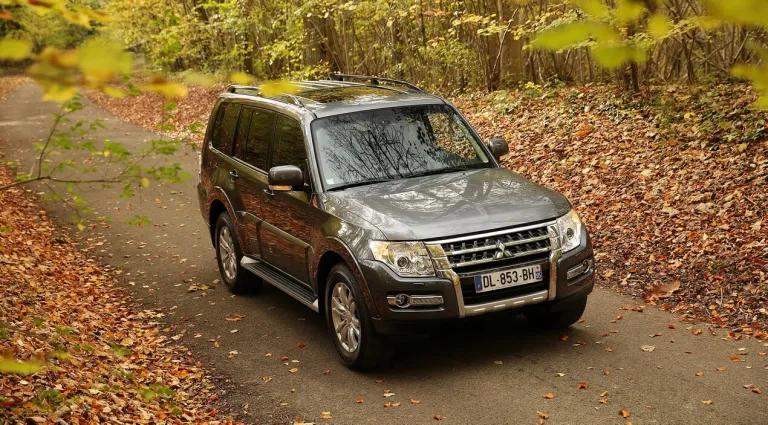
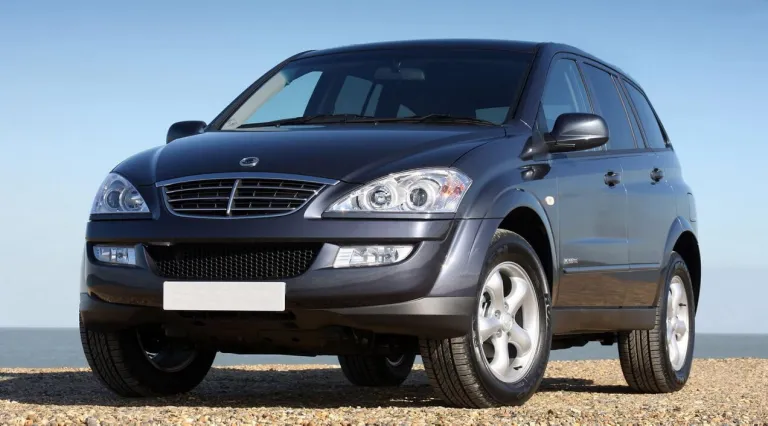
| Mitsubishi Pajero | SsangYong Kyron | |
|---|---|---|
| General | ||
| Version | Pajero V80/V90 · 3.2 DI-D diesel · 118 kW (160 PS) | diesel · 104 kW (141 PS) |
| Production years | 2006–2021 | 2005–2011 |
| Body | SUV | SUV |
| Class | SUV / crossover | SUV / crossover |
| Country | Japan | South Korea |
| Performance | ||
| Power Why it matters: More power means stronger acceleration and easier overtaking, especially with a full load. | 118 kW (160 PS) 158 hp Better | 104 kW (141 PS) 139 hp |
| Power, all versions | 62–184 kW (84–250 PS) 83–247 hp | 104–110 kW (141–150 PS) 139–148 hp |
| Torque Why it matters: Torque is the pulling force you feel when accelerating from low revs, towing or climbing hills. | 381 Nm 281 lb-ft | No data |
| Power per tonne | 50 kW/t 61 hp/ton calculated | No data |
| Engine and transmission | ||
| Fuel | Diesel | Diesel |
| Engine | 4 cyl | No data |
| Gearbox | 5-speed manual | No data |
| Drive | All-wheel drive | No data |
| Dimensions and weight | ||
| Length | 4,900 mm 192.9 in | 4,660 mm 183.5 in |
| Width | 1,875 mm 73.8 in | 1,880 mm 74.0 in |
| Height | 1,890 mm 74.4 in | 1,755 mm 69.1 in |
| Wheelbase | 2,780 mm 109.4 in | 2,740 mm 107.9 in |
| Kerb weight Why it matters: A lighter car is usually more agile and uses less energy. | 2,355 kg 5,192 lb | No data |
| Boot Why it matters: A bigger boot fits more luggage, shopping or a pram. | 663 l 23.4 cu ft Better | 620 l 21.9 cu ft |
| Fuel tank Why it matters: A larger tank means more distance between fuel stops. | No data | 75 l 19.8 gal US |
These cars do not differ in the data we have.
Equal rows hidden (3): Body, Class, Fuel.
Better marks the stronger figure — only for measurable specs (power, torque, 0–100 km/h, consumption, boot, weight).
In plain words
Mitsubishi Pajero has more power: 118 kW (160 PS) against 104 kW (141 PS) for SsangYong Kyron. Mitsubishi Pajero is 240 mm longer than SsangYong Kyron (4,900 mm vs 4,660 mm). Mitsubishi Pajero has the bigger boot: 663 l against 620 l. Mitsubishi Pajero is the older design (from 1982); SsangYong Kyron arrived in 2005. Mitsubishi Pajero is still in production; SsangYong Kyron is not. On the catalog figures, the Mitsubishi Pajero is the pick for family; the SsangYong Kyron is the pick for city. Our catalog has no kerb mass for the SsangYong Kyron yet, so some checks above leave it out.
Which one to choose
Choose the Mitsubishi Pajero if you need maximum towing capacity, seven seats and proven off-road hardware. Cars built from April 2013 carry a five-star ANCAP rating; check that recall work has been done (airbag parts on 2007 to 2012 builds, front lower control arm welds on 2017 to 2018 builds).
Choose the SsangYong Kyron if you want a frame-based diesel 4x4 with a low range and a large boot in a smaller footprint, and you can accept a vehicle without an independent crash-test rating.
Frequently asked questions
Is the SsangYong Kyron a body-on-frame SUV?
Yes. It is a mid-size body-on-frame SUV with rear-wheel drive or part-time four-wheel drive and a low-range transfer case.
Which tows more?
The Pajero: up to 3,500 kg braked for the five-door fourth generation, against 2,300 kg for the Kyron.
Do they have Euro NCAP ratings?
No. Neither the Pajero nor the Kyron has a Euro NCAP rating. ANCAP rated the fourth-generation Pajero four stars, then five stars from April 2013 builds.