
Ford Fiesta vs VW Polo: supermini rivals since the 1970s
Updated Report an error By Oleksandr Hnatiuk
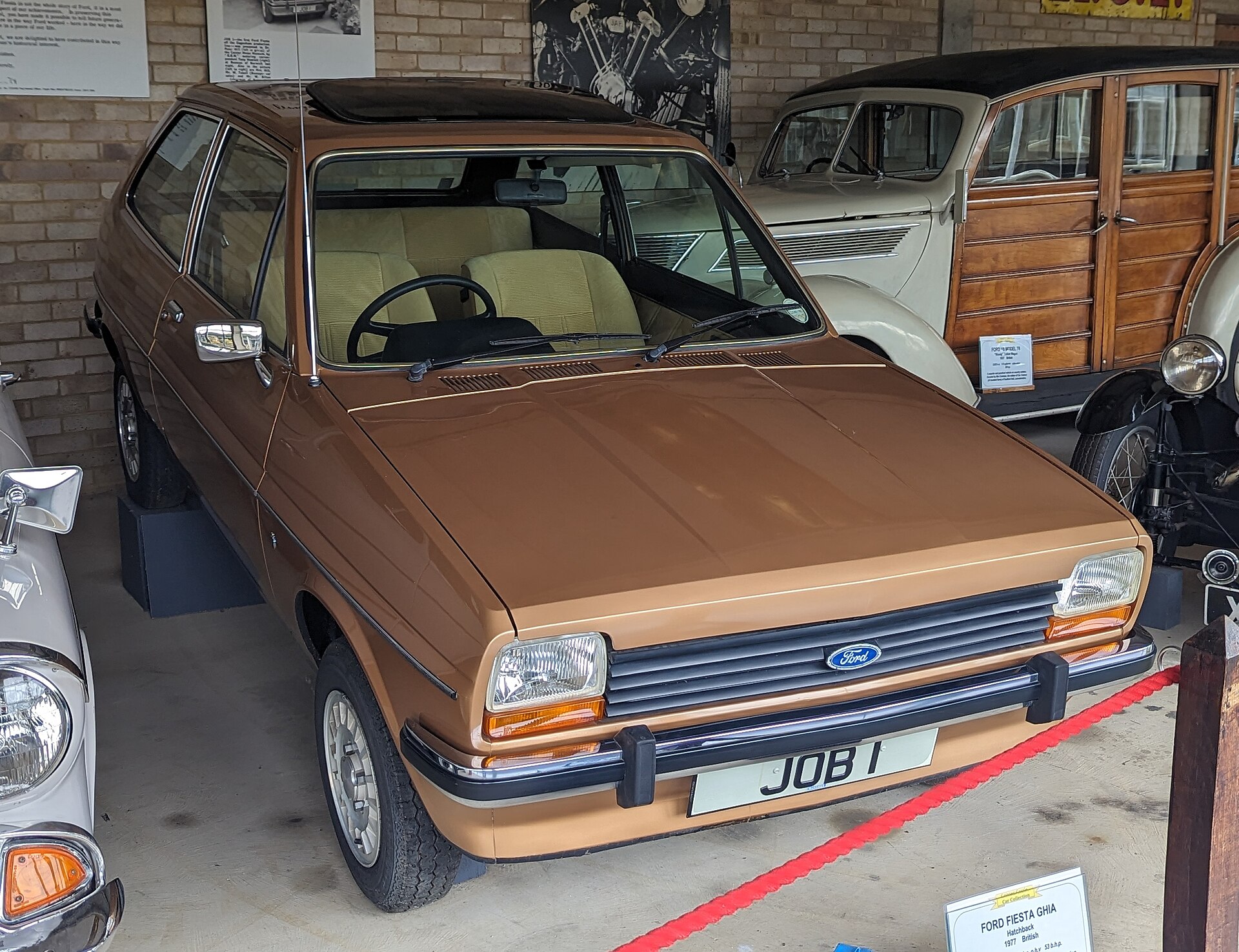
Ford · 2017–2023
Fiesta
- Power
- 147 kW200 PS
- 0–100 km/h
- 6.5 s
- Kerb mass
- 1,299 kg

Volkswagen · 2017–present
Polo VI
- Power
- 147 kW200 PS
- 0–100 km/h
- -
- Kerb mass
- 1,375 kg
At a glance
Who suits what, worked out from the catalog figures of the versions above.
Categories won: Fiesta 1 Polo VI 2
- Family Polo VI Boot: 351 l vs 292 l
- City Too close to call Length: 4,040 mm vs 4,053 mm
- Long trips Polo VI Wheelbase (ride comfort proxy): 2,564 mm vs 2,493 mm
- Performance Fiesta Power per tonne: 113 kW/t vs 107 kW/t
- Off-road Too close to call Drive and body: Front-wheel drive · Hatchback vs Front-wheel drive · Hatchback
Verdict Opinion
The Polo is the better new car because it is the only one still on sale, and its longer wheelbase and 351-litre boot make it the roomier of the two.
The Fiesta built its reputation on being sharp to drive, and as a used buy it is plentiful and simple. The 2017–2023 Mk7, especially the ST or the mild-hybrid 1.0 EcoBoost, is the one to look for.
- Oleksandr Hnatiuk
For almost half a century these two were direct rivals in Europe's small-car class. Volkswagen launched the Polo in 1975; Ford's Fiesta followed in 1976 and went on to outsell every other car in British history. Cologne built the last Fiesta on 7 July 2023, while the Volkswagen Polo remains on sale.
The final generations were near-contemporaries. Ford unveiled the seventh Fiesta in Cologne on 29 November 2016 and started production there on 16 May 2017. Volkswagen revealed the sixth Polo in Berlin on 16 June 2017 and began building it in July. Every Fiesta generation is covered in the Ford catalogue, and the sedan version has its own Fiesta sedan page.
Ford Fiesta vs VW Polo: size, engines, hot versions and value
Size and space
The two are almost exactly the same length: 4,040–4,068 mm for the Fiesta Mk7 and 4,053–4,067 mm for the Polo Mk6. The Volkswagen, on its MQB A0 platform, has the longer wheelbase at 2,564 mm against 2,493 mm, a gap of 71 mm. Our size comparison tool shows the two outlines side by side. Volkswagen quotes 351 litres for the Polo's boot, about 25 % more than its predecessor.
Everyday engines
Ford built its range around the 1.0 EcoBoost three-cylinder turbo; from 2020 an 11.5 kW belt starter-generator turned it into a 48-volt mild hybrid with up to 114 kW (155 PS). Base cars used a 1.1 with 51 or 63 kW, and a 1.5 TDCi diesel was offered with 63 and 88 kW. The Polo started with a 1.0 MPI of 48 kW (65 PS), followed by the 1.0 TSI with 70 kW (95 PS), a 1.6 TDI with 59 or 70 kW and a natural-gas 1.0 TGI.
Fiesta ST against Polo GTI
The hot versions arrive at the same output by different routes. The last Fiesta ST used a 1.5-litre EcoBoost three-cylinder with 147 kW (200 PS) and 290–320 Nm; it took 6.5 seconds to 100 km/h. The Polo GTI uses a 2.0 TSI four-cylinder, also with 147 kW (200 PS). Volkswagen builds the Polo GTI only at Kariega in South Africa, which also supplies all right-hand-drive markets.
Prices and safety
In Germany the Polo Trendline started at €12,975 with the 48 kW engine in August 2017. For historical perspective, the first Fiesta cost £1,856 in Britain in 1977. Euro NCAP gave the Fiesta Mk7 five stars in its 2017 test; the Polo Mk6 tested the same year scored 96 % for adult occupants and 85 % for children.
End of the line
Ford announced in October 2022 that the Fiesta would end, and the Puma crossover took over its place in the range. The Polo was facelifted in April 2021 with LED light bars and digital instruments as standard; Wikipedia lists its Spanish production at Pamplona from 2017 to 2024.
Race Stats side by side
Each figure is a 0–100 score from the catalog numbers, the same as on the 1CARS Race cards. PI is the overall performance index (100–999) and its class D–S.
| Stat | Fiesta | Polo VI |
|---|---|---|
| PI | A · 612 | B · 587 |
| Power | 54 | 52 |
| Grip | 48 | 47 |
| Handling | 76 | 71 |
| Top speed | 54 | 52 |
| Launch | 54 | 50 |
Grip and handling are estimates from drive type, weight, height and body (hover a figure to see where it comes from). 1CARS Race
Who wins a race?
Quarter-mile (402 m) drag from a standing start, dry road, no reaction time - the 1CARS Race physics on the catalog figures of these versions.
- 1 Fiesta2017–2023 · ST 1.5 EcoBoost · petrol · 147 kW (200 PS) 14.74 sat 158 km/h
- 2 Polo VIGTI 2.0 TSI · petrol · 147 kW (200 PS) 14.93 sat 154 km/h · +0.19 s
Size and weight
Side view to scale, all cars from the front bumper.
| Fiesta | Polo VI | |
|---|---|---|
| Length | 4,040 mm159.1 in | 4,053 mm159.6 in +13 mm +0.5 in +0.3% |
| Width | 1,734 mm68.3 in † | 1,751 mm68.9 in +17 mm +0.7 in +1.0% |
| Height | 1,483 mm58.4 in † | 1,438 mm56.6 in † −45 mm −1.8 in −3.0% |
| Wheelbase | 2,493 mm98.1 in | 2,564 mm100.9 in +71 mm +2.8 in +2.8% |
| Kerb weight | 1,299 kg2,864 lb | 1,375 kg3,031 lb +76 kg +168 lb +5.9% |
| Boot | 292 l10.3 cu ft † | 351 l12.4 cu ft +59 l +2.1 cu ft +20.2% |
| Fuel tank | 42 l11.1 gal US † | 40 l10.6 gal US † −2 l −0.5 gal US −4.8% |
| Fits a standard garage? | Yes | Yes |
Difference vs Fiesta (±). Garage check: a standard single garage takes a car up to about 5.0 m (16 ft 5 in) long and 1.9 m (6 ft 3 in) wide (width as listed in the catalog; some makers include the mirrors). Leave about 0.6 m (2 ft) to open the doors. † from another version of this generation.
Full specifications
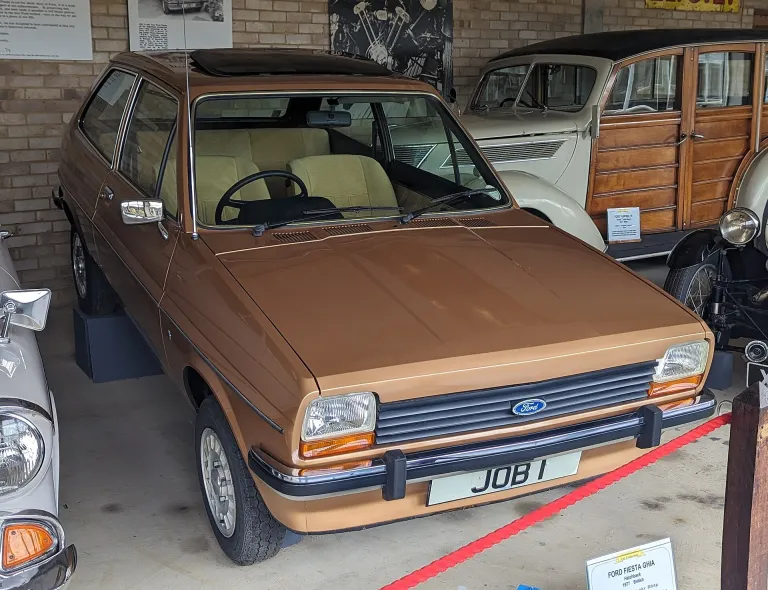
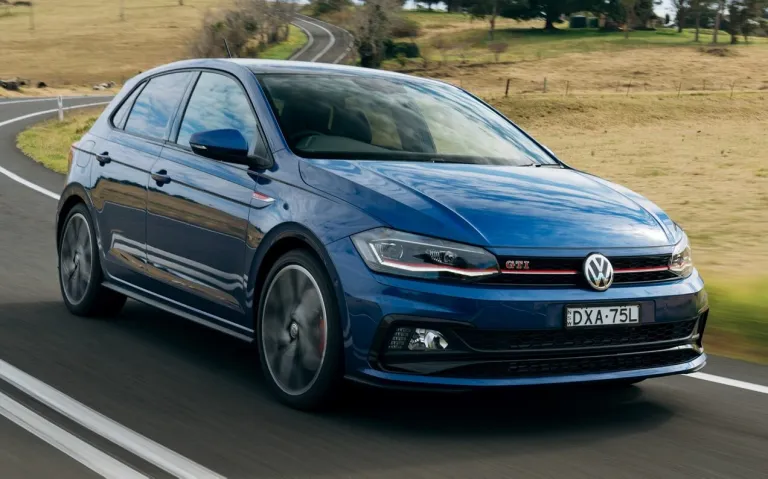
| Ford Fiesta | Volkswagen Polo | |
|---|---|---|
| General | ||
| Version | 2017–2023 · ST 1.5 EcoBoost · petrol · 147 kW (200 PS) | GTI 2.0 TSI · petrol · 147 kW (200 PS) |
| Production years | 2017–2023 | 2017–present |
| Body | Hatchback | Hatchback |
| Country | United States | Germany |
| Performance | ||
| Power Why it matters: More power means stronger acceleration and easier overtaking, especially with a full load. | 147 kW (200 PS) 197 hp | 147 kW (200 PS) 197 hp |
| Power, all versions | 30–147 kW (41–200 PS) 40–197 hp | 29–147 kW (39–200 PS) 39–197 hp |
| Torque Why it matters: Torque is the pulling force you feel when accelerating from low revs, towing or climbing hills. | 290 Nm 214 lb-ft | No data |
| 0–100 km/h Why it matters: A shorter 0–100 km/h time means quicker getaways and safer merging onto fast roads. | 6.5 s | No data |
| Power per tonne | 113 kW/t 138 hp/ton calculated Better | 107 kW/t 130 hp/ton calculated |
| Engine and transmission | ||
| Fuel | Petrol | Petrol |
| Engine | 1,497 cc · 3 cyl 1.5 l | 1,984 cc 2.0 l |
| Gearbox | 6-speed manual | No data |
| Drive | Front-wheel drive | Front-wheel drive |
| Dimensions and weight | ||
| Length | 4,040 mm 159.1 in | 4,053 mm 159.6 in |
| Width | 1,734 mm 68.3 in † | 1,751 mm 68.9 in |
| Height | 1,483 mm 58.4 in † | 1,438 mm 56.6 in † |
| Wheelbase | 2,493 mm 98.1 in | 2,564 mm 100.9 in |
| Kerb weight Why it matters: A lighter car is usually more agile and uses less energy. | 1,299 kg 2,864 lb Better | 1,375 kg 3,031 lb |
| Boot Why it matters: A bigger boot fits more luggage, shopping or a pram. | 292 l 10.3 cu ft † | 351 l 12.4 cu ft Better |
| Fuel tank Why it matters: A larger tank means more distance between fuel stops. | 42 l 11.1 gal US † Better | 40 l 10.6 gal US † |
| Economy and running costs | ||
| Fuel consumption Why it matters: Lower consumption cuts running costs and CO₂ emissions on every trip. | 6.7 l/100 km 35.1 mpg US | 6.7 l/100 km 35.1 mpg US |
| CO₂ | 153 g/km | 153 g/km |
| Fuel cost per year | €1,760/year estimated | €1,760/year estimated |
| Range on a full tank | 627 km 390 mi estimated | 597 km 371 mi estimated |
| Safety | ||
| Euro NCAP | ★★★★★ (2017) | ★★★★★ (2022) |
These cars do not differ in the data we have.
Equal rows hidden (7): Body, Power, Fuel, Drive, Fuel consumption, CO₂, Fuel cost per year.
Better marks the stronger figure - only for measurable specs (power, torque, 0–100 km/h, consumption, boot, weight).
Estimated at 15,000 km a year with fuel at €1.75/l petrol. † from another version of this generation.
In plain words
Volkswagen Polo is 13 mm longer than Ford Fiesta (4,053 mm vs 4,040 mm). Ford Fiesta is lighter by 76 kg (1,299 kg vs 1,375 kg). Volkswagen Polo has the bigger boot: 351 l against 292 l. At 15,000 km a year, fuel would cost about €1,760 (Ford Fiesta), €1,760 (Volkswagen Polo) (estimated). Volkswagen Polo is the older design (from 1975); Ford Fiesta arrived in 1976. Volkswagen Polo is still in production; Ford Fiesta is not. On the catalog figures, the Volkswagen Polo is the pick for family and long trips; the Ford Fiesta is the pick for performance. Our catalog has no 0–100 km/h for the Volkswagen Polo yet, so some checks above leave it out.
Which one to choose
Choose the Polo if you want a new or nearly new car with a manufacturer warranty, more rear space and a calm ride.
Choose a used Fiesta if driving fun at a low price matters more, or if you want a small hot hatch with a three-cylinder engine.
Either way ask for full service records, especially on turbocharged three-cylinder engines, and check the clutch on cars used mainly in town.
Frequently asked questions
Is the Ford Fiesta still made?
No. Production stopped in Cologne in July 2023, 47 years after the first Fiesta. Ford's Puma crossover took over its place in the range.
Which is bigger, the Fiesta or the Polo?
Their lengths differ by only a few millimetres, but the Polo Mk6 has a 71 mm longer wheelbase (2,564 mm against 2,493 mm) and a 351-litre boot.
Which is more powerful, the Fiesta ST or the Polo GTI?
Neither: both are rated at 147 kW (200 PS). The Fiesta ST uses a 1.5-litre three-cylinder, the Polo GTI a 2.0-litre four-cylinder.
Which is safer?
Euro NCAP gave the Fiesta Mk7 five stars in 2017; the Polo Mk6 scored 96 % for adult occupant protection in its 2017 test.