
Renault Clio vs Volkswagen Polo: superminis compared
Updated Report an error By Sarah Whitmore
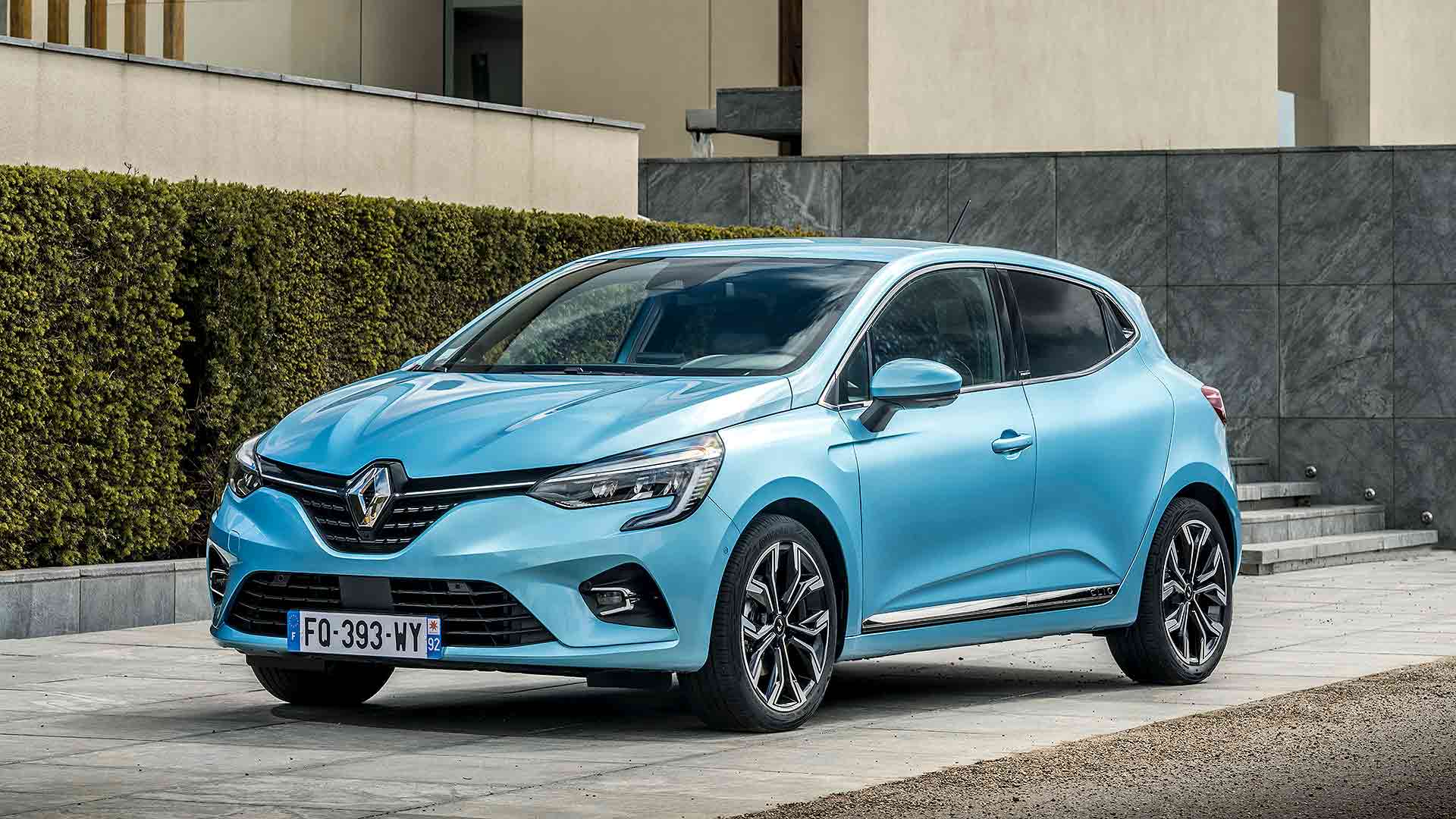
Renault · 2019–2025
Clio V
- Power
- 74 kW101 PS
- 0–100 km/h
- 11.8 s
- Top speed
- 187 km/h
- Kerb mass
- 1,165 kg

Volkswagen · 2017–present
Polo VI
- Power
- 70 kW95 PS
- 0–100 km/h
- 10.8 s
- Top speed
- 187 km/h
- Kerb mass
- 1,145 kg
At a glance
Who suits what, worked out from the catalog figures of the versions above.
Categories won: Clio V 0 Polo VI 2
- Family Polo VI Boot: 351 l vs 340 l
- City Polo VI Width: 1,751 mm vs 1,798 mm
- Long trips Too close to call Range: 955 km vs 909 km (estimated)
- Performance Too close to call Power per tonne: 64 kW/t vs 61 kW/t
- Off-road Too close to call Drive and body: Front-wheel drive · Hatchback vs Front-wheel drive · Hatchback
Verdict Opinion
The Clio is the more versatile supermini. It offers a petrol, a diesel and a full hybrid, has the larger boot in our catalogue, and the 2023 facelift gave it a fresher look. As a used buy it covers more needs than the Polo.
The Polo is the solid, conservative choice. It is still in production, has a 96% adult-occupant score in Euro NCAP, a wide choice of gearboxes including a DSG, and the 147 kW GTI for drivers who want a small hot hatch.
- Sarah Whitmore
The Clio and the Polo are the two superminis most European buyers shortlist first, and the Clio has been one of Europe's top-selling cars since it was launched. This comparison covers the fifth-generation Clio, unveiled at the 2019 Geneva Motor Show and facelifted on 18 April 2023, and the sixth-generation Polo, presented in Berlin on 16 June 2017 and updated in April 2021. Renault revealed a sixth-generation Clio at the Munich Motor Show on 8 September 2025, so the Clio V is now being replaced; the Polo VI continues, built outside Europe since Pamplona ended production in 2024.
In short: the Renault Clio has the larger boot in our catalogue, a full hybrid and a diesel. The Volkswagen Polo is a fraction longer, scored 96% for adult occupants in Euro NCAP and offers the 147 kW GTI. More detail is on our Renault Clio and Volkswagen Polo pages.
Renault Clio vs Volkswagen Polo: how they differ
Petrol engines: TCe 100 against 1.0 TSI 95
The Clio TCe 100 has a 1.0-litre turbo engine with 74 kW (100 PS) and 160 Nm; our catalogue lists 11.8 seconds to 100 km/h and 187 km/h. The Polo 1.0 TSI 95 delivers 70 kW (95 PS). At the bottom of both ranges sit non-turbo engines of 48 kW: the Clio SCe 65 and the Polo 1.0 MPI 65. Above them Renault offers the 1.3 TCe 130 with 96 kW and 240 Nm and a dual-clutch EDC gearbox.
Hybrid and diesel only at Renault
The Clio E-Tech hybrid, available from 2020, combines a 1.6-litre petrol engine with two electric motors, a multi-mode gearbox and a 1.2 kWh battery; our catalogue gives 105 kW. Renault also kept a 1.5 Blue dCi diesel with 63 kW (85 PS) and 220 Nm. The Polo VI launched with 1.6 TDI diesels of 80 and 95 PS and a 1.0 TGI natural-gas engine, but has no hybrid.
Polo GTI
The Polo GTI uses a 2.0 TSI with 147 kW (200 PS) and is built only in Kariega, South Africa. Our catalogue lists no performance version of the Clio V.
Size and boot
The two are almost the same size. The Clio is 4,050 mm long, 1,798 mm wide and 1,440 mm tall on a 2,583 mm wheelbase. The Polo measures 4,053–4,067 mm on 2,564 mm; it grew by 81 mm in length and 63 mm in width over the previous generation, and its boot went from 280 to 351 litres. Our catalogue lists 391 litres for the Clio.
Platforms and factories
The Clio V was the first model on Renault's CMF-B HS platform, shared with the Captur and the Nissan Juke, and is built in Bursa, Turkey, and Novo Mesto, Slovenia. The Polo VI was the first Volkswagen passenger car on the shortened MQB A0 platform. It was built in Pamplona, Spain, from 2017 to 2024; right-hand-drive markets are supplied from Kariega in South Africa.
Gearboxes
Volkswagen offers five- and six-speed manuals, a six-speed automatic and a seven-speed DSG in the Polo. Our catalogue lists manual gearboxes for the Clio TCe 100 and dCi, the EDC dual-clutch on the TCe 130 and an automatic on the E-Tech.
Euro NCAP
Euro NCAP tested the Polo 1.0 TSI in 2017 and gave it 96% for adult occupants, 85% for children, 76% for pedestrians and 59% for safety assist.
Race Stats side by side
Each figure is a 0–100 score from the catalog numbers, the same as on the 1CARS Race cards. PI is the overall performance index (100–999) and its class D–S.
| Stat | Clio V | Polo VI |
|---|---|---|
| PI | C · 466 | C · 469 |
| Power | 36 | 35 |
| Grip | 40 | 40 |
| Handling | 72 | 72 |
| Top speed | 33 | 33 |
| Launch | 24 | 28 |
Grip and handling are estimates from drive type, weight, height and body (hover a figure to see where it comes from). 1CARS Race
Who wins a race?
Quarter-mile (402 m) drag from a standing start, dry road, no reaction time - the 1CARS Race physics on the catalog figures of these versions.
- 1 Polo VI1.0 TSI 95 · petrol · 70 kW (95 PS) 17.56 sat 125 km/h
- 2 Clio VTCe 100 · petrol · 74 kW (101 PS) 17.91 sat 122 km/h · +0.35 s
Size and weight
Side view to scale, all cars from the front bumper.
| Clio V | Polo VI | |
|---|---|---|
| Length | 4,050 mm159.4 in | 4,053 mm159.6 in +3 mm +0.1 in +0.1% |
| Width | 1,798 mm70.8 in | 1,751 mm68.9 in −47 mm −1.9 in −2.6% |
| Height | 1,440 mm56.7 in | 1,438 mm56.6 in † −2 mm −0.1 in −0.1% |
| Wheelbase | 2,583 mm101.7 in | 2,564 mm100.9 in −19 mm −0.7 in −0.7% |
| Kerb weight | 1,165 kg2,568 lb | 1,145 kg2,524 lb −20 kg −44 lb −1.7% |
| Boot | 340 l12.0 cu ft | 351 l12.4 cu ft +11 l +0.4 cu ft +3.2% |
| Fuel tank | 42 l11.1 gal US | 40 l10.6 gal US −2 l −0.5 gal US −4.8% |
| Fits a standard garage? | Yes | Yes |
Difference vs Clio V (±). Garage check: a standard single garage takes a car up to about 5.0 m (16 ft 5 in) long and 1.9 m (6 ft 3 in) wide (width as listed in the catalog; some makers include the mirrors). Leave about 0.6 m (2 ft) to open the doors. † from another version of this generation.
Full specifications
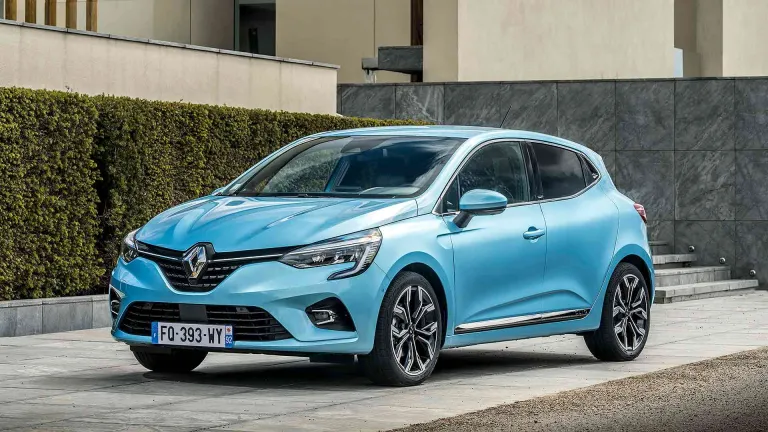
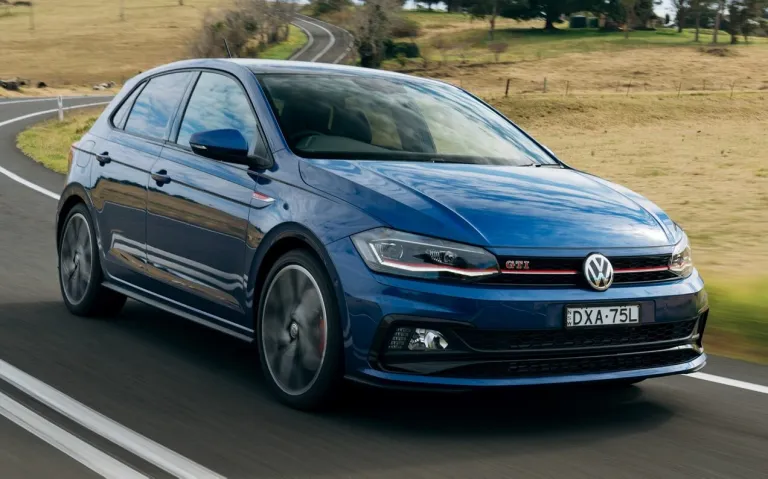
| Renault Clio | Volkswagen Polo | |
|---|---|---|
| General | ||
| Version | TCe 100 · petrol · 74 kW (101 PS) | 1.0 TSI 95 · petrol · 70 kW (95 PS) |
| Production years | 2019–2025 | 2017–present |
| Body | Hatchback | Hatchback |
| Country | France | Germany |
| Performance | ||
| Power Why it matters: More power means stronger acceleration and easier overtaking, especially with a full load. | 74 kW (101 PS) 99 hp Better | 70 kW (95 PS) 94 hp |
| Power, all versions | 48–103 kW (65–140 PS) 64–138 hp | 29–147 kW (39–200 PS) 39–197 hp |
| Torque Why it matters: Torque is the pulling force you feel when accelerating from low revs, towing or climbing hills. | 160 Nm 118 lb-ft | No data |
| 0–100 km/h Why it matters: A shorter 0–100 km/h time means quicker getaways and safer merging onto fast roads. | 11.8 s | 10.8 s Better |
| Top speed Why it matters: Top speed hints at how relaxed the car is at motorway speeds, even if you never reach it. | 187 km/h 116 mph | 187 km/h 116 mph |
| Power per tonne | 64 kW/t 77 hp/ton calculated Better | 61 kW/t 74 hp/ton calculated |
| Engine and transmission | ||
| Fuel | Petrol | Petrol |
| Gearbox | manual | No data |
| Drive | Front-wheel drive | Front-wheel drive |
| Dimensions and weight | ||
| Length | 4,050 mm 159.4 in | 4,053 mm 159.6 in |
| Width | 1,798 mm 70.8 in | 1,751 mm 68.9 in |
| Height | 1,440 mm 56.7 in | 1,438 mm 56.6 in † |
| Wheelbase | 2,583 mm 101.7 in | 2,564 mm 100.9 in |
| Kerb weight Why it matters: A lighter car is usually more agile and uses less energy. | 1,165 kg 2,568 lb | 1,145 kg 2,524 lb |
| Boot Why it matters: A bigger boot fits more luggage, shopping or a pram. | 340 l 12.0 cu ft | 351 l 12.4 cu ft Better |
| Fuel tank Why it matters: A larger tank means more distance between fuel stops. | 42 l 11.1 gal US Better | 40 l 10.6 gal US |
| Economy and running costs | ||
| Fuel consumption Why it matters: Lower consumption cuts running costs and CO₂ emissions on every trip. | 4.4 l/100 km 53.5 mpg US | 4.4 l/100 km 53.5 mpg US |
| CO₂ | 116 g/km | 101 g/km Better |
| Fuel cost per year | €1,160/year estimated | €1,160/year estimated |
| Range on a full tank | 955 km 593 mi estimated | 909 km 565 mi estimated |
| Safety | ||
| Euro NCAP | No data | ★★★★★ (2022) |
These cars do not differ in the data we have.
Equal rows hidden (6): Body, Top speed, Fuel, Drive, Fuel consumption, Fuel cost per year.
Better marks the stronger figure - only for measurable specs (power, torque, 0–100 km/h, consumption, boot, weight).
Estimated at 15,000 km a year with fuel at €1.75/l petrol. † from another version of this generation.
In plain words
Volkswagen Polo is quicker: 0–100 km/h in 10.8 s against 11.8 s for Renault Clio. Volkswagen Polo is 3 mm longer than Renault Clio (4,053 mm vs 4,050 mm). Volkswagen Polo is lighter by 20 kg (1,145 kg vs 1,165 kg). Volkswagen Polo has the bigger boot: 351 l against 340 l. At 15,000 km a year, fuel would cost about €1,160 (Renault Clio), €1,160 (Volkswagen Polo) (estimated). Volkswagen Polo is the older design (from 1975); Renault Clio arrived in 1990. On the catalog figures, the Volkswagen Polo is the pick for family and city.
Which one to choose
Choose the Renault Clio if you want a self-charging hybrid, a frugal diesel, or the most luggage space for the size.
Choose the Volkswagen Polo if you want a model that is still in production, a DSG automatic with a small petrol engine, or the Polo GTI.
Each car meets another rival on 1cars: Peugeot 208 vs Renault Clio and Ford Fiesta vs Volkswagen Polo.
Frequently asked questions
Which has the bigger boot, the Clio or the Polo?
Our catalogue lists 391 litres for the Clio V; the Polo VI has 351 litres.
Is there a hybrid Polo?
No. The Polo VI is sold with petrol engines and, earlier, diesel and natural-gas versions. The Clio E-Tech is a full hybrid with a 1.6-litre engine and two electric motors.
Which is more powerful, the Clio TCe 100 or the Polo 1.0 TSI?
The Clio TCe 100 has 74 kW (100 PS); the Polo 1.0 TSI 95 has 70 kW (95 PS).
Is the Clio V still sold new?
Renault revealed the sixth-generation Clio on 8 September 2025, so the fifth generation is being replaced. The Polo VI is still in production, outside Europe since 2024.