
Camaro Z/28 vs Boss 302 Mustang: the Trans-Am rivals
Updated Report an error By Felix Hartmann

Chevrolet · 1966–1969
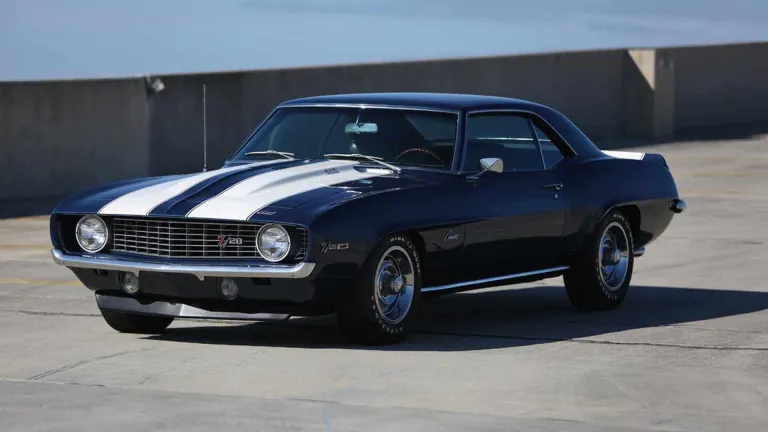
Camaro Z28
- Power
- 216 kW294 PS
Ford · 1969–1970
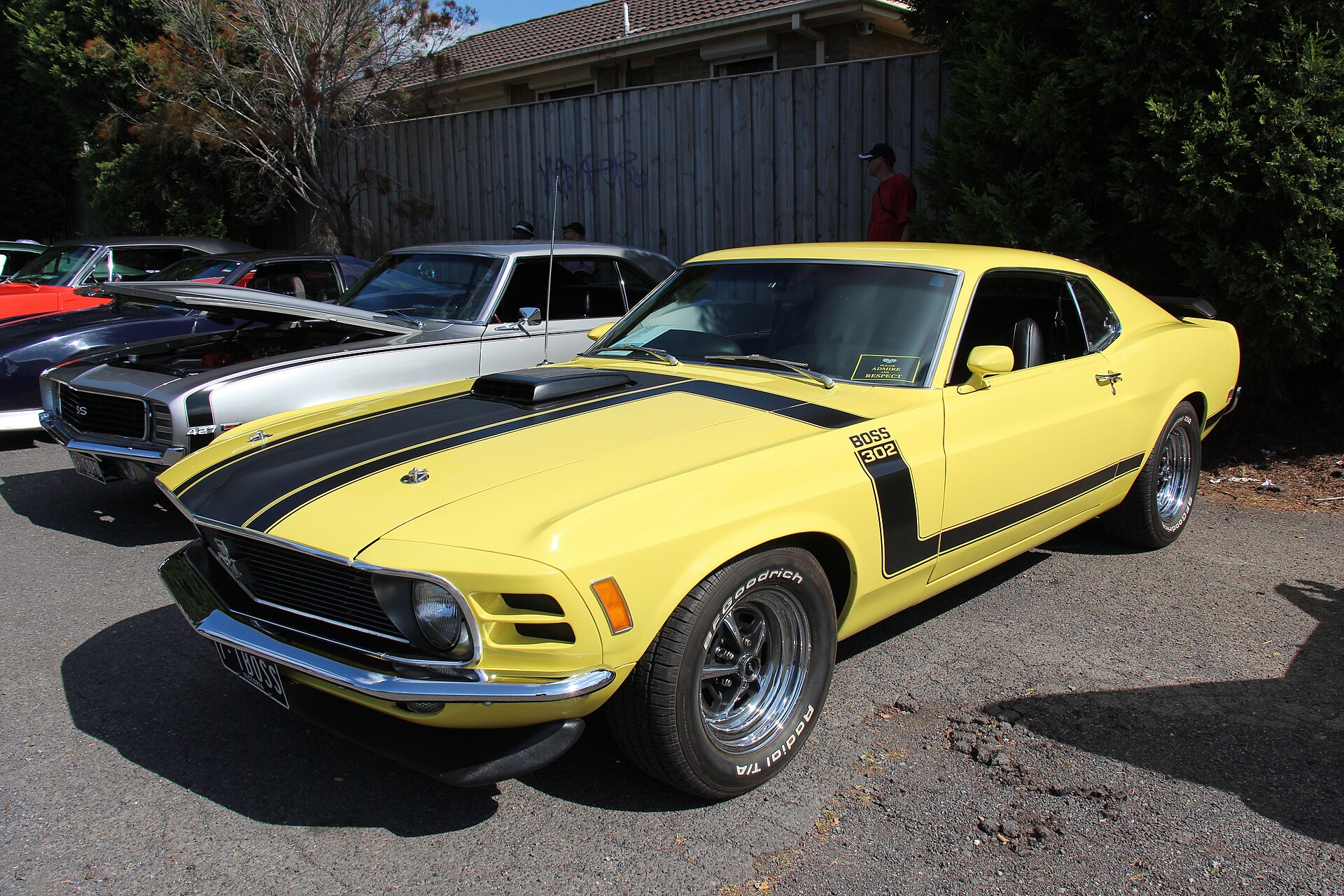
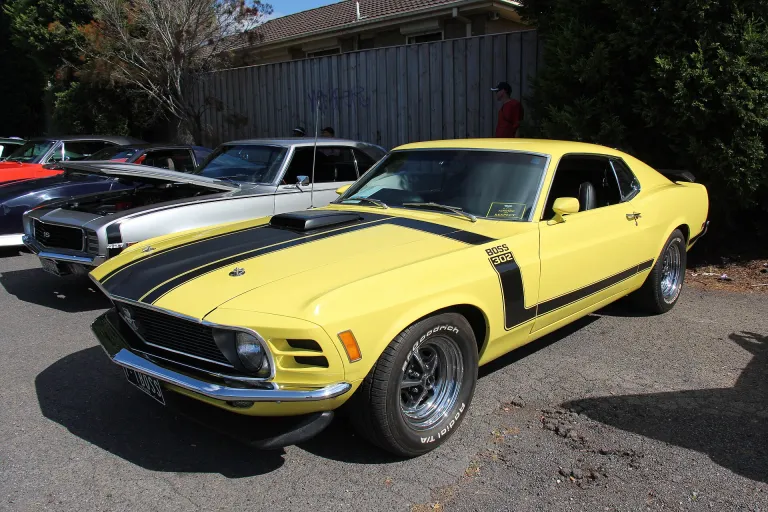
Boss 302
- Power
- 216 kW294 PS
Verdict Opinion
The Camaro Z/28 is the original of the pair. It created the idea of a homologation pony car, it won two Trans-Am titles in a row, and the 602 cars of 1967 make it the rarest version of the classic rivalry.
The Boss 302 is the more special engineering package. Its canted-valve heads previewed the Cleveland engines, the Shinoda body kit gave the Mustang its spoiler and wing, and it beat Penske in 1970. On the road the rated outputs are identical, so the choice comes down to brand loyalty, history and condition rather than numbers.
- Felix Hartmann
The Chevrolet Camaro Z/28 and the Ford Mustang Boss 302 exist for the same reason. The SCCA Trans-Am series limited engines to 5 litres (305 cubic inches), and both makers needed a road car to homologate a race engine of that size. Chevrolet got there first: the Z/28 option code appeared in December 1966 for the 1967 model year. Ford answered with the Boss 302 for 1969, styled by Larry Shinoda, a designer who had come over from General Motors.
In short: on paper the two are almost identical, with a 302-cubic-inch V8 rated at 216 kW (290 hp) at 5,800 rpm and a four-speed manual. The Camaro is the earlier car and the more successful racer; the Boss 302 is the more exotic engine and the car that won the 1970 title. Each has its own page in our catalogue: Chevrolet Camaro Z/28 and Ford Mustang Boss 302.
Camaro Z/28 vs Boss 302: engines, racing record and the revivals
Two 302s with the same rating
The Z/28 engine combined a 4-inch bore with a 3-inch stroke, a 780 cfm Holley four-barrel carburettor and an aluminium intake manifold. Chevrolet rated it at 216 kW (290 hp) at 5,800 rpm and 290 lb-ft (393 Nm) at 4,200 rpm in 1969. Wikipedia notes that the rating was deliberately understated, a common practice at the time for insurance and racing classes.
Ford's "G code" Boss 302 used a thin-wall, high-nickel block with four-bolt main bearings and solid lifters. Its canted-valve heads were derived from the planned 351 Cleveland design. Ford quoted the same 216 kW (290 hp) at 5,800 rpm, with 290 lb-ft at a lower 2,600 rpm.
Chassis and brakes
Both makers sold their car only with a four-speed manual. The Camaro used a close-ratio Muncie gearbox and a 12-bolt rear axle; in 1969 a Hurst shifter and 3.73 gears were standard. The Boss 302 got a Hurst shifter as standard in 1970. Each car had front disc brakes, and the Z/28 came on 15-inch rally wheels instead of the 14-inch wheels of other Camaros. Chevrolet also listed disc brakes on all four corners as option RPO JL8 in 1969; only 206 cars received them.
Ford lowered the Boss 302, fitted larger anti-roll bars and heavier-duty spindles, and reinforced the shock towers. Shinoda deleted the Mustang's fake rear scoops and added a front spoiler, a rear deck wing and the matt black bonnet option.
Rarity and size
Chevrolet sold just 602 Z/28s in 1967, nearly 7,200 in 1968 and more than 20,000 in 1969. Ford sold 1,628 Boss 302s in 1969 and 7,013 in 1970. The first-generation Camaro measured 4,691 mm in 1967–68 and 4,724 mm in 1969, on a 2,743 mm wheelbase. The 1969 Mustang also kept a 108-inch (2,743 mm) wheelbase, so the two cars were close in size.
- Camaro Z/28: 602 (1967), about 7,200 (1968), over 20,000 (1969)
- Boss 302: 1,628 (1969), 7,013 (1970)
- Both: 302 cu in V8, 216 kW (290 hp), four-speed manual, 2,743 mm wheelbase
Trans-Am results
The over-2-litre manufacturers' title went to Chevrolet in 1968 and 1969, with the Z/28 as its weapon. Ford's 1969 campaign suffered from tyre problems and slow pit stops. In 1970 Bud Moore ran two Boss 302s on Goodyear tyres, and Parnelli Jones beat Team Penske's lead driver Mark Donohue. Ford took the 1970 title, which was also the final year of the original Boss 302.
The 2012–2015 revivals
Both names returned in the S197 and fifth-generation era. The 2012–2013 Boss 302 used a reworked 5.0-litre Coyote V8 with 331 kW (450 PS) at 7,400 rpm and 515 Nm, and a six-speed manual. Ford built 750 Laguna Seca editions with Recaro seats, a Torsen differential and an X-brace in place of the rear seat. Chevrolet's 2014–2015 Z/28 used the 7.0-litre LS7 V8, a Tremec TR-6060 six-speed manual and Brembo carbon-ceramic brakes with 394 mm front rotors, and air conditioning became an option.
Full specifications
| Chevrolet Camaro Z28 | Ford Boss 302 Mustang | |
|---|---|---|
| General | ||
| Version | Z/28 302 V8 (290 hp gross) · petrol · 216 kW (294 PS) | Boss 302 · Boss 302 V8 (SAE gross) · petrol · 216 kW (294 PS) |
| Production years | 1966–1969 | 1969–1970 |
| Body | Coupe | Coupe |
| Class | No data | Sports car |
| Country | United States | United States |
| Performance | ||
| Power Why it matters: More power means stronger acceleration and easier overtaking, especially with a full load. | 216 kW (294 PS) 290 hp | 216 kW (294 PS) 290 hp |
| Power, all versions | 216 kW (294 PS) 290 hp | 216–331 kW (294–450 PS) 290–444 hp |
| Torque Why it matters: Torque is the pulling force you feel when accelerating from low revs, towing or climbing hills. | 393 Nm 290 lb-ft | No data |
| Engine and transmission | ||
| Fuel | Petrol | Petrol |
| Engine | 4,942 cc · 8 cyl 4.9 l | 4,949 cc · 8 cyl 4.9 l |
| Gearbox | 4-speed manual | 4-speed manual |
| Drive | Rear-wheel drive | Rear-wheel drive |
| Dimensions and weight | ||
| Length | 4,691 mm 184.7 in | No data |
| Width | 1,842 mm 72.5 in | No data |
| Height | 1,306 mm 51.4 in | No data |
| Wheelbase | 2,743 mm 108.0 in | No data |
These cars do not differ in the data we have.
Equal rows hidden (6): Body, Country, Power, Fuel, Gearbox, Drive.
In plain words
Chevrolet Camaro Z28 is the older design (from 1966); Ford Boss 302 Mustang arrived in 1969.
Which one to choose
Choose the Chevrolet Camaro Z/28 if you want the car that started the Trans-Am homologation race, a proven small-block with wide parts support, or a 1969 car with the rare JL8 brake package.
Choose the Ford Mustang Boss 302 if you prefer the exotic canted-valve engine, the Larry Shinoda look with spoiler and wing, or the make that won the 1970 championship. The 2012–2013 revival is the modern way into the name.
The wider rivalry continues in Camaro vs Mustang Fastback (1967–69) and Chevrolet Camaro vs Ford Mustang.
Frequently asked questions
Which was more powerful, the Z/28 or the Boss 302?
Neither on paper. Both factories rated their 302 V8 at 216 kW (290 hp) at 5,800 rpm. The Camaro's 290 lb-ft came at 4,200 rpm and the Ford's at 2,600 rpm, and the Z/28 rating is described as understated.
Why were both engines 302 cubic inches?
The SCCA Trans-Am series limited engines to 5 litres, or 305 cubic inches. Chevrolet and Ford built road cars with 302 V8s to homologate their race engines under that rule.
Who won the Trans-Am battle?
Chevrolet took the over-2-litre manufacturers' title in 1968 and 1969. Ford won it in 1970, when Parnelli Jones drove Bud Moore's Boss 302 and beat Mark Donohue of Team Penske.
How many were built?
Chevrolet sold 602 Z/28s in 1967, nearly 7,200 in 1968 and over 20,000 in 1969. Ford sold 1,628 Boss 302s in 1969 and 7,013 in 1970.
Did the names come back later?
Yes. Ford sold a 331 kW Boss 302 in 2012 and 2013, including 750 Laguna Seca editions. Chevrolet revived the Z/28 for 2014–2015 with a 7.0-litre LS7 V8 and carbon-ceramic brakes.