
Audi R8 vs Porsche 911: V10 against flat-six
Updated Report an error By Felix Hartmann

Audi · 2015–2024
R8 II (Type 4S)
- Power
- 456 kW620 PS
- 0–100 km/h
- 3.1 s
- Top speed
- 331 km/h
- Kerb mass
- 1,650 kg
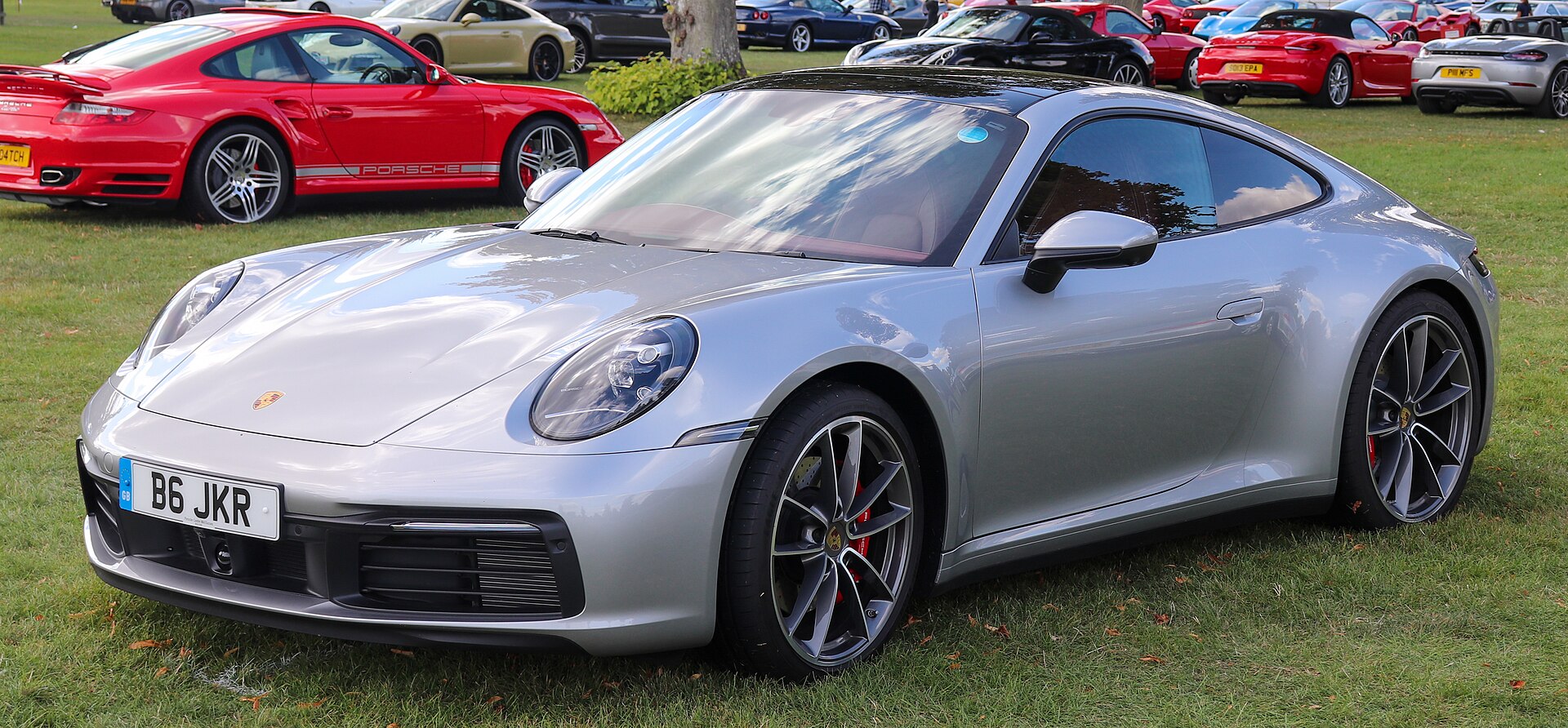
Porsche · 2019–present
911 992
- Power
- 478 kW650 PS
- 0–100 km/h
- 2.7 s
- Top speed
- 330 km/h
- Kerb mass
- 1,715 kg
At a glance
Who suits what, worked out from the catalog figures of the versions above.
Categories won: R8 II (Type 4S) 0 911 992 2
- City Too close to call Length: 4,426 mm vs 4,519 mm
- Performance 911 992 0–100 km/h: 2.7 s vs 3.1 s
- Running costs 911 992 Fuel per year: €3,230 vs €3,440 (estimated)
Verdict Opinion
The 911 is the more capable car on every objective measure in this comparison. The Turbo S has more power and much more torque, is faster to 100 km/h and around the Nordschleife, and the range continues to develop, with hybrid versions since 2024.
The R8 offers something the 911 cannot: a mid-mounted, naturally aspirated V10 with the sound and response that go with it, in a low, wide body shared with a Lamborghini. With production over, it has become a used and collector's car, and the right example is an emotional rather than a rational purchase.
— Felix Hartmann
Both come from the Volkswagen Group, both are German, and for nearly a decade they competed for the same buyers. The second-generation Audi R8 (Type 4S) was revealed at the 2015 Geneva Motor Show and built at Audi's Böllinger Höfe site in Heilbronn until 2024. It shared its Modular Sports System platform with the Lamborghini Huracán. The Porsche 911 of the 992 generation has been built in Stuttgart-Zuffenhausen since 2019 and received its 992.2 update in May 2024.
In short: the Audi R8 is the last of its kind, a mid-engine car with a naturally aspirated V10, and is now bought used. The Porsche 911 Turbo S is quicker, more powerful and still sold new. The GT3 is Porsche's answer for buyers who want a high-revving engine without turbos. Both models are covered in our catalogue: Audi R8 and Porsche 911.
Audi R8 vs Porsche 911: engines, speed and layout
V10 without turbos against flat-six with two
Every Type 4S used a 5.2-litre FSI V10 without turbochargers. At launch it came with 397 kW (540 PS) or, in the V10 plus, 449 kW (610 PS). After the 2019 update the V10 quattro had 419 kW (570 PS) and 560 Nm and the V10 performance quattro 456 kW (620 PS) and 580 Nm. The 992.1 Turbo S produces 478 kW (650 PS) and 800 Nm from its twin-turbo flat-six, 22 kW and 220 Nm more than the strongest R8. The 992.2 Turbo S T-Hybrid raises the output to 523 kW.
Acceleration and top speed
The R8 V10 performance quattro coupé reaches 100 km/h in 3.1 seconds and 331 km/h. The 992.1 Turbo S needs 2.7 seconds, and the 992.2 Turbo S T-Hybrid 2.5 seconds. On the Nürburgring Nordschleife, Sport Auto timed the 992.1 Turbo S at 7:17.3, and Porsche's 992.2 Turbo S lapped in 7:03.92.
Layout and size
The R8 carries its engine in the middle; the 911 behind the rear axle. The Audi is 4,426 mm long, 1,940 mm wide and only 1,240 mm tall on a 2,650 mm wheelbase. The 911 is 4,519–4,535 mm long and 1,852–1,900 mm wide, with a 2,450 mm wheelbase. Weights are close: our catalogue lists 1,650 kg for the R8 V10 performance quattro, and the 911 range spans 1,380 to 1,710 kg.
Gearboxes and drive
Audi fitted every Type 4S with a seven-speed S tronic dual-clutch gearbox; no manual was offered. Rear-wheel-drive versions joined the quattro cars: the RWS, the V10 RWD with 397 kW and the V10 performance RWD with 419 kW. Porsche uses an eight-speed PDK on most 911s but offers a six-speed manual on the GT3.
Naturally aspirated alternatives
A buyer who wants the R8's character in a new car will look at the 911 GT3. Its 4.0-litre flat-six has no turbochargers either and delivers 375 kW (510 PS), reaching 100 km/h in 3.4 seconds with PDK.
Special editions
The R8 ended with the R8 GT, announced in October 2022 and limited to 333 cars. Audi also built the electric R8 e-tron with 340 kW and a 92 kWh battery, of which fewer than 100 were sold, all in Europe.
Race Stats side by side
Each figure is a 0–100 score from the catalog numbers, the same as on the 1CARS Race cards. PI is the overall performance index (100–999) and its class D–S.
| Stat | R8 II (Type 4S) | 911 992 |
|---|---|---|
| PI | S · 832 | S · 803 |
| Power | 82 | 82 |
| Grip | 79 | 61 |
| Handling | 72 | 76 |
| Top speed | 89 | 88 |
| Launch | 86 | 83 |
Grip and handling are estimates from drive type, weight, height and body (hover a figure to see where it comes from). 1CARS Race
Who wins a race?
Quarter-mile (402 m) drag from a standing start, dry road, no reaction time — the 1CARS Race physics on the catalog figures of these versions.
- 1 R8 II (Type 4S)R8 II (Type 4S) · V10 performance quattro · petrol · 456 kW (620 PS) 9.70 sat 279 km/h
- 2 911 992Turbo S (992.1) · petrol · 478 kW (650 PS) 10.01 sat 271 km/h · +0.31 s
Size and weight
Side view to scale, all cars from the front bumper.
| R8 II (Type 4S) | 911 992 | |
|---|---|---|
| Length | 4,426 mm174.3 in | 4,519 mm177.9 in † +93 mm +3.7 in +2.1% |
| Width | 1,940 mm76.4 in | 1,852 mm72.9 in † −88 mm −3.5 in −4.5% |
| Height | 1,240 mm48.8 in | 1,289 mm50.7 in † +49 mm +1.9 in +4.0% |
| Wheelbase | 2,650 mm104.3 in | 2,450 mm96.5 in −200 mm −7.9 in −7.5% |
| Kerb weight | 1,650 kg3,638 lb | 1,715 kg3,781 lb +65 kg +143 lb +3.9% |
| Fits a standard garage? | Too wide | Tight |
Difference vs R8 II (Type 4S) (±). Garage check: a standard single garage takes a car up to about 5.0 m (16 ft 5 in) long and 1.9 m (6 ft 3 in) wide (width as listed in the catalog; some makers include the mirrors). Leave about 0.6 m (2 ft) to open the doors. † from another version of this generation.
Full specifications
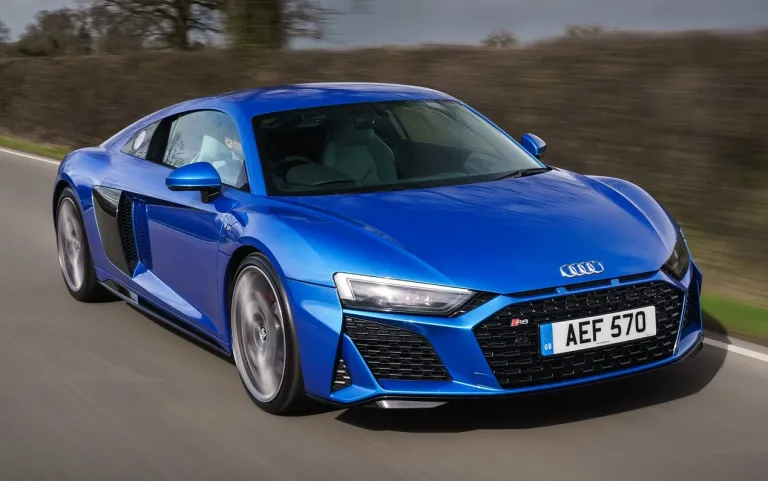
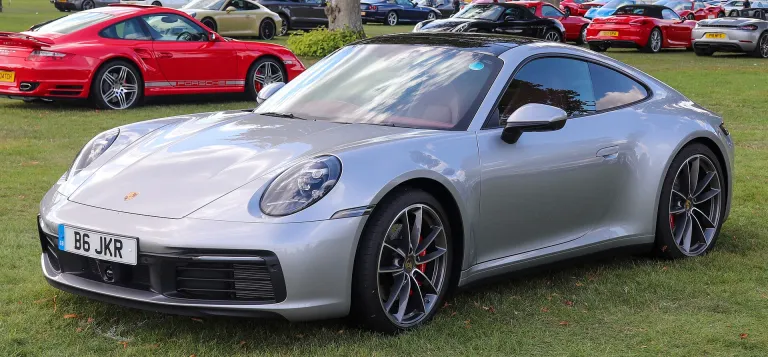
| Audi R8 | Porsche 911 | |
|---|---|---|
| General | ||
| Version | R8 II (Type 4S) · V10 performance quattro · petrol · 456 kW (620 PS) | Turbo S (992.1) · petrol · 478 kW (650 PS) |
| Production years | 2015–2024 | 2019–present |
| Body | Coupe | Coupe |
| Class | Sports car | Sports car |
| Country | Germany | Germany |
| Performance | ||
| Power Why it matters: More power means stronger acceleration and easier overtaking, especially with a full load. | 456 kW (620 PS) 612 hp | 478 kW (650 PS) 641 hp Better |
| Power, all versions | 309–456 kW (420–620 PS) 414–612 hp | 96–523 kW (131–711 PS) 129–701 hp |
| Torque Why it matters: Torque is the pulling force you feel when accelerating from low revs, towing or climbing hills. | 580 Nm 428 lb-ft | 800 Nm 590 lb-ft Better |
| 0–100 km/h Why it matters: A shorter 0–100 km/h time means quicker getaways and safer merging onto fast roads. | 3.1 s | 2.7 s Better |
| Top speed Why it matters: Top speed hints at how relaxed the car is at motorway speeds, even if you never reach it. | 331 km/h 206 mph | 330 km/h 205 mph |
| Power per tonne | 276 kW/t 336 hp/ton calculated | 279 kW/t 339 hp/ton calculated |
| Engine and transmission | ||
| Fuel | Petrol | Petrol |
| Engine | 5,204 cc · 10 cyl 5.2 l | No data |
| Gearbox | 7-speed dual-clutch | No data |
| Drive | All-wheel drive | All-wheel drive |
| Dimensions and weight | ||
| Length | 4,426 mm 174.3 in | 4,519 mm 177.9 in † |
| Width | 1,940 mm 76.4 in | 1,852 mm 72.9 in † |
| Height | 1,240 mm 48.8 in | 1,289 mm 50.7 in † |
| Wheelbase | 2,650 mm 104.3 in | 2,450 mm 96.5 in |
| Kerb weight Why it matters: A lighter car is usually more agile and uses less energy. | 1,650 kg 3,638 lb Better | 1,715 kg 3,781 lb |
| Economy and running costs | ||
| Fuel consumption Why it matters: Lower consumption cuts running costs and CO₂ emissions on every trip. | 13.1 l/100 km 18.0 mpg US | 12.3 l/100 km 19.1 mpg US Better |
| CO₂ | 297 g/km | 278 g/km Better |
| Fuel cost per year | €3,440/year estimated | €3,230/year estimated Better |
These cars do not differ in the data we have.
Equal rows hidden (5): Body, Class, Country, Fuel, Drive.
Better marks the stronger figure — only for measurable specs (power, torque, 0–100 km/h, consumption, boot, weight).
Estimated at 15,000 km a year with fuel at €1.75/l petrol. † from another version of this generation.
In plain words
Porsche 911 is quicker: 0–100 km/h in 2.7 s against 3.1 s for Audi R8. Porsche 911 is 93 mm longer than Audi R8 (4,519 mm vs 4,426 mm). Audi R8 is lighter by 65 kg (1,650 kg vs 1,715 kg). At 15,000 km a year, fuel would cost about €3,440 (Audi R8), €3,230 (Porsche 911) (estimated). Porsche 911 is the older design (from 1964); Audi R8 arrived in 2006. Porsche 911 is still in production; Audi R8 is not. On the catalog figures, the Porsche 911 is the pick for performance and running costs.
Which one to choose
Choose the Audi R8 if you want a naturally aspirated V10 and mid-engine balance, quattro or rear-wheel drive, and are buying used.
Choose the Porsche 911 if you want the fastest car of the pair, a car that is still sold new, a manual gearbox in the GT3, or the everyday usability of the Turbo S.
The 911 also faces Japan in Nissan GT-R vs Porsche 911; Lamborghini's earlier V10 car meets Ferrari in Ferrari F430 vs Lamborghini Gallardo. More mid-engine cars are listed in our supercars section.
Frequently asked questions
Is the Audi R8 still made?
No. Production of the second-generation R8 ran until 2024; the R8 GT, limited to 333 cars, was one of the last editions.
Which is faster, the R8 V10 performance or the 911 Turbo S?
The 911 Turbo S. The 992.1 version needs 2.7 seconds to 100 km/h against 3.1 seconds for the R8 V10 performance quattro, and has 478 kW against 456 kW.
Do the R8 and the Huracán share a platform?
Yes. The Type 4S R8 is built on the Volkswagen Group's Modular Sports System platform, shared with the Lamborghini Huracán.
Which 911 has a naturally aspirated engine like the R8?
The GT3 and GT3 RS. The 992 GT3's 4.0-litre flat-six has 375 kW (510 PS) and no turbochargers.