Best Soviet classic cars: seven landmark models
Soviet passenger cars were built for long service lives, poor roads and owners who did much of their own maintenance. That makes the best of them interesting classics today: simple, robust and rich in history. This list covers passenger cars designed and built in the USSR between 1946 and 1988, from GAZ's first post-war saloon to the last rear-wheel-drive Moskvich.
Our criteria were historical importance, engineering interest, production volume (which affects how easy a car is to keep running) and how usable it is today. We left out military utility vehicles and trucks, which have their own list, and transitional models whose catalogue data we could not verify.
The seven cars appear in chronological order. Every one has a full model page on 1cars, and the key figures in the text – production years, engines, power and build numbers – come from our researched fact sheets and English- and German-language reference sources. For each car we explain why it earns its place, who it suits and the one drawback to keep in mind.
-
1. GAZ-M20
The pioneer
- Production years
- 1946–1958
- Body type
- Sedan, Convertible
- Power output
- 37–38 kW (50–52 PS)
The Pobeda (Victory) was GAZ's first post-war car. Development began in 1943, production started in June 1946 and ran until 1958, with about 236,000 built, including some 14,000 four-door cabriolets. Its unitary ponton body made it one of the first Soviet cars of original design, while the 2.1-litre side-valve four gave 37 kW (50 PS), later 38 kW (52 PS). It was also licence-built in Poland as the FSO Warszawa. It suits collectors who want the car that started Soviet post-war motoring. The drawback: with a top speed of about 105 km/h and 0–100 km/h in around 45 seconds, it is slow in modern traffic.
Pros
- Historic first post-war GAZ design
- Unitary ponton body
- Licence-built in Poland as the FSO Warszawa
Cons
- Top speed of about 105 km/h
Spec sheet: GAZ-M20 2.1 l 37 kW (50 PS)
Full review: GAZ-M20 -
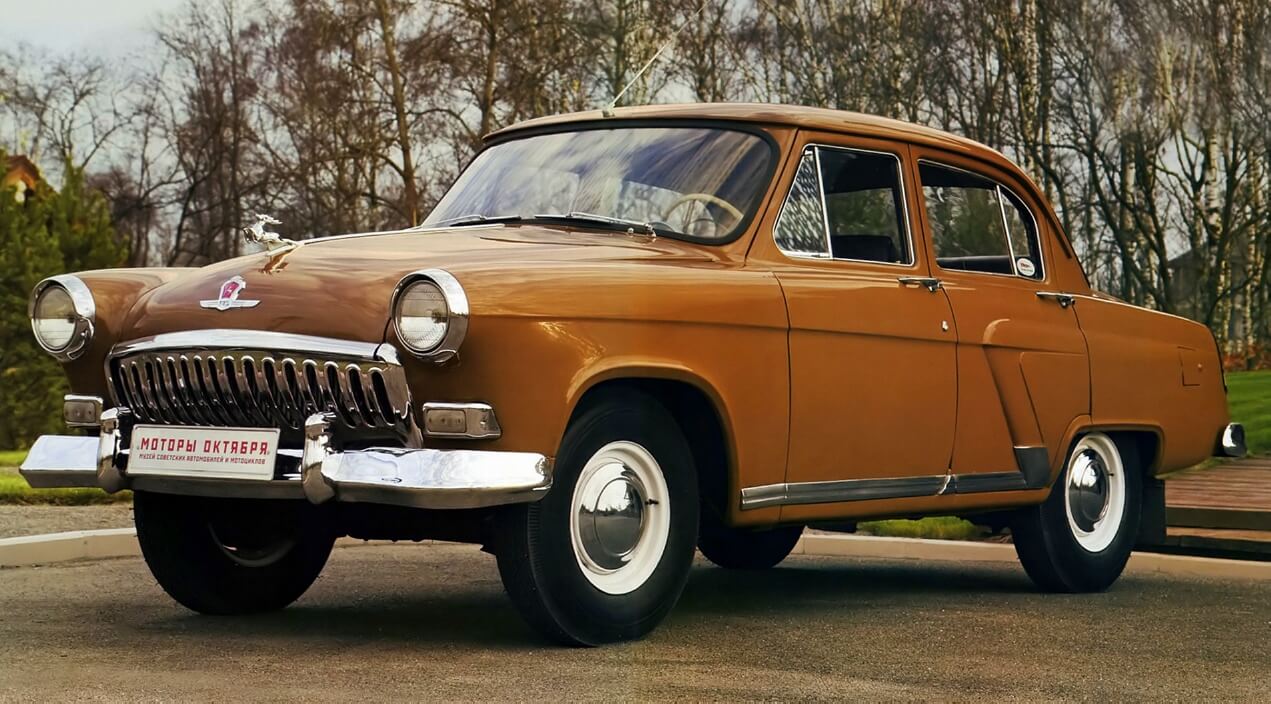
2. GAZ-21
The classic Volga
- Production years
- 1956–1970
- Body type
- Sedan
- Fuel
- Petrol
- Power output
- 48–59 kW (65–80 PS)
Shown in 1955 and built from 1956 to 1970, the Volga replaced the Pobeda and reached 639,478 cars, including the estate. The three series are easy to tell apart by their grilles, and from 1957 a 2,445 cc overhead-valve engine with an aluminium block gave 51 kW (70 PS), rising to 55 kW (75 PS) on third-series cars. A Volga won its class in Finland's Thousand Lakes Rally in 1959, and cars assembled in Belgium as Scaldia-Volgas were often fitted with diesel engines. It suits buyers who want a large, robust saloon of the late 1950s and 1960s. The drawback: from 1958 every car has a three-speed manual gearbox.
Full review: GAZ-21Pros
- 639,478 built
- Aluminium-block OHV engine from 1957
- Class win in the 1959 Thousand Lakes Rally
Cons
- Three-speed manual gearbox only
-
3. Moskvich-407
The export success
- Production years
- 1958–1963
- Body type
- Sedan
- Fuel
- Petrol
- Power output
- 33 kW (45 PS)
The 407 put a new 1,358 cc overhead-valve engine into the 402 body in 1958, lifting output to about 33 kW (45 PS) and top speed to 115 km/h. It was built until 1963, and 120,903 of the 359,980 cars were exported; Wikipedia describes it as the first Soviet car to sell successfully in the West. A four-speed synchromesh gearbox arrived in December 1959, and there were estates, vans and even four-wheel-drive versions. It suits enthusiasts looking for a compact and light classic: the saloon weighs about 910 kg. The honest drawback: drum brakes on all four wheels and rear leaf springs reflect its 1950s roots.
Pros
- About a third of production exported
- Light: about 910 kg
- Four-speed synchromesh gearbox from late 1959
Cons
- Drum brakes on all four wheels
Spec sheet: Moskvich-407 1.4 l 33 kW (45 PS)
Full review: Moskvich-407 -
4. Moskvich-412
Best to drive
- Production years
- 1967–1975
- Body type
- Sedan
- Fuel
- Petrol
- Power output
- 55 kW (75 PS)
From 1967 the 412 combined the 408 body with Igor Okunev's new 1,478 cc engine: aluminium block and head, an overhead camshaft and 55 kW (75 PS). It is often compared with BMW's M10, although Wikipedia calls the similarity superficial. A floor-mounted gear lever replaced the column shift in 1969 and front disc brakes arrived in 1970. Built by AZLK and IZh, it was sold in the UK as the Moskvitch 1500 from 1974. It suits drivers who want a Soviet classic that can keep up with traffic, with a top speed of about 140 km/h. The drawback: the leaf-sprung rigid rear axle limits handling on rough, fast bends.
Pros
- Aluminium OHC engine with 55 kW (75 PS)
- Front disc brakes from 1970
- Estate 427 and IZh-built versions
Cons
- Leaf-sprung rigid rear axle
Spec sheet: Moskvich-412 1.5 l 55 kW (75 PS)
Full review: Moskvich-412 -
5. GAZ-24
Best for space
- Production years
- 1970–1992
- Body type
- Sedan
After 32 pre-series cars in 1968 and 215 in 1969, full production of the GAZ-24 Volga started in 1970. Its 2,445 cc ZMZ-24D engine with an aluminium block gave 70 kW (95 PS), and an estate followed in 1972. Volgas were almost the only taxis in the USSR, and some taxis covered more than 1,000,000 km. The updated 24-10 was built until 1992, and the GAZ-3102 derivative kept the design alive for many more years. It suits buyers who want space and a body and engine proven by hard taxi work. The drawback: it is a large, heavy saloon, nicknamed 'barzha' (barge).
Full review: GAZ-24Pros
- Some taxis exceeded 1,000,000 km
- Spacious saloon and estate
- Long production, 1970–1992 including the 24-10
Cons
- Large and heavy – nicknamed the barge
-
6. Lada VAZ-2101
The people's car
- Production years
- 1970–1982
- Body type
- Sedan
- Fuel
- Petrol
- Power output
- 44 kW (60 PS)
The Zhiguli, sold abroad as the Lada 1200, was a licence-built Fiat 124 with more than 800 changes: higher ground clearance, rear drum brakes, a stronger body and a new overhead-camshaft engine designed by NAMI. The first cars left the AvtoVAZ line in April 1970. The 1.2-litre 2101 gave 44 kW (60 PS DIN) and was built until 1982, while the 1.3-litre 21011 and the 21013 kept the family going until 1988. In 1976 the Zhiguli range was the world's best-selling car series. It suits anyone who wants a simple, rear-wheel-drive classic. The drawback: early crankshafts were known to wear quickly.
Pros
- Fiat 124 basis, heavily re-engineered
- Overhead-camshaft engine
- Built in very large numbers
Cons
- Early crankshafts wore quickly
Spec sheet: Lada VAZ-2101 1.2 l (1,198 cc) 44 kW (60 PS)
Full review: Lada VAZ-2101 -
7. Moskvich-2140
Most usable Moskvich
- Production years
- 1976–1988
- Body type
- Sedan
- Fuel
- Petrol
- Power output
- 55 kW (75 PS)
The 2140 replaced the 412 in January 1976 with the same body structure but new panels, rectangular headlamps, a black plastic grille and interior updates such as hazard lights and a heated rear window. Its UZAM-412 engine kept 1,478 cc and 55 kW (75 PS), with a four-speed manual gearbox, rear-wheel drive and servo-assisted brakes with front discs. Production at AZLK ran until July 1988. A 2019 Czech road test of a preserved car found it robust and comfortable on unpaved roads. It suits drivers who want the most practical classic Moskvich. The drawback: the ageing bodies are prone to underbody corrosion.
Pros
- Same 55 kW (75 PS) aluminium engine as the 412
- Servo brakes with front discs
- Comfortable on poor roads
Cons
- Underbody corrosion on ageing cars
Spec sheet: Moskvich-2140 1.5 l Petrol
Full review: Moskvich-2140



Catalog: All Soviet-era models in the catalog - every model with specs, not only our picks.
How we chose
Selection. We considered Soviet passenger cars in launch order. We left out the GAZ-67, a wartime military four-by-four rather than a passenger car, the Moskvich-403 and Moskvich-408, transitional models we could not document well enough, and the late-1980s VAZ-2109, and included the GAZ-21 and GAZ-24 Volga, the Moskvich-407, Moskvich-412 and Moskvich-2140, all of which have researched data. Every car listed has a published model page on 1cars.
Data sources. Card facts come from the 1cars catalogue; for the VAZ-2101 and Moskvich-412 the years and power were corrected from sources before publication. Text facts come from our researched fact sheets for the Pobeda, Moskvich-407, -412 and -2140 and VAZ-2101 (based on English, German and Italian Wikipedia, AUTOCADE and Czech motoring press), and from English-language Wikipedia for the GAZ-21 and GAZ-24. Power is given in kW first, then PS; Soviet ratings follow the source.
Ranking. The list is in chronological order of launch; it is an editorial selection, not a score. Prices are deliberately not given.
Frequently asked questions
Which Soviet classic is the easiest to own today?
Cars built in large numbers, such as the VAZ-2101 family and the Moskvich-412 and 2140, are the simplest choices because so many were made. Early and rare cars such as the Pobeda cabriolet need more patience.
Was the VAZ-2101 simply a Fiat 124?
It was based on the Fiat 124, but more than 800 changes were made, including a new overhead-camshaft engine, rear drum brakes, a stronger body and higher ground clearance for poor roads.
Why are the GAZ-67 and Soviet trucks not included?
This list covers passenger cars. The GAZ-67 is a wartime military four-by-four, and Soviet trucks have their own list of legendary models.
Why are there no prices in this list?
Prices depend on the country, age, mileage and condition of each car and change quickly. We only publish facts that can be checked, so compare current local listings and a full service history before you buy.