
Moskvich-412
Specs, engines and history
Updated Published Sources (3) Report an error
By Oleksandr Hnatiuk, Automotive Editor & Used Car Specialist Reviewed by Felix Hartmann

- Built
- 1967–1975
- Top power
- 55 kW (75 PS)
The Moskvich-412 is a Soviet four-door saloon built by MZMA, renamed AZLK in 1968, from 1967 to 1975, and by the IZh plant until 1982. It was a development of the Moskvich-408 with a new aluminium 1.5-litre UZAM-412 engine rated at 55 kW (75 PS), and it was replaced by the Moskvich-2140 in 1976.
In short
- A rear-wheel-drive saloon derived from the Moskvich-408, with a four-speed manual gearbox and a kerb weight of 1,045 kg (2,304 lb).
- Its 1,478 cc overhead-camshaft engine, designed by Igor Okunev, has an aluminium block and head and is tilted 20 degrees in the engine bay.
- AZLK built the saloon from 1967 to 1975; IZh built the IZh-412 to 1982, and its van and pickup derivatives lasted until 2001.
- The car passed international safety tests at Montlhéry, finished 12th in the 1970 London–Mexico World Cup Rally and was sold in the UK.
Specs by version
Engines
| Version | Engine | Power | Drive |
|---|---|---|---|
| 1.5 55 kW (75 PS) Sedan | 1.5 l · Petrol 1,500 cc | 55 kW 75 PS74 hp | Rear-wheel drive |
Performance
Show all 1 versions
| Version | 0–100 km/h | Top speed |
|---|---|---|
| 1.5 55 kW (75 PS) Sedan | 19.0 s 0–62 mph | 140 km/h87 mph |
Dimensions and weight
Show all 1 versions
| Version | Length | Width | Wheelbase | Kerb weight | Fuel tank |
|---|---|---|---|---|---|
| 1.5 55 kW (75 PS) Sedan | 4,115 mm162.0 in | 1,550 mm61.0 in | 2,400 mm94.5 in | 1,045 kg2,304 lb | 45 l11.9 gal US |
Verified Manufacturer and type-approval data from our catalog · Sources and methodology
Development and production history
The Moskvich-412 began as an engine upgrade: the plant put a new, more powerful 1.5-litre unit into the existing Moskvich-408 and launched the result in 1967. The 408 itself had replaced the Moskvich-407.

The 412 was originally meant to replace the 408. That did not happen. The older car stayed in production because it tolerated 75-octane petrol and lower-grade oil. Until 1969 the 412 used the 408's body and chassis with a new engine and interior; from 1969 the two models shared the same body.
The plant changed its name during this period. MZMA became AZLK in October 1968, so documents name different makers for the same car. A second plant, IZh, built its own IZh-412 from 1967 to 1982. For the wider story of the factory, read the history of Moskvich and AZLK.
AZLK ended saloon production in 1975. The 408 was discontinued in December 1975, and its successor, the Moskvich-2140, entered production in January 1976. Some reference tables give 1976 as the 412's final year, which reflects this overlap with the 2140.
| Year | Event |
|---|---|
| 1964 | Prototype UZAM-412 engines built |
| 1966 | First production engine completed on 15 March; the engine also raced in the G4M |
| 1967 | Moskvich-412 enters production in March, using the 408 body; IZh-412 production starts |
| 1968 | MZMA renamed AZLK in October; a 412 finishes 20th in the London–Sydney Marathon |
| 1969 | Shared, safety-upgraded body with the 408; floor gear lever; M-427 estate; UK sales begin |
| 1970 | Front disc brakes introduced; best result of 12th in the London–Mexico World Cup Rally |
| 1972 | One-piece lifting tailgate for the 427 estate |
| 1973 | Peak UK sales of 3,462 cars; IZh-2125 Kombi hatchback launched |
| 1974 | UK cars rebadged Moskvitch 1500 |
| 1975 | AZLK saloon production ends |
| 1976 | Moskvich-2140 replaces the 412 at AZLK |
| 1982 | IZh-412-028 facelift with a black grille and hollow door handles |
| 1997 | IZh-21251 hatchback ends |
| 2001 | IZh-2715 van and IZh-27151 pickup end |
Body, chassis and safety engineering
The 412 is a conventional front-engined, rear-wheel-drive saloon with independent front suspension and a live rear axle. At the front, transverse arms and coil springs locate each wheel; at the rear, the axle sits on leaf springs. The wheelbase is 2,400 mm (94.5 in) and the width 1,550 mm (61.0 in); the car is about 4.1 m (13.5 ft) long, though published lengths vary.

The gearbox is a four-speed manual. Until early 1969 it was operated by a lever on the steering column; after that the lever moved to the floor. The brakes are dual-circuit with a servo. Front discs arrived in 1970, but drum-braked cars continued alongside them, so a 1970s car with front drums is not necessarily a conversion.
Safety tests at Montlhéry
The 1969 body was developed with export in mind. The car spent about five months on tests at the Montlhéry track in France and received an international safety certificate to UNECE standards. Further tests took place in Bulgaria, Czechoslovakia, Sweden in 1970–1971 and West Germany in 1972. The passive safety features are usually listed as a padded dashboard, a soft steering-wheel cover, seat belts and a reinforced body.
The UZAM-412 engine
The UZAM-412 is a 1,478 cc (90.2 cu in) inline four with a single overhead camshaft, rated at 55 kW (75 PS). It was designed by Igor Okunev and built by the UZAM engine plant, and it is also known as the Moskvitch-DM.
The block, cylinder head and inlet manifold are aluminium, the combustion chambers are hemispherical, and a chain drives the overhead camshaft. The crankshaft runs in five main bearings. Replaceable steel cylinder liners mean that a worn engine can be rebuilt without reboring the block. The whole unit is installed leaning 20 degrees to one side.
Peak power is usually quoted at 5,800 rpm, with 108 Nm (80 lb-ft) of torque between 3,400 and 3,800 rpm. Bore and stroke are given as 82 × 70 mm (3.23 × 2.76 in) and the compression ratio as 8.8:1, and the engine was specified for 80-octane petrol. The complete unit weighs about 146 kg (322 lb).
The BMW comparison
The UZAM-412 is often compared with the BMW M10 and M115, and the claim that it was copied from the BMW engine appears regularly in English-language articles. Hagerty describes the engine as "allegedly reverse-engineered" from the M10, yet notes that the tilt angle differs by about 10 degrees. Other references call the similarity superficial: both engines lean to one side and use a chain-driven overhead camshaft, but that is where the documented overlap ends. No source we found shows that the UZAM design was taken from BMW drawings.
Larger engines that stayed on paper
The engine was meant to grow. Versions of 1,702 cc (81 hp) and 1,799 cc (103 hp) were developed, the larger one for the M-356 prototype, but neither reached production. The prototypes M-353 (1970), M-355 (1972) and M-356 (1973–1975), larger facelifted hatchbacks, also stayed unbuilt.
Moskvich-412 specifications
The table covers the AZLK-built Moskvich-412 saloon with the standard 1.5-litre engine. Figures marked as usually quoted rest on a single reference source rather than factory documents.

| Parameter | Metric | Imperial |
|---|---|---|
| Production | 1967–1975 (AZLK) | 1967–1975 (AZLK) |
| Body | 4-door saloon | 4-door saloon |
| Engine | Petrol inline-four, SOHC | Petrol inline-four, SOHC |
| Displacement | 1,478 cc | 90.2 cu in |
| Bore × stroke | 82 × 70 mm | 3.23 × 2.76 in |
| Compression ratio | 8.8:1 | 8.8:1 |
| Maximum power | 55 kW (75 PS) at 5,800 rpm | 74 hp at 5,800 rpm |
| Maximum torque | 108 Nm at 3,400–3,800 rpm | 80 lb-ft at 3,400–3,800 rpm |
| Gearbox | 4-speed manual | 4-speed manual |
| Drive | Rear-wheel drive | Rear-wheel drive |
| Brakes | Front discs from 1970, rear drums | Front discs from 1970, rear drums |
| Wheelbase | 2,400 mm | 94.5 in |
| Width | 1,550 mm | 61.0 in |
| Kerb weight | 1,045 kg | 2,304 lb |
| Tyres | 165/80 R13 | 165/80 R13 |
| Fuel tank (usually quoted) | 45–46 L | 11.9–12.2 US gal |
| Top speed (usually quoted) | 140 km/h | 87 mph |
| 0–100 km/h (usually quoted) | 19 s | 19 s (0–62 mph) |
Fuel consumption is not listed because no reliable test-cycle figure was found. Length is also left out: published values range from 4,090 mm to 4,250 mm, and the higher one belongs to the later 2140.
Variants and derivatives
The 412 family includes the saloon, an estate, a delivery vehicle, the IZh-built versions and a sports engine. Letter suffixes on the saloon, such as E, I, U and P, marked versions for export, higher trim, commercial, official and sports use; the IE of 1969 was the export car with the safety-upgraded body.

| Variant | Years | Body / purpose | Engine | Notes |
|---|---|---|---|---|
| Moskvich-412 | 1967–1975 | 4-door saloon | UZAM-412, 1.5 L | Base model; 408 body until 1969 |
| Moskvich-427 | 1969–1976 | Estate | UZAM-412, 1.5 L | One-piece lifting tailgate from 1972 |
| Moskvich-434 | 1967–1973 | Sedan delivery / pickup | Not documented | Replaced by the IZh-2715 |
| IZh-412 | 1967–1982 | 4-door saloon | UZAM-412, 1.5 L | Kept twin round headlights; followed by the IZh-412-028 facelift in 1982 |
| IZh-427 | 1971–1982 | Estate | UZAM-412, 1.5 L | IZh version of the 427 |
| IZh-2125 Kombi | 1973–1982 | Hatchback | Not documented | Continued as IZh-21251 to 1997 |
| IZh-2715 | 1972–2001 | Van | Not documented | IZh-2715-01 facelift in 1982 |
| IZh-27151 | 1974–2001 | Pickup | Not documented | Built alongside the van |
| Moskvich-412-2V | Not documented | Sports and racing | Tuned UZAM-412, 100 hp | Used in sports cars |
The IZh cars are the easiest to confuse with AZLK ones. The IZh-412 and IZh-427 are almost identical to their AZLK counterparts but kept twin round headlights. The 1982 IZh-412-028 facelift added a black grille and hollow door handles. The longest-lived members of the family were the IZh-2715 van and IZh-27151 pickup, both built until 2001.
In service: rallies, export and reputation
Long-distance rallies gave the Moskvich-412 its best-known international results. In the 1968 London–Sydney Marathon, a 16,694 km (10,373 mi) event with 98 starters and 56 finishers, a 412 finished 20th, ahead of three 408s in 22nd, 33rd and 38th. The Teams' Prize went to Ford Australia, not to the Moskvich team. In the 1970 London–Mexico World Cup Rally, about 25,700 km (16,000 mi) long, the factory entered 412s with the 1.5-litre engine; the best finished 12th overall and two others 17th and 20th. Only 23 of the 96 starters reached the finish. The marque's wider motorsport story is told in our Moskvich racing history.

Sales and racing in the UK
The 412 was sold in the UK from 1969. The importer, SATRA Motors, started with 20 dealers and about 300 cars, and according to published figures sales peaked at 3,462 in 1973 through 268 dealers. From 1974 the car was badged Moskvitch 1500, and in 1975 only 344 were sold before the importer withdrew in 1976. In Finland it was sold as the Elite 1500 M. SATRA also raced the 412 in the 1972–1973 Group One saloon championship, and the car is credited with a 1-2-3 in the 1973 Avon Round Britain Rally and a class win in the 1973 Safari Rally.
Its UK reputation was mixed. In 1973 the Consumers' Association described the car as "dangerously unsafe", a finding reported in The Guardian and disputed by the importer. By then the car already held the safety certificate earned at Montlhéry, so the two verdicts point in opposite directions.
The related range was also assembled outside the Soviet Union. Balkancar in Lovech, Bulgaria, assembled Rila-badged versions of the 408, 412, 2140 and 2141 between 1966 and 1990, and Scaldia-Volga in Belgium assembled the 408.
Preservation and collecting today
For collectors, the main points of interest are the engine and the car's place in Soviet car history. Replaceable steel cylinder liners make an engine rebuild practical, and the aluminium construction is a point of interest in its own right. Identifying the exact version comes first, because two plants built near-identical cars from 1967 onwards:
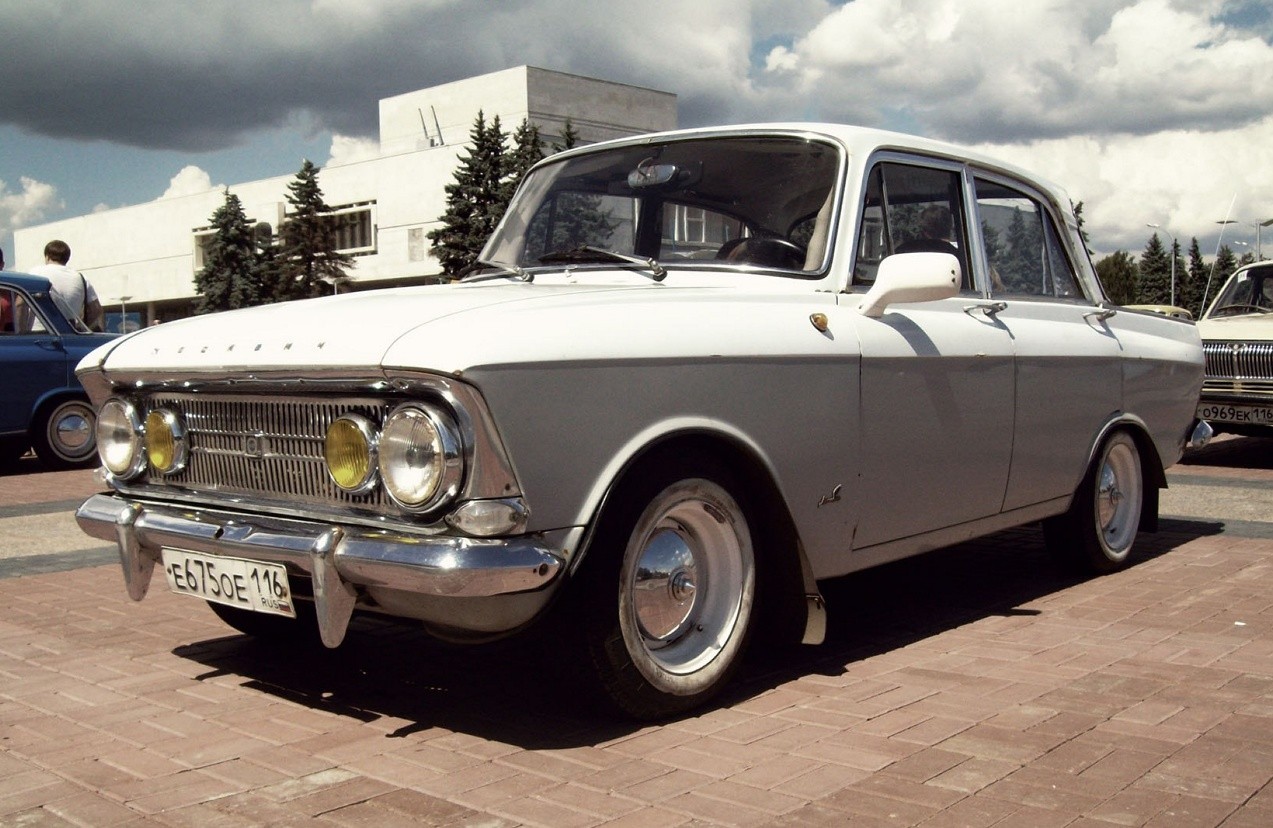
- Headlights: twin round lamps point to an IZh-built car.
- Gear lever: a column shift indicates a car built before early 1969, when the floor lever arrived.
- Front brakes: discs appeared in 1970, but drums continued, so the brakes alone do not date a car.
- Estate tailgate: a one-piece lifting tailgate on a 427 indicates 1972 or later.
- Grille and handles: a black grille with hollow door handles marks the 1982 IZh-412-028.

Published sources say little about parts supply or typical faults, so a pre-purchase inspection by someone who knows the UZAM engine is the safer route. For other cars of the period, browse our classic cars section or all Moskvich models.
Rivals
Compare with…
Compare Moskvich-412 with
- Lada VAZ-2101 full comparison
- Audi 80 quick spec comparison


Moskvich-412 in our rankings
- No. 12 of 126 · Smallest sedans (4,115 mm · top 10%)
- No. 50 of 452 · Lightest cars (1,045 kg · top 12%)
- No. 98 of 593 · Smallest cars (4,115 mm · top 17%)
- No. 17 of 85 · Lightest sedans (1,045 kg · top 20%)
- No. 585 of 1178 · Longest-running car nameplates (8 years · top 54%)
- No. 34 of 43 · Fastest cars of the 1960s (140 km/h · top 82%)
Shorter than 90% of ranked sedans in the 1CARS catalog (No. 12 of 126).
Moskvich-412 photos 18





Moskvich-412 videos 2

Moskvich-412 video 1

Moskvich-412 video 2
FAQ
When was the Moskvich-412 produced, and where?
AZLK, called MZMA until October 1968, built the Moskvich-412 saloon from 1967 to 1975. The IZh plant built its IZh-412 version from 1967 to 1982, and its van and pickup derivatives until 2001. Rila-badged cars were also assembled by Balkancar in Bulgaria.
How many Moskvich-412 were built?
No verified production total for the Moskvich-412 is published in the sources we checked, so we do not quote one. Export volumes are better documented: in the UK, for example, sales peaked at 3,462 cars in 1973, and 344 were sold in 1975, the last full year before the importer left.
What engine does the Moskvich-412 have?
It has the UZAM-412, a 1,478 cc inline four with an aluminium block and head, hemispherical combustion chambers and a chain-driven overhead camshaft. It produces 55 kW (75 PS) and is tilted 20 degrees. The engine was designed by Igor Okunev; a sports version, the 412-2V, produced 100 hp.
Was the Moskvich-412 engine copied from a BMW?
No source we found proves it. The UZAM-412 is often compared with the BMW M10 because both lean to one side and use a chain-driven overhead camshaft. Reference works call the similarity superficial, and Hagerty notes that the tilt angle differs by about 10 degrees.
What is the difference between the Moskvich-408 and the 412?
The main difference is the engine. The 412 has the 1.5-litre aluminium UZAM-412 rated at 55 kW (75 PS), while the 408 kept an older, smaller engine that tolerated 75-octane petrol. From 1967 to 1969 the 412 used the 408 body; from 1969 both shared the same body.
Is the Moskvich-412 collectable?
Yes, mainly as an example of Soviet engineering of the late 1960s and as a rally car with a documented history. Buyers should first identify the version, AZLK or IZh, saloon or estate, and have the UZAM engine checked by a specialist, as published information on parts and typical faults is limited.
Data sources
Data checked by an editor against the sources below.
- The text of this article (1cars archive)
- Wikipedia - Moskvitch 412
- Fastcarcheck


Comments 1
Moskvich-412 I'll buy an engine