
 Honda Logo
Specs, engines and history
Published Sources (3) Report an error
By Sarah Whitmore, Senior Automotive Writer
- Built
- 1996–2001
- Top power
- 67 kW (91 PS)
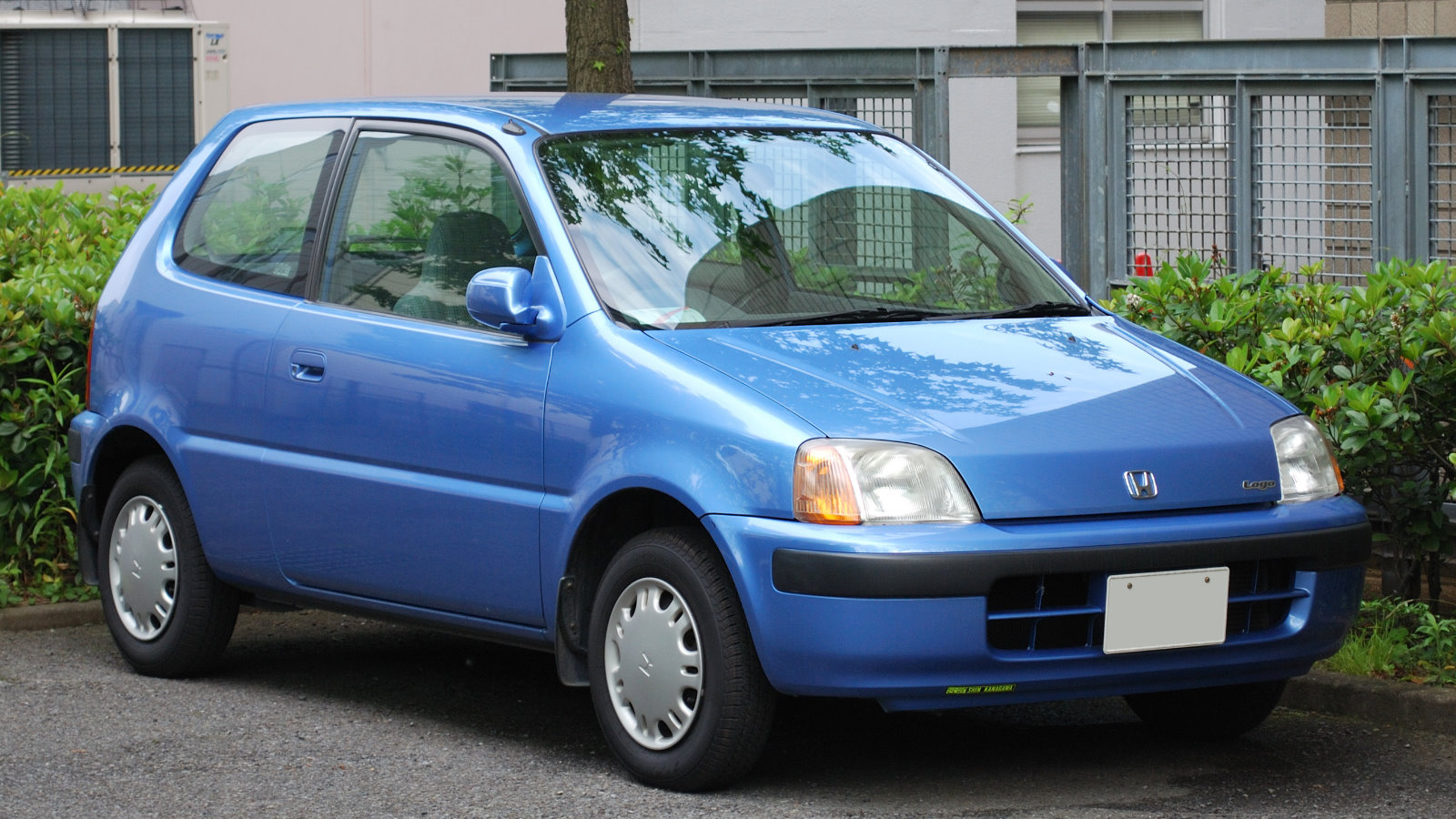
The Honda Logo is a 1.3-litre supermini hatchback that Honda built at its Suzuka plant in Japan from October 1996 to June 2001. It replaced the second-generation City, sat between the kei-class Life and the Civic, and used the D13B engine with 49 kW (66 PS) or, in the later TS, 67 kW (91 PS). Its successor was the Fit, sold in Europe as the Jazz.
In short
- Three- and five-door hatchback, model codes GA3 (front-wheel drive) and GA5 (four-wheel drive), built at Suzuka from 1996 to 2001.
- 1,343 cc D13B SOHC four-cylinder; five-speed manual, three-speed automatic or Honda Multimatic CVT.
- 202,601 sold in Japan in just under five years; in Europe only the three-door was offered, from September 1999.
- Euro NCAP gave it three stars for adult occupants in 2000. People searching for the Honda H badge will find it explained further down.
Size at a glance
| Dimensions | Honda Logo GA3/GA5 |
|---|---|
| Length | 3,750 mm147.6 in |
| Width | 1,645 mm64.8 in |
| Height | 1,490 mm58.7 in |
| Wheelbase | 2,360 mm92.9 in |
| Boot | 230 L8.1 cu ft |
Running cost
Fuel · Logo GA3 1.3 TS 16V 67 kW
about 1,650 EUR fuel a year at 15,000 km
6.2 l/100 km · petrol at 1.75 EUR/l · change mileage, fuel price or version
Specs by version
Engines
| Version | Engine | Power | Torque | Gearbox | Drive | Production years |
|---|---|---|---|---|---|---|
| 1.3 48 kW Europe | 1.3 l · 4 cyl · Petrol D13B | 48 kW 65 PS64 hp | 108 Nm80 lb-ft | 5-sp Manual | Front-wheel drive | 1999–2001 |
| 1.3 49 kW manual | 1.3 l · 4 cyl · Petrol D13B | 49 kW 67 PS66 hp | 111 Nm82 lb-ft | 5-sp Manual | Front-wheel drive | 1996–2001 |
| 1.3 49 kW Multimatic | 1.3 l · 4 cyl · Petrol D13B | 49 kW 67 PS66 hp | 111 Nm82 lb-ft | CVT | Front-wheel drive | 1996–2001 |
| 1.3 4WD 49 kW Multimatic S | 1.3 l · 4 cyl · Petrol D13B | 49 kW 67 PS66 hp | 111 Nm82 lb-ft | CVT | Four-wheel drive (4×4) | 1998–2001 |
| 1.3 TS 16V 67 kW | 1.3 l · 4 cyl · Petrol D13B | 67 kW 91 PS90 hp | 114 Nm84 lb-ft | - | Front-wheel drive | 1998–2001 |
Performance
Show all 5 versions
| Version | Fuel consumption |
|---|---|
| 1.3 48 kW Europe | 7.0 l/100 km33.6 mpg US · 40.4 mpg UK |
| 1.3 49 kW manual | 5.1 l/100 km46.1 mpg US · 55.4 mpg UK |
| 1.3 49 kW Multimatic | 5.6 l/100 km42.0 mpg US · 50.4 mpg UK |
| 1.3 4WD 49 kW Multimatic S | 6.5 l/100 km36.2 mpg US · 43.5 mpg UK |
| 1.3 TS 16V 67 kW | 6.2 l/100 km37.9 mpg US · 45.6 mpg UK |
Dimensions and weight
Show all 5 versions
| Version | Length | Width | Height | Wheelbase | Kerb weight | Fuel tank |
|---|---|---|---|---|---|---|
| 1.3 48 kW Europe | 3,784 mm149.0 in | 1,645 mm64.8 in | 1,529 mm60.2 in | 2,360 mm92.9 in | 913 kg2,013 lb | 40 l10.6 gal US |
| 1.3 49 kW manual | 3,750 mm147.6 in | 1,645 mm64.8 in | 1,490 mm58.7 in | 2,360 mm92.9 in | 790 kg1,742 lb | 40 l10.6 gal US |
| 1.3 49 kW Multimatic | 3,750 mm147.6 in | - | - | 2,360 mm92.9 in | - | 40 l10.6 gal US |
| 1.3 4WD 49 kW Multimatic S | - | - | - | - | 1,040 kg2,293 lb | 40 l10.6 gal US |
| 1.3 TS 16V 67 kW | - | - | - | - | - | 40 l10.6 gal US |
Verified Manufacturer and type-approval data from our catalog · Sources and methodology
Honda Logo at a glance
| Specification | Honda Logo |
|---|---|
| Years | October 1996 to June 2001 |
| Plant | Suzuka, Mie, Japan |
| Body styles | three-door and five-door hatchback (Europe: three-door only) |
| Model codes | GA3 (FWD), GA5 (4WD); E-GA3 until November 1998, then GF-GA3 |
| Engine | D13B 1,343 cc SOHC inline-four, fuel injection |
| Power | 49 kW (66 PS) 8-valve; 67 kW (91 PS) 16-valve TS; 48 kW (65 PS) in Europe |
| Torque | 111 Nm at 2,500 rpm (8-valve); 114 Nm at 4,800 rpm (TS) |
| Gearboxes | 5-speed manual, 3-speed automatic, Honda Multimatic CVT |
| Length and wheelbase | 3,750 mm (Japanese launch cars), 3,784 mm (Europe); wheelbase 2,360 mm |
| Kerb weight | 790-890 kg at launch; 913-990 kg in Europe; 1,040 kg late 4WD |
| Euro NCAP (2000) | three stars adult occupant, two stars pedestrian |
| Price new | JPY 770,000 to 1,088,000 (manual, before consumption tax, October 1996) |
Why Honda built the Logo
Honda announced the Logo on 3 October 1996 as the successor to the City; the three-door went on sale the next day and the five-door on 1 November 1996. In Japan it was sold through all of Honda's car dealerships under the slogan "human sizing". The launch press release set out four development pillars: packaging, everyday driving performance, safety, and resource and environmental conservation, with design and value for money added on top.
The packaging idea was called the Cubic Package: a tall, square body on a 2,360 mm wheelbase that gave five seats in a car 3,750 mm long. Honda described the Logo as a town car, compact outside, roomy inside and strong at low and mid engine speeds. The engineers tuned it for what the press release called half-throttle performance, because most city driving happens with the pedal half down.
Honda Logo engine and gearboxes
Every Logo uses the 1,343 cc D13B, a single-overhead-camshaft four-cylinder from Honda's D-series family with PGM-FI fuel injection and a bore and stroke of 75.0 x 76.0 mm. The launch version has two valves per cylinder and gives 49 kW (66 PS) at 5,000 rpm and 111 Nm at 2,500 rpm; 90 percent of that torque is available from 1,300 rpm. European cars were rated at 48 kW (65 PS) and 108 Nm.
The sporty TS arrived in November 1998 with a 16-valve version of the D13B: 67 kW (91 PS) at 6,300 rpm and 114 Nm at 4,800 rpm. It also got front and rear anti-roll bars, a leather three-spoke steering wheel and suspension lowered by 10 mm.
| Version | Engine | Power | Gearbox | 10-15 mode (Japan) |
|---|---|---|---|---|
| 3-door 1.3 (1996) | D13B 8-valve | 49 kW (66 PS) | 5-speed manual | 19.8 km/l (5.1 L/100 km) |
| 3-door 1.3 (1996) | D13B 8-valve | 49 kW (66 PS) | Multimatic CVT | 18.0 km/l (5.6 L/100 km) |
| 3-door 1.3 (1996) | D13B 8-valve | 49 kW (66 PS) | 3-speed automatic | 17.2 km/l (5.8 L/100 km) |
| TS (1998-2001) | D13B 16-valve | 67 kW (91 PS) | manual or CVT | 16.2 km/l (6.2 L/100 km) |
| 4WD GA5 (1998-2001) | D13B 8-valve | 49 kW (66 PS) | Multimatic S CVT | 15.4 km/l (6.5 L/100 km) |
The Honda Multimatic is a CVT with two driving modes, D for economy and S for sport, chosen with a switch on the steering wheel. In November 1998 it became the Multimatic S, which added Grade Logic Control to hold the right ratio on hills. Real Time 4WD arrived at the same time and came only with this gearbox. For Europe, a spec database lists a top speed of 160 km/h and combined consumption of 7.0 L/100 km on the European test, which is harder than the Japanese 10-15 mode.

Versions, facelifts and special editions
At launch the grades were B (three-door only), G and L, plus an S kit with sportier trim. Honda changed the car almost every year:
| Date | Change |
|---|---|
| 12 September 1997 | antibacterial steering wheel on all grades; G-allfa with ABS and passenger airbag; Logo Almas for wheelchair users |
| 4 January 1998 | Lachic special edition |
| 12 November 1998 | emissions update (GF- prefix), stiffer body shell, TS 16-valve, Real Time 4WD with Multimatic S |
| September 1999 | Sportic edition in Super Sonic Blue Pearl |
| 16 December 1999 | Coloris, fully body-coloured |
| 14 April 2000 | second facelift with a new interior; cheaper Sportic, earlier one renamed Sportic TS |
| 30 November 2000 | Topics, with keyless entry and a height-adjustable driver's seat |
| June 2001 | production ends; the Fit takes over |
Honda Logo prices in Japan
At launch in October 1996 the manual three-door cost JPY 770,000 as a B, JPY 918,000 as a G and JPY 1,058,000 as an L, all before consumption tax. The five-door G was JPY 948,000 and the five-door L JPY 1,088,000. The Multimatic CVT added JPY 80,000; a 1996 G five-door with the three-speed automatic was listed at JPY 998,000. Honda priced the base model at JPY 770,000, yet the car sold less well than hoped in Japan.
Honda Logo in Europe and the Euro NCAP test
Continental European sales began in September 1999, and the UK followed in the second half of 2000, in both cases with the three-door only. In the UK the Logo lasted about nine months before the Jazz replaced it. Honda treated it as a placeholder to give it a supermini presence until the Jazz was ready.
British reviews were cool. What Car? criticised the ride, handling and build quality, the RAC found it well equipped but already dated, and Parker's called the interior cheap and the noise levels poor, while praising the forward visibility. Owners were kinder: in December 2001 the Logo topped a European customer satisfaction survey.
Euro NCAP tested a left-hand-drive three-door in 2000. It scored three stars for adult occupant protection, with 17 points (6 frontal, 11 side), and two stars, 14 points, for pedestrian protection.

Capa, HR-V and the move to the Fit
The Logo platform carried two more Hondas. The tall Capa went on sale on 23 April 1998, and the three-door HR-V crossover followed on 22 September 1998; the later Honda HR-V generations still carry that name.
The Logo itself stayed a one-generation model. Honda ended production in June 2001 and launched the Fit, which went on sale in Europe as the Jazz. The latest version is described in our guide to the fourth-generation Honda Jazz.
Honda Logo the car and the Honda logo badge
Most people who type "honda logo" want the badge. Honda cars wear the H mark: the first H appeared in the early 1960s, on the T360 kei pickup and the S500 sports car, and the 1981 version, a soft-cornered trapezoid around the H, debuted on the City, the car the Logo later replaced. The chrome-effect H with red Honda script arrived on the 2000 model of the Honda Civic. Honda motorcycles keep the separate wing mark, which goes back to the 1947 Honda A engine and was inspired by the wings of the goddess Nike.
A flatter, wider H without a frame first appeared with the 0 Series electric cars. In January 2026 Kelley Blue Book reported that Honda will put it on new electric and next-generation hybrid models from 2027 and later on every car. Current models are listed under Honda models in the catalogue.
Honda Logo today what to check when buying
Check the model code on the plate first: E-GA3 marks a car built before November 1998, GF-GA3 or GF-GA5 a later one with the stiffer body and updated emissions. The 16-valve TS and the 4WD exist only in the later series.
On a Multimatic car, check that the CVT pulls away smoothly and that S mode holds revs on a climb. Kerb weight rose from 790-890 kg at launch to 1,040 kg for the late 4WD, while the 8-valve engine kept its 49 kW (66 PS). No reliable dated price guide for the Logo exists, so values depend on condition and paperwork.
Photo gallery

Honda Logo in our rankings
- No. 3 of 108 · Lightest hatchbacks (790 kg)
- No. 20 of 586 · Lightest cars (790 kg · top 4%)
- No. 45 of 756 · Smallest cars (3,750 mm · top 6%)
- No. 82 of 405 · Most economical cars (5.1 l/100 km · top 21%)
- No. 31 of 133 · Smallest hatchbacks (3,750 mm · top 24%)
- No. 37 of 76 · Most economical hatchbacks (5.1 l/100 km · top 49%)
Lighter than 97% of ranked hatchbacks in the 1CARS catalog (No. 3 of 108).
FAQ
Is the Honda Logo a car?
Yes. The Honda Logo is a 1.3-litre supermini hatchback built in Japan from 1996 to 2001. The phrase also refers to Honda's H badge, which is a separate topic covered above.
When was the Honda Logo made and what replaced it?
Honda built the Logo from October 1996 to June 2001 at Suzuka. It replaced the City and was succeeded by the Fit, which Europe knows as the Jazz.
How economical is the Honda Logo?
The manual Logo is rated at 19.8 km/l, or 5.1 L/100 km, in the Japanese 10-15 mode. European data give about 7.0 L/100 km combined, which is closer to real driving.
Was the Honda Logo sold in the UK?
Yes, briefly. The UK received the three-door Logo from the second half of 2000 for about nine months, after continental Europe had started sales in September 1999.
What does the Honda H logo mean?
The H stands for Honda and its founder, Soichiro Honda. Cars carry the H mark, motorcycles the wing mark, and a new frameless H follows on new models from 2027.
Data sources
Data checked by an editor against the sources below.
- Wikipedia - Honda Logo
- Wikipedia - ホンダ・ロゴ
- Auto-data - Honda Logo Ga3 1.3 65hp 12316


