Honda Jazz — the Fourth-Generation Hybrid in Detail
The Honda Jazz is a B-segment car and one of Honda's global models, sold around the world as the Jazz or, in Japan, the Americas and China, as the Fit. It is known for good road manners, agility and outstanding practicality. Four generations have been built since 2001; the latest was revealed at the Tokyo Motor Show on 23 October 2019 and is sold in Europe exclusively as a hybrid, the Jazz e:HEV.
Key takeaways
- Four generations: 2001, 2007, 2013 (in Europe from 2015, facelift 2017) and 2019/2020.
- The fourth generation is hybrid-only in Europe: a 1.5 Atkinson-cycle petrol engine with 72 kW (98 PS) plus a traction motor with 80 kW (109 PS) and 253 Nm.
- Two versions: the standard Jazz and the rugged-looking Jazz Crosstar.
- Folding and flip-up "Magic Seats" and 298 to 1,203 litres of luggage space.
Honda Jazz at a glance
The name refers to jazz music, with its improvisation and complex rhythms. More Honda models are listed in our Honda catalogue.
| Generation | Years | Notes |
|---|---|---|
| First | 2001–2007 | Debut in Japan in June 2001 |
| Second | 2007–2013 | Debut October 2007; hybrid version from 2010 |
| Third | 2013–2020 | Launched in Japan in 2013, in Europe in spring 2015; facelift 2017 |
| Fourth | 2019 onwards | Tokyo Motor Show, October 2019; hybrid-only in Europe from June 2020; facelift 2022–2023 |
History
The first Jazz went on sale in 2001, and the second generation was built until 2013. The third generation appeared in 2013 but reached Europe only in spring 2015, and it was updated in 2017. The fourth generation was unveiled in Tokyo in October 2019 under the Fit name used in Japan. In February 2020 Honda revealed its full specifications and showed the European version under the familiar Jazz name. In Europe it is offered only with the e:HEV hybrid powertrain. This article focuses on the fourth-generation Jazz.
Exterior
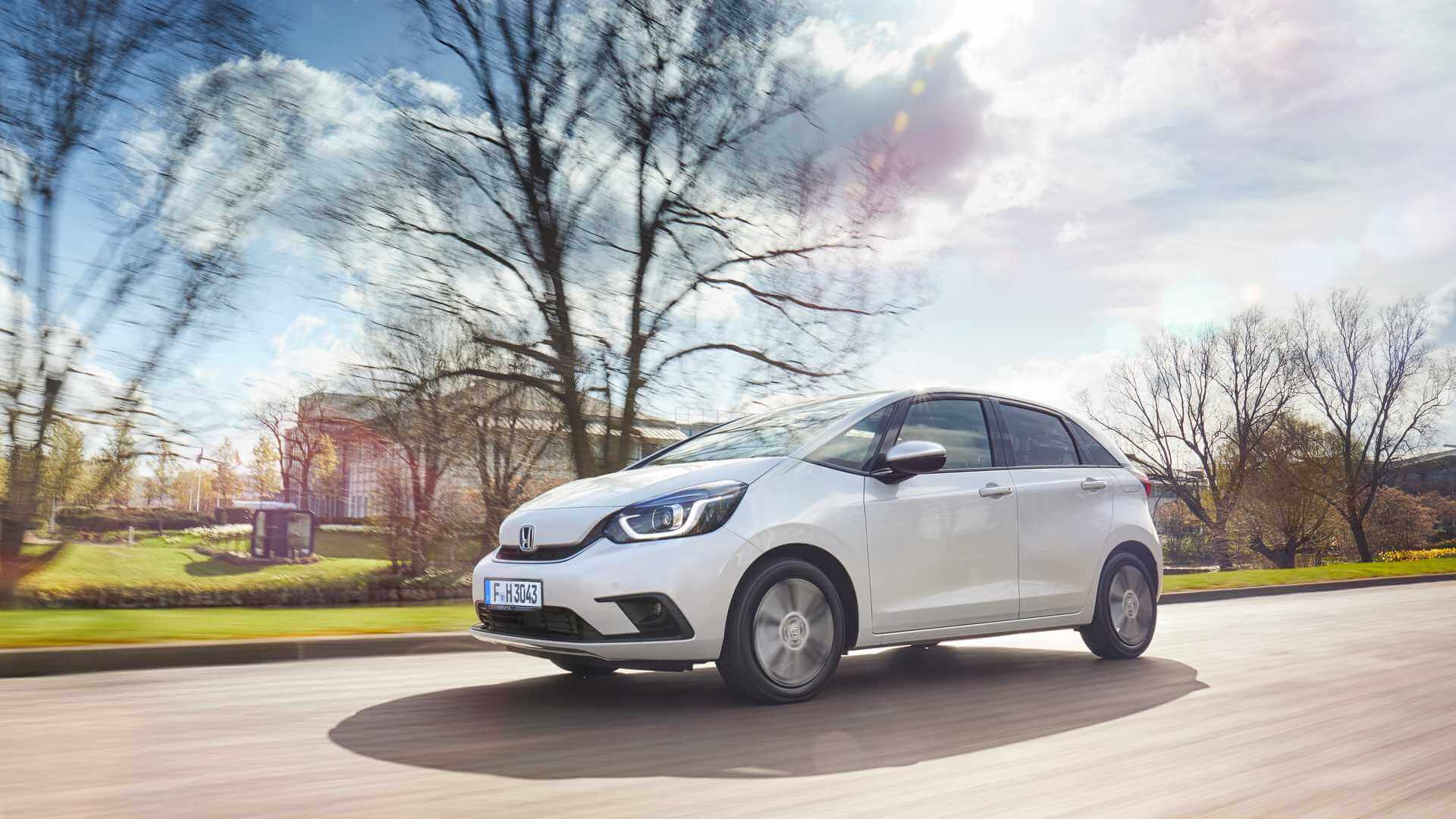
The new generation completely changed the Jazz's appearance. Its proportions are tidier than before, which makes it easier to use in town, and it has plenty of bright details that help it stand out in traffic and beyond.
The front is shorter, a little higher and less steeply raked, but it is still rounded, so the view from the driver's seat remains excellent. Decoration is kept to a minimum. The short bonnet has smooth changes in height and pronounced side ridges. Below them sit large headlights with LED "brackets", connected by a narrow slot in the centre of the bumper decorated with a thin chrome line and a large Honda badge. The simpler, wedge-shaped body improves the drag coefficient, which helps fuel consumption.
The lower bumper has a trapezoidal main intake and two side recesses with fog lamps and gloss-black decorative inserts, plus gentle sculpting and the number-plate mount. Ground clearance is a modest 136 mm. The Jazz rides on 16-inch wheels with a five-petal design.
In profile the car looks light, although less striking than at the front. The interestingly shaped windows are framed and divided by gloss-black strips, and the mirrors are almost triangular, partly painted black and with integrated indicators. Gentle wave-like surfacing, slightly flared arches and unusual wheels complete the picture.
The rear is stylish too. The slightly sloping tailgate has an interesting gloss-black spoiler, a large rear window and big tail lights, with some wave-like sculpting and chrome badges. The bumper is large and plain, with rear fog lamps and subtle sculpting.
Interior
The fourth-generation Jazz feels simple and cosy inside, and the designers deserve praise for that: the cabin is uncomplicated, functional and well thought out. Fabric upholstery, a limited range of seat adjustments and a plain centre tunnel reveal that this is an affordable car; more expensive versions have leather upholstery.
The driver has a 7-inch digital instrument display instead of analogue dials and a two-spoke multifunction steering wheel familiar from the electric Honda e. The centre of the dashboard carries a large 9-inch infotainment "tablet" with Apple CarPlay and Android Auto. Below it is a neat climate control panel with a small monochrome display.
The front seats are completely new. They are designed to stabilise the body and reduce fatigue on long journeys, with good side support and a wide range of adjustment; heating is optional. Between them is a console with a fold-down armrest, the electric parking brake switch and two auxiliary switches.
The rear bench is shaped for two passengers; a third can squeeze in, but not comfortably. The new generation kept one of the Jazz's biggest advantages — its flexible cabin. The rear seats can fold flat into the floor, or their cushions can be flipped up vertically like cinema seats, making room for tall items. The boot holds 298 litres with five seats in use and 1,203 litres with the unequally split rear seats folded, with a flat floor.
Engine and hybrid system
| Component | Detail |
|---|---|
| Petrol engine | 1.5-litre four-cylinder, Atkinson cycle, naturally aspirated |
| Engine output | 72 kW (98 PS), 127 Nm |
| Generator motor | Driven by the petrol engine |
| Traction motor | 80 kW (109 PS), 253 Nm, drives the front wheels |
| Transmission | Fixed-ratio e-CVT |
| 0–100 km/h | 9.4 s |
| Top speed | 175 km/h |
| Combined consumption | About 4.5 l/100 km |
The e:HEV system (Honda's i-MMD) uses two electric motors. The first is connected to the petrol engine and works as a generator; the second drives the front wheels. There are three driving modes, which the car selects automatically:
- Engine Drive — at steady higher speeds the petrol engine drives the wheels directly through a fixed ratio and a clutch;
- Hybrid Drive — the petrol engine powers the generator, which supplies electricity to the traction motor;
- EV Drive — the traction motor runs directly from the battery.
Chassis
The fourth-generation Jazz uses a front-wheel-drive platform with a monocoque body that makes extensive use of high- and ultra-high-strength steel, the latter accounting for 18%. The front suspension is independent with MacPherson struts and the rear a semi-independent torsion beam, with anti-roll bars at both ends. Rack-and-pinion steering with electric assistance makes the car easy to drive, and all four wheels have disc brakes (ventilated at the front), with ABS, EBD and other electronic aids.
Safety and equipment
The new Jazz improved in safety as well as in looks and comfort. In the 2020 Euro NCAP test it scored 87% for adult occupant protection, 83% for child occupants, 80% for pedestrians and 76% for safety assist. Its equipment includes hill-start assist, low-speed collision mitigation braking, parking assistance, adaptive cruise control, forward collision warning, light and rain sensors, lane departure warning and lane keeping assist, traffic-sign recognition, ABS and EBD, ten airbags including side and curtain airbags, brake assist, tyre-pressure warning, pretensioned three-point belts, fog lamps, Vehicle Stability Assist, LED daytime running lights and tail lights, an immobiliser, the digital instrument panel and ISOFIX mounts.
The body is stronger, with defined crumple zones. Honda also added the Honda Personal Assistant voice-control system and the My Honda+ smartphone app, which can lock and unlock the car remotely and offers "intelligent geofencing" that alerts the owner if the car leaves a defined area.
Even the base version comes with ten airbags, the digital instrument display, air conditioning, an audio system, electric windows on all doors, automatic emergency braking, adaptive cruise control, recognition of traffic signs, pedestrians and cyclists, and lane keeping assist.
What owners say
Owners of earlier generations praise the economical engines, compact size and solid build quality. For city use the Jazz is one of the best cars around, with excellent manoeuvrability and a large boot for its class when the rear seats are folded; fuel economy is another plus. On the other hand, owners mention firm suspension, low ground clearance and limited power, as well as the noise insulation and the cost of repairs and parts, and passengers can tire on long trips. The new generation improves on safety, equipment and comfort.
Rivals
The fourth-generation Jazz competes with other hybrid and compact city cars such as the Toyota Yaris Hybrid, Renault Clio E-Tech and Hyundai i20.
Verdict
Honda designs cars a little differently from European manufacturers, and not everyone will like that. But the fourth-generation Jazz is a thoughtfully engineered compact car that remains easy to recommend as a small car. In Europe it is now sold only as a hybrid, with a modern exterior and an innovative cabin. It may not be the best-seller in its class, but it will certainly find its buyers.
FAQ
Is the Honda Jazz the same car as the Honda Fit?
Yes. The car is called Jazz in Europe and many other regions and Fit in Japan, the Americas and China.
Is the new Honda Jazz only available as a hybrid?
In Europe, yes: since June 2020 the fourth-generation Jazz has been sold only with the e:HEV hybrid system.
How powerful is the Honda Jazz e:HEV?
Its traction motor delivers 80 kW (109 PS) and 253 Nm; the 1.5 petrol engine produces 72 kW (98 PS). It reaches 100 km/h in 9.4 seconds.
How big is the Honda Jazz boot?
298 litres with five seats in use and 1,203 litres with the rear seats folded.