
 Honda e
Specs, engines and history
Published Sources (2) Report an error
By Oleksandr Hnatiuk, Automotive Editor & Used Car Specialist
- Built
- 2020–2024
- Top power
- 113 kW (154 PS)
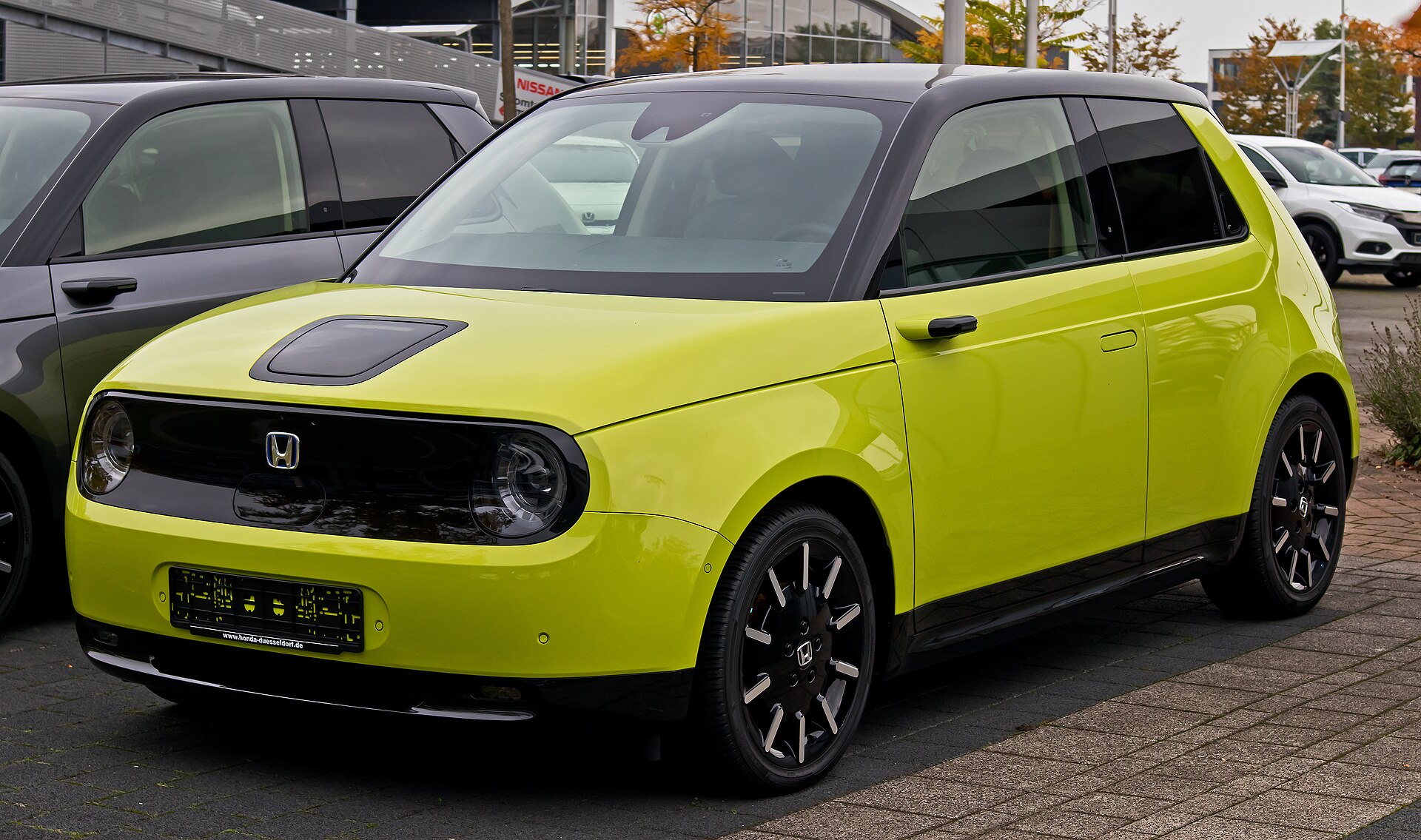
The Honda e is a four-seat electric city car that Honda built at Yorii, Saitama, from 2020 to January 2024. It drives the rear wheels with a 100 kW or 113 kW motor, stores 35.5 kWh in its battery and covers up to 222 km on the WLTP cycle. Camera side mirrors and five dashboard screens made it stand out; a high price and short range cut its sales to about 12,500.
In short
- Previewed by the 2017 Urban EV Concept; production car shown at Frankfurt in September 2019, European deliveries from summer 2020.
- Rear motor with 100 kW (136 PS) or 113 kW (154 PS) in the Advance, 315 Nm, 0-100 km/h in 9.0 or 8.3 seconds.
- 35.5 kWh battery, 210-222 km WLTP, about 160-180 km in real-world tests; 80% on a CCS2 rapid charger in about 30 minutes.
- From GBP 26,160 and EUR 29,470 (after subsidies) in 2019; used from GBP 11,790 in the UK in December 2025.
Size at a glance
| Dimensions | Honda e ZC7 |
|---|---|
| Length | 3,895 mm153.3 in |
| Width | 1,750 mm68.9 in |
| Height | 1,512 mm59.5 in |
| Wheelbase | 2,530 mm99.6 in |
| Boot | 171 L6.0 cu ft |
Specs by version
Engines
| Version | Engine | Power | Torque | Gearbox | Drive | Production years |
|---|---|---|---|---|---|---|
| 100 kW 35.5 kWh | Electric | 100 kW 136 PS134 hp | 315 Nm232 lb-ft | 1-sp Single-speed | Rear-wheel drive | 2020–2022 |
| Advance 113 kW 16-inch | Electric | 113 kW 154 PS152 hp | 315 Nm232 lb-ft | 1-sp Single-speed | Rear-wheel drive | 2020–2024 |
| Advance 113 kW 17-inch | Electric | 113 kW 154 PS152 hp | 315 Nm232 lb-ft | 1-sp Single-speed | Rear-wheel drive | 2020–2024 |
Performance
Show all 3 versions
| Version | 0–100 km/h | Top speed | Range |
|---|---|---|---|
| 100 kW 35.5 kWh | 9.0 s 0–62 mph | 145 km/h90 mph | 222 km138 mi |
| Advance 113 kW 16-inch | 8.3 s 0–62 mph | 145 km/h90 mph | 222 km138 mi |
| Advance 113 kW 17-inch | 8.3 s 0–62 mph | 145 km/h90 mph | 210 km130 mi |
Dimensions and weight
Show all 3 versions
| Version | Length | Width | Height | Wheelbase | Kerb weight | Boot | Battery |
|---|---|---|---|---|---|---|---|
| 100 kW 35.5 kWh | 3,895 mm153.3 in | 1,750 mm68.9 in | 1,512 mm59.5 in | 2,530 mm99.6 in | 1,514 kg3,338 lb | 171 l6.0 cu ft | 35 kWh |
| Advance 113 kW 16-inch | 3,895 mm153.3 in | 1,750 mm68.9 in | 1,512 mm59.5 in | 2,530 mm99.6 in | 1,527 kg3,366 lb | 171 l6.0 cu ft | 35 kWh |
| Advance 113 kW 17-inch | 3,895 mm153.3 in | 1,750 mm68.9 in | 1,512 mm59.5 in | 2,530 mm99.6 in | 1,542 kg3,400 lb | 171 l6.0 cu ft | 35 kWh |
Verified Manufacturer and type-approval data from our catalog · Sources and methodology
Honda e at a glance
| Specification | Honda e |
|---|---|
| Body and seats | five-door supermini hatchback, four seats |
| Production | 2020 - January 2024, Yorii plant, Saitama, Japan (model code ZC7) |
| Layout | rear motor, rear-wheel drive, battery under the floor |
| Motor | MCF5 permanent-magnet, 100 kW (136 PS) or 113 kW (154 PS), 315 Nm |
| Battery | 35.5 kWh lithium-ion, water-cooled |
| WLTP range | 222 km (16-inch wheels), 210 km (Advance on 17-inch wheels) |
| Charging | CCS2 DC, 80% in 30-31 minutes; 6.6 kW AC on board |
| Performance | 0-100 km/h 9.0 s (8.3 s Advance), 145 km/h |
| Length and wheelbase | 3,895 mm, 2,530 mm |
| Boot | 171 litres, 861 litres with the rear seats folded |
| Euro NCAP | four stars (2020) |
| Price at launch | GBP 26,160 in the UK, EUR 29,470 in Germany (2019, after subsidies) |
From the Urban EV concept to the Honda e
Honda showed the Urban EV Concept in 2017, a three-door hatchback with a friendly face that the press compared with city cars of the 1970s and early 1980s. The five-door e Prototype followed at the Geneva show in March 2019 with flush door handles, side cameras in place of mirrors and a charging port in the middle of the bonnet, reachable from either side. The production car, designed by Ken Sahara (exterior) and Akinori Myoui (interior), was revealed at the Frankfurt IAA in September 2019.
UK and European customers could reserve a car from 20 May 2019, prices were announced on 10 September 2019 and deliveries started in summer 2020. Japanese sales began on 30 October 2020. The launch markets were Europe and Japan, and the US was not among them.

Honda e versions, motor and performance
The Honda e sits on a dedicated electric platform with the motor at the rear and the water-cooled battery under the floor between the axles. Honda quotes a 50/50 weight distribution, and with no drive to the front wheels there is no torque steer. All four wheels have MacPherson strut suspension, and the turning circle is about 9.2 m between walls (4.3 m radius at the wheels).
| Version | Power | Torque | 0-100 km/h | WLTP range | Kerb weight |
|---|---|---|---|---|---|
| Honda e | 100 kW (136 PS) | 315 Nm | 9.0 s | 222 km | 1,514 kg |
| Honda e Advance, 16-inch | 113 kW (154 PS) | 315 Nm | 8.3 s | 222 km | 1,527 kg |
| Honda e Advance, 17-inch | 113 kW (154 PS) | 315 Nm | 8.3 s | 210 km | 1,542 kg |
According to German Wikipedia, the base version was built until August 2022 and the Advance until January 2024. Both versions use a single-speed transmission and are limited to 145 km/h. Single Pedal Control lets the driver slow the car with regenerative braking by lifting off the accelerator. The Advance adds a centre camera mirror, Honda Parking Pilot, a heated windscreen and steering wheel, and an eight-speaker 376 W audio system.

Honda e range and charging times
The official WLTP range is 222 km (137 miles) on 16-inch wheels and 210 km (131 miles) on the Advance with 17-inch wheels. Real-world tests came in lower: Carwow managed 113 miles (182 km), and Honest John suggests about 100 miles (161 km) in everyday use.
The CCS2 socket accepts DC rapid charging: 80% takes about 30 minutes on a 100 kW charger and 31 minutes on a 50 kW unit. The on-board AC charger is rated at 6.6 kW, so a 7.4 kW wallbox fills the battery in 4.1 hours, and a 2.3 kW household socket takes 18.8 hours. Three-phase 22 kW charging was not offered.

Honda e cabin, screens and boot space
The dashboard is a single panel of five screens: an 8.8-inch driver display, two 12.3-inch touchscreens that can run separate apps and swap places, and two 6-inch displays for the Side Camera Mirror System at each end. Apple CarPlay and Android Auto are standard, and a voice assistant answers to "OK Honda".
The price of the compact body is space. The boot holds 171 litres with the rear seats in use and 861 litres with them folded, and the car seats only four. At 3,895 mm long, 1,750 mm wide and 1,512 mm high, the Honda e is a city car first.

Honda e Euro NCAP rating
Euro NCAP gave the Honda e four stars in 2020, with 76% for adult occupants, 82% for children, 62% for vulnerable road users and 65% for safety assist. Honda Sensing driver assistance was standard on every version.
Honda e prices and sales by year
At the September 2019 announcement the Honda e cost GBP 26,160 in the UK and EUR 29,470 in Germany after local subsidies, with the Advance at GBP 28,660 and EUR 32,470. Before the German purchase premium, the list price in Germany was EUR 33,850 in 2019. In Japan it cost about JPY 4.5 million in 2020. Prices then rose: by 2023 the UK car cost more than GBP 37,000, a July 2022 Limited Edition of 50 cars for Europe started at GBP 38,120, and the base price at the end was cited as EUR 39,900.
| Year | Europe | Japan |
|---|---|---|
| 2020 | 4,028 | 427 |
| 2021 | 3,752 | 721 |
| 2022 | 2,110 | 371 |
Honda had aimed for about 10,000 sales a year in Europe and 1,000 in Japan. Total global sales reached about 12,500 in roughly three years. Germany registered 3,162 cars from launch to December 2023, with 2021 the best year at 1,256.
Why the Honda e was discontinued
In late 2023 Honda announced that production would end in January 2024 with no second generation. Wikipedia lists the reasons: slow sales, a base price seen as too high, a short WLTP range, limited practicality and rivals that offered more for less. Japanese sales ended in July 2024. In Europe, Honda moved its electric focus to the larger Honda e:Ny1, an SUV based on the HR-V, and the small Super-N became its electric car for the UK, with orders opening on 22 June 2026 from GBP 18,995 and showroom arrivals due in July.
The car still collected praise. It was World Urban Car of the Year 2021, won a Red Dot "Best of the Best" award in 2020 and became the first Japanese car to win German Car of the Year (2021).
Buying a used Honda e
Used prices have fallen well below the original list prices: Carwow listed used cars from GBP 11,790 in December 2025, which makes the Honda e an option for buyers who mainly drive in town. Rivals at the time offered more range: Carwow quotes 217 miles for the Peugeot e-208, 145 miles for the Mini Electric and 230 miles for the Renault Zoe.
- Battery: Honda covers the battery for 8 years or 100,000 miles with a guaranteed 70% capacity; check the remaining warranty.
- Recall: Carwow lists one recall, for a seatbelt reminder that may not display.
- Wheels: 16-inch wheels give the full 222 km WLTP figure; 17-inch wheels on the Advance cut it to 210 km.
- Ride: reviewers mention a firm ride and limited seat support, so test on rough roads.
The rest of the line-up is listed among Honda models.
Honda e in our rankings
- No. 58 of 753 · Smallest cars (3,895 mm · top 8%)
- No. 35 of 132 · Smallest hatchbacks (3,895 mm · top 27%)
- No. 35 of 107 · Heaviest hatchbacks (1,542 kg · top 33%)
- No. 48 of 136 · Most torque: hatchbacks (315 Nm · top 37%)
- No. 92 of 195 · Most powerful hatchbacks (113 kW · top 48%)
- No. 54 of 106 · Quickest hatchbacks, 0–100 (8.3 s · top 51%)
Shorter than 92% of ranked cars in the 1CARS catalog (No. 58 of 753).
FAQ
What is the real range of the Honda e?
The Honda e covers about 160-180 km (100-113 miles) in real driving, according to Honest John and Carwow tests. The official WLTP figure is 222 km on 16-inch wheels and 210 km for the Advance on 17-inch wheels, from a 35.5 kWh battery.
Why was the Honda e discontinued?
Honda ended production in January 2024 because sales were slow: about 12,500 cars in three years against a target of 10,000 a year in Europe alone. A high price, a short range and stronger rivals were the main reasons, and Honda shifted to the e:Ny1.
How long does a Honda e take to charge?
A Honda e charges to 80% in about 30 minutes on a CCS2 rapid charger. On a 7.4 kW home wallbox a full charge takes 4.1 hours, because the on-board AC charger is rated at 6.6 kW; a household socket needs 18.8 hours.
Was the Honda e sold in the US?
No. Honda's launch markets for the Honda e were the UK, continental Europe and Japan, and its sales targets covered only Europe and Japan. The United States was not among them.
Data sources
Data checked by an editor against the sources below.
- Wikipedia - Honda E
- Hondanews - 2020 Honda E 33


