
 Lincoln Continental
All generations, specs and history
Published Sources (2) Report an error
By Sarah Whitmore, Senior Automotive Writer
- Built
- 1939–2020
- Generations
- 8
- Top power
- 298 kW (405 PS)
Timeline
Continental generations
Click a generation for its own page
- Continental I 1939–1948 · Coupe, Convertible
- Continental II 1961–1969 · Sedan, Coupe · 224–272 kW (305–370 PS)
- Continental III 1970–1979 · Sedan, Coupe
- Continental IV 1980 · Sedan, Coupe · 96–104 kW (131–141 PS)
- Continental V 1982–1987 · Sedan · 84–98 kW (114–133 PS)
- Continental VI 1988–1994 · Sedan · 104–119 kW (141–162 PS)
- Continental VII 1995–2002 · Sedan · 194–205 kW (264–279 PS)
- Continental VIII 2016–2020 · Sedan · 227–298 kW (309–405 PS)
Newest first · 8 generations since 1939
- 2016 VIII 2016–2020 · Sedan · 227–298 kW (309–405 PS)
- 1995 VII 1995–2002 · Sedan · 194–205 kW (264–279 PS)
- 1988 VI 1988–1994 · Sedan · 104–119 kW (141–162 PS)
- 1982 V 1982–1987 · Sedan · 84–98 kW (114–133 PS)
- 1980 IV 1980 · Sedan, Coupe · 96–104 kW (131–141 PS)
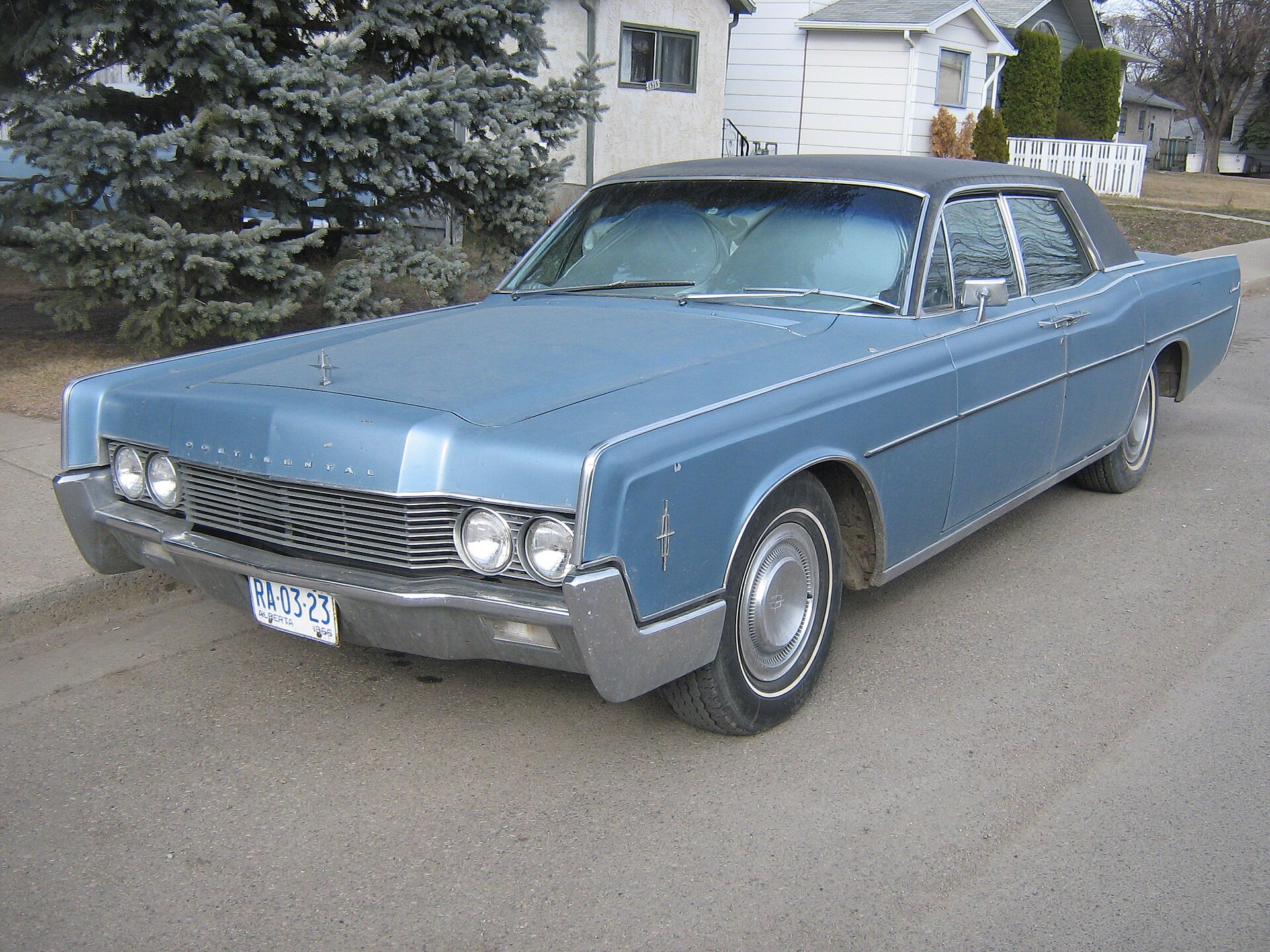
- 1970 III 1970–1979 · Sedan, Coupe
-
1961
- 1939 I 1939–1948 · Coupe, Convertible

All generations by year: Continental VIII (2016–2020) · Continental VII (1995–2002) · Continental VI (1988–1994) · Continental V (1982–1987) · Continental IV (1980) · Continental III (1970–1979) · Continental II (1961–1969) · Continental I (1939–1948)
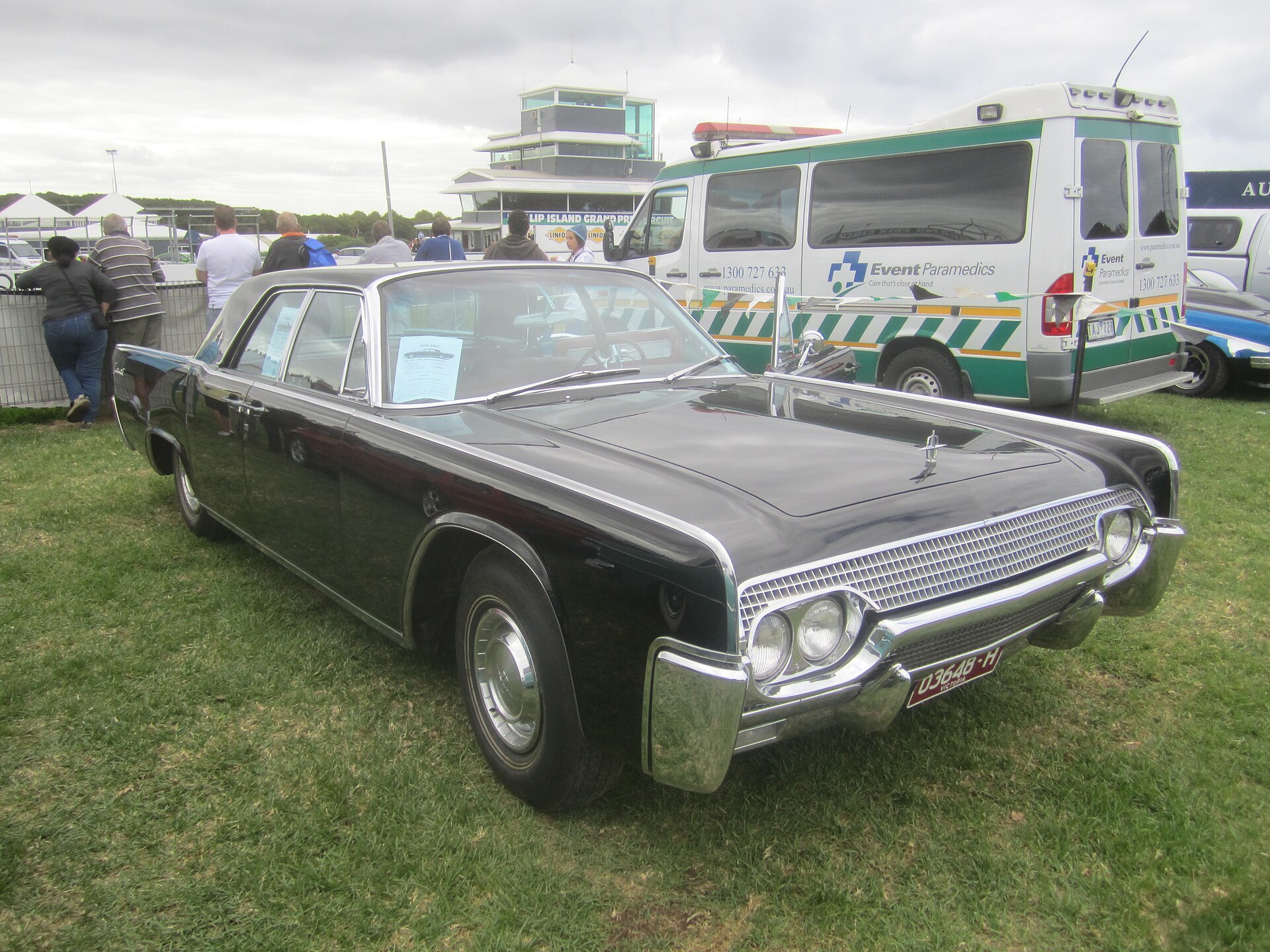
The Lincoln Continental is Lincoln's longest-running name, used on and off from 1939 to 2020 across ten generations. The best known is the 1961-1969 fourth generation: a slab-sided unibody saloon and four-door convertible with rear-hinged back doors, a 7.0-litre V8 of 224 kW (300 hp) and a two-year warranty. Lincoln built 334,345 of them.
In short
- Name in use 1939-1948, 1956-1960 (Continental Mark cars), 1961-1980, 1982-2002 and 2017-2020; production of the last car ended on 30 October 2020.
- 1961-1969 car: designed under Elwood Engel, 334,345 built, including 21,347 four-door convertibles in 1961-1967.
- Engines of that car: 430 cu in (7.0 L) V8 of 224-239 kW (300-320 hp), then 462 (7.6 L) and 460 (7.5 L) V8s of 254-272 kW (340-365 hp), SAE gross.
- Price new in 1961: USD 6,067 for the saloon, USD 6,713 for the convertible.
Specs by version
Engines
| Version | Engine | Power | Gearbox | Drive | Production years |
|---|---|---|---|---|---|
| Diesel · 1 version | |||||
| Continental V · 2.4 turbodiesel | 6 cyl · Diesel | 85 kW 116 PS114 hp | - | Rear-wheel drive | 1984–1985 |
| Petrol · 13 versions | |||||
| Continental I · V12 cabriolet | 12 cyl · Petrol | - | - | Rear-wheel drive | 1939–1948 |
| Continental II · 430 V8 sedan (1961-1962) | 7.0 l · 8 cyl · Petrol 7,046 cc | 224 kW 305 PS300 hp | 3-sp Automatic | Rear-wheel drive | 1961–1962 |
| Continental II · 462 V8 convertible (1966-1967) | 7.6 l · 8 cyl · Petrol 7,571 cc | 254 kW 345 PS341 hp | 3-sp Automatic | Rear-wheel drive | 1966–1967 |
| Continental III · 460 V8 | 7.5 l · 8 cyl · Petrol 7,538 cc | - | - | Rear-wheel drive | 1970–1978 |
| Continental IV · 5.0 V8 | 4.9 l · 8 cyl · Petrol 4,942 cc | 96 kW 131 PS129 hp | - | Rear-wheel drive | 1980 |
| Continental IV · 5.8 V8 (351) | 5.8 l · 8 cyl · Petrol 5,752 cc | 104 kW 141 PS139 hp | - | Rear-wheel drive | 1980 |
| Continental V · 5.0 V8 | 4.9 l · 8 cyl · Petrol 4,942 cc | 98 kW 133 PS131 hp | - | Rear-wheel drive | 1982–1987 |
| Continental VI · 3.8 V6 (1988-1990) | 3.8 l · 6 cyl · Petrol 3,797 cc | 104 kW 141 PS139 hp | Automatic | Front-wheel drive | 1988–1990 |
| Continental VI · 3.8 V6 (1993-1994) | 3.8 l · 6 cyl · Petrol 3,797 cc | 119 kW 162 PS160 hp | Automatic | Front-wheel drive | 1993–1994 |
| Continental VII · 4.6 V8 (1995-1998) | 4.6 l · 8 cyl · Petrol 4,601 cc | 194 kW 264 PS260 hp | Automatic | Front-wheel drive | 1995–1998 |
| Continental VII · 4.6 V8 (1999-2002) | 4.6 l · 8 cyl · Petrol 4,601 cc | 205 kW 279 PS275 hp | Automatic | Front-wheel drive | 1999–2002 |
| Continental VIII · 3.7 V6 | 3.7 l · 6 cyl · Petrol 3,726 cc | 227 kW 309 PS304 hp | Automatic | - | 2016–2020 |
| Continental VIII · 3.0 twin-turbo V6 | 6 cyl · Petrol | 298 kW 405 PS400 hp | Automatic | - | 2016–2020 |
Dimensions and weight
Show all 2 versions
| Version | Wheelbase | Kerb weight |
|---|---|---|
| Continental II · 430 V8 sedan (1961-1962) | 3,124 mm123.0 in | - |
| Continental II · 462 V8 convertible (1966-1967) | 3,200 mm126.0 in | 2,591 kg5,712 lb |
Verified Manufacturer and type-approval data from our catalog · Sources and methodology
Lincoln Continental at a glance
| Specification | Lincoln Continental (1961-1969) |
|---|---|
| Years | Model years 1961-1969 |
| Production total | 334,345 (Hagerty and Wikipedia yearly figures) |
| Body styles | Four-door saloon; four-door convertible (1961-1967); two-door hardtop coupé (1966-1969) |
| Designer | Elwood Engel, Ford design vice president |
| Layout | Front engine, rear-wheel drive, unibody |
| Engines | 7.0 L (430 cu in) MEL V8; 7.6 L (462 cu in) MEL V8; 7.5 L (460 cu in) V8 |
| Power | 224 kW (300 hp) in 1961 to 272 kW (365 hp) for the 460, SAE gross |
| Torque | 630 Nm (465 lb-ft) to 658 Nm (485 lb-ft) |
| Gearbox | Three-speed automatic: Twin-Range, then C6, then Select-Shift |
| Wheelbase | 3,124 mm (123 in); 3,200 mm (126 in) from 1964 |
| Weight | 2,591 kg (5,712 lb) for a 1967 convertible |
| Price new | USD 6,067 (saloon) and USD 6,713 (convertible) in 1961 |
Ten generations of the Continental name
| Generation | Model years | Bodies | Engines | Production |
|---|---|---|---|---|
| 1 | 1939-1942, 1946-1948 | Coupé, cabriolet | V12 | About 400 hand-built 1940 cars plus two dozen 1939 cars; later totals not confirmed |
| Continental Mark II to Mark V | 1956-1960 | Coupé, saloon, convertible, limousine | 6.0 L and 7.0 L V8 | Separate Continental Mark series |
| 4 | 1961-1969 | Saloon, four-door convertible, coupé | 7.0-7.6 L V8 | 334,345 |
| 5 | 1970-1979 | Coupé, saloon | 7.5 L and 6.6 L V8 | 614,151 |
| 6 | 1980 | Coupé, saloon | 5.0 L V8 96 kW (129 hp); 5.8 L V8 104 kW (140 hp) | 31,233 |
| 7 | 1982-1987 | Saloon | 5.0 L V8 98 kW (131 hp); 3.8 L V6; 2.4 L turbodiesel six | 136,069 |
| 8 | 1988-1994 | Saloon, front-wheel drive | 3.8 L V6 104-119 kW (140-160 hp) | 327,989 |
| 9 | 1995-2002 | Saloon, front-wheel drive | 4.6 L V8 194-205 kW (260-275 hp) | About 224,000 US sales |
| 10 | 2017-2020 | Saloon | 3.7 L V6 227 kW (305 hp); 2.7 and 3.0 L twin-turbo V6 up to 298 kW (400 hp) | US and China sales |
The first Continental was Bob Gregorie's V12 coupé and cabriolet, sold until 1948 at USD 2,727 and USD 2,778 that year. The name was then retired until 1956, when Ford's separate Continental division launched the Mark II; those cars and the 1958-1960 Mark III, IV and V have their own Continental Mark Series hub. After 1980 the big Continental became the Town Car, and the 1982 Continental was a smaller saloon. The ninth generation ended with the 2002 model year, the name came back in autumn 2016 after a 14-year gap, and the tenth generation, offered with Coach Door Edition models above USD 100,000, closed Lincoln's saloon line in 2020.

Why Ford built a smaller Lincoln for 1961
Elwood Engel had drawn a proposal for the 1961 Thunderbird in 1958, and Ford's management liked it enough to want it turned into a four-door Lincoln. The result was a unibody stretched from the 1961 Ford Thunderbird platform. Hagerty notes that the 1961 car was 10.6 in (269 mm) shorter than a Cadillac and 15.4 in (391 mm) shorter than a Chrysler Imperial. Hagerty's guide describes the body as a unitized shell with slab sides.
The rear doors were hinged at the back, so both doors on each side opened from the central pillar. On the convertible, Lincoln built the first four-door convertible from a major American maker since the Second World War. Its power top folded into the boot with ten relays, five reversing motors and around 15 limit switches, depending on year, while the side windows dropped automatically.
Ford backed the car with a two-year or 24,000-mile warranty, which Wikipedia describes as the first bumper-to-bumper cover on an American car. Car Life gave the 1961 Continental its Engineering Excellence Award.

1961 to 1969 year by year
The 430 cu in V8 of 1961-1962 gave 224 kW (300 hp) and 630 Nm (465 lb-ft) with a two-barrel carburettor. In 1963 a four-barrel carburettor, slightly higher compression and a new exhaust raised it to 239 kW (320 hp). The wheelbase grew by 76 mm (3 in) in 1964, and 1965 cars received front disc brakes. For 1966 the body grew another 4 in (102 mm), a two-door hardtop coupé joined the range and the 462 cu in V8 arrived with 254 kW (340 hp) and 658 Nm (485 lb-ft). The convertible ended after 1967 with 2,276 cars, and the 460 V8 with 272 kW (365 hp) took over from late 1968.
| Model year | Saloons | Convertibles | Coupés | Total |
|---|---|---|---|---|
| 1961 | 22,303 | 2,857 | - | 25,160 |
| 1962 | 27,849 | 3,212 | - | 31,061 |
| 1963 | 28,095 | 3,138 | - | 31,233 |
| 1964 | 32,969 | 3,328 | - | 36,297 |
| 1965 | 36,824 | 3,356 | - | 40,180 |
| 1966 | 35,809 | 3,180 | 15,766 | 54,755 |
| 1967 | 32,331 | 2,276 | 11,060 | 45,667 |
| 1968 | 29,719 | - | 9,415 | 39,134 |
| 1969 | 29,351 | - | 9,032 | 30,858 |
Totals and the 1961 split come from Wikipedia, the body split for 1962-1969 from Hagerty's buyer's guide. For 1969 the two disagree: Hagerty's saloon and coupé figures add up to 38,383, while Wikipedia's 30,858 is the figure that matches the 334,345 total.


SS-100-X and the presidential Continental
The best-known fourth-generation Continental is SS-100-X, a 1961 open limousine converted by Hess & Eisenhardt for the White House. After President John F. Kennedy was assassinated in it in Dallas in November 1963, the car was rebuilt with a fixed roof and armour. Such cars were special conversions; the showroom range stayed with the saloon, the convertible and, from 1966, the coupé.
Lincoln Continental today: what to check when buying
Hagerty's guides rate 1963 and 1966 as the best years and call rust the main threat to the unitized body. Check the centre pillar where the doors latch, the floors, the frame rails, the lower doors, the boot lid, the cowl vent, the area around the rear window and the floor under the battery. Glassfibre patches and heavy filler are warning signs; proper repairs use steel panels.
On a convertible, test the top and rear windows several times. Getting a dead top working can cost USD 5,000-6,000, and Hagerty puts the value difference at about USD 5,000. The crankshaft-mounted power-steering pump wants Type F fluid, and a wrong fuel pump can cause vapour lock. Original trim and period-correct parts are scarce, while 460-engined cars are easier to keep running. Front disc brakes are a common retrofit for 1961-1964 cars.
Values: Hagerty's valuation tool gave about USD 43,100 for a 1965 saloon in good condition in January 2025, about EUR 37,000 at 0.86 euro per dollar, with factory air conditioning adding 10 per cent. Convertibles cost far more: a 1965 convertible sold for USD 330,000 in January 2020. The Lincoln catalogue lists the other Lincoln models, and the brand's background is in our history of Lincoln.
Lincoln Continental evolution in numbers
Did you know?
- The Lincoln Continental ran for 81 years, from 1939 to 2020, over 8 generations in our catalog.
- The biggest jump in power came with the Continental VIII: up to 298 kW (405 PS), 93 kW more than the Continental VII.
Most powerful version, kW
Figures from the 1cars catalog: power is the strongest version of each generation; generations without the figure are left out.
Lincoln Continental in our rankings
- No. 1 of 38 · Heaviest convertibles and roadsters (2,591 kg)
- No. 2 of 190 · Biggest engines: sedans (7,538 cc)
- No. 3 of 66 · Biggest engines: convertibles and roadsters (7,571 cc)
- No. 7 of 34 · Most torque: convertibles and roadsters (658 Nm)
- No. 13 of 791 · Biggest engines: cars (7,571 cc · top 2%)
- No. 23 of 489 · Cars with the most generations (8 generations · top 5%)
Bigger engine than 98% of ranked sedans in the 1CARS catalog (No. 2 of 190).
FAQ
Why does the 1961-1969 Continental have suicide doors?
Elwood Engel's design hinged the rear doors at the back, so front and rear doors open from the central pillar. The layout, often called coach doors, returned on the tenth generation's Black Label Coach Door Edition.
How many 1961-1969 Lincoln Continentals were built?
334,345 in nine model years, including 21,347 four-door convertibles from 1961 to 1967. The best year was 1966 with 54,755 cars, the year the two-door hardtop coupé was added.
What engine does a 1960s Lincoln Continental have?
A 7.0-litre (430 cu in) V8 of 224-239 kW (300-320 hp) in 1961-1965, a 7.6-litre 462 V8 of 254 kW (340 hp) from 1966 and a 7.5-litre 460 V8 of 272 kW (365 hp) from late 1968, all SAE gross.
When did Lincoln stop making the Continental?
Production of the tenth generation ended on 30 October 2020, leaving Lincoln without a saloon in the US. The name had earlier been absent from 1949 to 1955, in 1981 and from 2003 to 2016.
How much is a 1960s Lincoln Continental worth?
A 1965 saloon in good condition was worth about USD 43,100 (about EUR 37,000) in Hagerty's valuation tool in January 2025, with factory air conditioning adding 10 per cent. Four-door convertibles cost far more; one 1965 car sold for USD 330,000 in 2020.
Data sources
Data checked by an editor against the sources below.
- Wikipedia - Lincoln Continental
- Hagerty - Media


