
 Fiat Dino
All generations, specs and history
Published Sources (1) Report an error
By Sarah Whitmore, Senior Automotive Writer
- Built
- 1966–1973
- Generations
- 2
- Top power
- 132 kW (179 PS)
Timeline
Dino generations
Click a generation for its own page
- Dino 2000 1966–1969 · Coupe, Convertible · 118 kW (160 PS)
- Dino 2400 1969–1973 · Coupe, Convertible · 132 kW (179 PS)
Newest first · 2 generations since 1966
- 1969 2400 1969–1973 · Coupe, Convertible · 132 kW (179 PS)
- 1966 2000 1966–1969 · Coupe, Convertible · 118 kW (160 PS)
All generations by year: Dino 2400 (1969–1973) · Dino 2000 (1966–1969)
Which one is mine?
Pick the year of first registration to see which generation it is.
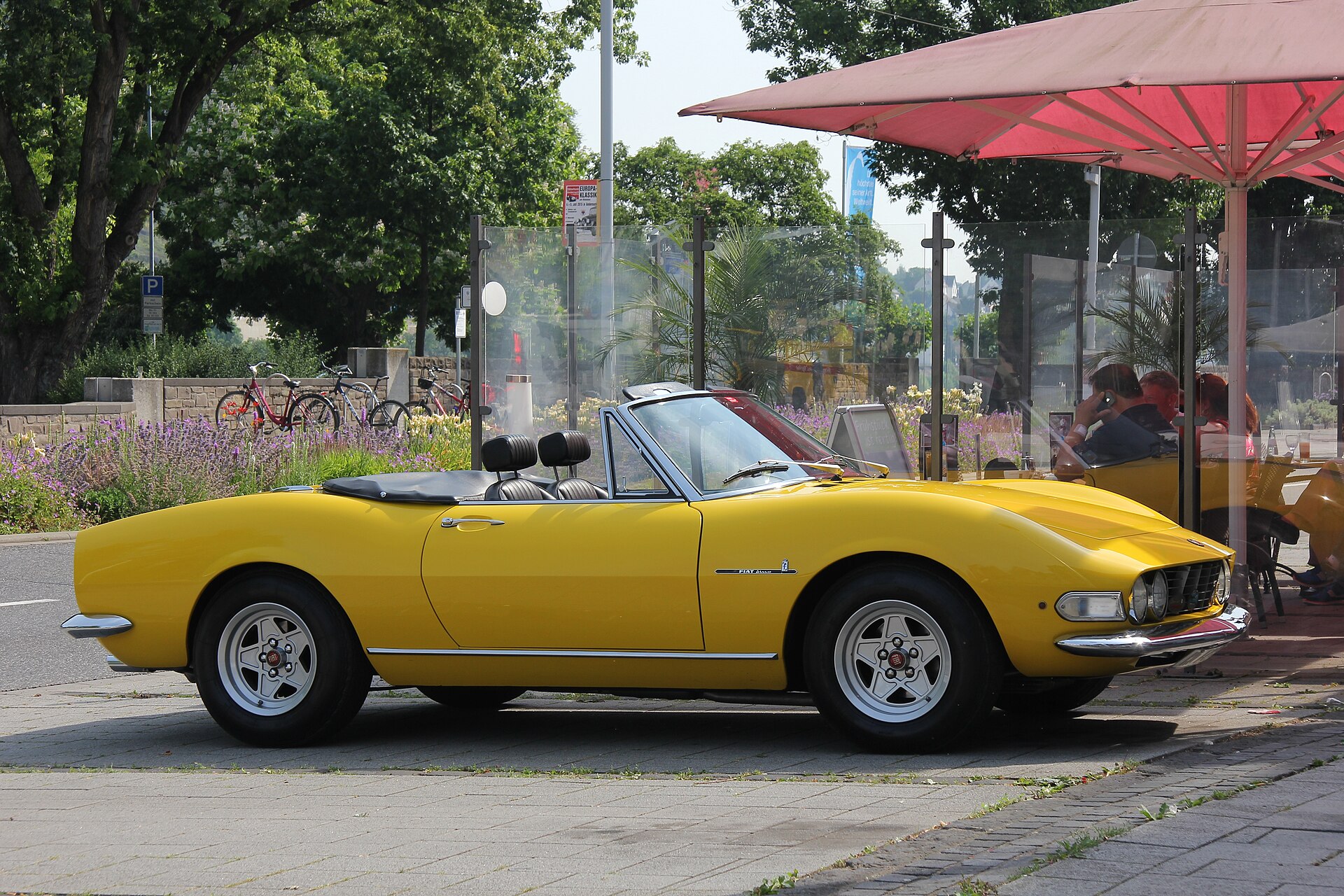
The Fiat Dino is the front-engined sports car that Fiat built from 1966 to 1973 to put Ferrari's Dino V6 into series production. The Pininfarina Spider and the longer Bertone Coupé used a 2.0-litre engine of 118 kW (160 PS) and, from 1969, a 2.4-litre of 132 kW (180 PS). Between 7,651 and 7,803 were made, and the same V6 powered the Ferrari Dino 206 GT and 246 GT.
In short
- Spider shown at the Turin Motor Show in autumn 1966, Coupé at Geneva in March 1967; production ended in 1972 or 1973 depending on the source.
- Fiat built the engine so that Ferrari could homologate its V6 for Formula 2, which required 500 road engines in 12 months.
- Production: 1,163 Spider 2.0, 3,670 Coupé 2.0, 420 Spider 2.4 and 2,398 Coupé 2.4, according to Italian Wikipedia and Hagerty.
- The 2.4 moved to Ferrari's Maranello line in December 1969 and gained independent rear suspension and a ZF gearbox.
Specs by version
Engines
| Version | Engine | Power | Torque | Gearbox | Drive | Production years |
|---|---|---|---|---|---|---|
| Dino 2000 · Dino Spider 2.0 | 2.0 l · 6 cyl · Petrol 1,987 cc | 118 kW 160 PS158 hp | 163 Nm120 lb-ft | 5-sp Manual | Rear-wheel drive | 1966–1969 |
| Dino 2000 · Dino Coupé 2.0 | 2.0 l · 6 cyl · Petrol 1,987 cc | 118 kW 160 PS158 hp | 163 Nm120 lb-ft | 5-sp Manual | Rear-wheel drive | 1967–1969 |
| Dino 2400 · Dino Spider 2400 | 2.4 l · 6 cyl · Petrol 2,418 cc | 132 kW 179 PS177 hp | 216 Nm159 lb-ft | 5-sp Manual | Rear-wheel drive | 1969–1973 |
| Dino 2400 · Dino Coupé 2400 | 2.4 l · 6 cyl · Petrol 2,418 cc | 132 kW 179 PS177 hp | 216 Nm159 lb-ft | 5-sp Manual | Rear-wheel drive | 1969–1973 |
Performance
Show all 4 versions
| Version | Top speed |
|---|---|
| Dino 2000 · Dino Spider 2.0 | 210 km/h130 mph |
| Dino 2000 · Dino Coupé 2.0 | 200 km/h124 mph |
| Dino 2400 · Dino Spider 2400 | 210 km/h130 mph |
| Dino 2400 · Dino Coupé 2400 | 205 km/h127 mph |
Dimensions and weight
Show all 4 versions
| Version | Length | Width | Wheelbase | Kerb weight |
|---|---|---|---|---|
| Dino 2000 · Dino Spider 2.0 | - | - | 2,280 mm89.8 in | 1,240 kg2,734 lb |
| Dino 2000 · Dino Coupé 2.0 | 4,507 mm177.4 in | 1,696 mm66.8 in | 2,550 mm100.4 in | 1,280 kg2,822 lb |
| Dino 2400 · Dino Spider 2400 | - | - | 2,280 mm89.8 in | - |
| Dino 2400 · Dino Coupé 2400 | 4,507 mm177.4 in | 1,696 mm66.8 in | 2,550 mm100.4 in | - |
Verified Manufacturer and type-approval data from our catalog · Sources and methodology
Fiat Dino at a glance
| Specification | Fiat Dino |
|---|---|
| Years | October 1966 to 1972/1973 |
| Production total | 7,651 (Italian Wikipedia, Hagerty US); 7,803 (English Wikipedia, Hagerty UK) |
| Plants | Rivalta near Turin (1966-1969); Ferrari, Maranello (from December 1969) |
| Body styles | two-seat-plus Spider, 2+2 Coupé |
| Design | Spider by Pininfarina; Coupé by Bertone (Giorgetto Giugiaro, finished by Marcello Gandini) |
| Layout | front engine, rear-wheel drive, limited-slip differential |
| Engines | 1,987 cc and 2,418 cc 65-degree V6, four overhead camshafts |
| Power | 118 kW (160 PS) at 7,200 rpm; 132 kW (180 PS) at 6,600 rpm |
| Kerb weight | Spider 1,150-1,240 kg; Coupé 1,270-1,380 kg |
| Top speed | Coupé 200-205 km/h; Spider 210 km/h |
| 0-97 km/h (60 mph) | 8.7 s (2400, Auto Express data) |
| Price new | about GBP 4,000 for an early Spider, according to Hagerty UK |
A Formula 2 rule that needed 500 engines
New FIA rules for Formula 2, announced in 1965 for the 1967 season, allowed engines of up to 1,600 cc and six cylinders. The catch was that the engine block had to come from a homologated road car built in at least 500 units within 12 months. Ferrari had a suitable V6 but no way to build that many road cars, so on 1 March 1965 Fiat agreed to make the engines and a car to carry them.
The engine family carried the name of Alfredo "Dino" Ferrari, Enzo Ferrari's son, who died in 1956 and who is credited with the V6 concept. Vittorio Jano is believed to have designed the original racing unit, and Aurelio Lampredi, by then at Fiat, adapted it for road use. The first 500 Spiders, chassis AS00001 to AS000500, were the homologation batch.
Fiat Dino V6 engine: 2.0 and 2.4 specs
The V6 used an unusual 65-degree bank angle, two chain-driven overhead camshafts per bank, two valves per cylinder and three twin-choke Weber carburettors. The 2.0-litre had an aluminium block with cast-iron liners and revved to 7,200 rpm. In 1968 it gained Magneti Marelli Dinoplex electronic ignition, which Wikipedia describes as the first standard electronic ignition on a production car.
| Version | Years | Displacement | Power | Torque | Top speed |
|---|---|---|---|---|---|
| Spider 2.0 | 1966-1969 | 1,987 cc | 118 kW (160 PS) | 163 Nm | 210 km/h |
| Coupé 2.0 | 1967-1969 | 1,987 cc | 118 kW (160 PS) | 163 Nm | 200 km/h |
| Spider 2400 | 1969-1972/73 | 2,418 cc | 132 kW (180 PS) | 216 Nm | 210 km/h |
| Coupé 2400 | 1969-1972/73 | 2,418 cc | 132 kW (180 PS) | 216 Nm | 205 km/h |
Torque and top speeds come from English Wikipedia; Supercar Nostalgia gives 126 lb-ft (171 Nm) for the 2.0. The engine sat up front in the Fiat and amidships in the Ferrari Dino 206 GT and 246 GT, where Ferrari quoted 132 kW (180 PS) for its 2.0, although Fiat built the engines for both makers.
Pininfarina Spider and Bertone Coupé
Fiat gave the two bodies to rival coachbuilders. Pininfarina styled the Spider and pressed its shells at Grugliasco, about 10 km from Rivalta; the car sat on a 2,280 mm wheelbase and had an aluminium boot lid. Bertone built the Coupé on a wheelbase 270 mm longer, 2,550 mm, with room for four. Giugiaro sketched it in 1963 and Gandini finished it after Giugiaro left for Ghia. The Coupé outsold the Spider by almost four to one, which is why open cars cost far more today.
The early cars had a live rear axle on leaf springs, a single leaf per side on the Spider and two on the Coupé. In February 1967 the Spider received the wood-rimmed wheel and wood trim of the Coupé. Pininfarina also built four special Dinos, including the Parigi shooting brake for the 1967 Paris show and the Ginevra berlinetta for Geneva in 1968, both designed by Paolo Martin.
The 2400 and the move to Maranello
The 2400, shown at Turin in October 1969, was a more thorough update than its name suggests. The bore grew to 92.5 mm and the stroke to 60 mm, the block changed to cast iron, and power rose to 132 kW (180 PS). A ZF five-speed gearbox with a dog-leg first gear replaced Fiat's own unit, Girling brakes were fitted, and the rear axle gave way to independent suspension with coil springs and parts from the Fiat 130. From December 1969 assembly moved to Ferrari's line at Maranello, and Hagerty notes that these Ferrari-built cars are considered the more reliable ones.
A Spider entered by the French Fiat-Abarth importer finished 18th overall at Le Mans in 1968. The 2.4-litre V6 later went into the Ferrari 246 GT and the rally-winning Lancia Stratos. Fiat built no direct successor; the wider company story is told in the history of Fiat.
Fiat Dino today: what to check when buying
Rust has claimed many Dinos, especially Spiders, says Hagerty. Auto Express lists the wings, floor, the base of the A-pillars, wheel arches, doors and jacking points; sagging sills show up as uneven door gaps. Exterior parts are scarce and expensive, although much of the switchgear came from other Fiats.
The V6 needs its valve clearances checked every 6,000 miles, and neglect speeds cam and valve wear. Sodium-filled valves on the 2.4 could break, so ask whether solid valves have been fitted. A smoky engine means worn bores and an expensive rebuild. A notchy gearshift and heavy clutch are normal, and erratic oil pressure is common. Mismatched engine and chassis numbers do not mean a swapped engine, since they rarely matched from the factory. Auto Express estimated in 2018 that about 1,100 cars survive worldwide, all left-hand drive.
Hagerty's US price guide showed USD 47,800 for a 1968 2.0 Coupé in October 2025, about EUR 41,000 at the exchange rate of the time. In November 2020 Hagerty UK reported a 1970 2400 Spider sold for USD 145,600, roughly EUR 123,000 then. Other Fiats are listed in the Fiat catalogue.
Photo gallery


Video

Fiat Dino: first vs latest generation
| Spec | Dino 2000 | Dino 2400 | Change |
|---|---|---|---|
| Years | 1966–1969 | 1969–1973 | 3 years apart |
| Most powerful version | 118 kW (160 PS) | 132 kW (179 PS) | +14 kW (+12%) |
| Length | 4,507 mm | 4,507 mm | same |
| Width | 1,696 mm | 1,696 mm | same |
| Wheelbase | 2,550 mm | 2,550 mm | same |
| Top speed | 210 km/h | 210 km/h | same |
Oldest and newest generation in the 1cars catalog. Power is the strongest version of each; other rows are shown only when both generations have the figure.
Fiat Dino in our rankings
- No. 4 of 57 · Fastest cars of the 1960s (210 km/h)
- No. 132 of 539 · Lightest cars (1,240 kg · top 25%)
- No. 13 of 48 · Longest convertibles and roadsters (4,507 mm · top 28%)
- No. 32 of 120 · Lightest coupes (1,280 kg · top 29%)
- No. 58 of 128 · Smallest coupes (4,507 mm · top 46%)
- No. 222 of 521 · Fastest cars (210 km/h · top 46%)
Faster than 91% of ranked cars of the 1960s in the 1CARS catalog (No. 4 of 57).
FAQ
Does the Fiat Dino have a Ferrari engine?
Yes, in design. The V6 came from Ferrari's Dino racing engine and was adapted by Aurelio Lampredi, but Fiat built the 2.0-litre engines at its own plant. The 2.4-litre cars were assembled on Ferrari's Maranello line from December 1969.
How many Fiat Dinos were made?
Italian Wikipedia and Hagerty give 7,651: 1,163 Spider 2.0, 3,670 Coupé 2.0, 420 Spider 2.4 and 2,398 Coupé 2.4. English Wikipedia and Hagerty UK quote 7,803, and small differences in the Spider counts appear between sources.
What is the difference between the Fiat Dino 2.0 and 2400?
The 2400 has a 2,418 cc cast-iron V6 of 132 kW (180 PS) instead of the 1,987 cc aluminium unit of 118 kW (160 PS). It also gained independent rear suspension, a ZF gearbox and stronger Girling brakes, and was assembled at Maranello.
Which Fiat Dino is the most valuable?
The 2400 Spider, of which only 420 were built. A 1970 example sold for USD 145,600 in 2020, according to Hagerty UK, while Hagerty's US guide valued a 1968 2.0 Coupé at USD 47,800 in October 2025.
Data sources
Data checked by an editor against the sources below.
- Wikipedia - Fiat Dino


