
 Saab 99
Specs, engines and history
Published Sources (3) Report an error
By Oleksandr Hnatiuk, Automotive Editor & Used Car Specialist
- Built
- 1968–1984
- Top power
- 107 kW (145 PS)
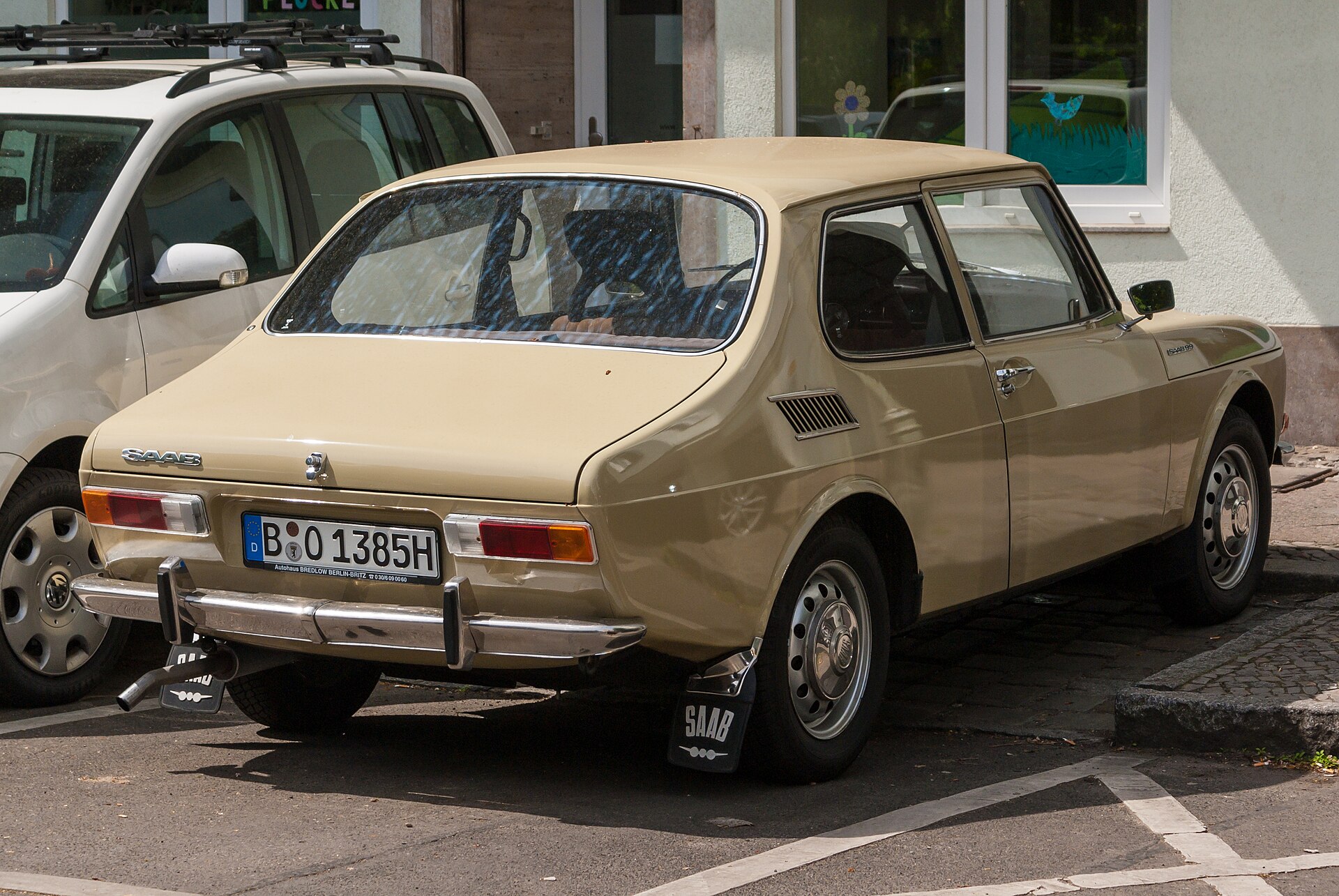
The Saab 99 is the front-wheel-drive family car that Saab built from 1968 to 1984, the start of its second generation of cars after the 92 and 96. Styled by Sixten Sason, it came as a two- and four-door saloon and as a three- and five-door Combi Coupé, with engines from 1.7 to 2.0 litres. Its 1978 Turbo version brought turbocharging to an everyday Saab.
In short
- Unveiled in Stockholm on 22 November 1967, built from autumn 1968 to 1984: 588,643 cars, or 614,003 including the Saab 90.
- Triumph-built 1.7 and 1.85 engines at first, then Saab's own 2.0 from 1972; from 59 kW (80 PS) to 107 kW (145 PS).
- The 99 Turbo of 1978-1980 (10,607 built) gave Saab the first win by a turbocharged car in a World Rally Championship event, the 1979 Swedish Rally.
- Early safety and comfort features: headlamp wipers on Swedish cars from 1970, a heated driver's seat from 1972 and 8 km/h impact bumpers in 1972.
Specs by version
Engines
| Version | Engine | Power | Drive | Production years |
|---|---|---|---|---|
| 1.7 | 1.7 l · 4 cyl · Petrol 1,709 cc | 59 kW 80 PS79 hp | Front-wheel drive | 1968–1971 |
| 1.85 | 1.9 l · 4 cyl · Petrol 1,854 cc | 63 kW 86 PS84 hp | Front-wheel drive | 1971 |
| 1.7 E | 1.7 l · 4 cyl · Petrol 1,709 cc | 64 kW 87 PS86 hp | Front-wheel drive | 1969–1971 |
| 2.0 | 2.0 l · 4 cyl · Petrol 1,985 cc | 74 kW 101 PS99 hp | Front-wheel drive | 1976 |
| 2.0 EMS | 2.0 l · 4 cyl · Petrol 1,985 cc | 81 kW 110 PS109 hp | Front-wheel drive | 1972 |
| 2.0 i | 2.0 l · 4 cyl · Petrol 1,985 cc | 87 kW 118 PS117 hp | Front-wheel drive | 1975 |
| 2.0 Turbo | 2.0 l · 4 cyl · Petrol 1,985 cc | 107 kW 145 PS143 hp | Front-wheel drive | 1978–1980 |
Performance
Show all 1 versions
| Version | 0–100 km/h | Top speed |
|---|---|---|
| 1.7 | 14.5 s 0–62 mph | 145 km/h90 mph |
Dimensions and weight
Show all 3 versions
| Version | Length | Kerb weight |
|---|---|---|
| 1.7 | 4,350 mm171.3 in | - |
| 2.0 EMS | - | 1,161 kg2,560 lb |
| 2.0 Turbo | - | 1,234 kg2,721 lb |
Verified Manufacturer and type-approval data from our catalog · Sources and methodology
Saab 99 at a glance
| Item | Saab 99 |
|---|---|
| Years | 1968-1984 (Saab 90 derivative 1984-1987) |
| Production | 588,643; 614,003 including the Saab 90 |
| Plants | Trollhättan and Arlöv (Sweden), Uusikaupunki (Finland, Saab-Valmet), Mechelen (Belgium, from 1973) |
| Body styles | 2-door saloon; 4-door from February 1970; 3-door Combi Coupé from January 1974; 5-door Combi Coupé from 1976 |
| Designer | Sixten Sason |
| Layout | longitudinal engine tilted 45 degrees with the gearbox beneath, front-wheel drive |
| Engines | 1,709 cc, 1,854 cc and 1,985 cc OHC inline-fours |
| Power | 59 kW (80 PS) to 107 kW (145 PS) |
| Length | 4,350 mm (launch car) |
| Kerb weight | 1,148-1,234 kg (EMS and Turbo versions) |
| Top speed | 145 km/h (1.7) to about 185-200 km/h (Turbo; figures vary between sources) |
| 0-100 km/h | 14.5 s (1.7) to about 9 s (Turbo) |
| Price new | just under DM 26,000 for the 99 Turbo in Germany in 1978 |
Project Gudmund: Saab's step up in size
Work on the car began on 2 April 1964 under the code name Gudmund. Saab had built small two-stroke and V4 cars since the 92, whose beginnings we cover in our Saab 92 story, and the 99 was a larger, more conventional four-cylinder car. In February 1965 Saab signed a contract with Standard-Triumph in Coventry for the engine. Sason, the company's long-time designer, died in April 1967 and did not see the production car.
The two-door was shown to the press almost a year before series production, and Saab lent dozens of cars to private drivers for everyday testing. The first production cars followed in autumn 1968, and 4,190 were built that year. The full company story, from aircraft to the end of car production, is in our Saab history.
Engineering for Swedish roads
The engine was mounted lengthwise, tilted 45 degrees, with the gearbox under it so that the unit sat close to the bulkhead. A fully synchronised four-speed gearbox with a freewheel drove the front wheels. Double wishbones located the front, and a light rigid rear axle used trailing arms, a Panhard rod and coil springs. ATE disc brakes on all four wheels worked through diagonally split circuits with a servo, and the handbrake acted on the front wheels until Girling brakes replaced the system in autumn 1974.
Safety was part of the brief. The steering column had a collapsible joint from the start, headlamp wipers were standard in Sweden from 1970, and 1972 brought an electrically heated driver's seat and plastic bumpers that took 8 km/h impacts and kept their shape. Inertia-reel seat belts followed in 1974, and the body had crumple zones front and rear.
From Triumph to Saab engines
The British-built engine proved unreliable, so Saab bought the licence, reworked it and from 1972 made its own 2.0 version, the B engine, in Södertälje. The sporty EMS of 1972 used Bosch D-Jetronic injection; from 1975 K-Jetronic took over.
| Engine | From | Displacement | Power |
|---|---|---|---|
| 1.7 carburettor (Triumph) | 1968 | 1,709 cc | 59 kW (80 PS) |
| 1.7 E, fuel injection | 1969 | 1,709 cc | 64 kW (87 PS) |
| 1.85 carburettor | 1971 | 1,854 cc | 63 kW (86 PS) |
| 1.85 fuel injection | 1971 | 1,854 cc | 70 kW (95 PS) |
| 2.0 EMS, D-Jetronic | 1972 | 1,985 cc | 81 kW (110 PS) |
| 2.0 carburettor | 1976 | 1,985 cc | 74 kW (100 PS) |
| 2.0 twin carburettors | 1976 | 1,985 cc | 79 kW (108 PS) |
| 2.0 fuel injection, K-Jetronic | 1975 | 1,985 cc | 87 kW (118 PS) |
| 2.0 Turbo | 1978 | 1,985 cc | 107 kW (145 PS) |
The 1.7 E from autumn 1969 could be ordered with a three-speed Borg-Warner automatic. The original 1.7 reached 145 km/h, took 14.5 seconds to 100 km/h and used about 9 l/100 km; the EMS reached about 170 km/h.
Combi Coupé and the 99 Turbo
For 1974 Saab added the Combi Coupé, with a longer rear overhang and a lifting tailgate: 1.84 m of load length and 1.5 cubic metres of space. A five-door version appeared at Geneva in March 1976, and the 1977 cars gained larger indicators and a new dashboard.
The Turbo was shown at Frankfurt in September 1977. About 100 pre-series cars were built that year and sales began in January 1978. A Garrett turbocharger, Bosch injection and a 7.2:1 compression ratio lifted the 2.0 to 107 kW (145 PS) and 235 Nm, with boost from about 1,500 rpm. A four-speed gearbox was fitted at first and a five-speed from 1980; production ran to 10,607 cars by 1980. Autocar timed the three-door at 8.9 seconds from 0 to 60 mph and noted torque steer and heavy steering at parking speed, while Motor praised its roadholding and stability in 1980.
In 1979 Stig Blomqvist won the Swedish Rally in a works three-door Turbo, beating Björn Waldegård's Escort. Motor Sport called it "a win for the first time by a turbocharged car".
How the 99 ended
The Saab 900, built on the 99's structure with a longer nose, went into production at Trollhättan in summer 1978. The 99 saloons continued at Arlöv and Uusikaupunki, and from summer 1982 only the two-door 99 GL remained. In spring 1984 the Saab 90 replaced it: the 99's body with the rear of the 900, 4.58 m long, a 2.0 engine with 74 kW (100 PS) and a five-speed gearbox. About 25,000 were built until 1987. The story of Sweden's other car maker of the period is in our history of Volvo.
Saab 99 today: what to check when buying
Auto Bild names rust on the wheel arches, sills and the bottoms of the doors as the main body problems, along with a headlining that comes adrift. Gearboxes can become noisy. On a Turbo, the turbocharger suffers if the engine is switched off straight after hard driving without idling to cool, so ask how the car was used. Mechanical parts such as turbos, brakes and suspension are easy to find; body panels and trim for early cars are harder, and Auto Bild suggests searching in Sweden, the Netherlands and Denmark. Early Triumph-engined cars carry the reliability record that pushed Saab to build its own engine.
The Turbo is the most valuable 99. Hagerty UK quoted in July 2022 about EUR 10,000 (GBP 8,500) for a good 99 Turbo, about EUR 16,500 (GBP 14,000) for a very well presented car and more than EUR 23,600 (GBP 20,000) for concours examples. The car is listed in our Saab catalogue, and more European cars of the period are in our classic cars section.
Photo gallery

Saab 99 in our rankings
- No. 79 of 418 · Lightest cars (1,161 kg · top 19%)
- No. 23 of 117 · Smallest sedans (4,350 mm · top 20%)
- No. 279 of 1142 · Longest-running car nameplates (16 years · top 26%)
- No. 20 of 74 · Lightest sedans (1,161 kg · top 28%)
- No. 32 of 98 · Longest hatchbacks (4,350 mm · top 33%)
- No. 183 of 558 · Smallest cars (4,350 mm · top 33%)
Lighter than 81% of ranked cars in the 1CARS catalog (No. 79 of 418).
FAQ
How many Saab 99s were built?
Saab built 588,643 cars of the 99 between 1968 and 1984. Counting the Saab 90, the two-door derivative built until 1987, the total rises to 614,003. Of these, 10,607 were 99 Turbos.
Who designed the Saab 99?
Sixten Sason, Saab's long-standing industrial designer, styled the 99. He died in April 1967, months before the car was unveiled in Stockholm on 22 November 1967 and more than a year before production began.
Was the Saab 99 Turbo the first turbocharged car?
No. It was one of the first turbocharged cars sold as an affordable family model, with 107 kW (145 PS), and in 1979 it became the first turbocharged car to win a World Rally Championship event, the Swedish Rally.
What engines did the Saab 99 use?
At first a 1.7-litre four-cylinder built by Triumph, then a 1.85. From 1972 Saab used its own 1,985 cc B engine with carburettors, fuel injection or, from 1978, a turbocharger, covering 59 kW (80 PS) to 107 kW (145 PS).
Data sources
Data checked by an editor against the sources below.
- Wikipedia - Saab 99
- Automobilrevue - Saab 99 Moderni A Bezpecny 40940
- Autobild - Saab 99 Turbo 912314


