
 Saab 900
Specs, engines and history
Published Sources (1) Report an error
By Oleksandr Hnatiuk, Automotive Editor & Used Car Specialist
- Built
- 1978–1993
- Top power
- 129 kW (175 PS)
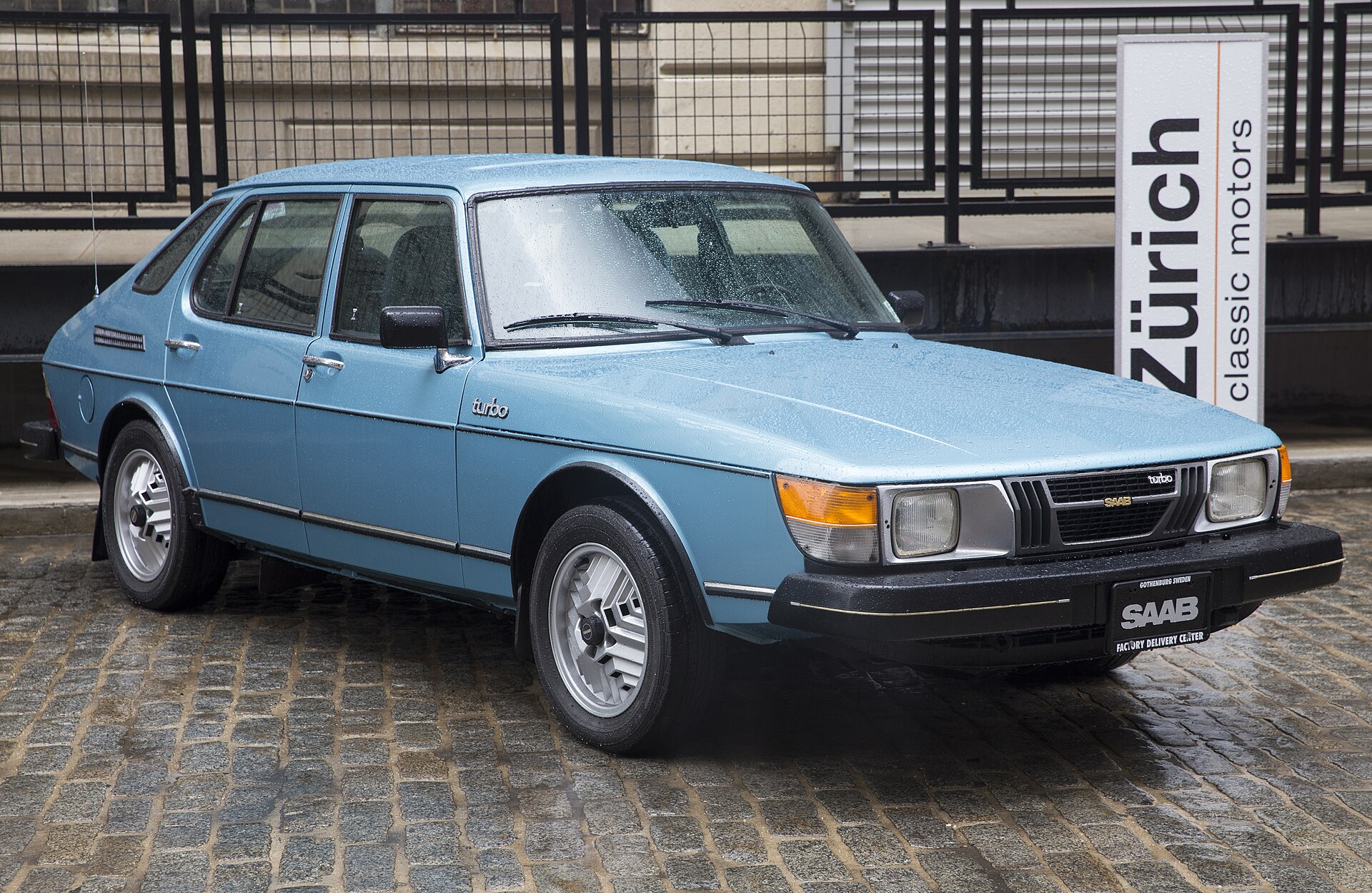
The classic Saab 900 is the front-wheel-drive car that Saab built from 1978 to 1993 by giving the 99 a longer front end and a new interior. It came as a three- and five-door hatchback, a two- and four-door saloon and, from 1986, a convertible, with 2.0 and 2.1-litre four-cylinders and the turbocharged versions that came to define the brand. In all, 908,817 were built.
In short
- Presented on 12 May 1978 for the 1979 model year; the last classic hatchbacks and saloons were built on 26 March 1993, with the convertible continuing for the 1994 model year.
- 908,817 built, including 48,888 convertibles; Hagerty counts 202,284 first-generation Turbos.
- Turbo from launch with 107 kW (145 PS), APC knock control from 1982 and the 16-valve Turbo 16 with 129 kW (175 PS) from 1984.
- Replaced in 1994 by a new 900 on GM's GM2900 platform, shared with the Opel Vectra.
Specs by version
Engines
| Version | Engine | Power | Drive | Production years |
|---|---|---|---|---|
| 2.0 GL | 2.0 l · 4 cyl · Petrol 1,985 cc | 74 kW 101 PS99 hp | Front-wheel drive | 1979 |
| 2.0 i | 2.0 l · 4 cyl · Petrol 1,985 cc | 87 kW 118 PS117 hp | Front-wheel drive | 1979 |
| 2.1 i 16V | 4 cyl · Petrol | 103 kW 140 PS138 hp | Front-wheel drive | 1991–1993 |
| 2.0 Turbo | 2.0 l · 4 cyl · Petrol 1,985 cc | 107 kW 145 PS143 hp | Front-wheel drive | 1979 |
| 2.0 Turbo LPT | 2.0 l · 4 cyl · Petrol 1,985 cc | 107 kW 145 PS143 hp | Front-wheel drive | 1990–1993 |
| 2.0 Turbo 8V intercooler | 2.0 l · 4 cyl · Petrol 1,985 cc | 114 kW 155 PS153 hp | Front-wheel drive | 1986 |
| 2.0 Turbo 16 | 2.0 l · 4 cyl · Petrol 1,985 cc | 129 kW 175 PS173 hp | Front-wheel drive | 1984–1993 |
Performance
Show all 3 versions
| Version | 0–100 km/h | Top speed |
|---|---|---|
| 2.0 i | 11.4 s 0–62 mph | 175 km/h109 mph |
| 2.0 Turbo | 9.5 s 0–62 mph | 202 km/h126 mph |
| 2.0 Turbo 16 | 8.5 s 0–62 mph | 217 km/h135 mph |
Dimensions and weight
Show all 1 versions
| Version | Length |
|---|---|
| 2.0 Turbo | 4,685 mm184.4 in |
Verified Manufacturer and type-approval data from our catalog · Sources and methodology
Saab 900 at a glance
| Item | Saab 900 (classic) |
|---|---|
| Years | 1978-1993 (convertible 1986-1993, plus 1994 model-year cars) |
| Production | 908,817, including 48,888 convertibles |
| Plants | Trollhättan and Arlöv (Sweden); Valmet, Uusikaupunki (Finland), which built 238,898 cars |
| Body styles | 3- and 5-door hatchback; 4-door saloon from 1981; 2-door saloon from January 1984; convertible from 1986 |
| Design | Björn Envall, head of design at Trollhättan |
| Layout | longitudinal engine, front-wheel drive, structure of the 99 with a longer nose |
| Engines | 2.0 eight- and 16-valve, naturally aspirated and turbocharged; 2.1 16-valve from 1991 |
| Power | 74 kW (100 PS) to 129 kW (175 PS); UK Carlsson 138 kW (185 bhp) |
| Length | 4,685 mm (hatchback); 4,940 mm (long-wheelbase CD) |
| Kerb weight | 1,344 kg (Turbo 16 four-door) |
| Top speed | 175 km/h (900i) to 217 km/h (Turbo 16 S) |
| 0-100 km/h | 11.4 s (900i) to 8.5 s (Turbo 16 S) |
| Price new | DM 30,000 for the top Turbo in Germany in 1979 |
Why Saab lengthened the 99
Instead of an all-new design, the 900 kept the 99's structure and added a longer front with more room for crumple zones. It grew slightly in every direction except height, and Björn Envall's team gave it a new nose and dashboard; Classic Car Weekly still praises its driving position, control layout and long-distance seats. Production began at Trollhättan in summer 1978, while the 99 carried on at other plants. The 900 kept the front-wheel drive that Saab had used since its first car, the 92 of 1947, and it was the last Saab developed entirely in Sweden; the 9000 of 1984 shared a platform with Fiat. Saab's path from aircraft to cars is told in our Saab history.
Engines and the turbo programme
At launch Europe had four versions: the GL with a single carburettor, the twin-carburettor GLs, the fuel-injected EMS and GLE, and the Turbo with a Garrett turbocharger. The B engine gave way to the lighter H engine from the early 1980s, and in 1982 Saab added Automatic Performance Control (APC). Its knock sensor let the engine adjust boost to fuel quality, so Turbos could run on different octane grades.
| Engine | From | Power |
|---|---|---|
| 2.0 single carburettor (GL) | 1979 | 74 kW (100 PS) |
| 2.0 twin carburettors (GLs) | 1979 | 79 kW (108 PS) |
| 2.0 injection (EMS, GLE, 900i) | 1979 | 87 kW (118 PS) |
| 2.0 Turbo, eight valves | 1979 | 107 kW (145 PS) |
| 2.0 Turbo 16, 16 valves | 1984 | 129 kW (175 PS) |
| 2.0 Turbo, eight valves, intercooler | 1986 | 114 kW (155 PS) |
| 2.0 low-pressure turbo | 1990 | 107 kW (145 PS) |
| 2.1 injection, 16 valves (B212) | 1991 | 103 kW (140 PS) |
The Turbo 16 of 1984 brought one of the first mass-produced 16-valve turbo engines. Wikipedia gives 9.5 seconds from 0 to 100 km/h and 202 km/h for the eight-valve Turbo, and 8.5 seconds and 217 km/h for the Turbo 16 S; Auto Bild measured 8.7 seconds and 210 km/h for the 16 S, so figures vary between sources. In 1979 the German Turbo was the most expensive four-cylinder car on sale there. US cars of 1979 used lower ratings: 86 kW (115 hp) for the injection model and 101 kW (135 hp) for the Turbo.
Saloons and the convertible
A four-door saloon joined the hatchbacks for 1981, and a two-door saloon, built only by Valmet, followed in January 1984. The 1987 facelift brought the sloping "slant front" nose.
The convertible came from the US. Robert Sinclair, head of Saab in America from 1979, asked for one, and the American Sunroof Company engineered the roof mechanism using many Buick parts. A prototype stood on the Saab stand at Frankfurt, and the first production cars reached customers in 1986. Valmet in Finland built them, the first 400 went to the US, and by 1986 buyers faced a 12-month wait. In 1988 Saab made 288 SiS convertibles, one for each American dealer, and the classic convertible outlived the hatchback by a year.

Aero, Carlsson and other special 900s
The 1984 Turbo 16 S, sold as the Aero in Europe, the SPG in North America and the T16S in the UK, added a body kit to the 16-valve engine; 7,625 SPGs went to North America over six years. Auto Bild put its German price at DM 43,500, DM 5,000 more than the standard top Turbo of its time. Britain had two exclusive models: the Carlsson of 1990-1992 with 138 kW (185 bhp) and the Ruby, 150 cars with the Carlsson engine. The long-wheelbase CD, built in Finland, was 200 mm longer than the standard car. The US Commemorative Edition closed the run with 314 Turbo hatchbacks in 1993 and 500 Turbo convertibles in 1994.

The 1994 900 and the end of the classic
The classic 900 ended on 26 March 1993. Its successor, also called 900, arrived for 1994 on GM's GM2900 platform shared with the Opel Vectra, with a transverse engine, and was renamed the Saab 9-3 in 1998.
Saab 900 today: what to check when buying
Hagerty UK lists the areas to inspect: door bottoms, the fuel filler, sunroof drain channels, the battery tray, the front bulkhead, the windscreen surround, the underside of the fuel tank, the rear crossmember, jacking points and suspension mounts. Classics World adds inner and outer sills, floorpans, front chassis rails, wishbone mounts and the boot floor, and warns that the Turbo 16 S side cladding can hide corrosion.
Blue smoke at start-up points to a worn turbo, and a failing APC unit causes rough running. Exhaust manifolds crack and studs break, neglected engines blow head gaskets, and the timing chain needs replacing at about 125,000 miles (200,000 km). The manual gearbox is the weak link on hard-driven Turbos: listen for layshaft-bearing noise and watch for it jumping out of third or fourth. On a convertible, check that the electric hood works and that water stays out; Hagerty puts a new hood at about GBP 1,200.
| Model | Price guide (Hagerty UK, July 2022) |
|---|---|
| Early 900 Turbo, very clean original car | about EUR 5,900-10,600 (GBP 5,000-9,000) |
| Turbo 16 S | about EUR 7,100 (GBP 6,000) usable; EUR 11,800-14,200 (GBP 10,000-12,000) for the best |
| Convertible | about EUR 2,400 (GBP 2,000) more than a three-door |
| Carlsson or Ruby, immaculate | about EUR 23,600 (GBP 20,000) |
More Saabs are in our Saab catalogue, and other European cars of the era in our classic cars section.
Saab 900 in our rankings
- No. 8 of 16 · Quickest cars of the 1970s, 0–100 (9.5 s)
- No. 9 of 24 · Fastest cars of the 1970s (202 km/h)
- No. 12 of 96 · Longest hatchbacks (4,685 mm · top 13%)
- No. 19 of 74 · Fastest hatchbacks (217 km/h · top 26%)
- No. 290 of 1124 · Longest-running car nameplates (15 years · top 28%)
- No. 36 of 95 · Biggest engines: hatchbacks (1,985 cc · top 38%)
Longer than 87% of ranked hatchbacks in the 1CARS catalog (No. 12 of 96).
FAQ
How many classic Saab 900s were built?
Saab built 908,817 classic 900s between 1978 and 1993, including 48,888 convertibles. Hagerty counts 202,284 first-generation Turbos among them, around 50,000 of which were convertibles.
What is the difference between the classic 900 and the 1994 900?
The classic 900 of 1978-1993 was Saab's own design, built on the 99's structure with a longitudinal engine. The 1994 car used GM's GM2900 platform, shared with the Opel Vectra, with a transverse engine, and became the 9-3 in 1998.
Which classic Saab 900 is the fastest?
Among regular models, the 16-valve Turbo 16 S (Aero, SPG or T16S) with 129 kW (175 PS) reached up to 217 km/h. The UK-only Carlsson of 1990-1992 had more power, 138 kW (185 bhp).
When did the Saab 900 convertible appear?
The first production convertibles reached customers in 1986. Built by Valmet in Finland, the classic convertible stayed in production after the hatchback ended in March 1993 and was sold as a 1994 model.
Data sources
Data checked by an editor against the sources below.
- Wikipedia - Saab 900


