
 Saab 96
All generations, specs and history
Published Sources (3) Report an error
By Oleksandr Hnatiuk, Automotive Editor & Used Car Specialist
- Built
- 1960–1980
- Generations
- 2
- Top power
- 50 kW (68 PS)
Timeline
96 generations
Click a generation for its own page

two-stroke and V4 overlapped in 1966–1968, so V4 sits on a second lane
- 96 two-stroke 1960–1968 · Sedan · 28–38 kW (38–52 PS)
- 96 V4 1966–1980 · Sedan · 46–50 kW (63–68 PS)
Newest first · 2 generations since 1960
- 1966 V4 1966–1980 · Sedan · 46–50 kW (63–68 PS) two-stroke and V4 overlapped in 1966–1968
-
1960
All generations by year: 96 V4 (1966–1980) · 96 two-stroke (1960–1968)
Which one is mine?
Pick the year of first registration to see which generation it is.
- 96 V4 1966–1980
- 96 two-stroke 1960–1968
The Saab 96 is the two-door front-wheel-drive saloon that Saab unveiled on 17 February 1960 and built until January 1980. It began with an 841 cc three-cylinder two-stroke engine, switched to Ford's 1.5-litre V4 from the 1967 model year, and won the Monte Carlo Rally twice with Erik Carlsson. Saab and Valmet built 547,221 of them in Sweden and Finland.
In short
- Built 1960-1980 at Trollhättan (Sweden) and Uusikaupunki (Finland); 547,221 cars.
- Two-stroke three-cylinder of 841 cc with 28-38 kW (38-52 PS), then a 1,498 cc Ford V4 with 46-50 kW (62-68 PS).
- Erik Carlsson won the RAC Rally in 1960, 1961 and 1962 and the Monte Carlo Rally in 1962 and 1963.
- Freewheel and column gearchange kept until the end; replaced in stages by the Saab 99 and Saab 900.
Specs by version
Engines
| Version | Engine | Power | Torque | Drive | Production years |
|---|---|---|---|---|---|
| 96 two-stroke · 841 two-stroke 38 PS | 0.8 l · 3 cyl · Petrol 841 cc | 28 kW 38 PS38 hp | 79 Nm58 lb-ft | Front-wheel drive | 1960–1964 |
| 96 two-stroke · 841 two-stroke 42 PS | 0.8 l · 3 cyl · Petrol 841 cc | 31 kW 42 PS42 hp | - | Front-wheel drive | 1966–1968 |
| 96 two-stroke · Sport / Monte Carlo 841 | 0.8 l · 3 cyl · Petrol 841 cc | 38 kW 52 PS51 hp | - | Front-wheel drive | 1962–1968 |
| 96 V4 · 1.5 V4 62 PS (Sweden) | 1.5 l · 4 cyl · Petrol 1,498 cc | 46 kW 63 PS62 hp | - | Front-wheel drive | 1976 |
| 96 V4 · 1.5 V4 65 PS | 1.5 l · 4 cyl · Petrol 1,498 cc | 48 kW 65 PS64 hp | 115 Nm85 lb-ft | Front-wheel drive | 1967–1976 |
| 96 V4 · 1.5 V4 Super 68 PS | 1.5 l · 4 cyl · Petrol 1,498 cc | 50 kW 68 PS67 hp | - | Front-wheel drive | 1977–1980 |
Performance
Show all 1 versions
| Version | 0–100 km/h | Top speed |
|---|---|---|
| 96 V4 · 1.5 V4 65 PS | 19.0 s 0–62 mph | 149 km/h93 mph |
Dimensions and weight
Show all 2 versions
| Version | Kerb weight |
|---|---|
| 96 two-stroke · 841 two-stroke 38 PS | 813 kg1,792 lb |
| 96 V4 · 1.5 V4 65 PS | 930 kg2,050 lb |
Verified Manufacturer and type-approval data from our catalog · Sources and methodology
Saab 96 at a glance
| Item | Saab 96 |
|---|---|
| Years | February 1960 to January 1980 |
| Production | 547,221 |
| Plants | Trollhättan (Sweden), Saab-Valmet at Uusikaupunki (Finland) |
| Body style | 2-door saloon; Saab 95 estate as sister model |
| Designer | Sixten Sason (body based on the Saab 92/93) |
| Layout | longitudinal engine ahead of the gearbox, front-wheel drive |
| Engines | 841 cc two-stroke three-cylinder; 1,498 cc Ford V4 (1.7 for the US from 1971) |
| Power | 28 kW (38 PS) to 50 kW (68 PS) |
| Weight | 873-950 kg |
| Top speed | 149 km/h (V4, Auto Bild Klassik) |
| 0-100 km/h | 16-19 s for the V4, figures vary between sources |
| Price new | DM 13,800 in Germany in 1976 (V4) |
The 96 is part of the Saab story told in our Saab history, and the brand's later models are in our Saab catalogue.
From the 92 to the 96: Sixten Sason's shape grows up
The 96 grew out of the first Saab, the 92 of 1947, whose aircraft-inspired shape is covered in our article on how Saab built its first car. Developed internally as project 93C, the 96 kept Sixten Sason's rounded fastback profile and the front-drive engineering of the 93 it replaced. Saab presented it to the press in Stockholm on 17 February 1960, and the 96 and the new 95 estate were shown in Britain at the London Motor Show the same year.
The layout explains the car's reputation in snow. The three-cylinder engine sat ahead of the gearbox and drove the front wheels, which put most of the weight over the driven wheels. Saab used high-quality steel and built the body to survive Swedish roads, and the gear lever stayed on the steering column for the car's whole life.
Two-stroke years, 1960-1968
The first 96 used an 841 cc three-cylinder two-stroke with 28 kW (38 PS), rising to 29 kW (40 PS) by 1965 and 31 kW (42 PS) in 1966 with a three-throat Solex carburettor. A two-stroke needs oil mixed into the fuel, and it gave the car its high-revving sound. Saabplanet's period figures give 0-60 mph in 25.6 seconds and a kerb weight of 813 kg for an early car.
The sporting model appeared in 1962 as the 96 Sport, with triple carburettors and separate oil injection, and was renamed Monte Carlo in 1966 to celebrate Carlsson's wins. It produced 38 kW (52 PS). Seat belts were fitted from 1962 and dual-circuit brakes from 1964. In 1965 the front end was lengthened, losing the original bullnose, and in 1966 a four-speed gearbox became standard in place of the three-speed with its unsynchronised first gear.

The Ford V4 and the long middle age
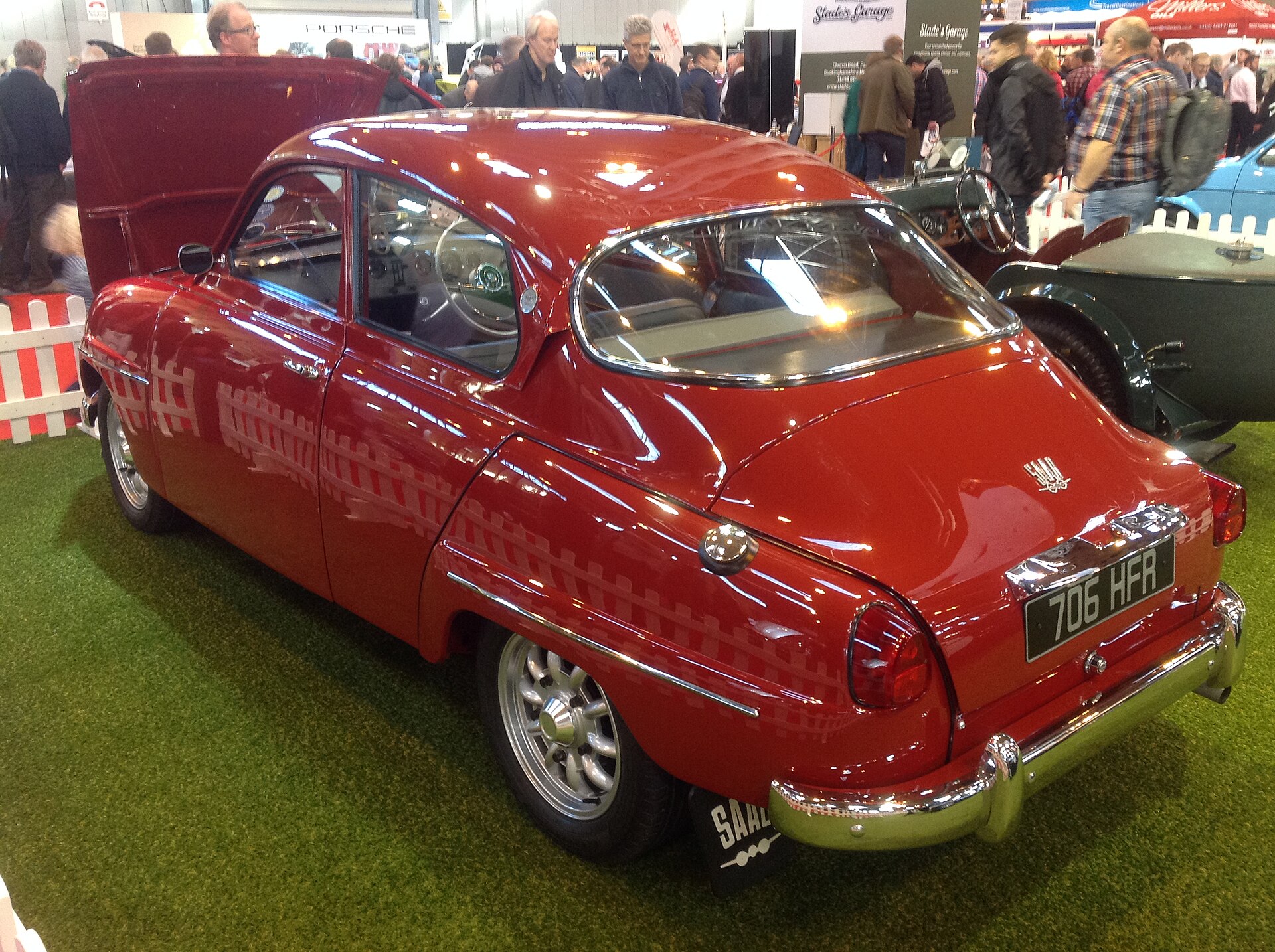
Tightening emissions rules were closing in on two-stroke engines, and Saab found its answer at Ford of Germany. From August 1966, for the 1967 model year, the 96 was offered with the 1,498 cc Taunus V4. The four-stroke made 48 kW (65 PS) and much more low-down torque, and the V4 and two-stroke were sold side by side until 1968. Front disc brakes arrived in 1967, the windows grew in 1968, a brake servo became standard in 1969 and a new dashboard followed in 1970.
| Engine | Displacement | Power | Years |
|---|---|---|---|
| Two-stroke three-cylinder | 841 cc | 28 kW (38 PS) | 1960-1964 |
| Two-stroke three-cylinder | 841 cc | 29-31 kW (40-42 PS) | 1965-1968 |
| Sport / Monte Carlo two-stroke | 841 cc | 38 kW (52 PS) | 1962-1968 |
| Ford V4 | 1,498 cc | 48 kW (65 PS) | 1967-1976 |
| Ford V4, Swedish emissions spec | 1,498 cc | 46 kW (62 PS) | 1976 |
| Ford V4 "Super" | 1,498 cc | 50 kW (68 PS) | 1977-1980 |
| Ford V4, US market | 1.7 litres | 48 kW (65 hp) | 1971-1972 |
The V4 kept the freewheel, which let the engine idle on the overrun and allowed clutchless gear changes. In 1972 Saab claimed a first for the 96 with factory-fitted electrically heated seats, and in August 1975 impact-absorbing bumpers similar to those of the 99 appeared, while the rear seat moved 5 cm backwards. Saab stopped importing the 96 to the UK in 1976 and marked the end with 150 metallic burgundy Souvenir cars. From the 1979 model year production moved to Valmet in Finland, where the last 96 was built in January 1980. Other European saloons that shared its long career are gathered in our classic cars section.
Erik Carlsson and the rally record
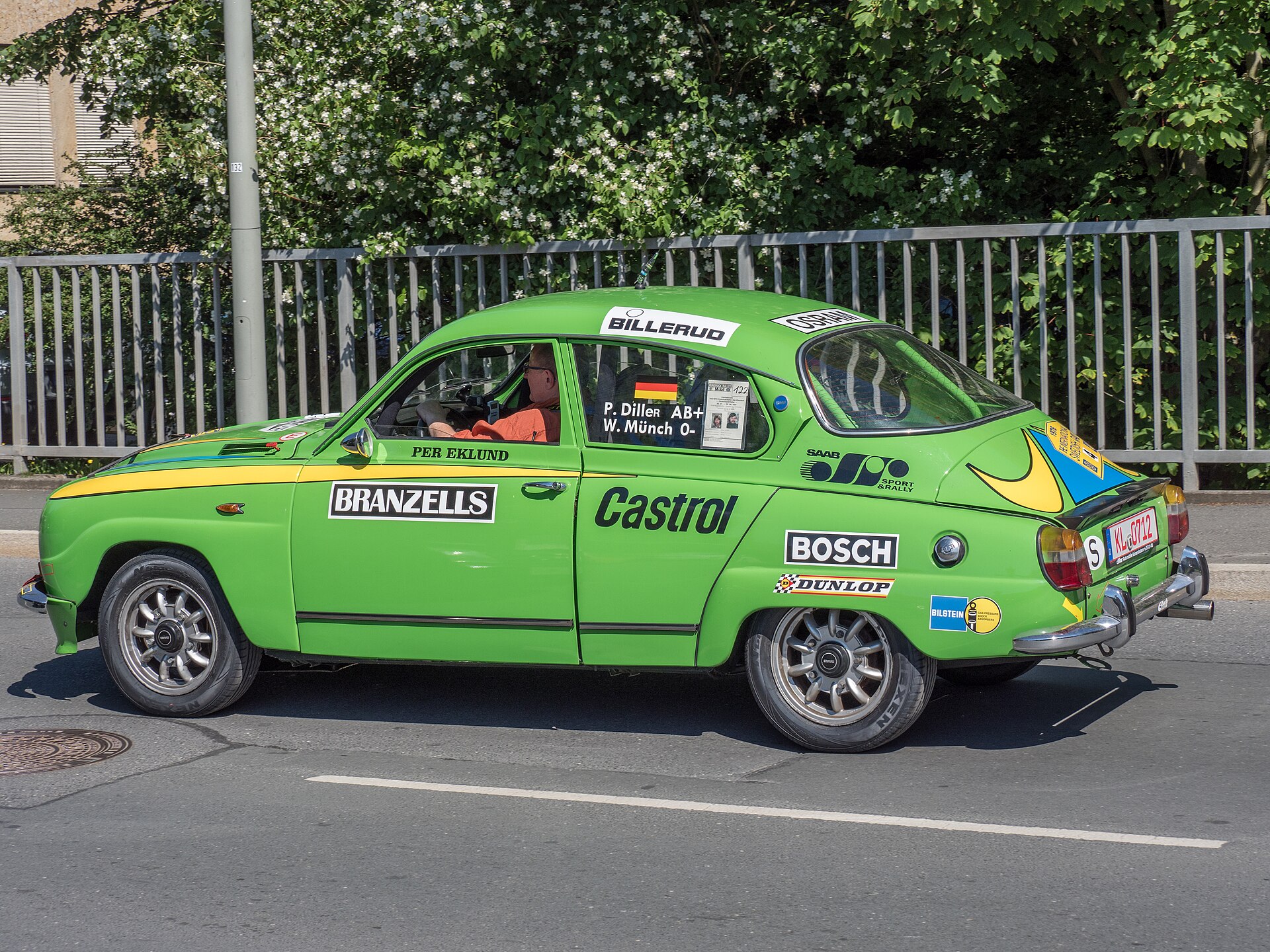
The 96 made Saab's name in motorsport. Erik Carlsson won the RAC Rally three times in a row from 1960 to 1962 and the Monte Carlo Rally in 1962 and 1963, and he finished second on the 1964 East African Safari. With the V4, Stig Blomqvist and co-driver Arne Hertz won the Swedish Rally in 1972 and 1973, and Per Eklund won it again in 1976. Long after production, a 1966 two-stroke 96 driven by Alex LaFortune set a Bonneville record of 110.113 mph (177.2 km/h) on 16 August 2011 in the class for stock-bodied production cars with 750 cc engines. The 96 is among the cars in our best classic cars of the 1960s.

Saab 96 today: what to check when buying
Rust is the main enemy, even on a car built from good steel. Hagerty UK lists the outer panels, the areas around the front and rear screen frames, the passenger and boot floors, the front bulkhead behind blocked drain holes, the rear inner wheelarches, the suspension mounts and the front valance. Auto Bild Klassik adds the door bottoms, the driver's floor and the seams between body and wings, and notes that rust protection was only average, especially on cars from 1977.
The two-stroke has just seven moving parts, but it needs the correct fuel and oil mixture and rusts inside when laid up for years, and its parts are harder to find than V4 parts. On the V4, a rumble from the bottom end means worn main bearings, and the fibre balance shaft gear can strip from around 50,000 miles; steel replacements exist. Auto Express expects a V4 rebuild at around 100,000 miles. Many owners replace the poor original carburettor with a Weber. A failing freewheel announces itself with a whirring noise, early three-speed gearboxes want oil every 6,000 miles, and post-1974 cars have a stronger gearbox.
Values from Hagerty UK, November 2023 (GBP converted at about 1.17):
- Two-stroke: about EUR 7,000 (GBP 6,000) for a clean, usable car and about EUR 12,900 (GBP 11,000) in excellent show condition.
- V4: about EUR 7,600 (GBP 6,500) for a car ready for regular use and about EUR 14,000 (GBP 12,000) for an immaculate one.
- Sport and Monte Carlo models sell for significantly more; the 95 estate carries no premium over the saloon.

Saab 96: first vs latest generation
| Spec | 96 two-stroke | 96 V4 | Change |
|---|---|---|---|
| Years | 1960–1968 | 1966–1980 | 6 years apart |
| Most powerful version | 38 kW (52 PS) | 50 kW (68 PS) | +12 kW (+32%) |
| Lightest kerb weight | 813 kg | 930 kg | +117 kg |
Oldest and newest generation in the 1cars catalog. Power is the strongest version of each; other rows are shown only when both generations have the figure.
Saab 96 in our rankings
- No. 2 of 65 · Lightest sedans (813 kg)
- No. 7 of 399 · Lightest cars (813 kg)
- No. 186 of 1116 · Longest-running car nameplates (20 years · top 18%)
- No. 12 of 19 · Fastest cars of the 1960s (149 km/h · top 64%)
- No. 59 of 69 · Fastest sedans (149 km/h · top 86%)
- No. 57 of 64 · Power-to-weight: sedans (52 kW/t · top 90%)
Lighter than 98% of ranked cars in the 1CARS catalog (No. 7 of 399).
FAQ
How many Saab 96s were made?
Saab built 547,221 cars of the 96 between 1960 and January 1980, according to Wikipedia and Saabplanet. Hagerty UK gives a much lower figure of about 329,000, so totals vary between sources; the Saab 95 estate is counted separately.
When did the Saab 96 get the V4 engine?
The Ford Taunus V4 of 1,498 cc became available in August 1966 for the 1967 model year, with 48 kW (65 PS). The two-stroke stayed on sale alongside it until 1968 and was then dropped.
Why does the Saab 96 have a freewheel?
The freewheel protected the two-stroke engine, which relied on oil mixed into the fuel and could seize when coasting downhill on a closed throttle. Saab kept it on the V4, where it also allowed gear changes without the clutch.
What replaced the Saab 96?
The Saab 99, launched in 1967, took over as Saab's main model, and the 900 followed in 1978. The 96 stayed in production beside them until January 1980, with the final cars built by Valmet in Finland.
Data sources
Data checked by an editor against the sources below.
- Wikipedia - Saab 96
- Autobild - Saab 96 V4 1570751
- Saabplanet - Celebrating 60 Years Of An Icon Saab 96


