 Saab 9-5
All generations, specs and history
Published Sources (5) Report an error
By Felix Hartmann, Automotive Technology & EV Contributor
- Built
- 1997–2012
- Generations
- 2 · YS3E to YS3G
Timeline
9-5 generations
Click a generation for its own page
Newest first · 2 generations since 1997


All generations by year: 9-5 YS3G (2010–2011) · 9-5 YS3E (1997–2010)
Which one is mine?
Pick the year of first registration to see which generation it is.
Check by VINThe Saab 9-5 is an executive car from the Swedish brand Saab, launched in 1997 as the replacement for the Saab 9000. It was the brand's flagship, positioned just above the Saab 9-3, and it competed with the Volvo S80 and the leading German executive cars of its time, such as the Mercedes-Benz E-Class (W210), BMW 5 Series (E39) and Audi A6. Two generations were built before Saab's financial collapse.
In short
- First generation 1997–2010, offered as a saloon and as the SportCombi estate; 483,593 were built.
- The second generation was revealed at the Frankfurt motor show on 15 September 2009 and built only from 2010 to 2011 — just 11,280 cars.
- The most powerful first-generation versions, called Aero, had up to 191 kW (260 PS); the second generation's top engine was a 221 kW (300 PS) 2.8 V6 turbo with XWD all-wheel drive.
- Saab touches include the Night Panel button and the ignition switch between the front seats.
Specs by version
Engines
| Version | Engine | Gearbox | Drive | Production years |
|---|---|---|---|---|
| YS3E · 1997–2010 | ||||
| YS3E · 2.3 L 4 cyl Automatic (S5) · 2006 (EPA) | 2.3 l · 4 cyl 2,300 cc | 5-sp Automatic | Front-wheel drive | 2006 |
| YS3E · 2.3 L 4 cyl Manual 5-spd · 2006 (EPA) | 2.3 l · 4 cyl 2,300 cc | 5-sp Manual | Front-wheel drive | 2006 |
| YS3E · 2.3 L 4 cyl Automatic (S5) · 2005 (EPA) | 2.3 l · 4 cyl 2,300 cc | 5-sp Automatic | Front-wheel drive | 2005 |
| YS3E · 2.3 L 4 cyl Manual 5-spd · 2005 (EPA) | 2.3 l · 4 cyl 2,300 cc | 5-sp Manual | Front-wheel drive | 2005 |
Performance
Show all 4 versions
| Version | Fuel consumption |
|---|---|
| YS3E · 1997–2010 | |
| YS3E · 2.3 L 4 cyl Automatic (S5) · 2006 (EPA) | 11.8 l/100 km19.9 mpg US · 23.9 mpg UK |
| YS3E · 2.3 L 4 cyl Manual 5-spd · 2006 (EPA) | 10.7 l/100 km22.0 mpg US · 26.4 mpg UK |
| YS3E · 2.3 L 4 cyl Automatic (S5) · 2005 (EPA) | 11.8 l/100 km19.9 mpg US · 23.9 mpg UK |
| YS3E · 2.3 L 4 cyl Manual 5-spd · 2005 (EPA) | 11.2 l/100 km21.0 mpg US · 25.2 mpg UK |
Verified Manufacturer and type-approval data from our catalog · Sources and methodology
Saab 9-5 at a glance
The first-generation 9-5 was updated twice, in the early 2000s and in the mid-2000s. Production of the saloon ended in July 2009 and of the estate in February 2010, after 252,236 saloons and 231,357 estates had been built. The second generation arrived in 2010 while General Motors was trying to sell the Saab brand, and production at Trollhättan stopped in spring 2011 because of the company's liquidity problems. Saab was declared bankrupt in December 2011. More about the brand's cars is in our Saab catalogue, its smaller sibling is covered in Saab 9-3, and the company's story in Saab history.
Generations
| Generation | Years | Body styles | Built |
|---|---|---|---|
| First | 1997–2010 | Saloon, SportCombi estate | 483,593 |
| Second | 2010–2011 | Saloon (SportCombi estate planned) | 11,280 |
First generation (1997–2010)
Design
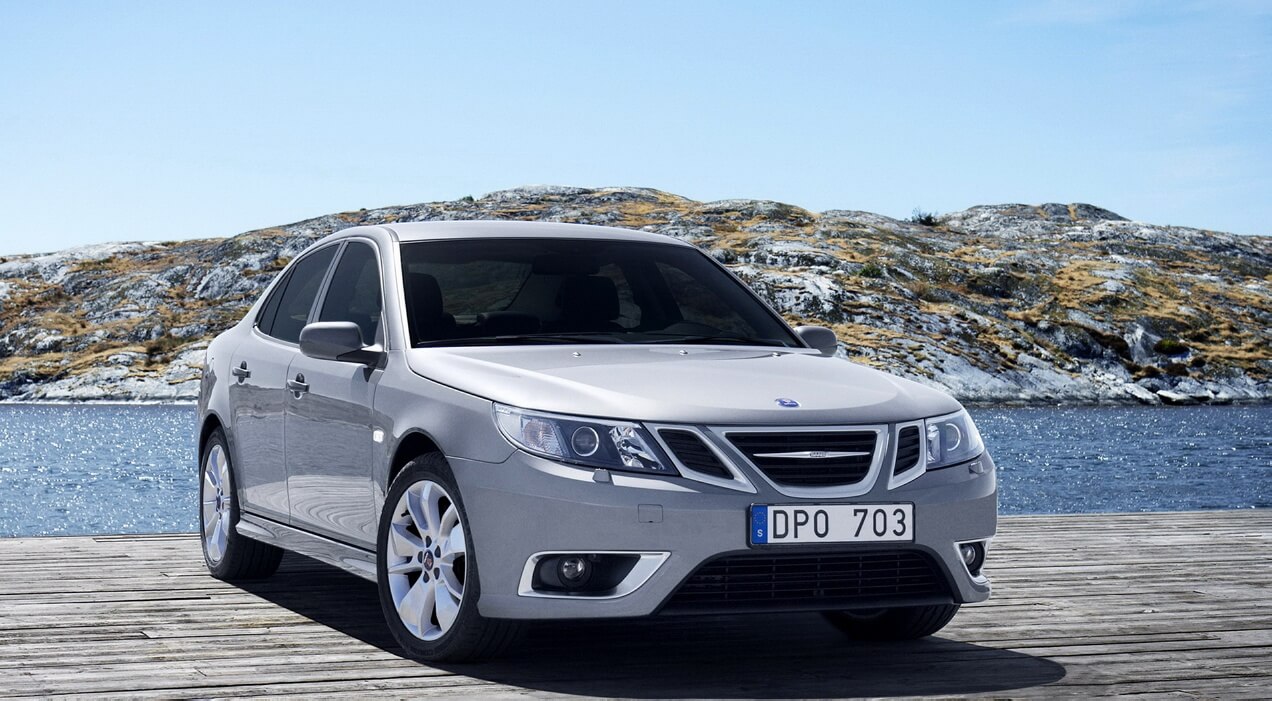
The first 9-5 was offered as a saloon and an estate. The sporty Aero versions had a body kit that made the car look lower, ground clearance reduced by 10 mm (to 124 mm), and 17-inch wheels instead of the standard 16-inch ones, which made room for more powerful brakes. The front had large headlights and a slightly protruding bumper. The 2002 update replaced the headlight wipers, which tended to scratch and dull the plastic lenses, with washer jets, and brought new bumpers; the front bumper grew by 20 mm and became one piece with the grille. At the rear, large tail lights extended onto the boot lid above a prominent bumper. Owners report excellent corrosion resistance: many cars show no rust even after years of use.
Interior
The 9-5's speedometer has an unusual scale: the numbers and intervals are larger up to 140 km/h and smaller above it, because Saab reasoned that most driving happens below that speed and the most-used range should be easiest to read. A Night Panel button on the dashboard switches off all instruments except the speedometer to reduce distraction at night, although warnings such as low fuel still appear.
Aero versions with an automatic gearbox had buttons on the steering wheel for manual gear changes. The front seats could be ordered with heating and ventilation, and the glovebox could be cooled. Turbo versions had double sun visors that covered both the top of the windscreen and the side windows. The rear-view mirror dims automatically, and in true Saab fashion the ignition switch sits between the front seats, ahead of the gear lever. The saloon's boot holds 500 litres.
Engines and transmissions
| Engine | Years | Power (kW / PS) |
|---|---|---|
| 2.0t (low-pressure turbo) | 1997–2009 | 110 kW / 150 PS |
| 2.3t (low-pressure turbo) | 1997–2009 | 125–136 kW / 170–185 PS |
| 2.3T Aero (high-pressure turbo) | 1999–2009 | 169–191 kW / 230–260 PS |
| 3.0 V6 (low-pressure turbo) | 1998–2003 | 147 kW / 200 PS |
| 1.9 TiD diesel | late 2000s | 110 kW / 150 PS |
| 2.2 TiD diesel | early 2000s | 88 kW / 120 PS |
| 3.0 V6 TiD diesel | early 2000s | 130 kW / 177 PS |
Saab offered both low-pressure and high-pressure turbocharged petrol engines, plus diesels. The most common were the four-cylinder 2.0 and 2.3 engines; the strongest went into the 9-5 Aero. The gearbox options were a robust five-speed manual and an Aisin automatic, with four speeds until 2001 and five speeds from 2002.
Second generation (2010–2011)
Design
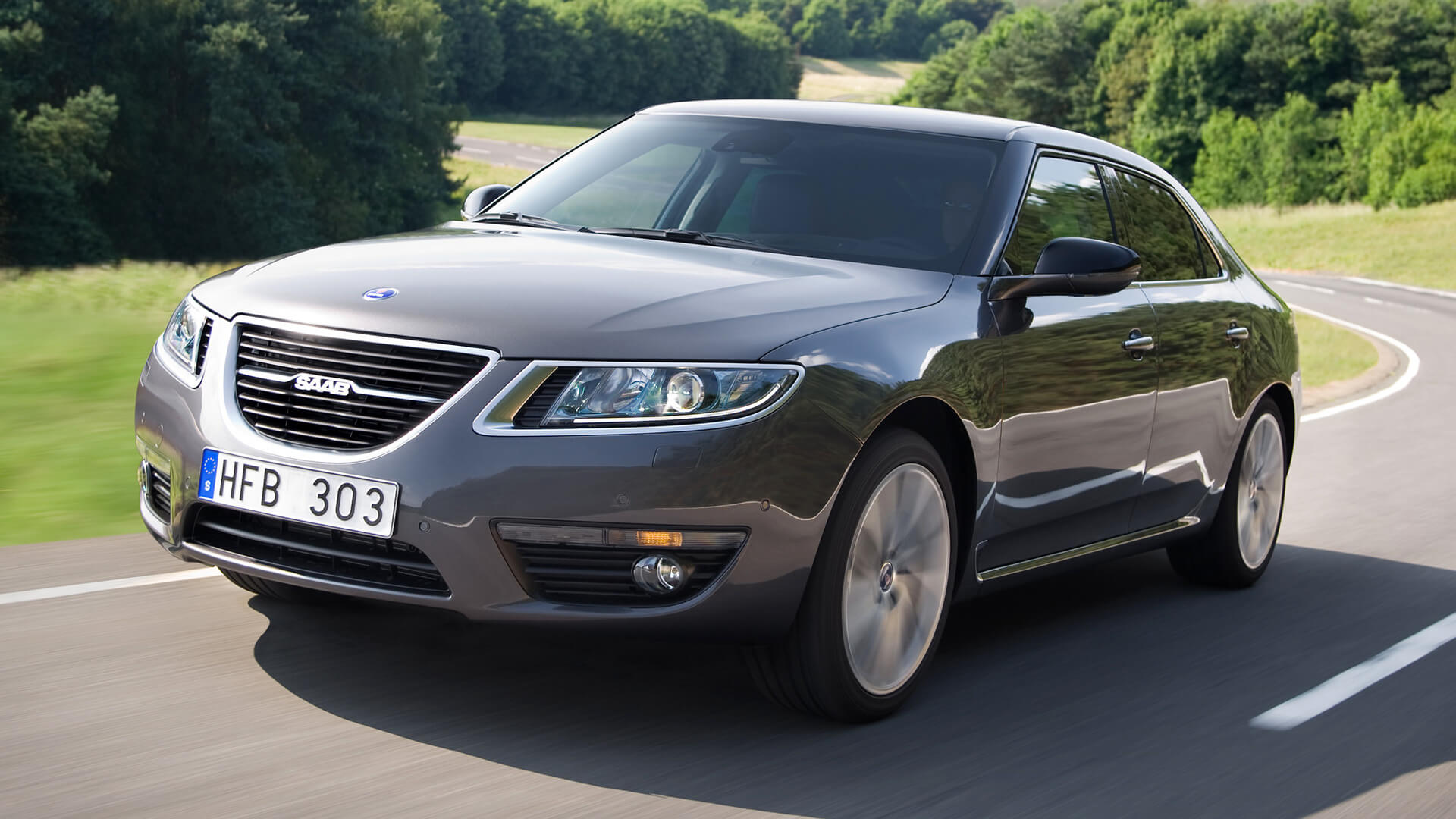
The new 9-5 was unveiled at the Frankfurt motor show in September 2009. It combined refined lines with the brand's traditional solidity and was planned as a saloon and the 9-5 SportCombi estate. At just over 5 metres long, it was the largest Saab ever, longer even than the 9-7X SUV. Although some found it slightly bulky, it kept the brand's signature features: a wraparound windscreen look, a sloping front and gently raked rear pillars that make the saloon look almost like a hatchback.
At the front, adaptive headlights similar to Opel's adjust the beam to speed and weather, widening it in rain and fog, either side of a small chrome-framed grille, with small round fog lights at the bottom of the bumper. Wheels range from 16 to 19 inches, and plenty of chrome trim and black-painted pillars create a "floating" roof effect. At the rear, the Aero has visible trapezoidal exhaust outlets, while the 2.0 hides its exhaust under the bumper; a decorative strip and a horizontal LED line connect the tail lights.
Interior
Saab's engineers again managed to disguise many General Motors components. The cabin has grille-style air vents, a starter button on the centre tunnel and many physical buttons despite the touchscreen. The dashboard is angled towards the driver, although some of the plastics feel rough. The Night Panel is still there and now switches the instruments off entirely, so the rev-counter needle drops to zero and the fuel gauge reads empty while it is active. The instrument cluster has three round dials — rev counter, speedometer with a trip-computer screen, and a combined gauge for temperature, fuel and turbo boost — with green needles and lighting.
A large central air vent at the top of the console can be adjusted separately by driver and passenger, above the touchscreen for infotainment and navigation and the climate controls. The multifunction armrest has three latches: one for a small storage tray, one for a larger compartment with a power socket, and one that slides the lid forward. Three adults fit comfortably in the back, with good head- and legroom, a rear armrest with cupholders and air vents. The 515-litre boot is practical, with rails and fastening points for nets and hidden side compartments; a spare wheel sits under the floor.
Engines and transmissions
| Engine | Power (kW / PS) |
|---|---|
| 1.6T petrol | 134 kW / 182 PS |
| 2.0T petrol (also BioPower) | 164 kW / 223 PS |
| 2.8T V6 Turbo petrol | 221 kW / 300 PS |
| 2.0 TiD diesel | 118 kW / 160 PS |
| 2.0 TTiD twin-turbo diesel | 140 kW / 190 PS |
Developed in difficult times for the company, the second generation used General Motors engines. Power went through a six-speed manual or six-speed automatic gearbox, and the top-spec versions came only with the automatic and XWD all-wheel drive. The fastest versions reached 100 km/h in 6.9 seconds and 250 km/h, while the base car needed 10.1 seconds and reached 215 km/h; combined consumption ranged from 7.8 to 10.6 l/100 km. XWD uses an electronically controlled clutch to drive the rear wheels and a second clutch acting as a limited-slip rear differential, which together with the brakes allows torque to be shifted between wheels.
Chassis
The second generation is based on GM's Epsilon II platform, shared with the Opel Insignia, but Saab's engineers stretched the wheelbase by 10 cm and retuned the anti-roll bars, springs and dampers; magnetorheological dampers were available. Front suspension uses MacPherson-type struts and the rear an independent multi-link design. Brakes are discs, ventilated at the front.
Safety
Like Volvo, Saab took safety very seriously, testing cars at its own proving ground and simulating real-world crashes beyond Euro NCAP's standard 64 km/h offset test. Owners report that the 9-5 protected them well in serious accidents, thanks to a strong structure, good brakes and electronic aids.
Strengths and weaknesses
Owners praise the comfort, strong performance and individuality of the 9-5. It is considered reliable when well maintained, everything is designed thoughtfully, and the body resists corrosion well. The cabin is comfortable and roomy, the boot practical and the ride smooth. The downsides are that parts can be hard to find and expensive since Saab's demise, the car needs careful maintenance, and ground clearance is limited. Saab itself regarded Audi as its main rival.
Image credits · Photos from Wikimedia Commons under free licences
- Saab 9-5 YS3E · Photo: OSX / Wikimedia Commons, Public domain
- Saab 9-5 YS3G · Photo: Rutger van der Maar / Wikimedia Commons, CC BY 2.0
Saab 9-5 in our rankings
- No. 258 of 912 · Longest-running car nameplates (14 years · top 30%)
- No. 347 of 557 · Biggest engines: cars (2,300 cc · top 63%)
- No. 180 of 256 · Most economical cars (10.7 l/100 km · top 71%)
- No. 258 of 345 · Cars with the most generations (2 generations)
In production longer than 70% of ranked nameplates in the 1CARS catalog (No. 258 of 912).
FAQ
How many generations of the Saab 9-5 are there?
Two: the first from 1997 to 2010, and the second, built only in 2010–2011.
How many second-generation Saab 9-5s were built?
Only 11,280, because production stopped in 2011 when Saab ran out of money.
What is the Night Panel in a Saab?
A button that switches off all instruments except the speedometer to reduce distraction when driving at night.
What was the most powerful Saab 9-5?
The second-generation 2.8 V6 Turbo with XWD, producing 221 kW (300 PS). In the first generation, the Aero reached up to 191 kW (260 PS).
Which car is the second-generation Saab 9-5 related to?
It shares GM's Epsilon II platform with the Opel Insignia, but with a 10 cm longer wheelbase.
Data sources
Data checked by an editor against the sources below.
- Wikipedia — Saab 9 5
- US EPA fueleconomy.gov — 22649.shtml
- US EPA fueleconomy.gov — 22680.shtml
- US EPA fueleconomy.gov — 20927.shtml
- US EPA fueleconomy.gov — 20926.shtml