
 Saab Sonett
All generations, specs and history
Published Sources (2) Report an error
By Oleksandr Hnatiuk, Automotive Editor & Used Car Specialist
- Built
- 1956–1974
- Generations
- 2
- Top power
- 48 kW (65 PS)
Timeline
Sonett generations
Click a generation for its own page
- Sonett II / Sonett V4 1966–1969 · Coupe · 44–48 kW (60–65 PS)
- Sonett III 1970–1974 · Coupe · 48 kW (65 PS)
Newest first · 2 generations since 1966
- 1970 III 1970–1974 · Coupe · 48 kW (65 PS)
- 1966 II / Sonett V4 1966–1969 · Coupe · 44–48 kW (60–65 PS)
All generations by year: Sonett III (1970–1974) · Sonett II / Sonett V4 (1966–1969)
Which one is mine?
Pick the year of first registration to see which generation it is.
- Sonett III 1970–1974
- Sonett II / Sonett V4 1966–1969
The Saab Sonett is the small fibreglass sports car family that Saab built in three forms: the Sonett I roadster prototype of 1956, of which six were made, the Sonett II and Sonett V4 coupés of 1966-1969, and the restyled Sonett III of 1970-1974. All were front-wheel drive with Saab two-stroke or Ford V4 engines, and 10,236 production cars were built, most of them for the United States.
In short
- Sonett I (Saab 94): six right-hand-drive roadsters, 1955-1957, 748 cc two-stroke with 42 kW (57.5 PS) and a weight of 600 kg.
- Sonett II and V4: 1,868 coupés (258 plus 1,610) built at ASJ in Arlöv, first with the 841 cc two-stroke, from 1967 with the 1.5-litre Ford V4.
- Sonett III: 8,368 built from 1970 to 1974, restyled with input from Sergio Coggiola, 48 kW (65 hp) from 1.5 and later 1.7 litres.
- Production ended in 1974 after slow sales in the United States and the 1973 oil crisis.
Specs by version
Engines
| Version | Engine | Power | Drive | Production years |
|---|---|---|---|---|
| Sonett II / Sonett V4 · Sonett II 841 two-stroke | 0.8 l · 3 cyl · Petrol 841 cc | 44 kW 60 PS59 hp | Front-wheel drive | 1966–1967 |
| Sonett II / Sonett V4 · Sonett V4 1.5 | 1.5 l · 4 cyl · Petrol 1,498 cc | 48 kW 65 PS64 hp | Front-wheel drive | 1967–1969 |
| Sonett III 1.5 V4 | 1.5 l · 4 cyl · Petrol 1,498 cc | 48 kW 65 PS64 hp | Front-wheel drive | 1970–1971 |
| Sonett III 1.7 V4 | 1.7 l · 4 cyl · Petrol 1,698 cc | 48 kW 65 PS64 hp | Front-wheel drive | 1971–1974 |
Performance
Show all 3 versions
| Version | 0–100 km/h | Top speed |
|---|---|---|
| Sonett II / Sonett V4 · Sonett II 841 two-stroke | 12.5 s 0–62 mph | 150 km/h93 mph |
| Sonett II / Sonett V4 · Sonett V4 1.5 | 12.5 s 0–62 mph | 160 km/h99 mph |
| Sonett III 1.5 V4 | 13.0 s 0–62 mph | 165 km/h103 mph |
Verified Manufacturer and type-approval data from our catalog · Sources and methodology
Saab Sonett at a glance
| Item | Saab Sonett |
|---|---|
| Years | 1956 (Sonett I prototypes); 1966-1974 (series cars) |
| Production | 6 Sonett I; 258 Sonett II two-stroke; 1,610 Sonett V4; 8,368 Sonett III |
| Plants | ASJ, Arlöv (Sweden); Saab, Trollhättan |
| Body styles | 2-seat roadster (Sonett I); 2-seat coupé (II, V4, III) |
| Designers | Sonett II: Björn Karlström (MFI 13 project); Sonett III: Sergio Coggiola, adapted by Gunnar A. Sjögren |
| Layout | front engine, front-wheel drive, steel frame with fibreglass body |
| Engines | 748 cc and 841 cc three-cylinder two-strokes; 1,498 cc and 1,698 cc Ford V4 |
| Power | 42-48 kW (57.5-65 PS) |
| Weight | 600 kg (Sonett I) |
| Top speed | 150 km/h (II), 160 km/h (V4), 165 km/h (III) |
| 0-100 km/h | 12.5 s (II and V4), 13 s (III) |
| Price new | USD 3,200-3,800 for the Sonett V4 in the US |
The Sonett is one of the less common chapters in our Saab history; the rest of the range is in our Saab catalogue, and other sports cars of the period are in our classic cars section.
Sonett I: an aircraft maker's lightweight roadster
The first Sonett was built on a budget of SEK 75,000 and shown at the Stockholm motor show on 16 March 1956 as the Saab 94. Its riveted aluminium chassis weighed under 70 kg, and the glass-reinforced plastic body came from Soab of Gothenburg. The engine was a 748 cc three-cylinder two-stroke from the Saab 93, the successor of Saab's first car, the 92, tuned to 42 kW (57.5 PS), and turned round so that it sat behind the gearbox while still driving the front wheels.
The whole car weighed 600 kg, and Saab projected a top speed of 190 km/h. A run of 2,000 cars was planned for 1957 and later abandoned. Only six were built, between 1955 and early 1957, all with right-hand drive, and all six survive. Decades later, in September 1996, Erik Carlsson drove prototype number one to a Swedish record for cars under 750 cc at 159.4 km/h.

Sonett II and Sonett V4: from two-stroke to Ford power
Saab returned to the idea in the mid-1960s. The Sonett II grew out of the MFI 13, a design by Björn Karlström developed by Malmö Flygindustri, and was assembled by ASJ (Aktiebolaget Svenska Järnvägsverkstäderna) at Arlöv. It had a sheet steel frame with an integrated roll bar, a fibreglass coupé body and the 841 cc two-stroke from the 96 Monte Carlo, here with 44 kW (60 PS). Wikipedia gives 0-100 km/h in 12.5 seconds and 150 km/h; 28 cars were built in 1966 and 230 in 1967.
The two-stroke was already out of step with US emissions rules, and Saab's most important market for the car was America. Car number 259 was the first Sonett with the 1,498 cc Ford Taunus V4 of 48 kW (65 hp). The taller engine needed a bulge in the bonnet, drawn by Gunnar A. Sjögren, and the wheels grew half an inch wider than the Sonett II's four-inch rims. Top speed rose to 160 km/h. Saab built 70 V4 cars in 1967, 900 in 1968 and 640 in 1969, nearly all for export to the United States, where they sold for USD 3,200 to 3,800.
| Model | Years | Engine | Power | 0-100 km/h | Top speed | Built |
|---|---|---|---|---|---|---|
| Sonett I | 1956-1957 | 748 cc two-stroke | 42 kW (57.5 PS) | - | 190 km/h (projected) | 6 |
| Sonett II | 1966-1967 | 841 cc two-stroke | 44 kW (60 PS) | 12.5 s | 150 km/h | 258 |
| Sonett V4 | 1967-1969 | 1,498 cc V4 | 48 kW (65 hp) | 12.5 s | 160 km/h | 1,610 |
| Sonett III | 1970-1974 | 1,498 cc, later 1,698 cc V4 | 48 kW (65 hp) | 13 s | 165 km/h | 8,368 |
Figures from Wikipedia EN. The Saab Network quotes 1,868 cars for the second-generation coupés, which matches the 258 two-strokes and 1,610 V4s combined. Sources date the 1.7-litre engine to 1971 or 1972.

Sonett III: Italian lines on a carried-over centre
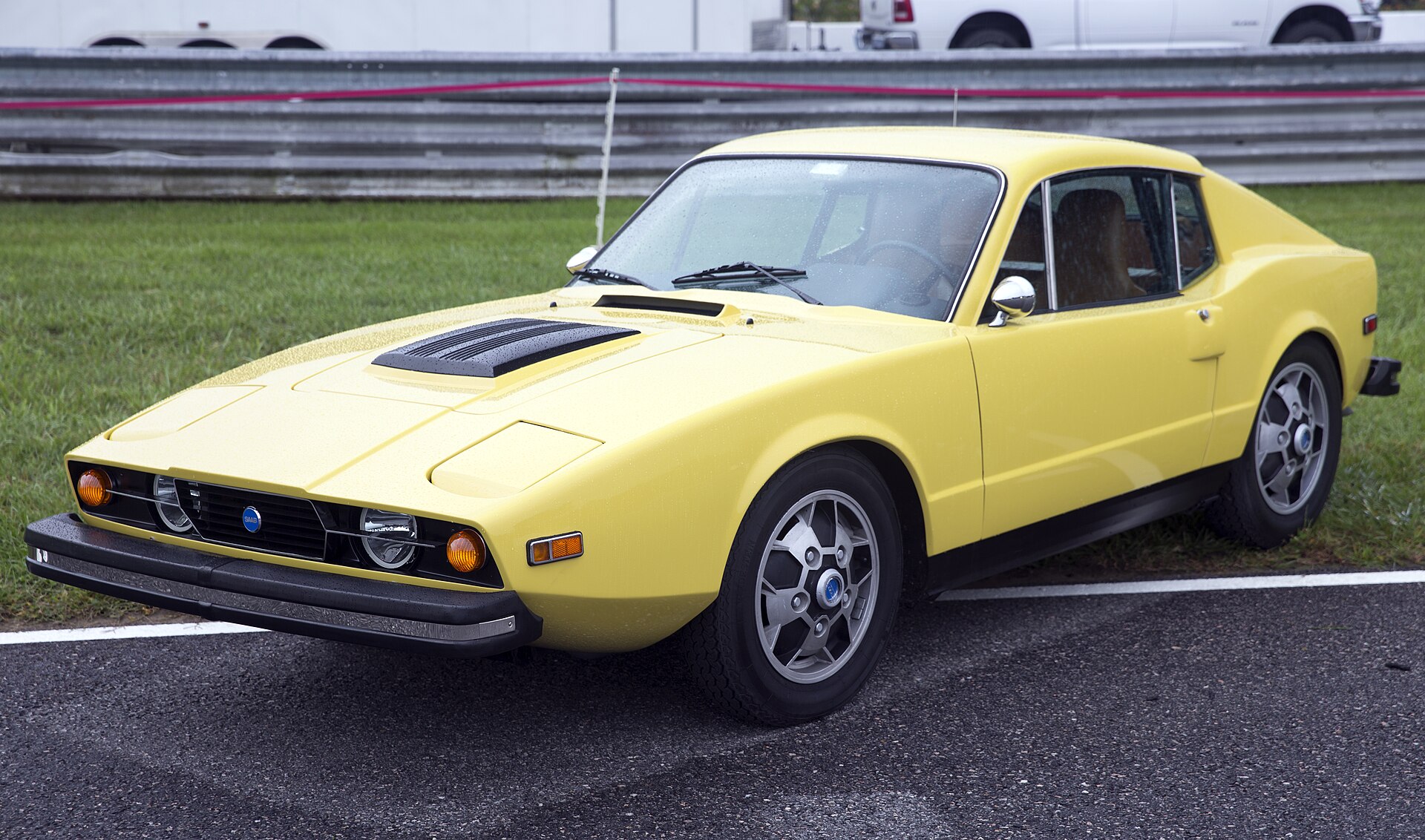
For 1970 Saab wanted a more modern shape without the cost of a new floorpan. The Turin designer Sergio Coggiola produced the first proposal for a new nose and tail, and Gunnar A. Sjögren adapted and toned it down to fit the existing centre section. The result was a wedge-shaped coupé with a drag coefficient of 0.31, slightly heavier than the Sonett II. Saab unveiled it at the New York Auto Show in 1970 in standard form, with steel wheels and brown corduroy trim, and as a luxury version with alloy wheels and leather.
The Sonett III used the 1,498 cc V4 at first, then from 1971 the 1,698 cc version. Lower compression to meet emissions rules meant the bigger engine still gave 48 kW (65 hp). Saab fitted a lower 42:9 final drive than the 96's 39:8, and Wikipedia lists 0-100 km/h in 13 seconds and 165 km/h; Hagerty UK quotes 106 mph (171 km/h). US dealers could fit air conditioning, and from 1973 the car carried large impact bumpers to meet American rules.
The Sonett III was the best-selling Sonett, with 8,368 cars, and there were no official UK exports. Sales were still disappointing, and the 1973 oil crisis made a small two-seater an even harder sell. Production ended in late 1974; the last car, a bright yellow Sonett III built at Arlöv, is kept at the Saab museum in Trollhättan.
Saab Sonett today: what to check when buying
The fibreglass body cannot rot, so attention goes to the sheet steel frame beneath it: inspect it from below, around the suspension mounts and wherever water can collect. Fibreglass can crack, so look for stress cracks and poorly repaired accident damage in the panels.
The V4 shares its weak points with the Saab 96: Hagerty UK warns that the fibre balance shaft gear can wear and cause vibration, that a rumbling bottom end points to tired main bearings, and that the cooling system and water pump need checking when hot. Many Sonetts have had a later 1.7-litre V4 fitted for more power, and Hagerty notes that such swaps have not hurt resale. Two-stroke Sonett IIs are the rarest and need the right fuel and oil mixture. Engine and running gear parts are shared with the 96 and 95, which keeps mechanical repairs manageable; body and trim parts are much harder to find.
Values from dated Hagerty data:
- Sonett III in good condition: about EUR 10,700 (USD 11,100), Hagerty valuation tool, January 2025.
- In July 2019 Hagerty valued excellent (#2) cars at USD 23,800 for a Sonett II two-stroke, USD 17,300 for a Sonett V4 and USD 10,300 for a Sonett III, about EUR 21,200, 15,400 and 9,200 at that time.
In Hagerty's figures the rare two-stroke cars cost the most, and the Sonett III is the affordable way into the family.
Saab Sonett: first vs latest generation
| Spec | Sonett II / Sonett V4 | Sonett III | Change |
|---|---|---|---|
| Years | 1966–1969 | 1970–1974 | 4 years apart |
| Most powerful version | 48 kW (65 PS) | 48 kW (65 PS) | same (0%) |
| Best 0–100 km/h | 12.5 s | 13.0 s | +0.5 s |
| Top speed | 160 km/h | 165 km/h | +5 km/h |
Oldest and newest generation in the 1cars catalog. Power is the strongest version of each; other rows are shown only when both generations have the figure.
Saab Sonett in our rankings
- No. 560 of 1130 · Longest-running car nameplates (8 years · top 54%)
- No. 18 of 27 · Fastest cars of the 1960s (160 km/h · top 67%)
- No. 15 of 20 · Quickest cars of the 1970s, 0–100 (13.0 s · top 75%)
- No. 22 of 28 · Fastest cars of the 1970s (165 km/h · top 79%)
- No. 538 of 685 · Biggest engines: cars (1,698 cc · top 79%)
- No. 349 of 398 · Fastest cars (165 km/h · top 89%)
In production longer than 46% of ranked nameplates in the 1CARS catalog (No. 560 of 1130).
FAQ
How many Saab Sonetts were built?
Saab built 10,236 production Sonetts between 1966 and 1974: 258 Sonett II two-strokes, 1,610 Sonett V4s and 8,368 Sonett IIIs. Six Sonett I prototypes from 1956 come on top of that total.
What engine does the Saab Sonett have?
The Sonett II used Saab's 841 cc three-cylinder two-stroke with 44 kW (60 PS). From 1967 the Sonett V4 and Sonett III used Ford's Taunus V4, first with 1,498 cc and later with 1,698 cc, both rated at 48 kW (65 hp).
Was the Saab Sonett sold in Europe?
Only in small numbers. Nearly all Sonett V4s went to the United States, and the Sonett III was designed for American buyers and launched at the New York Auto Show in 1970. There were no official imports to the UK.
Why did Saab stop making the Sonett?
Sales stayed disappointing, and the 1973 oil crisis hit demand for small sports cars in the US. Saab ended production in late 1974 after 8,368 Sonett IIIs.
Data sources
Data checked by an editor against the sources below.
- Wikipedia - Saab Sonett
- Co - Cars That Time Forgot Saab Sonett Iii


