
 Fiat X1/9
All generations, specs and history
Published Sources (2) Report an error
By Sarah Whitmore, Senior Automotive Writer
- Built
- 1972–1989
- Generations
- 2
- Top power
- 63 kW (86 PS)
Timeline
X1/9 generations
Click a generation for its own page
- X1/9 1300 1972–1978 · Roadster · 55 kW (75 PS)
- X1/9 Five Speed / 1500 1978–1989 · Roadster · 56–63 kW (76–86 PS)
Newest first · 2 generations since 1972
- 1978 Five Speed / 1500 1978–1989 · Roadster · 56–63 kW (76–86 PS)
- 1972 1300 1972–1978 · Roadster · 55 kW (75 PS)
All generations by year: X1/9 Five Speed / 1500 (1978–1989) · X1/9 1300 (1972–1978)
Which one is mine?
Pick the year of first registration to see which generation it is.
- X1/9 Five Speed / 1500 1978–1989
- X1/9 1300 1972–1978
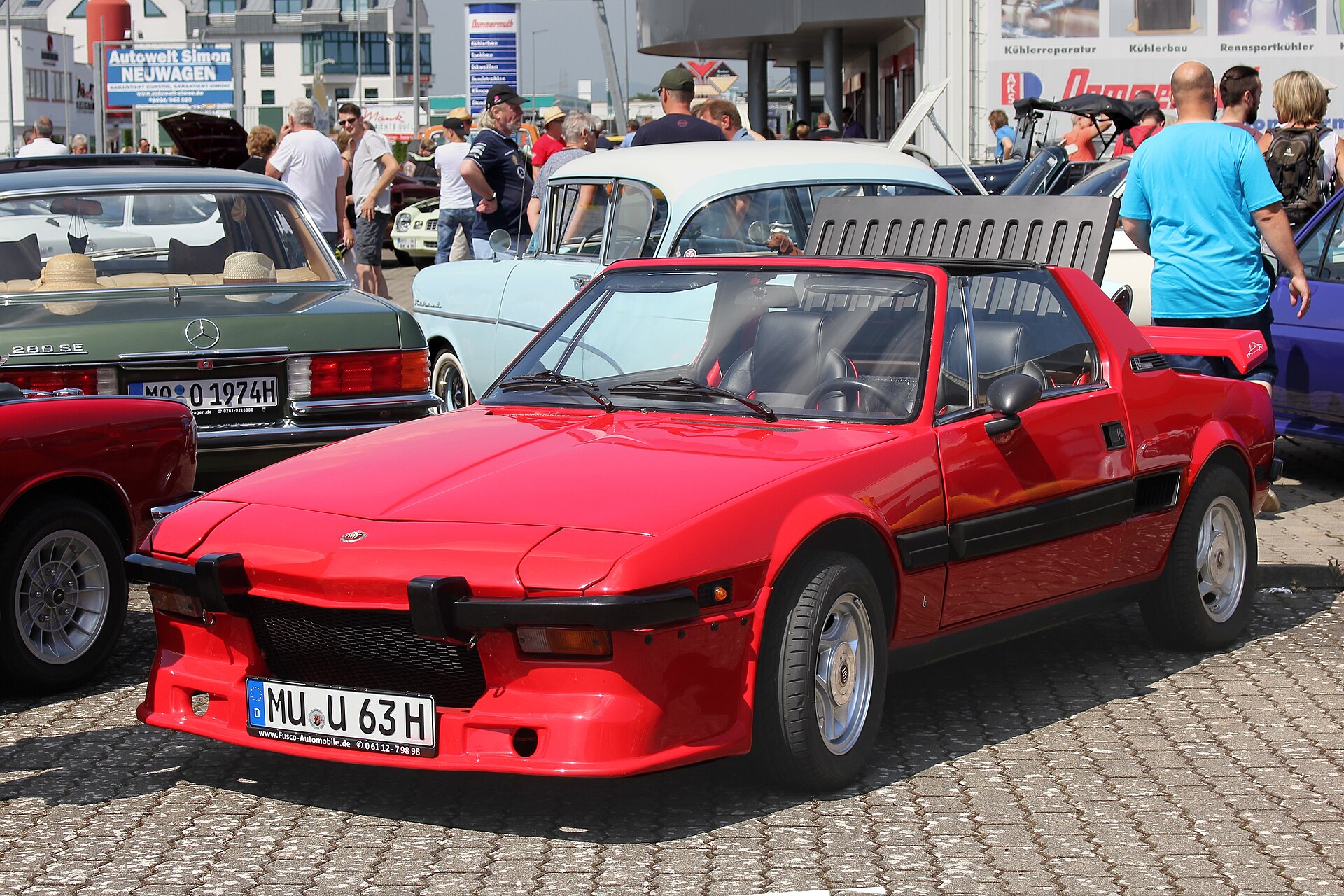
The Fiat X1/9 is a two-seat mid-engined targa built from 1972 to 1989, designed by Marcello Gandini at Bertone around the engine and gearbox of the front-drive Fiat 128. It began with a 1,290 cc four of 55 kW (75 PS) and gained a 1,498 cc engine and five speeds in 1978-1979. Bertone took over the car in 1982, and about 160,000 were made.
In short
- Announced in late 1972 as "the first mid-engined sports car destined for volume production".
- Engines: 1.3 litres with 55 kW (75 PS), then 1.5 litres with 63 kW (85 PS); US cars from 1980 had Bosch fuel injection.
- Fiat built about 140,500 cars to 1982 and Bertone about 19,500 from 1982 to 1989; roughly two-thirds were sold in the US.
- Removable roof panel stowed in the front boot, pop-up headlamps and disc brakes on all four wheels.
Size at a glance
Fiat X1/9 1300
The Fiat X1/9 Five Speed / 1500 is 139 mm longer and 10 mm taller than the Fiat X1/9 1300.
| Dimensions | Fiat X1/9 Five Speed / 1500 | Fiat X1/9 1300 | Difference |
|---|---|---|---|
| Length | 3,969 mm156.3 in | 3,830 mm150.8 in | +139 mm+5.5 in |
| Width | 1,570 mm61.8 in | 1,570 mm61.8 in | Same |
| Height | 1,180 mm46.5 in | 1,170 mm46.1 in | +10 mm+0.4 in |
| Wheelbase | 2,202 mm86.7 in | 2,202 mm86.7 in | Same |
Specs by version
Engines
| Version | Engine | Power | Torque | Gearbox | Drive | Production years |
|---|---|---|---|---|---|---|
| X1/9 1300 · 1300 | 1.3 l · 4 cyl · Petrol 1,290 cc | 55 kW 75 PS74 hp | 97 Nm72 lb-ft | 4-sp Manual | Rear-wheel drive | 1972–1978 |
| X1/9 Five Speed / 1500 · 1500 injection (US) | 1.5 l · 4 cyl · Petrol 1,498 cc | 56 kW 76 PS75 hp | - | 5-sp Manual | Rear-wheel drive | 1980–1989 |
| X1/9 Five Speed / 1500 · 1500 Five Speed | 1.5 l · 4 cyl · Petrol 1,498 cc | 63 kW 86 PS84 hp | 118 Nm87 lb-ft | 5-sp Manual | Rear-wheel drive | 1978–1989 |
| X1/9 Five Speed / 1500 · Bertone VS 1500 | 1.5 l · 4 cyl · Petrol 1,498 cc | 63 kW 86 PS84 hp | - | 5-sp Manual | Rear-wheel drive | 1982–1989 |
Performance
Show all 2 versions
| Version | Top speed |
|---|---|
| X1/9 1300 · 1300 | 170 km/h106 mph |
| X1/9 Five Speed / 1500 · 1500 Five Speed | 185 km/h115 mph |
Dimensions and weight
Show all 2 versions
| Version | Length | Width | Height | Wheelbase |
|---|---|---|---|---|
| X1/9 1300 · 1300 | 3,830 mm150.8 in | 1,570 mm61.8 in | 1,170 mm46.1 in | 2,202 mm86.7 in |
| X1/9 Five Speed / 1500 · 1500 Five Speed | 3,969 mm156.3 in | 1,570 mm61.8 in | 1,180 mm46.5 in | 2,202 mm86.7 in |
Verified Manufacturer and type-approval data from our catalog · Sources and methodology
Fiat X1/9 at a glance
| Item | Fiat X1/9 |
|---|---|
| Years | 1972-1989 (as Bertone X1/9 from 1982) |
| Production | about 160,000 (figures vary between sources) |
| Builders | Fiat with Bertone bodies to 1982; Bertone alone 1982-1989 |
| Body style | two-door targa, two seats |
| Designer | Marcello Gandini (Bertone) |
| Layout | transverse mid engine, rear-wheel drive |
| Engines | 1,290 cc and 1,498 cc SOHC four-cylinder |
| Power | 55 kW (75 PS) to 63 kW (85 PS); US 1.5: 56 kW (75 hp) |
| Kerb weight | 880-920 kg |
| Top speed | 170 km/h (1.3); 185 km/h (1.5) |
| 0-60 mph | 12.7 s (1.3), 10.4 s (1.5), Hagerty UK |
| Size | 3,830 mm long (3,969 mm from 1978), 1,570 mm wide, wheelbase 2,202 mm |
| Price new | USD 4,167 in 1974 (US market) |
The X1/9 belongs in the Fiat catalogue, although the last cars wore Bertone badges.
From a Bertone show car to a production Fiat
The shape started as a Bertone show car. At the 1969 Turin show the coachbuilder displayed the Autobianchi A112 Runabout, a wedge-shaped open two-seater with a prominent roll bar. Wikipedia IT records that Gianni Agnelli saw the prototype at Bertone in 1971, and the production car kept its proportions, its roll-over hoop and its sharp nose. Fiat intended the new car as the replacement for its small 850 Spider.
Fiat held the launch back until after the Turin Motor Show of November 1972 so that the X1/9 would not overshadow the new Fiat 126. Press drives followed at the end of that month. In February 1973 CAR magazine called it "the most significant sports car of our time", according to Practical Classics.

Engineering: a 128 drivetrain moved behind the seats
Gandini, who also drew the Lancia Stratos, placed the transverse engine and gearbox of the Fiat 128 behind the cabin and drove the rear wheels. The result was a light car of 880-920 kg, only 1,170 mm high. The design was planned from the start to meet the coming US safety regulations. The removable roof panel fits in the front boot, so the car carries luggage at both ends.
Other details included pop-up headlamps, a spoiler built into the nose and 227 mm discs at every wheel. The first engine was the 1,290 cc SOHC four of the 128 family, rated like the 128 Sport Coupe 1300 at 55 kW (75 PS) at 6,000 rpm and 97 Nm at 3,400 rpm, linked to a four-speed gearbox. Hagerty UK gives 0-60 mph in 12.7 seconds and 106 mph (170 km/h).

Five Speed, US bumpers and the Bertone years
The Series II of 1978-1979 brought the 1,498 cc engine from the Fiat Strada (Ritmo) with 63 kW (85 PS) and 118 Nm, plus a five-speed gearbox. Hagerty UK quotes 0-60 mph in 10.4 seconds and 112 mph, while Wikipedia lists 185 km/h. The body grew to 3,969 mm.
US cars show the clearest changes. The 1974 cars had small steel bumpers, the 1975-1978 cars wore ladder-style impact bumpers, and the 1979 cars received square aluminium bumpers. Their 1.5-litre engine gave 50 kW (67 hp) in 1979; from 1980 Bosch injection lifted it to 56 kW (75 hp). US list prices rose from USD 4,167 in 1974 to USD 13,990 in 1984. Right-hand-drive cars reached the UK in 1976 according to Hagerty UK and in 1977 according to Practical Classics.
| Version | Years | Engine | Power | Gearbox | Notes |
|---|---|---|---|---|---|
| X1/9 1300 | 1972-1978 | 1,290 cc | 55 kW (75 PS) | 4-speed | launch model, LHD only at first |
| X1/9 Five Speed / 1500 | 1978-1989 | 1,498 cc | 63 kW (85 PS) | 5-speed | Series II, longer bumpers |
| US 1500 | 1980-1989 | 1,498 cc | 56 kW (75 hp) | 5-speed | Bosch fuel injection |
| Bertone VS | from 1982 | 1,498 cc | 63 kW (85 PS) | 5-speed | two-tone paint, leather, electric windows |
| Bertone Gran Finale | 1989 | 1,498 cc | 63 kW (85 PS) | 5-speed | run-out edition with rear spoiler |
In 1982 Fiat ended its own production and handed the X1/9 to Bertone, which replaced the Fiat badges with its own and sold the car until 1989. Bertone added the better-equipped VS and, in 1982, the In with red leather trim. The final Gran Finale got a rear spoiler and special badges. Wikipedia counts about 140,500 Fiat-built cars and about 19,500 Bertone cars; Practical Classics gives 163,750 in total and Classics World about 170,000. The X1/9 had no direct heir until the front-engined Fiat Barchetta.

Racing versions and prototypes
Scuderia Filipinetti showed a race car at the Geneva Motor Show in March 1973 with about 118 kW (160 PS). Abarth built the X1/9 Prototipo rally car in 1973, with a 1,840 cc engine of about 147 kW (200 PS) according to Wikipedia IT, but Fiat chose the 131 Abarth for its rally programme. Dallara's Icsunonove of 1975 ran in the Group 5 class of the World Championship for Makes.
Fiat X1/9 today: what to check when buying
Hagerty UK's buying guide warns that rust can affect every panel, joint and seam. Check the inner wheel arches, floorpans, sills, engine and suspension mounts and the headlamp pods. Practical Classics adds the windscreen surround, a repair that costs over GBP 1,000 at a specialist, and Classics World lists the front suspension turrets and the roll bar. Triple-skinned bulkheads around the engine can hide corrosion, and steel coolant pipes running through the body can rot the car from inside.
The engines last well with routine servicing. Change the cambelt every three to four years or about 30,000 miles (48,000 km), use the correct coolant, and look for oil leaks between camshaft carrier and head or signs of a failed head gasket. The five-speed gearbox is weaker than the four-speed, with poor second and third synchromesh on some cars, and worn linkage bushes make the shift vague. Rear wishbone ball joints, seized calipers and leaking brake master cylinders are other common faults. Gearbox parts, interior trim and roof seals are hard to source, and the roof drains must be clear.
Hagerty UK's guide of February 2023 gives about EUR 2,900 (GBP 2,500) for a rough running project, EUR 6,300 (GBP 5,500) for a good 1500, about EUR 10,400 (GBP 9,000) for a clean right-hand-drive car and up to EUR 23,000 (GBP 20,000) for the best concours examples. Late, well-equipped 1500s are the sensible choice for regular use. Other affordable sports cars of the period are listed in the classic cars section.
Fiat X1/9: first vs latest generation
| Spec | X1/9 1300 | X1/9 Five Speed / 1500 | Change |
|---|---|---|---|
| Years | 1972–1978 | 1978–1989 | 6 years apart |
| Most powerful version | 55 kW (75 PS) | 63 kW (86 PS) | +8 kW (+15%) |
| Length | 3,830 mm | 3,969 mm | +139 mm |
| Width | 1,570 mm | 1,570 mm | same |
| Wheelbase | 2,202 mm | 2,202 mm | same |
| Top speed | 170 km/h | 185 km/h | +15 km/h |
Oldest and newest generation in the 1cars catalog. Power is the strongest version of each; other rows are shown only when both generations have the figure.
Fiat X1/9 in our rankings
- No. 6 of 36 · Smallest convertibles and roadsters (3,830 mm)
- No. 37 of 554 · Smallest cars (3,830 mm · top 7%)
- No. 253 of 1138 · Longest-running car nameplates (17 years · top 25%)
- No. 17 of 35 · Fastest cars of the 1970s (185 km/h · top 55%)
- No. 268 of 407 · Fastest cars (185 km/h · top 68%)
- No. 26 of 36 · Longest convertibles and roadsters (3,969 mm · top 73%)
Shorter than 93% of ranked cars in the 1CARS catalog (No. 37 of 554).
FAQ
Who designed the Fiat X1/9?
Marcello Gandini designed it at Bertone. The shape grew out of Bertone's Autobianchi A112 Runabout show car of 1969, and Bertone also built the bodies for Fiat before taking over the whole car in 1982.
How many Fiat X1/9s were made?
About 160,000, according to Wikipedia: roughly 140,500 by Fiat from 1972 to 1982 and 19,500 by Bertone from 1982 to 1989. Other sources give 163,750 or about 170,000, so figures vary.
Is the Fiat X1/9 1300 or 1500 better?
The 1500 suits most buyers. It has 63 kW (85 PS) against 55 kW (75 PS), a five-speed gearbox and more equipment, and Hagerty UK recommends late cars. Early 1300s are rarer, and Classics World says collectable early cars can fetch two to three times the price of a later roadworthy one.
Why does the X1/9 have a Bertone badge?
Fiat stopped building the car in 1982 and Bertone, which had made the bodies from the start, took over production and sales. From then on it was sold as the Bertone X1/9 until the Gran Finale edition of 1989.
Data sources
Data checked by an editor against the sources below.
- Wikipedia
- Co - Buying Guide Fiat X1 9 1972 1989


