
 Dodge Coronet R/T
All generations, specs and history
Published Sources (5) Report an error
By Felix Hartmann, Automotive Technology & EV Contributor
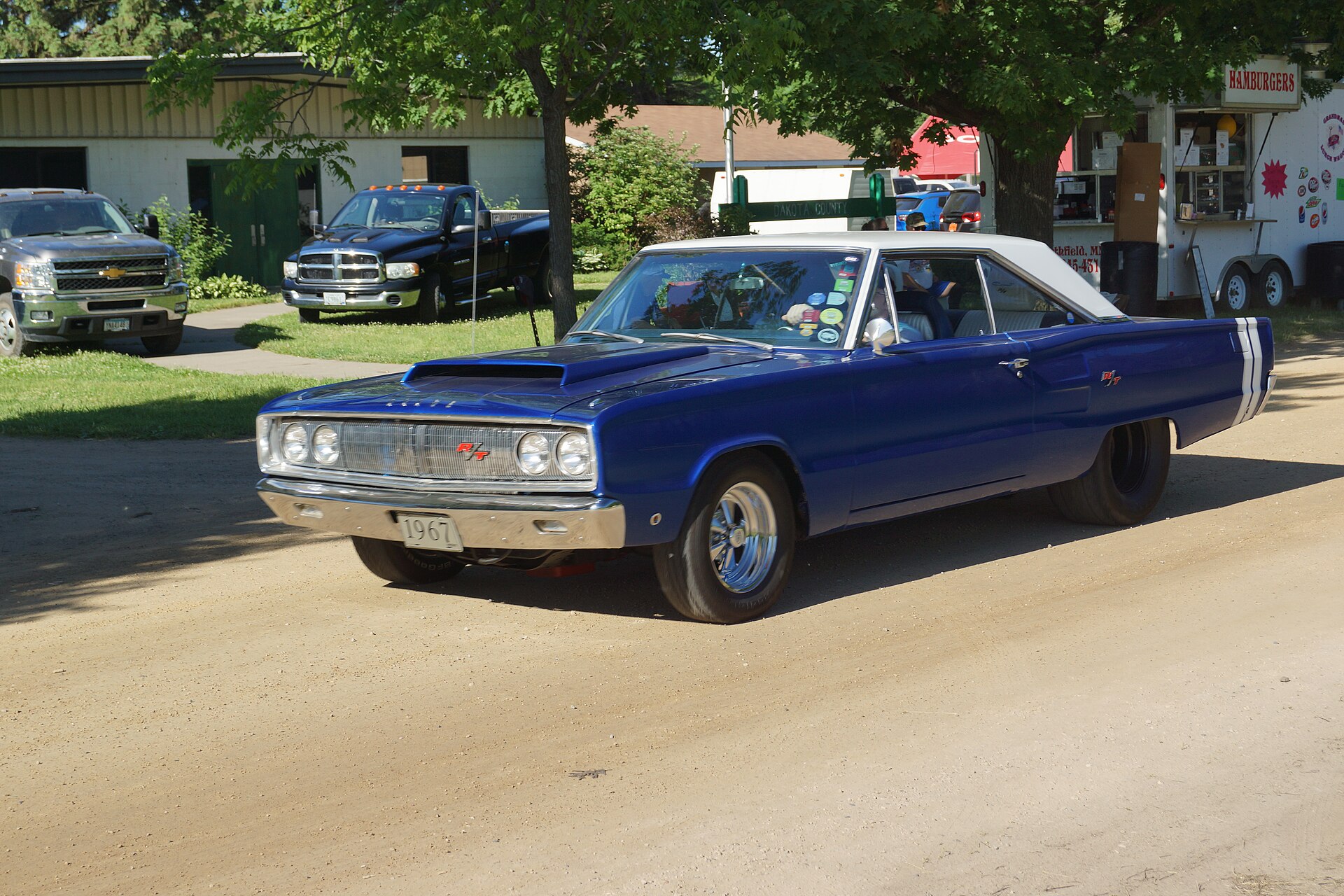
- Built
- 1967–1970
- Generations
- 2
- Top power
- 317 kW (431 PS)
Timeline
Coronet R/T generations
Click a generation for its own page
- Coronet R/T I 1967 · Coupe, Convertible · 280–317 kW (381–431 PS)
- Coronet R/T II 1968–1970 · Coupe, Convertible · 280–317 kW (381–431 PS)
Newest first · 2 generations since 1967
- 1968 II 1968–1970 · Coupe, Convertible · 280–317 kW (381–431 PS)
- 1967 I 1967 · Coupe, Convertible · 280–317 kW (381–431 PS)
All generations by year: Coronet R/T II (1968–1970) · Coronet R/T I (1967)
Which one is mine?
Pick the year of first registration to see which generation it is.
- Coronet R/T II 1968–1970
- Coronet R/T I 1967
The Dodge Coronet R/T was the top performance version of Dodge's mid-size Coronet from 1967 to 1970, sold as a two-door hardtop or convertible. Every R/T left the factory with at least the 7.2 L (440 cu in) Magnum V8, rated at 280 kW (375 hp, SAE gross), and the 426 Hemi was the expensive option. Dodge built about 31,000 R/Ts in four model years.
In short
- Built for 1967-1970 on the Chrysler B-body; R/T stood for Road/Track and first appeared on this car.
- Standard 440 Magnum: 280 kW (375 hp) and 651 Nm (480 lb-ft); the 426 Hemi added 317 kW (425 hp) for US$908 in 1967.
- Production fell from 10,737 in 1967 to 2,615 in 1970, when the Super Bee and Charger R/T took its buyers.
- Motor Trend timed a 1967 440 car at 7.2 seconds to 60 mph and 15.4 seconds over the quarter mile.
Specs by version
| Version | Engine | Power | Torque | Drive | Production years |
|---|---|---|---|---|---|
| Coronet R/T I · 440 Magnum 4-barrel V8 (SAE gross) | 7.2 l · 8 cyl · Petrol 7,206 cc | 280 kW 381 PS375 hp | 651 Nm480 lb-ft | Rear-wheel drive | 1967 |
| Coronet R/T I · 426 Hemi V8, two 4-barrel (SAE gross) | 7.0 l · 8 cyl · Petrol 6,981 cc | 317 kW 431 PS425 hp | 664 Nm490 lb-ft | Rear-wheel drive | 1967 |
| Coronet R/T II · 440 Magnum 4-barrel V8 (SAE gross) | 7.2 l · 8 cyl · Petrol 7,206 cc | 280 kW 381 PS375 hp | 651 Nm480 lb-ft | Rear-wheel drive | 1968–1970 |
| Coronet R/T II · 440 Six Pack V8, three 2-barrel (SAE gross) | 7.2 l · 8 cyl · Petrol 7,206 cc | 291 kW 396 PS390 hp | - | Rear-wheel drive | 1970 |
| Coronet R/T II · 426 Hemi V8, two 4-barrel (SAE gross) | 7.0 l · 8 cyl · Petrol 6,981 cc | 317 kW 431 PS425 hp | 664 Nm490 lb-ft | Rear-wheel drive | 1968–1970 |
Verified Manufacturer and type-approval data from our catalog · Sources and methodology
Coronet R/T at a glance
| Specification | Dodge Coronet R/T |
|---|---|
| Model years | 1967-1970 |
| Built | about 30,900 in total (2,615 in 1970) |
| Body | two-door hardtop, convertible |
| Platform | Chrysler B-body (Coronet) |
| Standard engine | 7.2 L (440 cu in) Magnum V8, one four-barrel carburettor |
| Power | 280 kW (375 hp, SAE gross) |
| Torque | 651 Nm (480 lb-ft) |
| Optional engines | 7.0 L (426 cu in) Hemi, 317 kW (425 hp); 1970 also 440 Six Pack, 291 kW (390 hp) |
| Gearboxes | three-speed TorqueFlite automatic, four-speed manual |
| 0-60 mph | 7.2 s (Motor Trend, 1967 440 car) |
| Quarter mile | 15.4 s on street tyres with a passenger (Motor Trend) |
| Price new | US$3,052 in 1967 (hardtop) |
Road and Track: why Dodge built the R/T
The R/T badge first appeared on the 1967 Coronet, and the letters stood for Road/Track. Dodge built the car on the Coronet 500, its best-trimmed two-door, and gave it bucket seats, a grille inspired by the Charger, a dummy louvred bonnet scoop and R/T emblems. The list price of US$3,052 for the 1967 hardtop was US$426 above a Coronet 500.
Under the trim came a heavy-duty package: firmer suspension with a front anti-roll bar, heavier brakes, a 70-amp battery and Red Line tyres. That made the R/T Dodge's answer to the Plymouth GTX, its corporate twin, which sold 12,690 cars in 1967. Chrysler kept the Hemi for its named performance models from that year: the Charger, the Coronet R/T and the GTX. The R/T therefore sat at the top of the Coronet range, priced and equipped as the comfortable fast car of the family.
The 440 Magnum and the Hemi option
The 440 Magnum was the R/T's standard engine in every year. In 1967 it had a Carter AFB four-barrel carburettor and was rated at 280 kW (375 hp) with 651 Nm (480 lb-ft) of torque, figures that suited a heavy car on street tyres. A TorqueFlite automatic was standard and the four-speed manual was the alternative; 1,355 of the 1967 cars had the manual.
The 426 Hemi was the only engine option in 1967 and cost US$908, nearly a third of the car's base price. Motor Trend raced a Magnum car against a Hemi car in its June 1967 issue: the 440 leapt ahead at the start, and the Hemi caught it just past the quarter-mile mark. On the drag strip the 440 was competitive too: "Dandy" Dick Landy set the 1967 AHRA B/SA national record at 12.61 seconds and 110.02 mph in a Coronet R/T.
| Engine | Years | Power (SAE gross) | Torque | Notes |
|---|---|---|---|---|
| 440 Magnum, one four-barrel | 1967-1970 | 280 kW (375 hp) | 651 Nm (480 lb-ft) | standard |
| 426 Hemi, two four-barrels | 1967-1970 | 317 kW (425 hp) | 664 Nm (490 lb-ft) | US$908 in 1967 |
| 440 Six Pack, three two-barrels | 1970 | 291 kW (390 hp) | not quoted in the sources used | 194 US-market cars |
Autoevolution counts 349 Hemi R/Ts for 1967, including 55 W023 Super Stock cars and only four convertibles, and 637 R/Ts with the Hemi across all four years. The Hemi R/T was a rare car even when new.
Coronet R/T year by year
For 1967 the R/T used the facelifted Coronet body. Sports Car Market gives 10,109 hardtops and 628 convertibles, 10,737 in total; autoevolution prints 10,809.
For 1968 the Coronet was redesigned on the B-body shared with the Charger, and the R/T joined Dodge's Scat Pack, marked by bumblebee stripes around the tail. Production rose slightly to 10,849, including 519 convertibles, 423 of them with the automatic. The 1969 car kept the body and the 440, and output fell to about 7,200.
The 1970 R/T had a heavy facelift with twin oval grilles around the headlamps, nicknamed "bumblebee wings", plus dummy scoops on the rear wings. The 440 Six Pack with three two-barrel carburettors joined the list, while TorqueFlite stayed standard and the four-speed came at no charge. Only 2,615 were built: 2,319 hardtops and 296 convertibles, two of them with the Hemi.
| Model year | Built | Share of all Coronets | Notes |
|---|---|---|---|
| 1967 | 10,737 (10,809 in another count) | about 6% | 628 convertibles |
| 1968 | 10,849 | 5.5% | new B-body, Scat Pack stripes |
| 1969 | about 7,200 | 4.1% | Super Bee takes the budget buyers |
| 1970 | 2,615 | 2.3% | new front end, 440 Six Pack added |

The R/T against the Super Bee and Charger R/T
The R/T's decline came mostly from inside Dodge. In mid-1968 the Super Bee arrived on the same Coronet body with a 383 V8 and a base price of US$3,027, an answer to the cheap Plymouth Road Runner. The redesigned 1968 Charger offered the same 440 Magnum in its R/T form and outsold the Coronet R/T despite a higher price. The R/T was left between the two, costlier than the Super Bee and plainer than the Charger.
By 1970 both the Super Bee and the Charger R/T outsold it. Street Muscle also blames the 1970 recession and the polarising new front end. Even in its best year the R/T was a small-volume car next to the Pontiac GTO, which sold more than 70,000 units in 1967. For 1971 Dodge moved its two-door intermediates to the Charger line, the Coronet became a saloon and estate only, and the R/T badge stayed with the Charger.
Coronet R/T today: what to check
The first check is the VIN: in auction records, 1967 R/T hardtops carry VINs beginning WS23, where W stands for Coronet. Dodge built many more Coronet 440s and 500s than R/Ts, and a car with R/T badges, stripes and a 440 can be a later conversion; the fender tag and, where it survives, the broadcast sheet should agree with the VIN.
Hemi cars need the strongest proof, because fewer than 640 R/Ts had the engine and a Hemi swap is a common upgrade. Convertibles are rare in any form: autoevolution counts 1,760 R/T convertibles over the four years, most of them with the four-barrel 440.
As a dated reference, a 1967 R/T 440 with the four-speed sold for US$35,200 including premium at Auctions America in Auburn in May 2015, according to Sports Car Market. The Dodge catalogue holds the full Coronet range of those years, and the American muscle car guide sets the R/T among its mid-size rivals from GM and Ford.

Dodge Coronet R/T: first vs latest generation
| Spec | Coronet R/T I | Coronet R/T II | Change |
|---|---|---|---|
| Years | 1967 | 1968–1970 | 1 years apart |
| Most powerful version | 317 kW (431 PS) | 317 kW (431 PS) | same (0%) |
Oldest and newest generation in the 1cars catalog. Power is the strongest version of each; other rows are shown only when both generations have the figure.
Dodge Coronet R/T in our rankings
- No. 30 of 645 · Biggest engines: cars (7,206 cc · top 5%)
- No. 11 of 94 · Most powerful cars of the 1970s (291 kW · top 12%)
- No. 23 of 190 · Biggest engines: coupes (7,206 cc · top 13%)
- No. 12 of 102 · Most powerful cars of the 1960s (317 kW · top 16%)
- No. 112 of 495 · Most torque: cars (664 Nm · top 24%)
- No. 293 of 1022 · Most powerful cars (317 kW · top 30%)
Bigger engine than 95% of ranked cars in the 1CARS catalog (No. 30 of 645).
FAQ
What does R/T mean on a Dodge?
R/T stands for Road/Track. Dodge first used the badge on the 1967 Coronet R/T to mark a car meant for both street driving and the drag strip, and later applied it to the Charger, the Challenger and other models.
What engine did the Coronet R/T have?
The standard engine was the 7.2 L (440 cu in) Magnum V8 with 280 kW (375 hp, SAE gross). The 426 Hemi with 317 kW (425 hp) was optional in all four years, and the 440 Six Pack with 291 kW (390 hp) joined it for 1970.
How many Coronet R/Ts were made?
About 31,000 between 1967 and 1970: 10,737 in 1967 (another count gives 10,809), 10,849 in 1968, about 7,200 in 1969 and 2,615 in 1970. Only about 637 had the Hemi.
What is the difference between the Coronet R/T and the Super Bee?
The R/T was the better-trimmed car with the 440 as standard, while the Super Bee of 1968-1970 was a cheaper Coronet with a 383 V8 as standard. Both shared the B-body and could have the Hemi.
Data sources
Data checked by an editor against the sources below.
- Wikipedia - Dodge Coronet
- Autoevolution - 1970 Dodge Coronet Has Rare R T Goodies Numbers Match 273888
- Sportscarmarket - 1967 Dodge Coronet R T 440
- Wikipedia - Dodge Dart
- Streetmusclemag


