 Mercedes-Benz G-Class
Specs, engines and history
Published Report an error
By Felix Hartmann, Automotive Technology & EV Contributor
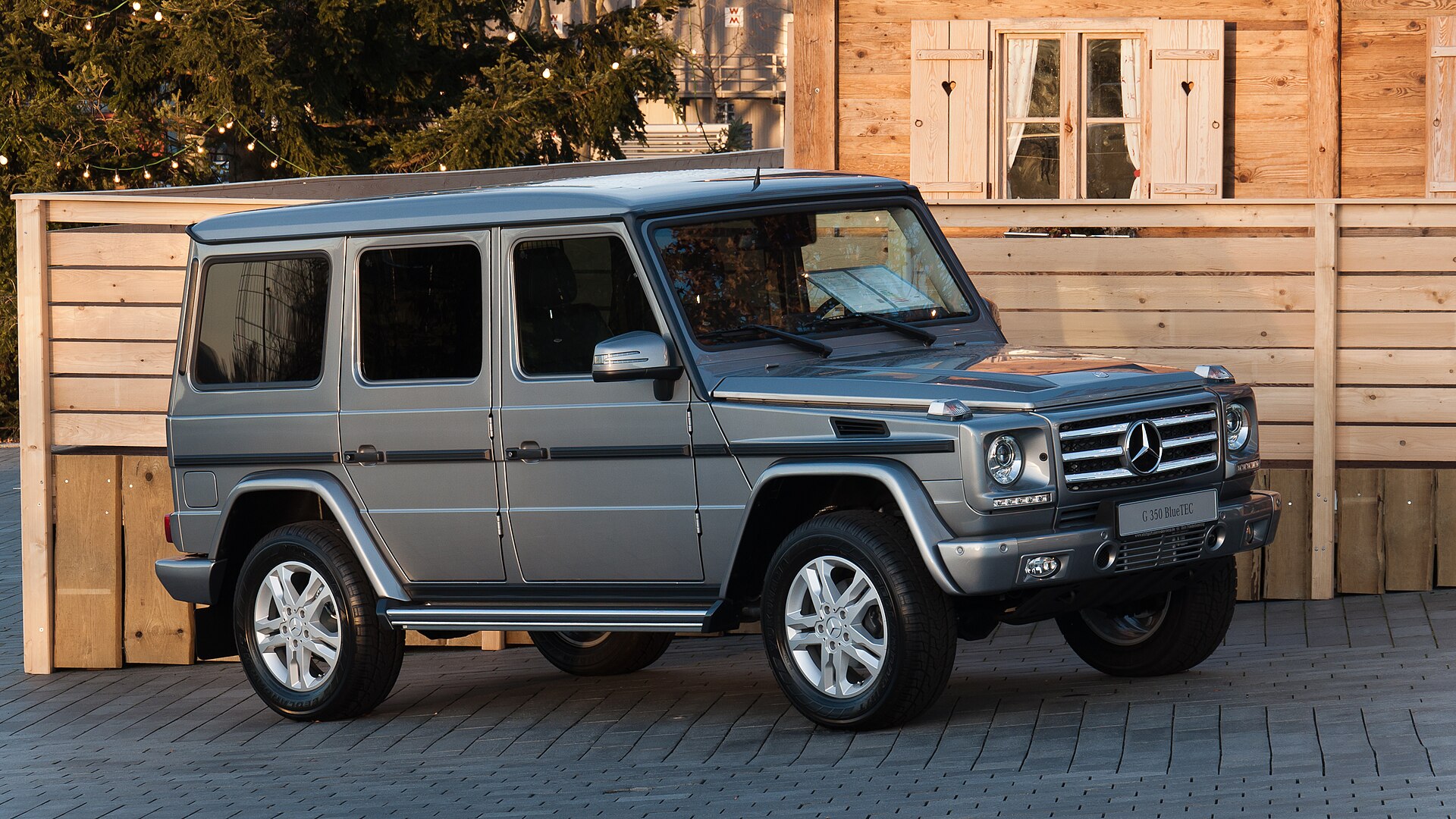
Which G-Class to buy - verdict
Our verdict · Felix Hartmann
- For classic character: a W460 or early W463 with a diesel, simple mechanics and part-time or permanent four-wheel drive.
- For a usable classic with V8 power: a 1998–2008 G 500 with 218 kW.
- For modern comfort: the second generation from 2018, with independent front suspension and 170 kg less weight.
- For maximum performance: the G 63 with 430 kW (585 PS).
- For electric off-roading: the G 580 with four motors and 432 kW, if a 3,085 kg kerb weight is acceptable.
Use our comparison tool to set the G-Class against other large SUVs.
The Mercedes-Benz G-Class is the off-road vehicle that Daimler-Benz and Steyr-Daimler-Puch developed in the 1970s and have built in Graz, Austria, since 1979. Known as the G-Wagen (from Geländewagen, "cross-country vehicle") and in some countries as the Puch G, it began as a rugged utility and military truck and turned into a luxury SUV without losing its body-on-frame design and three locking differentials. More than 500,000 had been built by April 2023, and since 2024 it is also available as the electric G 580.
In short
- In production since 1979 at Graz (today Magna Steyr): W460 (1979–1991), W461 utility models, W463 from 1990, second-generation W463 from 2018.
- Body-on-frame construction, permanent four-wheel drive from 1990 and three fully locking differentials.
- Outputs from 65 kW (88 PS) in the early 300 GD to 430 kW (585 PS) in today's Mercedes-AMG G 63.
- The electric G 580 with EQ Technology (2024) has four motors with 432 kW in total and a 116 kWh battery.
Mercedes-Benz G-Class at a glance
| Specification | Mercedes-Benz G-Class |
|---|---|
| Segment | full-size off-road vehicle / luxury SUV |
| Production | since 1979 in Graz, Austria (Steyr-Daimler-Puch, now Magna Steyr) |
| Series | W460, W461, W462 (Greece), W463, W464 (military), W465 (G 580 electric) |
| Body styles | short- and long-wheelbase station wagons, cabriolet and utility versions |
| Construction | body on frame, three locking differentials, low-range transfer case |
| Power range | 65–430 kW (88–585 PS); G 580 electric 432 kW |
| Other names | G-Wagen, Geländewagen, Puch G (Austria, Switzerland and other markets until 2000) |
| Milestones | 100,000th in 1992, 400,000th in 2020/2021, 500,000th in April 2023 |
The G-Class sits in our Mercedes-Benz catalogue, and two of its most extreme versions have their own pages: the six-wheeled G63 AMG 6x6 and the V12-powered G65 AMG.
Origins: a military idea from Iran and Austria
The idea is usually traced to the Shah of Iran, Mohammad Reza Pahlavi, who suggested a military vehicle to Mercedes-Benz. In 1972 Daimler-Benz and Steyr-Daimler-Puch of Graz agreed to develop it together: Stuttgart was responsible for design and testing, Graz for production planning. A wooden model was shown to the management in 1973, and drivable prototypes were tested from 1974 in German coal mines, the Sahara and the Arctic Circle. A new plant for largely hand assembly was built in Graz in 1975.
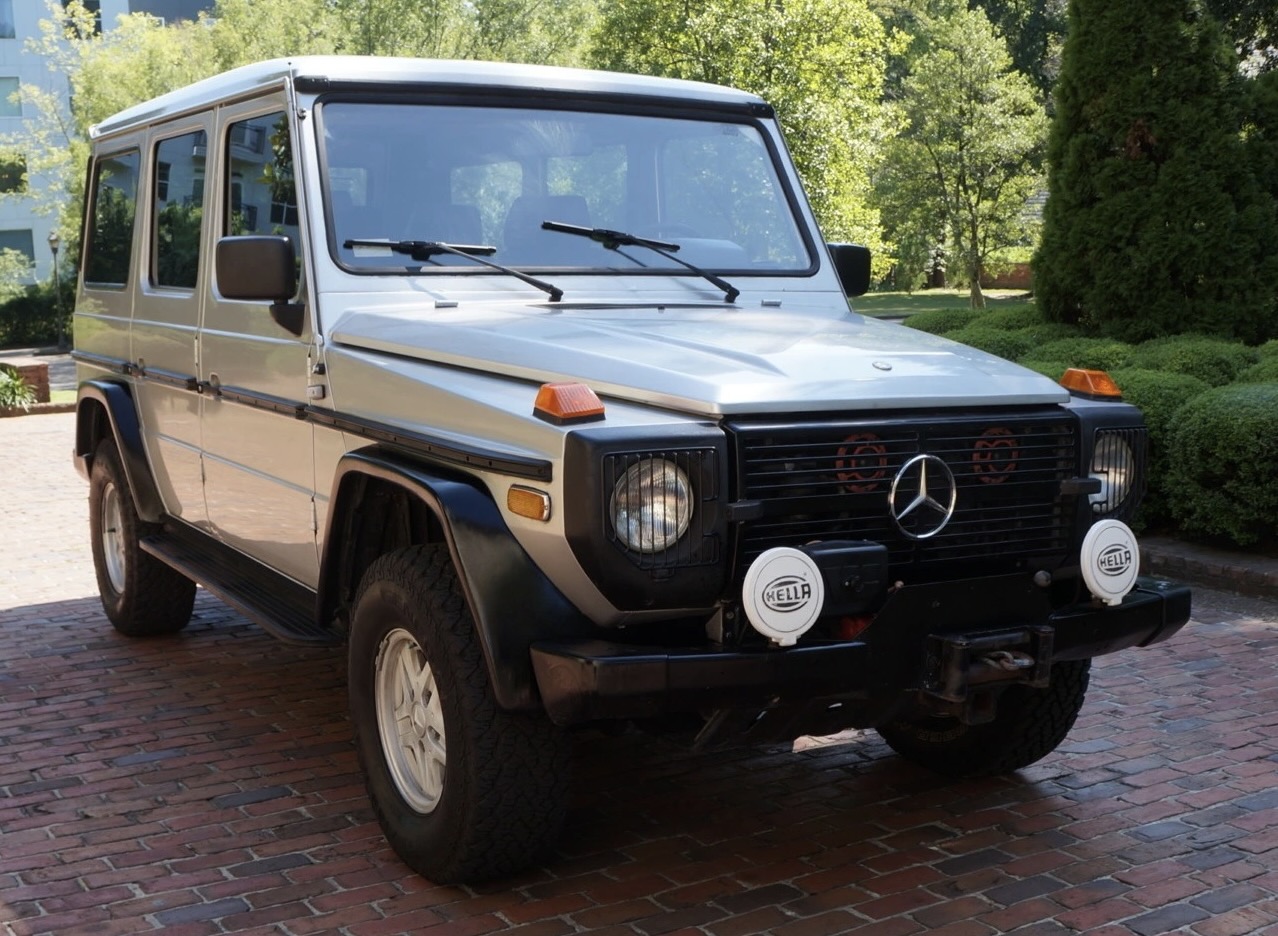
The civilian W460 went on sale in September 1979, after a press presentation at the Toulon off-road proving ground in France. In Austria, Switzerland, Yugoslavia and several Eastern European markets it was sold as the Puch G, because Puch had the stronger off-road reputation there; that arrangement ended in 2000. The range was officially renamed G-Class in 1994.

G-Class series and generations
| Series | Code | Years | Body styles | Engines | Power (kW / hp) |
|---|---|---|---|---|---|
| Original model | W460 | 1979–1991 | five body variants, short and long wheelbase | 2.3 and 2.8 petrol, 2.5 and 3.0 diesel | 63–116 kW (84–156 hp) |
| Utility / military | W461 | 1991–2019 civilian, to 2022 military | W460 body | W463 powertrains | depends on version |
| Luxury model | W463 | 1990–2018 | SWB/LWB wagon, cabriolet | I4, I6, V6, V8, V12 petrol and diesel | up to 450 kW (603 hp) |
| Second generation | W463 (II) | 2018–2024 | LWB wagon | 2.0 I4, 3.0 I6 diesel, 4.0 V8 | 190–430 kW (255–577 hp) |
| Facelift / electric | W465 | from 2024 | LWB wagon | 48-volt engines; G 580 with four electric motors | up to 432 kW (579 hp) |
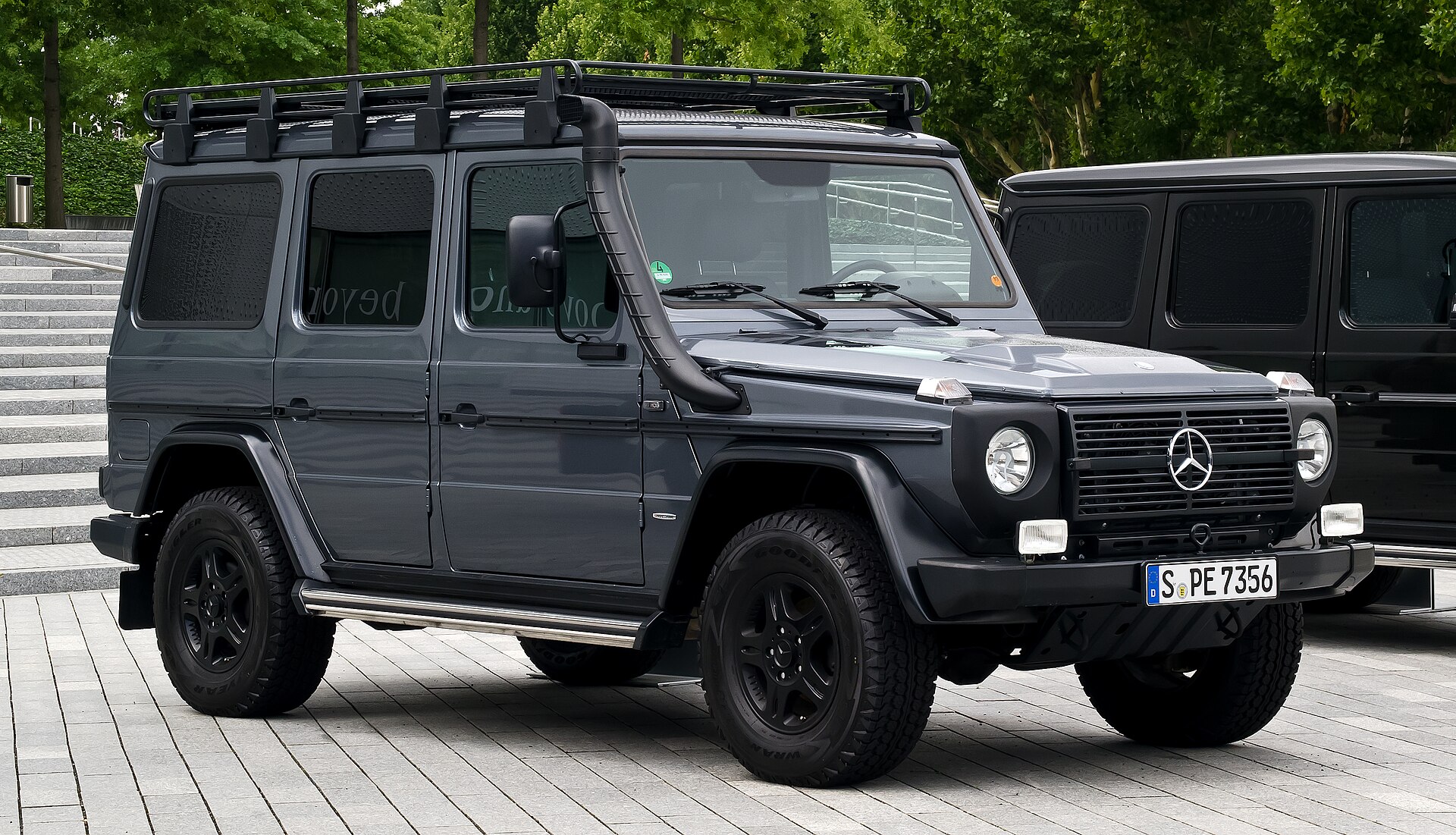
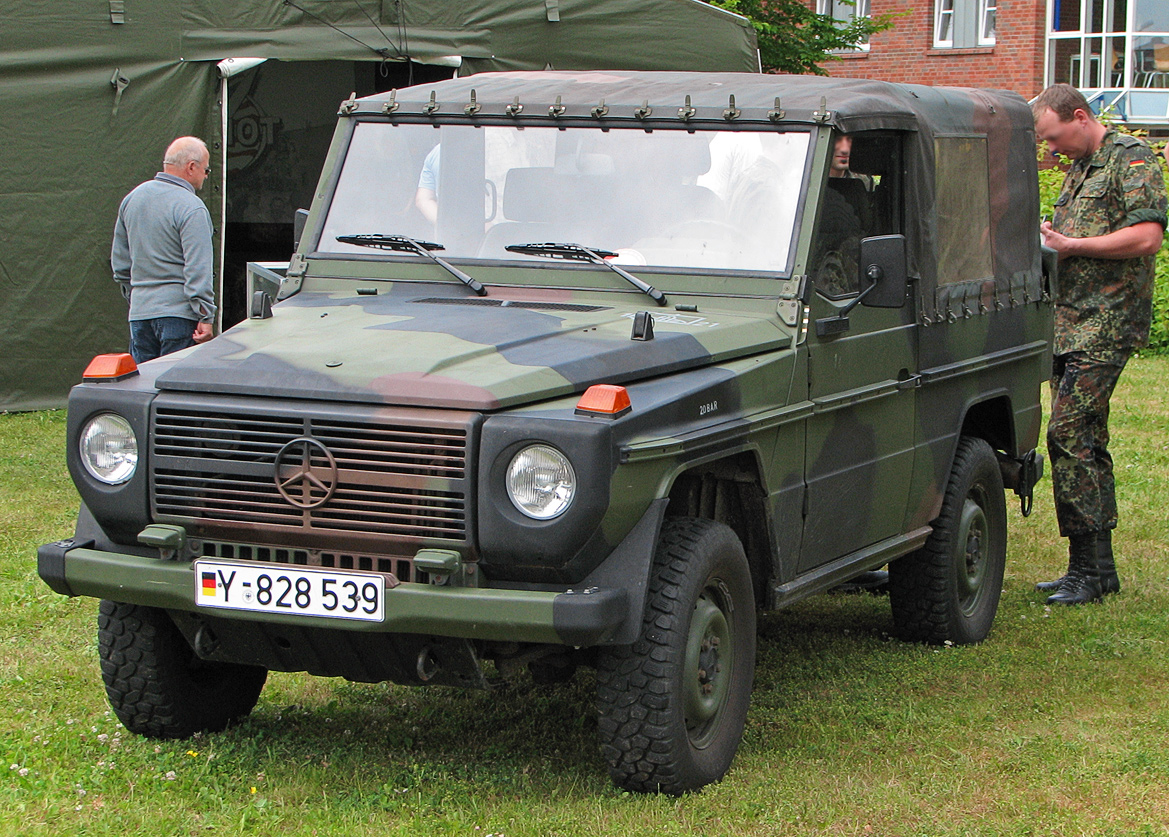
The W461 kept the plain body of the W460 and later used the W463 powertrains. It was the choice of armed forces and authorities: the Bundeswehr's 250 GD "Wolf" and the Argentine Army, the first military user from 1981, are well-known examples, and Peugeot built the P4 under licence in France with Peugeot engines. In 2023 the military W464 replaced it.

W463: from utility vehicle to luxury SUV
The W463 of 1990 changed the character of the car. It brought ABS, permanent four-wheel drive and electrically switched locking differentials, together with a much better-equipped interior. Mercedes-Benz later noted that it had the widest engine range of any Mercedes model. Power rose step by step:
- the 500 GE of 1993 brought a 5.0-litre V8 with 177 kW (241 PS);
- the G 500 of 1998 had a 5.0-litre V8 with 218 kW (296 PS);
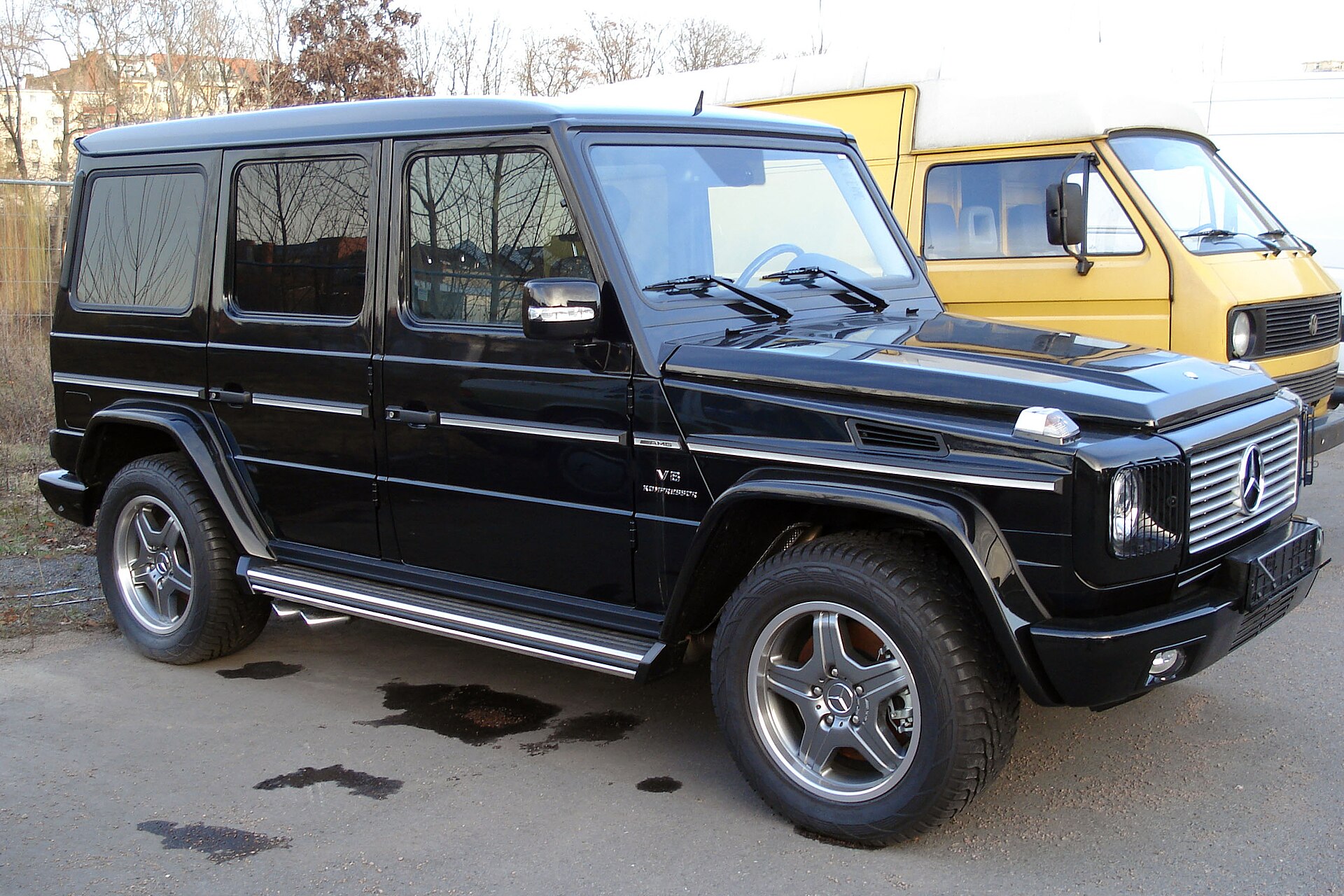
- the G 55 AMG started with 260 kW (354 PS) and, supercharged from 2004, reached 350 kW (476 PS);
- the G 63 AMG of 2012 used a 5.5-litre biturbo V8 with 400 kW (544 PS), and the G 65 AMG a V12 with 450 kW (612 PS) and 1,000 Nm.
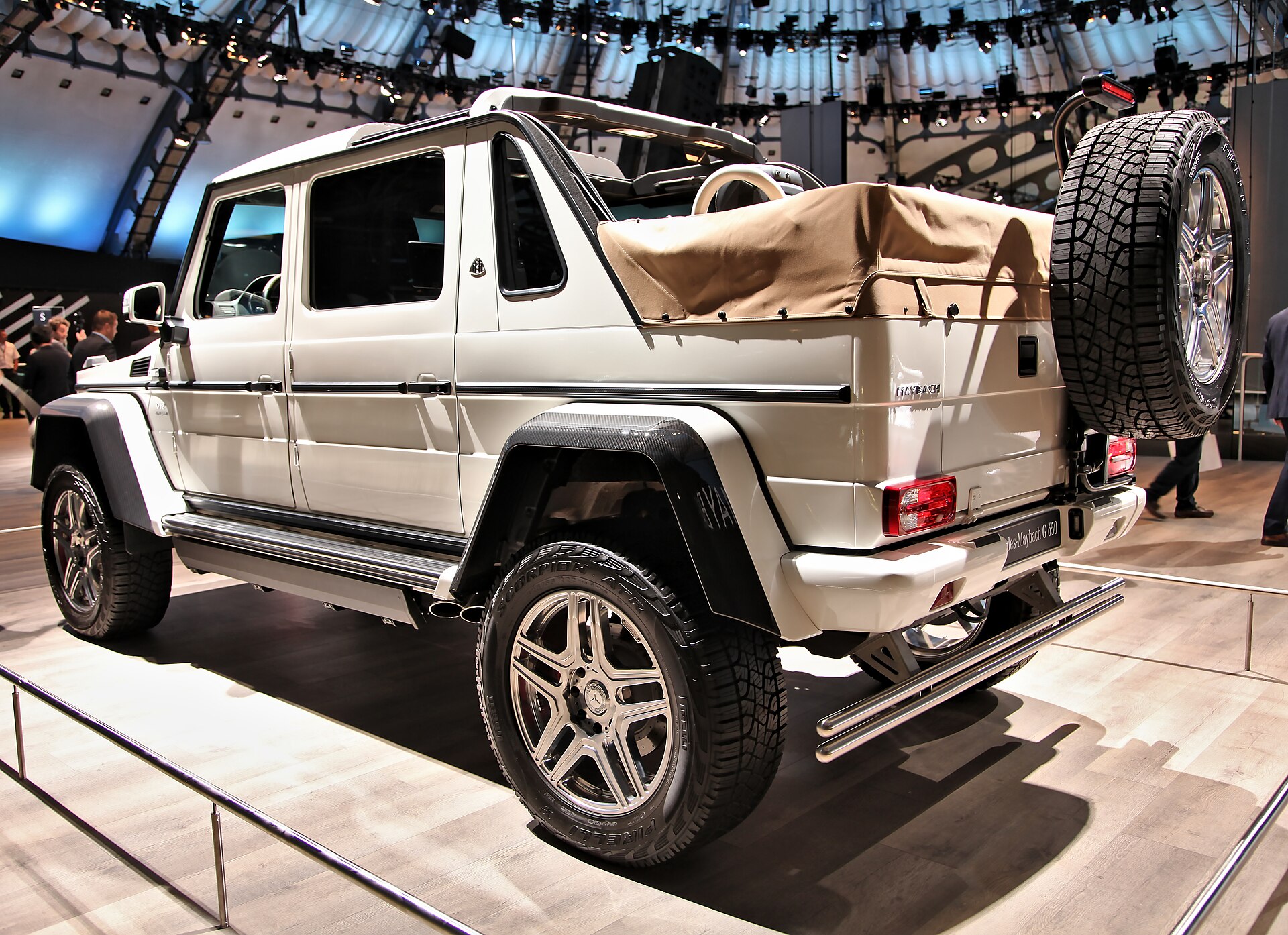
Special models pushed the limits further. The G 63 AMG 6x6, developed from a vehicle for the Australian Army, sold just over 100 units until May 2015. The G 500 4x4² of 2015–2018 used portal axles, and a G 63 4x4² followed in 2022. A G 650 Landaulet limited to 99 units was delivered from September 2017 at €749,700 in Germany. The Vatican received a specially built 230 G cabriolet in 1980 for Pope John Paul II's visit to Germany; the "Papa G" is now in the Mercedes-Benz Museum.


Second generation from 2018 and the W465 update
The new G-Class was presented on 14 January 2018 at the Detroit motor show. It kept the W463 code and the classic shape, but was rebuilt almost completely: according to Wikipedia DE it is 121 mm wider and 53 mm longer, has 6 mm more ground clearance and weighs about 170 kg less. It gained independent front suspension and rack-and-pinion steering, while the rear keeps a solid axle; the low-range ratio changed from 2.1:1 to 2.9:1. The G 500 went on sale in Germany in May 2018 from €107,040.
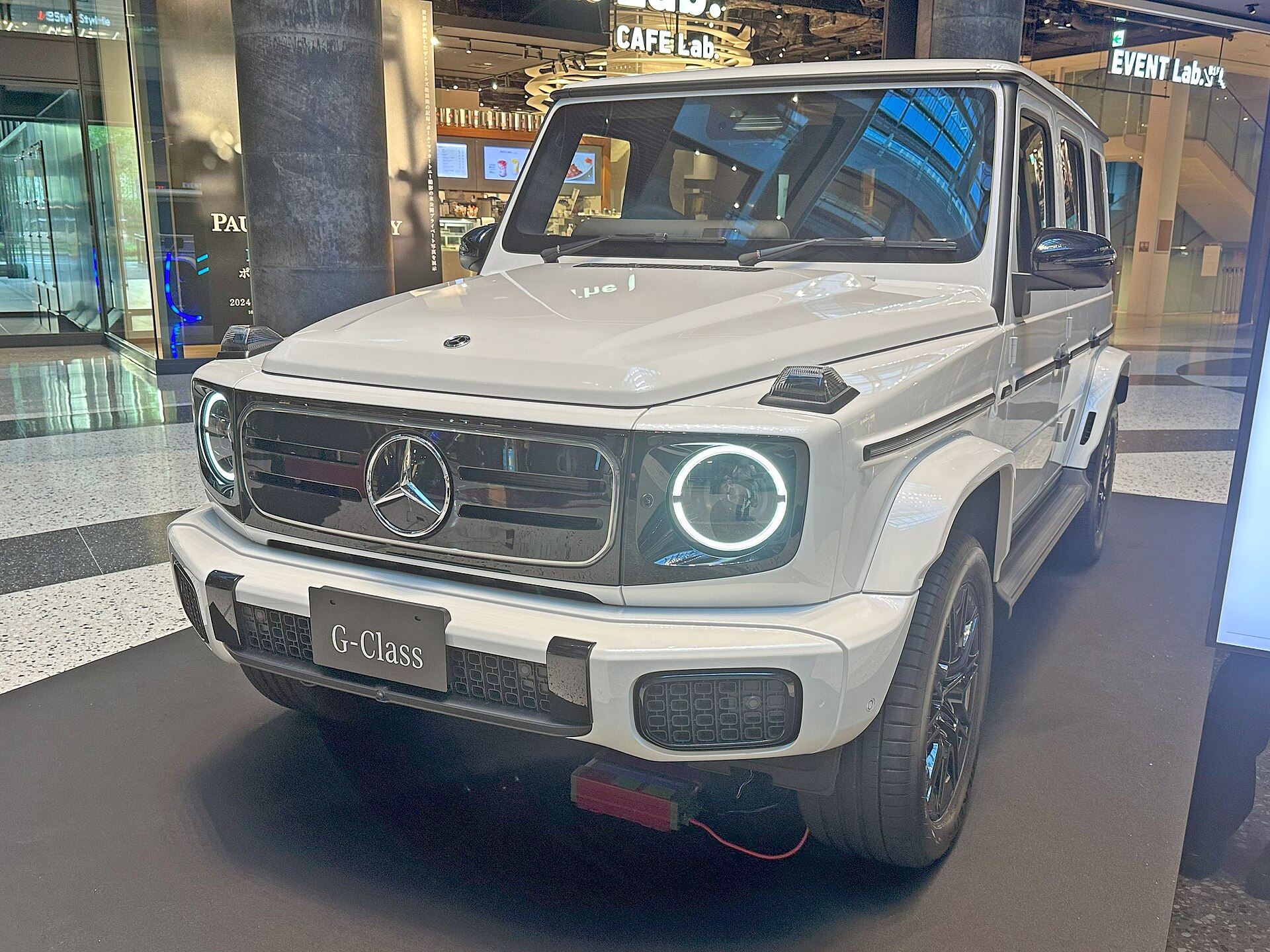
In spring 2024 the next update (W465) gave every combustion engine a 48-volt system with an integrated starter-generator. On 24 April 2024 Mercedes presented the G 580 with EQ Technology in Beijing. It has one electric motor per wheel with 432 kW in total and a 116 kWh battery, can turn on the spot around its vertical axis, and weighs 3,085 kg in EU specification.

Engines and performance of key versions
| Version | Years | Engine | Power | Torque |
|---|---|---|---|---|
| 300 GD (W460) | 1979–1991 | 3.0 I5 diesel | 65 kW (88 PS) | 172 Nm |
| 280 GE (W460) | 1979–1990 | 2.8 I6 petrol | 116 kW (158 PS) | 226 Nm |
| 230 GE (W460) | 1982–1990 | 2.3 I4 petrol | 93 kW (126 PS) | 192 Nm |
| 500 GE (W463) | 1993–1994 | 5.0 V8 | 177 kW (241 PS) | 365 Nm |
| G 500 (W463) | 1998–2008 | 5.0 V8 | 218 kW (296 PS) | 456 Nm |
| G 55 AMG Kompressor | 2004–2006 | 5.4 V8 supercharged | 350 kW (476 PS) | 700 Nm |
| G 63 AMG | 2012–2015 | 5.5 V8 biturbo | 400 kW (544 PS) | 800 Nm |
| G 65 AMG | 2012–2015 | 6.0 V12 biturbo | 450 kW (612 PS) | 1,000 Nm |
| G 500 (2018) | from 2018 | 4.0 V8 biturbo (M176) | 310 kW (421 PS) | 610 Nm |
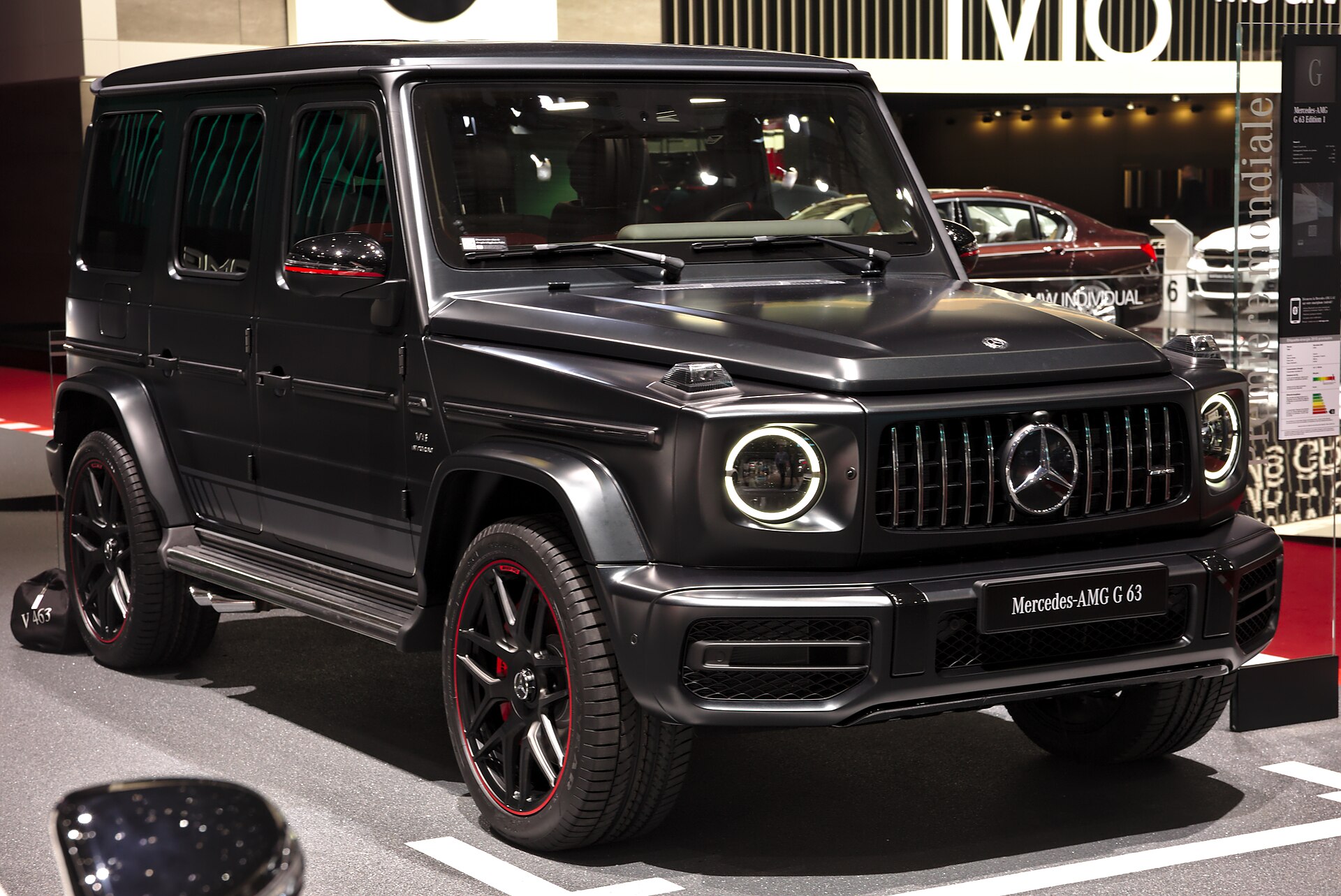
| G 63 (2018) | from 2018 | 4.0 V8 biturbo (M177) | 430 kW (585 PS) | 850 Nm |
| G 350 (China) | from 2020 | 2.0 I4 turbo (M264) | 190 kW (258 PS) | 370 Nm |
| G 580 with EQ Technology | from 2024 | four electric motors | 432 kW (587 PS) | - |
The 2018 G 63 reaches 100 km/h in 4.5 seconds and is limited to 220 km/h, or 240 km/h with the AMG Driver's Package. The diesel G 350 d (from 2019) and G 400 d (from 2020) use the OM656 straight six with 210 kW (282 hp) and 243 kW (326 hp).

Dimensions of the long-wheelbase model
| Parameter | Metric | Imperial |
|---|---|---|
| Wheelbase (four-door) | 2,850 mm | 112.2 in |
| Length, 2010–2018 | 4,686 mm | 184.5 in |
| Width, 2010–2018 | 1,824 mm | 71.8 in |
| Height, 2010–2018 | 1,930 mm | 76.0 in |
| Kerb weight, G 580 (EU) | 3,085 kg | 6,801 lb |
Production and prices over the years
Kittler's figures quoted by Wikipedia DE count 167,794 G-Class built from 1979 to 2002. The 100,000th car left Graz in 1992. Sales reached a record of almost 20,000 in 2016, and Graz built 41,174 in 2021, its best year. Wikipedia EN dates the 400,000th G to 4 December 2020, Wikipedia DE to 2021; the 500,000th followed in April 2023.
Prices show how the car moved up-market. In 1993 a 300 GE cost DM 88,500 and a 500 GE DM 178,250 in Germany (about €45,000 and €91,000 at the fixed DM rate). The 2018 G 500 started at €107,040 in Germany, and in the US the 2018 G 550 cost US$149,900 and the G 63 US$188,050.
Photo gallery


Mercedes-Benz G-Class photos 7
FAQ
Why is the G-Class called G-Wagen?
G stands for Geländewagen, German for cross-country vehicle. The name G-Class has been official since 1994.
Where is the G-Class built?
In Graz, Austria, since 1979 - first by Steyr-Daimler-Puch, today by Magna Steyr under contract to Mercedes-Benz.
How many generations of the G-Class are there?
The civilian car has had three main stages: the W460 of 1979, the W463 of 1990 and the second-generation W463 of 2018, updated as the W465 in 2024. The W461 and W464 are utility and military series.
Is there an electric G-Class?
Yes. The G 580 with EQ Technology, presented in April 2024, has four electric motors with 432 kW and a 116 kWh battery.
What is the most powerful G-Class?
Among series models, the G 65 AMG V12 with 450 kW (612 PS) and 1,000 Nm; today's G 63 has 430 kW (585 PS) and the electric G 580 432 kW.