WEY — Great Wall Motor's Premium SUV Brand, From VV7 to Lanshan
WEY is the premium SUV brand of the Chinese manufacturer Great Wall Motor, introduced on 16 November 2016 and named after the company's chairman, Wei Jianjun. It began with the VV7, VV5 and VV6 crossovers and gave birth to the Tank off-roader in 2020. From 2021 it moved to a coffee-named range of plug-in hybrids. Today it sells large hybrid SUVs and an MPV in China, and its first car in Europe was the Coffee 01, later renamed Wey 05.
Key takeaways
- Introduced on 16 November 2016 as Great Wall's "accessible luxury" SUV brand; the first model, the VV7, went on sale in China in April 2017.
- The name comes from the surname of Great Wall Motor chairman Wei Jianjun.
- The Tank 300 started life as the Wey Tank 300 in July 2020 before Tank became a brand of its own in 2021.
- The Mocha plug-in hybrid was sold in Europe as the Coffee 01 and, from 2024, as the GWM Wey 05.
WEY at a glance
| Fact | Value |
|---|---|
| Introduced | 16 November 2016 |
| Parent | Great Wall Motor (Baoding, Hebei) |
| Name | After chairman Wei Jianjun |
| First model | VV7, on sale April 2017 |
| Main plant | Tianjin, China |
| Model families | VV series (2017–2021), Coffee series (Mocha, Latte, Macchiato), Lanshan, Gaoshan, V8X, V9X |
| Europe | Coffee 01 / Wey 05 plug-in hybrid, from late 2022 |
| Brand CEO | Feng Fuzhi |
Great Wall's move upmarket
Great Wall Motor was founded in 1984 in Baoding, Hebei, from a repair works that dated back to 1976. It became known for pickups and for Haval SUVs, a standalone brand since March 2013. The company's history is told in the Great Wall Motors history. By the mid-2010s it wanted a brand above Haval. On 16 November 2016 it introduced WEY, named after Wei Jianjun, who had become a director of Great Wall in July 1990 at the age of 26. The new brand was to build premium crossovers and SUVs based on Haval engineering.
The VV series: VV7, VV5 and VV6
The first WEY was the VV7, developed under the code name "01" and launched in China in April 2017. A Haval Coupe concept had previewed its design, and the exterior is credited to Rong Ma. It was built in Tianjin on architecture shared with the Haval H6 and the WEY VV5. The 2.0-litre turbo petrol engine had 169 kW (227 hp) and 387 Nm, and a seven-speed dual-clutch gearbox was standard. There were two trims, VV7 C and the sportier VV7 S. A fastback VV7 GT and a version styled by Brabus followed. A plug-in hybrid paired the 2.0-litre engine with an 85 kW electric motor for an electric range of 50 km.
The smaller VV5 arrived in late 2017 and the VV6 in 2018; the P8, a mid-size crossover, was sold from 2018 to 2020. The whole VV family ended in 2021, when the coffee-named models replaced it.

Tank: an off-roader that became a brand
In July 2020 Great Wall presented three new platforms, among them a longitudinal ladder-frame platform for off-road vehicles. Its first product was shown the same month at the Chengdu Auto Show as the Wey Tank 300, a retro-styled off-road SUV with three locking differentials and a low-range gearbox. It went on sale in China on 17 December 2020. Demand was strong enough for Great Wall to change its plan. In March 2021 it announced that the off-road Tank models would form an independent brand, while WEY would concentrate on urban SUVs. The story of that brand is in the Tank 300 guide.

The Coffee series and the move to plug-in hybrids
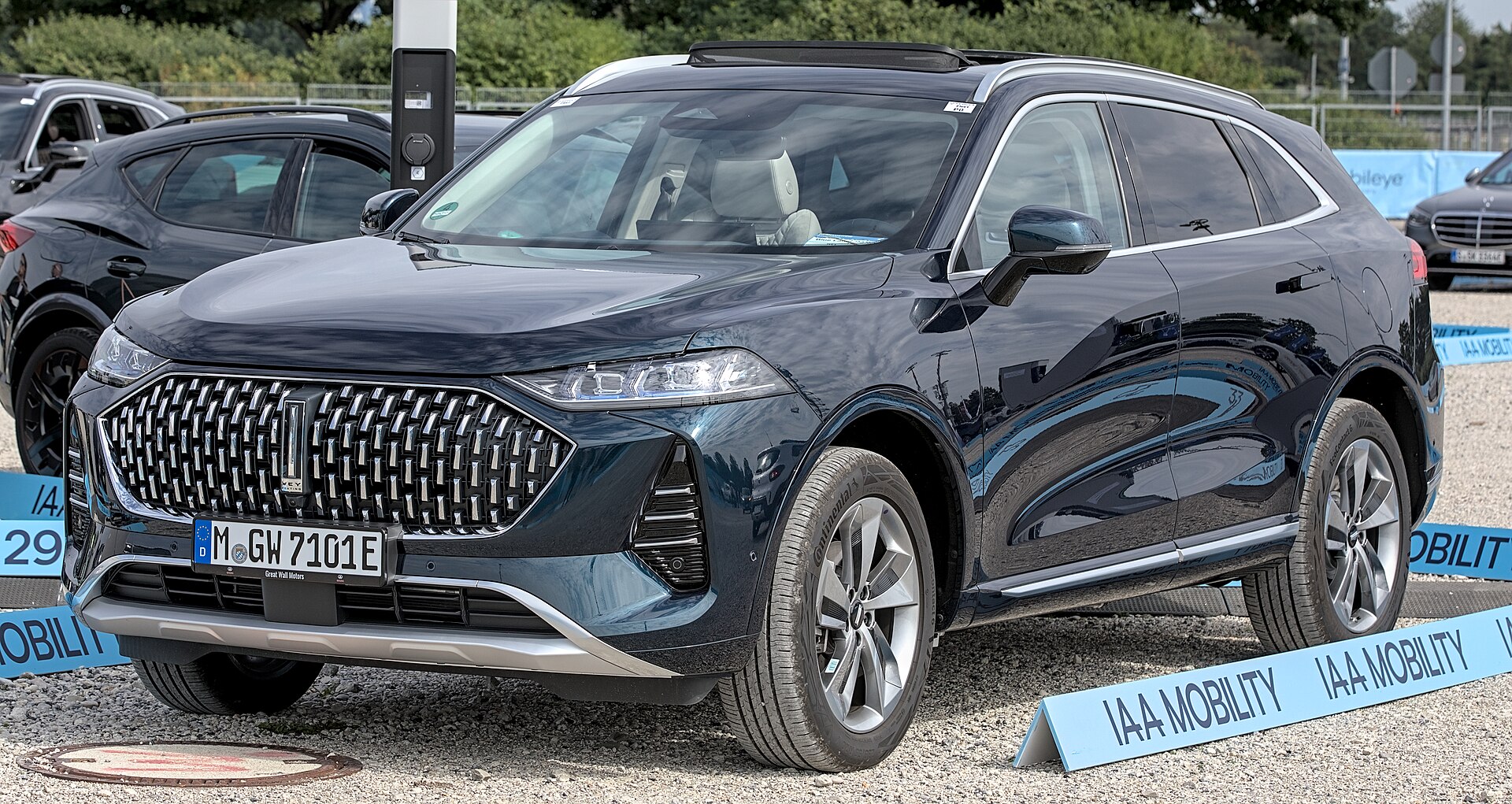
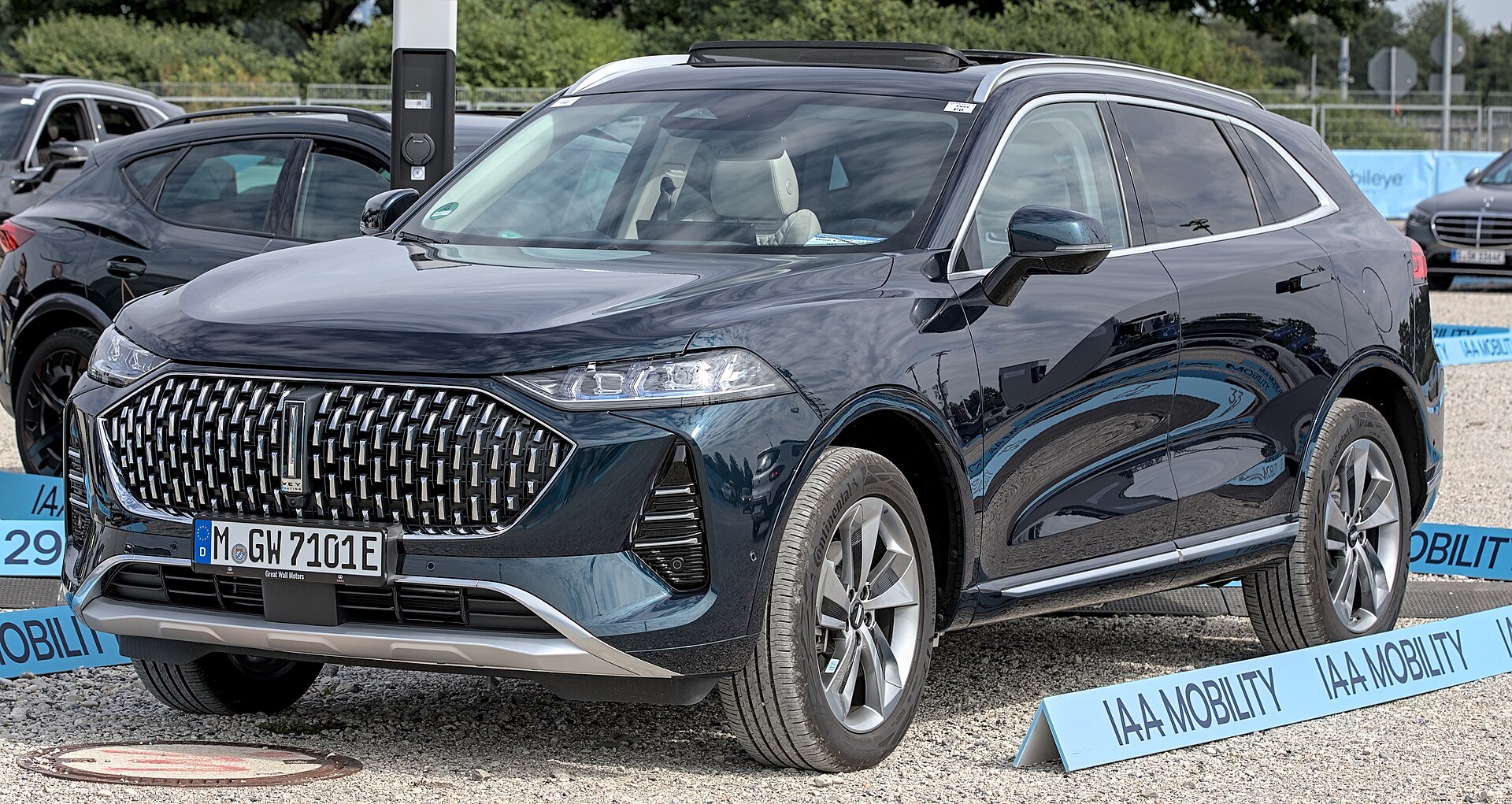
WEY's second generation of models took their names from coffee. The Mocha, a mid-size crossover about 4.88 metres long, was presented in January 2021 and went on sale in April 2021 at Auto Shanghai, replacing the VV7. At launch it had a 2.0-litre turbo petrol engine with 157 kW (213 PS). The Latte and Macchiato compact crossovers, also launched in 2021, took over from the VV5. Plug-in hybrid versions used a multi-mode DHT hybrid drive with an 85 kW motor. The Mocha PHEV had a 45 kWh battery until 2023 and a 35.04 kWh NMC battery from 2024.
At the end of 2022 WEY announced its arrival in Germany and France; in Europe the Mocha PHEV is sold as the Coffee 01. Euro NCAP tested the Coffee 01 in 2022 and gave it 91% for adult occupant protection, 87% for child occupants, 79% for vulnerable road users and 94% for safety assist. From 2024 the car is called the GWM Wey 05 in Europe. The change followed Great Wall's "One GWM" strategy of November 2023, which made GWM the master brand in export markets and turned Haval, Ora and WEY into sub-brands. Sales of the Mocha in China were modest: 5,037 in 2023, 2,924 in 2024 and 1,915 in 2025. The car and its versions are covered in the Wey Mocha and Coffee 01 guide.

Lanshan, Gaoshan and the large hybrids
The largest WEY of the early 2020s is the Lanshan, Chinese for "blue mountain" and sold for export as the Wey 07. It was reportedly unveiled at the 2022 Guangzhou Auto Show and has been built in Tianjin since 2023. The full-size crossover is 5,156 mm long, with a 3,050 mm wheelbase and a kerb weight of 2,395 kg. Its plug-in hybrid system combines a 1.5-litre turbo petrol engine with a 115 kW electric motor for a system output of 380 kW (517 PS) and 933 Nm. The battery of up to 44.5 kWh gives 180 km of electric range on China's CLTC test cycle. Chinese sales reached 23,486 in 2023, 42,499 in 2024 and 35,899 in 2025.
The Gaoshan MPV joined it in 2023, and two more full-size SUVs, the V8X and V9X, were launched in 2026. The current range consists of the Gaoshan, Lanshan, Mocha and V9X, with the V8X listed as a 2026 model.

Where WEY stands
WEY remains a small part of Great Wall's business. The group sold 1,323,672 vehicles in 2025, most of them under the Haval and GWM pickup names. WEY's role is that of a technology and premium brand: large plug-in hybrid SUVs for China and a limited presence abroad under the GWM name. Its models on 1cars are listed in the WEY catalogue, and other family hybrids are compared in the best plug-in hybrid SUVs.
WEY timeline
| Year | Event |
|---|---|
| 2016 | WEY introduced (16 November) |
| 2017 | VV7 on sale (April); VV5 follows late in the year |
| 2018 | VV6 and P8 |
| 2020 | Wey Tank 300 shown in Chengdu (July), on sale 17 December |
| 2021 | Tank becomes a separate brand (March); Mocha, Latte and Macchiato replace the VV series |
| 2022 | Coffee 01 tested by Euro NCAP; arrival in Germany and France announced |
| 2023 | Lanshan and Gaoshan in production; "One GWM" strategy (November) |
| 2024 | Coffee 01 renamed GWM Wey 05 in Europe |
| 2026 | V8X and V9X launched |
Landmark WEY models
| Model | Years | Why it matters |
|---|---|---|
| VV7 | 2017–2021 | First WEY, built in Tianjin |
| Wey Tank 300 | 2020–2021 | Off-roader that became the Tank brand |
| Mocha / Coffee 01 / Wey 05 | 2021–present | First coffee-named model and WEY's car for Europe |
| Lanshan (Wey 07) | 2023–present | Full-size plug-in hybrid, 42,499 sold in China in 2024 |
| Gaoshan | 2023–present | First WEY MPV |
Photo gallery

FAQ
Who owns WEY?
Great Wall Motor, the Chinese manufacturer from Baoding that also owns Haval, Ora, Tank and the GWM pickups.
Where does the name WEY come from?
From the surname of Great Wall Motor chairman Wei Jianjun.
Is the Wey Coffee 01 the same car as the Wey 05?
Yes. The plug-in hybrid Mocha was sold in Europe as the Coffee 01 until the end of 2023 and as the GWM Wey 05 from 2024.
Was the Tank 300 a WEY?
At first, yes: it was shown in July 2020 as the Wey Tank 300. In 2021 Tank became a separate brand.
Sources
- Wikipedia — Wey (marque) (accessed 24 Oct 2026)
- Wikipedia — Great Wall Motor (accessed 24 Oct 2026)
- Wikipedia — Wey VV7 (accessed 24 Oct 2026)
- Wikipedia — Wey Mocha (accessed 24 Oct 2026)
- Wikipedia — Wey Lanshan (accessed 24 Oct 2026)
- Wikipedia — Tank 300 (accessed 24 Oct 2026)
Found a mistake? Report an error