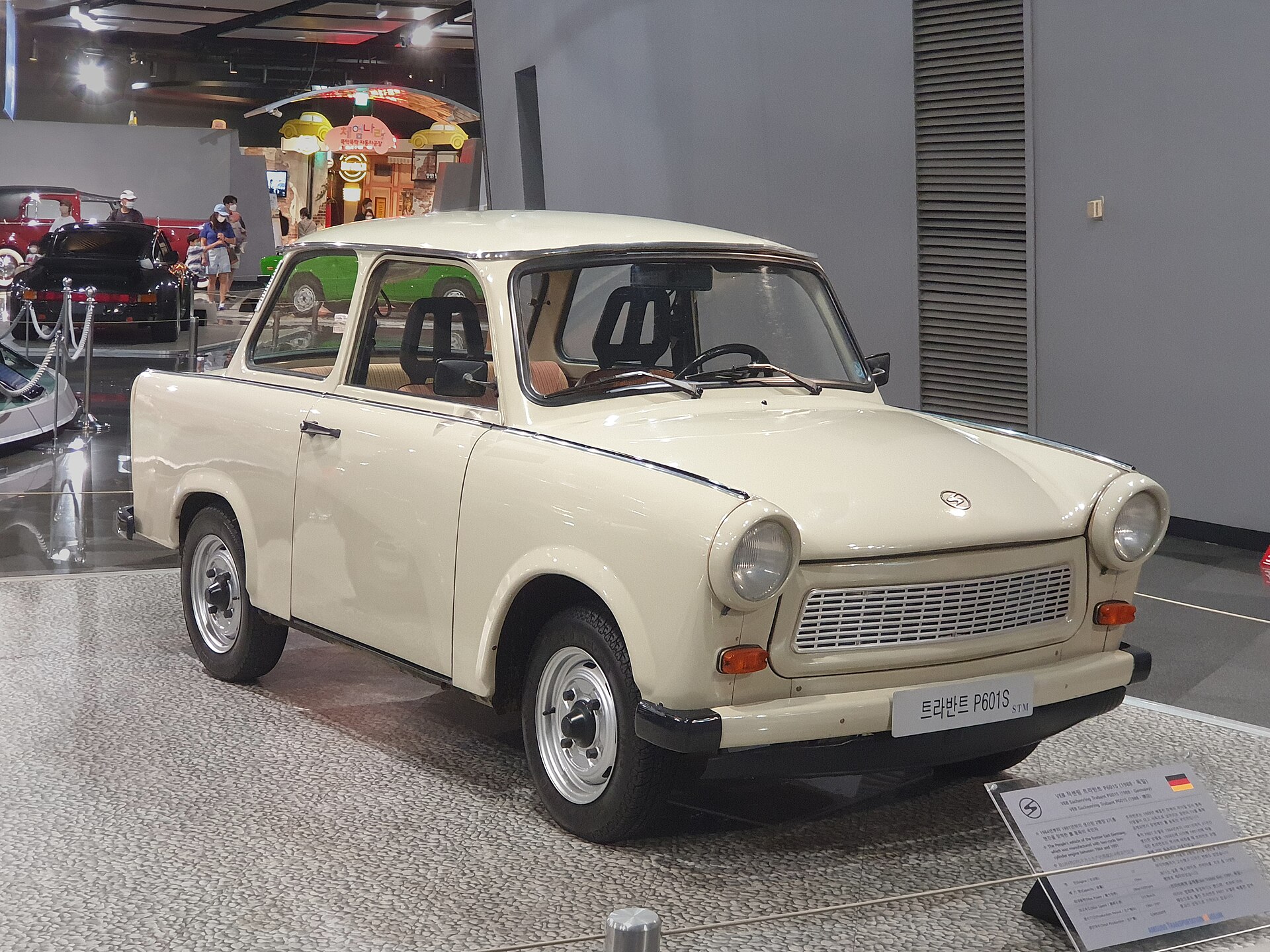
Trabant — The Two-Stroke Car From Zwickau and Its Long Life
Trabant was the car brand of VEB Sachsenring in Zwickau, East Germany, and the most common car in the country for more than 30 years. The first Trabant left the factory on 7 November 1957; its body was made of duroplast, a plastic of cotton waste and phenol resin, and its engine was a small air-cooled two-stroke derived from pre-war DKW practice. The 601 of 1964 stayed in production with few changes until 1990, buyers waited up to 13 years for a new car, and the Trabant became a symbol of the fall of the Berlin Wall in 1989. Production ended in 1991.
Key takeaways
- Built by VEB Sachsenring Automobilwerke Zwickau, formed in 1958 from AWZ and the former Horch works; the site had been part of the pre-war Auto Union and DKW business.
- The P 50 of 1957–1962 had a 499 cc two-stroke of 13 kW (17 PS) and duroplast body panels on a steel frame.
- The 601 (1964–1990) was built 2,818,547 times; in 1985 it cost 8,500 East German marks.
- The Trabant 1.1 with a Volkswagen-based four-stroke engine was built from May 1990 until April 1991.
Trabant at a glance
| Fact | Value |
|---|---|
| Maker | VEB Sachsenring Automobilwerke Zwickau |
| First car | 7 November 1957 (P 50 pre-series) |
| Body | Duroplast panels on a steel frame |
| Engine | Air-cooled two-cylinder two-stroke, 499–594.5 cc |
| Best-known model | Trabant 601 (1964–1990) |
| Last model | Trabant 1.1 with a 1,043 cc four-stroke (1990–1991) |
| Total production | 3,096,999 or 3.7 million, depending on the source |
| End of production | April 1991 |
Zwickau: DKW roots and the P70
Zwickau had been home to the pre-war Auto Union and its DKW cars. After the division of Germany, Auto Union re-formed in West Germany and eventually became Audi, while the factories in Zwickau kept the DKW two-stroke tradition. The first post-war products of the Zwickau works were essentially copies of pre-war DKW designs. Those predecessors are listed in the catalogues of Auto Union and DKW.
The direct ancestor of the Trabant was the AWZ P70, built by VEB Automobilwerke Zwickau from 1955 to 1959. It used a 684 cc two-cylinder two-stroke of 16 kW (22 PS) from the IFA F8 and a new body of duroplast on a wooden frame with a plywood floor; it is described as one of the first cars with an all-plastic body, after the Chevrolet Corvette. In 1958 AWZ merged with the former Horch factory to form VEB Sachsenring Automobilwerke Zwickau, and 36,151 P70s were built.
The P 50 and the duroplast body
The first Trabant, the P 50, left the Zwickau works on 7 November 1957 as one of 50 pre-series cars, and series production ran from August 1958 to September 1962. It had front-wheel drive, unitary construction, independent suspension and an air-cooled two-stroke of 499 cc with 13 kW (17 PS), later 15 kW (20 PS) with a fully synchronised gearbox from 1960. Its duroplast body panels, made from cotton waste and phenol resins, sat on a steel frame. The material was developed in 1953 by the engineer Wolfgang Barthel. Steel was scarce in East Germany, and duroplast could be formed in a press, which suited volume production better than glass fibre. Saloon, estate and panel-van versions were offered.
Annual output grew from 1,780 in 1958 to 39,335 in 1961, and 131,495 P 50s were built. The saloon cost 7,450 DDR marks for its whole production run. Top speed was about 90 km/h, and fuel use was about 8 litres per 100 km. In October 1962 production switched to the Trabant 600, which had a 594 cc engine of 17 kW (23 PS).
The 601: 26 years of one design
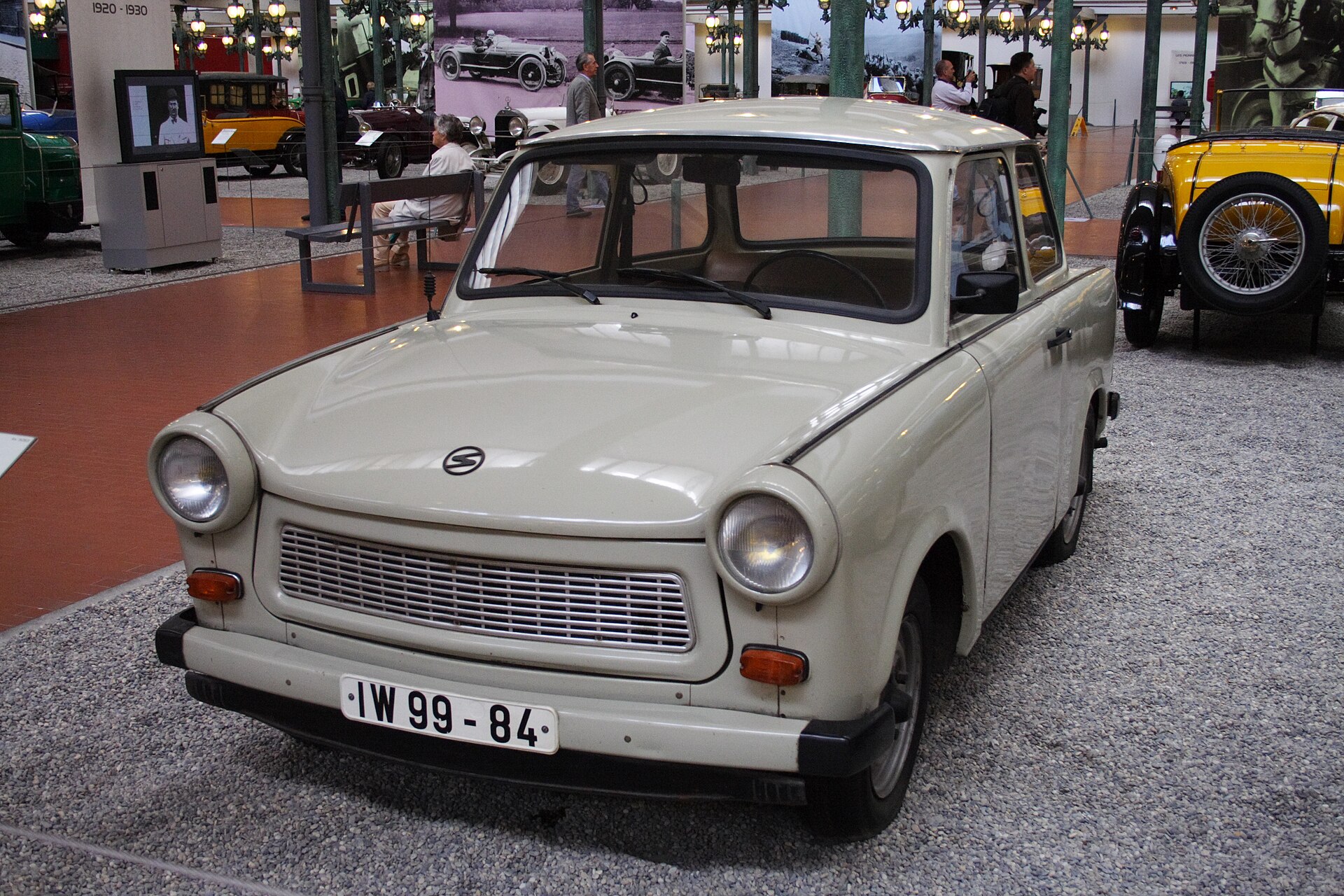
The Trabant 601 of 1964 was a facelift of its predecessor, with a new front, bonnet, roof and rear on the original P 50 underpinnings. Its 594.5 cc two-stroke gave 16.9 kW (23 PS), and from 1969 19.1 kW (26 PS), for a car weighing 615 kg as a saloon. It ran on 88 RON petrol mixed with two-stroke oil at 1:50. At 19.1 kW for 615 kg the ratio is about 31 W per kg, which the power-to-weight calculator can compare with any modern car.
Besides the saloon there was the Universal estate, the doorless Kübel utility model of 1966 and its civilian version, the Tramp, from 1978. Production rose from 34,000 a year in 1964 to 100,000 in 1973 and peaked at 150,000 in 1989.
In 1985 a 601 Standard cost 8,500 East German marks and the most expensive 601 Universal S de Luxe 9,700 marks. In all, 2,818,547 601s were built from June 1964 to July 1990. The designers proposed several replacements, but the government rejected them repeatedly because of shortages of raw materials. The 601 is covered in detail in the Trabant 601 article, and the model's long run can be compared with other cars in the longest-produced models data.


Waiting lists and the fall of the Wall
Demand always exceeded supply. In 1989 the official price was 7,450 marks, demand outstripped production by 43 to 1, and waiting lists reached up to 13 years; buying a car usually took about ten. Used Trabants sold for more than twice the price of new ones.
In mid-1989 thousands of East Germans drove their Trabants through Hungary or Czechoslovakia to West Germany. When pictures of the border crossings during the fall of the Berlin Wall were broadcast around the world, the car became an emblem of East Germany. The journalist Richard Leiby later described it as "a symbol of the technological and social backwardness of the East German state."
The Trabant 1.1 and the end
The last version was the Trabant 1.1. It used a 1,043 cc four-stroke engine of 33 kW (45 PS), a locally built version of the Volkswagen Polo's EA111 unit, together with front disc brakes and MacPherson struts. Series production began in May 1990, after the two German states had agreed on reunification. It ended in April 1991 after only eleven months.
The Zwickau factory in Mosel was sold to Volkswagen AG, and the rest of the company became HQM Sachsenring GmbH. Total Trabant production is given as 3,096,999 in one part of the Trabant article and as 3.7 million in another.

After 1991: symbol and collector's car
After the Wall fell, many Trabants were abandoned in the West; in the early 1990s they sold for a few Deutsche Marks or were given away. Duroplast proved hard to dispose of, and in the late 1990s Sachsenring shredded body shells and used the pieces as filler in paving blocks. Prices later rose as the car became a collector's item. In 1997 a Trabant passed the moose test without rolling over. In 2007 the model maker Herpa acquired the rights to the name and showed a "newTrabi" model. In 2009 the Trabant nT concept, planned as an electric car with a 45 kW (61 PS) motor, was presented in Frankfurt. It did not go into production. Trabant models are listed in the Trabant catalogue, and other cars of the period are in the classic cars section.

Trabant timeline
| Year | Event |
|---|---|
| 1955 | AWZ P70 with duroplast body |
| 1957 | First Trabant P 50 leaves the factory (7 November) |
| 1958 | VEB Sachsenring formed; P 50 series production (August) |
| 1960 | 15 kW (20 PS) engine and synchronised gearbox |
| 1962 | Trabant 600 with 594 cc engine |
| 1964 | Trabant 601 |
| 1969 | 601 engine raised to 19.1 kW (26 PS) |
| 1973 | Output reaches 100,000 a year |
| 1989 | Peak output of 150,000; fall of the Berlin Wall |
| 1990 | Trabant 1.1 with VW-based engine (May); last 601 (July) |
| 1991 | End of production (April) |
| 2009 | Trabant nT electric concept |
Landmark Trabant models
| Model | Years | Why it matters |
|---|---|---|
| AWZ P70 | 1955–1959 | Duroplast-bodied predecessor |
| P 50 | 1957–1962 | First Trabant, 499 cc two-stroke |
| 600 | 1962–1965 | 594 cc engine of 17 kW (23 PS) |
| 601 | 1964–1990 | 2,818,547 built, the best-known Trabant |
| 601 Kübel / Tramp | 1966 / 1978 | Doorless utility versions |
| 1.1 | 1990–1991 | Four-stroke Volkswagen-based engine |
Photo gallery

FAQ
What is a Trabant made of?
Its body panels are duroplast, a material made of cotton waste and phenol resins, fitted to a steel frame.
How long did people wait for a Trabant?
Waiting lists reached up to 13 years in 1989, and getting a car usually took about ten years.
How many Trabants were built?
The Trabant article gives 3,096,999 in one place and 3.7 million in another. The 601 alone was built 2,818,547 times.
What engine does a Trabant have?
An air-cooled two-cylinder two-stroke of 499 cc (P 50) or 594.5 cc (601). The last Trabant 1.1 had a 1,043 cc four-stroke based on the Volkswagen Polo engine.
When did Trabant production end?
In April 1991, after eleven months of Trabant 1.1 production.
Sources
- Wikipedia — Trabant (accessed 24 Oct 2026)
- Wikipedia — Trabant P50 (accessed 24 Oct 2026)
- Wikipedia — Trabant 601 (accessed 24 Oct 2026)
- Wikipedia — AWZ P70 (accessed 24 Oct 2026)
- Wikipedia — Duroplast (accessed 24 Oct 2026)
Found a mistake? Report an error