Trabant 601
Specs, engines and history
Published Sources (1) Report an error
By Felix Hartmann, Automotive Technology & EV Contributor
- Built
- 1964–1990
- Top power
- 19 kW (26 PS)
Which Trabant 601 to choose
Our verdict · Felix Hartmann
- For originality: a late 601 S or S de Luxe in unrestored condition, from the 1980s with the improved carburettor.
- For practicality: a 601 Universal, the three-door estate.
- For rarity: a Kübel or a Tramp, or one of the Hycomat cars with the automatic clutch.
- For a modern engine: a Trabant 1.1 with the Volkswagen four-stroke, built for only eleven months.
More cars of the period are in the 1980s classics and 1960s classics sections.
Trabant was the car brand of VEB Sachsenring Automobilwerke Zwickau, a state-owned maker in East Germany. The Zwickau works had been part of the pre-war Auto Union and DKW business, and their first post-war products were close to old DKW designs. The AWZ P70 of 1955–1959 was the first car with a body made from recycled material; the Trabant was the second. The first Trabant, the 500 cc P50, left the factory on 7 November 1957. The name comes from the Middle High German drabant, meaning "companion" or "satellite", and was inspired by the Sputnik satellite.
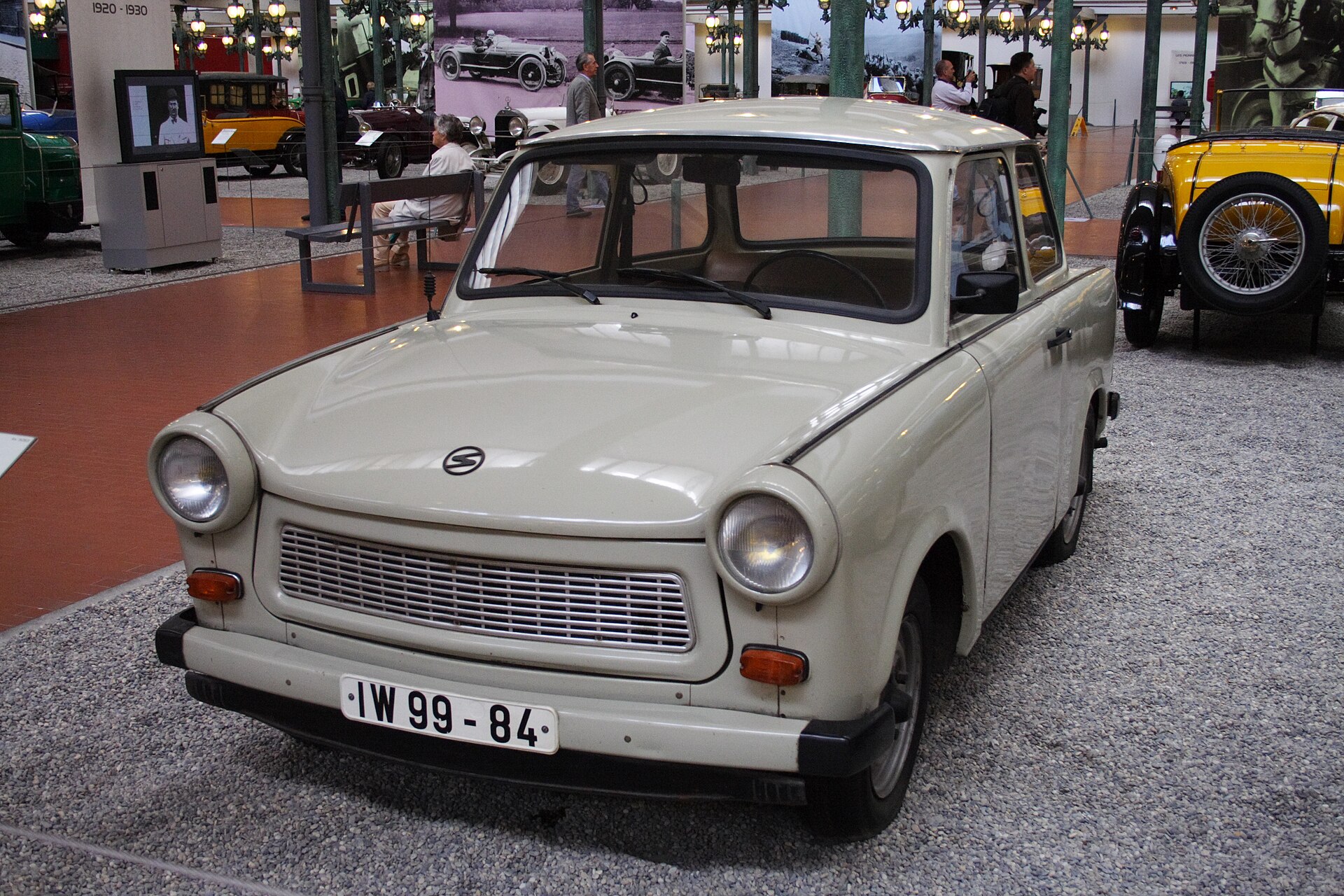
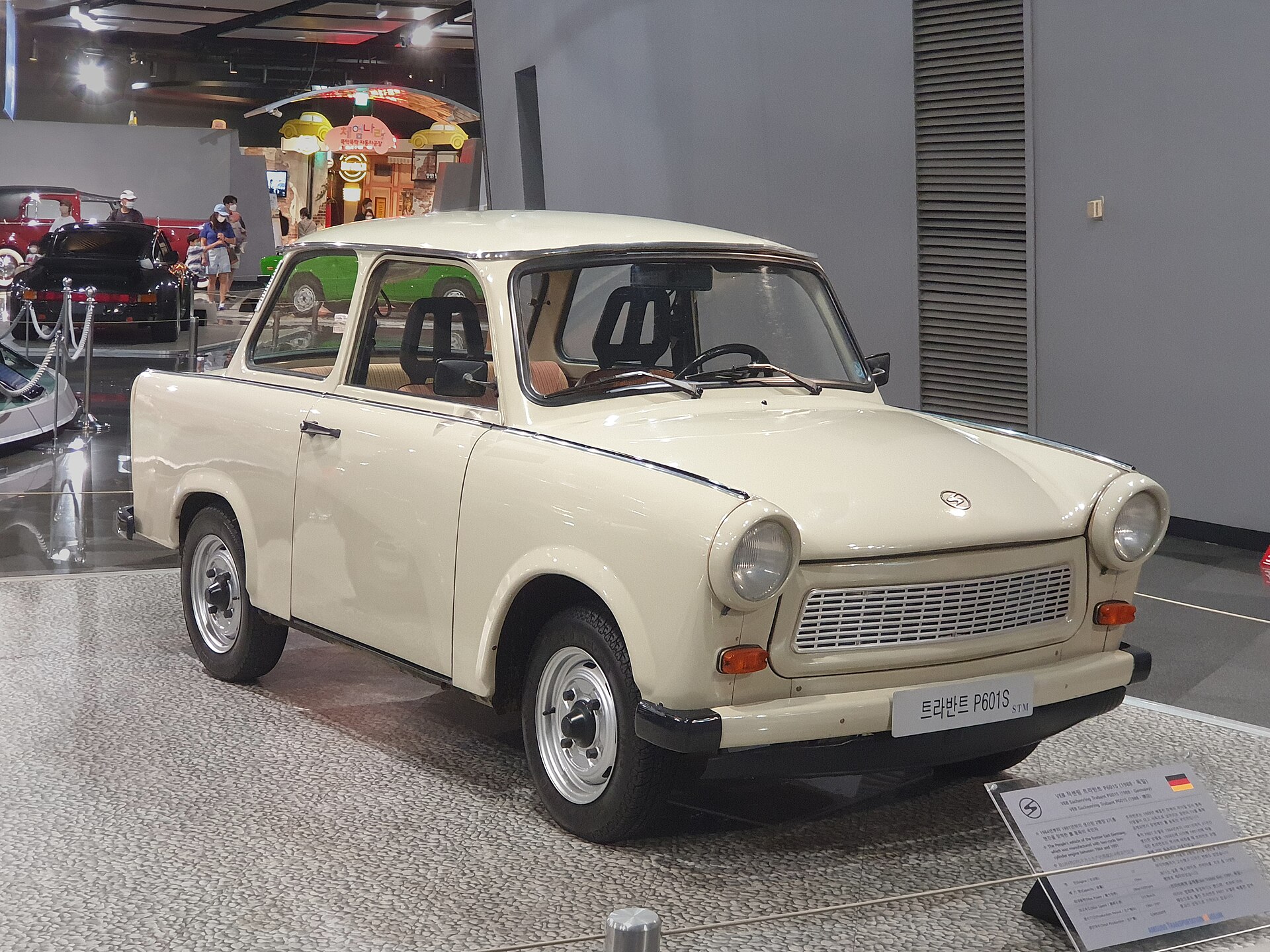
The 601 is the Trabant almost everyone knows. Built in Zwickau from June 1964 to July 1990, it reached 2,818,547 cars. It has a two-stroke twin of 594 cc, front-wheel drive and a body of Duroplast, a hard plastic made with recycled cotton waste and phenol resins. It hardly changed in 26 years, and buyers often waited ten years or more for one. In 1989 it became a symbol of the opening of the Berlin Wall.
Specs by version
Verified Manufacturer and type-approval data from our catalog · Sources and methodology
In short
- Built from June 1964 to July 1990 at VEB Sachsenring, Zwickau; 2,818,547 cars.
- Two-stroke twin of 594 cc: 17 kW (23 PS) at first, 19 kW (26 PS) from 1969.
- Duroplast body panels on a unitary structure; saloon, Universal estate, Kübel and Tramp versions.
- Price in 1985: 8,500 East German marks for the 601 Standard; waiting lists of ten years or more were not unusual.
Trabant 601 at a glance
| Parameter | Value |
|---|---|
| Maker | VEB Sachsenring Automobilwerke, Zwickau, East Germany |
| Production | June 1964 – July 1990 |
| Built | 2,818,547 |
| Body | Duroplast panels; two-door saloon (Limousine), three-door estate (Universal), Kübel, Tramp |
| Layout | transverse front engine, front-wheel drive |
| Engine | two-stroke twin, 594.5 cc |
| Power | 17 kW (23 PS) first P60 engine; 19 kW (26 PS) P62 from 1969 |
| Torque | 54 Nm at 3,000 rpm |
| Gearbox | four-speed manual; Hycomat automatic clutch as an option |
| Suspension | independent on all wheels; rack-and-pinion steering |
| Wheelbase | 2,020 mm |
| Length × width × height | 3,555 × 1,505 × 1,440 mm (Universal 3,560 × 1,510 mm) |
| Weight | 615 kg (Universal 650 kg) |
| Top speed | 100 km/h in the spec table; 107 km/h after later improvements |
| Fuel | 88 RON petrol mixed 1:50 with two-stroke oil |
From the P50 to the 601
The P50 of 1957 had a 500 cc engine with 13 kW (17 PS). In June 1964 the 601 arrived with the 594 cc P60 engine. For the rest of its life the 601 changed mainly in detail. The P62 engine of 1969 raised power to 19 kW (26 PS), and in 1984 a two-stage carburettor cut fuel use by about one litre per 100 km.
The body panels were Duroplast, made from recycled cotton waste and phenol resins from the East German dye industry. Under them sat a unitary structure with independent suspension on all four wheels and rack-and-pinion steering. The Trabant article in English Wikipedia gives the car's average service life as 28 years.

Engine: the two-stroke twin
The 594 cc twin is a two-stroke, so it burns its lubricating oil and leaves the typical blue smoke behind. Owners mixed 88 RON regular petrol with two-stroke oil at a ratio of 1:50. The engine gave 17 kW (23 PS) in its first form and 19 kW (26 PS) from 1969, with 54 Nm at 3,000 rpm. It drove the front wheels through a four-speed gearbox. With 19 kW and 615 kg, the saloon has about 31 kW per tonne, and fuel use rose quickly under hard acceleration or when towing. The power-to-weight calculator puts that figure against modern small cars. The two-stroke design also limited exports to Western Europe from the 1970s, where sales stayed negligible.
Versions: saloon, estate, utility and Hycomat
| Version | Years | Body / purpose | Notes |
|---|---|---|---|
| 601 Limousine | 1964–1990 | two-door saloon | 3,555 mm long, 615 kg |
| 601 Universal | 1964–1990 | three-door estate | 3,560 mm long, 650 kg |
| 601 Kübel | from 1966 | doorless utility car | - |
| 601 Tramp | from 1978 | civilian version of the Kübel | mainly exported to Greece |
| 601 Hycomat (601 H) | 1965–1990 | automatic clutch | also for drivers with disabilities |
| 800 RS | 1986–1988 | rally car | 771 cc engine, five-speed gearbox |
The Hycomat system was developed in 1964 and built in series from 1965. From 1982 a Universal adapted for disabled drivers was also offered. Trim levels ran from the Standard to the S de Luxe. In 1978 a 601 saloon cost 7,850 East German marks as a Standard and up to 9,600 marks as an S de Luxe with both equipment packages. In 1985 a 601 Standard cost 8,500 marks and a 601 Universal S de Luxe 9,700 marks.

Changes year by year
German Wikipedia lists the updates in detail. The most important were:
| Year | Change |
|---|---|
| 1964 | pre-series production from January, international presentation on 1 March, series production from June |
| 1965 | Universal estate moves to the 601 body; Hycomat automatic clutch offered |
| 1966 | military (P 601 A) and forestry (P 601 F) Kübel versions |
| 1967 | duplex front brakes |
| 1969 | 19 kW (26 PS) engine (P63 in German Wikipedia), diaphragm-spring clutch |
| 1971 | sliding seats with adjustable backrests; fuel tank from 24 to 26 litres |
| 1974 | P65 engine, oil ratio from 1:33 to 1:50, hazard lights, new gearing; top speed 108 km/h |
| 1978 | S de Luxe top trim |
| 1980 | dual-circuit brakes |
| 1984 | 12-volt electrics with alternator, H4 headlights, new carburettor |
| 1985 | transistor ignition |
| April 1988 | coil springs on the rear axle |
Fuel use fell over the years. German Wikipedia quotes test figures of 8.2 litres per 100 km in 1964 and 8.7 in 1970, and a drop from about 8 to 6.9 litres in the 1980s. A 1969 test measured a top speed of 105 km/h.
Production and exports
| Year | Built |
|---|---|
| 1964 | 29,691 |
| 1970 | 86,200 |
| 1980 | 118,436 |
| 1988 | 145,600 (the peak) |
| 1989 | 144,852 |
| 1990 | 64,340 |
German Wikipedia dates the milestones as follows: the 500,000th Trabant on 21 April 1968, the millionth on 22 November 1973 and the two-millionth on 1 October 1982. The three-millionth followed on 21 May 1990. The main export markets were Poland, Hungary and Czechoslovakia, and Hungary received its 100,000th Trabant in 1975. A few cars were sold in the Netherlands, Belgium, Greece and Iceland.
Waiting lists, the Wall and the end in Zwickau
Waiting times of ten years or more for a new Trabant were not unusual. The car became a symbol of the breaching of the Berlin Wall in 1989. English Wikipedia also notes that it was not the car of the ruling officials, who usually drove other makes.
After 1989 Sachsenring made a deal with Volkswagen for a 1.1-litre four-stroke engine. The result, the Trabant 1.1, looked almost the same as the 601. The 601 ended in July 1990, and the 1.1 was dropped in April 1991 after only eleven months, beaten by cheaper Western cars. The Mosel part of the Zwickau works was sold to Volkswagen and became a centre for engine production that also builds Golf and Passat models. The rest of the company became HQM Sachsenring GmbH. Volkswagen's side of the story is in the history of Volkswagen.
| Date | Event |
|---|---|
| 7 November 1957 | first Trabant P50 leaves the Zwickau factory |
| June 1964 | Trabant 601 enters production |
| 1966 | Kübel utility version added |
| 1969 | P62 engine with 19 kW (26 PS) |
| 1978 | Tramp version added |
| 1984 | two-stage carburettor |
| 1989 | the Trabant becomes a symbol of the open Wall |
| July 1990 | end of 601 production |
| April 1991 | Trabant 1.1 discontinued |
| 2009 | electric Trabant nT concept shown in Frankfurt |

The Trabant today
Former East Germans remember the car with mixed feelings: loud and uncomfortable, but robust and easy to repair. Trabants are now collectors' items, and owners' clubs exist across Europe. The 601 is still used in rallies, for daily driving, for city tours in Berlin and even as a stretch limousine. It has had roles in films such as Go Trabi Go and Everything Is Illuminated. In 2009 a consortium including Herpa, IndiKar and IAV showed the Trabant nT in Frankfurt. It was an electric concept with a 45 kW motor and a lithium-ion battery.

Photo gallery


Trabant 601 in our rankings
- No. 93 of 912 · Longest-running car nameplates (26 years · top 12%)
- No. 123 of 124 · Most powerful German cars (19 kW)
- No. 94 of 94 · Most powerful cars of the 1960s (19 kW)
- No. 853 of 859 · Most powerful cars (19 kW)
- No. 556 of 557 · Biggest engines: cars (595 cc)
In production longer than 88% of ranked nameplates in the 1CARS catalog (No. 93 of 912).
FAQ
How many Trabant 601s were built?
2,818,547 between June 1964 and July 1990.
What engine does the Trabant 601 have?
A two-stroke twin of 594 cc with 17 kW (23 PS) at first and 19 kW (26 PS) from 1969, running on petrol mixed 1:50 with oil.
What is the Trabant body made of?
Duroplast, a hard plastic made from recycled cotton waste and phenol resins, fixed to a unitary structure.
How long was the waiting list for a Trabant?
Waits of ten years or more for a new car were not uncommon, according to English Wikipedia.
How fast is a Trabant 601?
About 100 km/h in the spec table, and 107 km/h for later cars after improvements.
Data sources
Data checked by an editor against the sources below.