AMC: American Motors, the Independent That Challenged Detroit
American Motors Corporation, known as AMC, was an independent American car maker. It was formed on 1 May 1954 by the merger of Nash-Kelvinator and the Hudson Motor Car Company. For 33 years it survived beside General Motors, Ford and Chrysler by doing what they did not: compact Ramblers in the 1950s, small cars such as the Gremlin and Pacer, and the four-wheel-drive Eagle. Its most valuable asset, Jeep, outlived it after Chrysler bought AMC in 1987.
Key takeaways
- Formed 1 May 1954 from Nash-Kelvinator and Hudson; at the time the largest corporate merger in US history.
- Under George Romney the compact Rambler was America's third best-selling car in 1960 and 1961.
- AMC bought Kaiser Jeep in February 1970 for US$70 million, and Jeep soon brought about half of its sales.
- Chrysler agreed to buy AMC on 9 March 1987 for about US$1.5 billion; the brand ended in 1988.
AMC at a glance
| Fact | Value |
|---|---|
| Formed | 1 May 1954 (Nash-Kelvinator + Hudson Motor Car Company) |
| Main car plant | Kenosha, Wisconsin |
| Key people | George W. Mason, George Romney, Roy Abernethy, Dick Teague (design) |
| Brands | Nash and Hudson (to 1957), Rambler, AMC, Jeep (from 1970), Eagle |
| Main partner | Renault (from 1979) |
| End | Bought by Chrysler in 1987; became Jeep-Eagle division in 1988 |
| Best-known models | Rambler, Javelin, AMX, Gremlin, Hornet, Pacer, Eagle, Jeep Cherokee XJ |
Origins: Nash, Hudson and the 1954 merger
AMC was built from two established names, Nash-Kelvinator and Hudson. The merger, a stock transfer completed on 1 May 1954, created the fourth-largest American car company with assets of US$355 million. It was the biggest corporate merger in US history up to that time.
George W. Mason, the head of Nash-Kelvinator, became president and chief executive. He died suddenly on 8 October 1954, and his assistant George Romney, who had joined Nash-Kelvinator in 1948, became president and chairman. Romney cancelled Mason's plan to add Studebaker-Packard to the group. In 1955 Nash and Hudson production was concentrated at the Nash plant in Kenosha, Wisconsin, which would remain AMC's main factory.
Romney and the Rambler
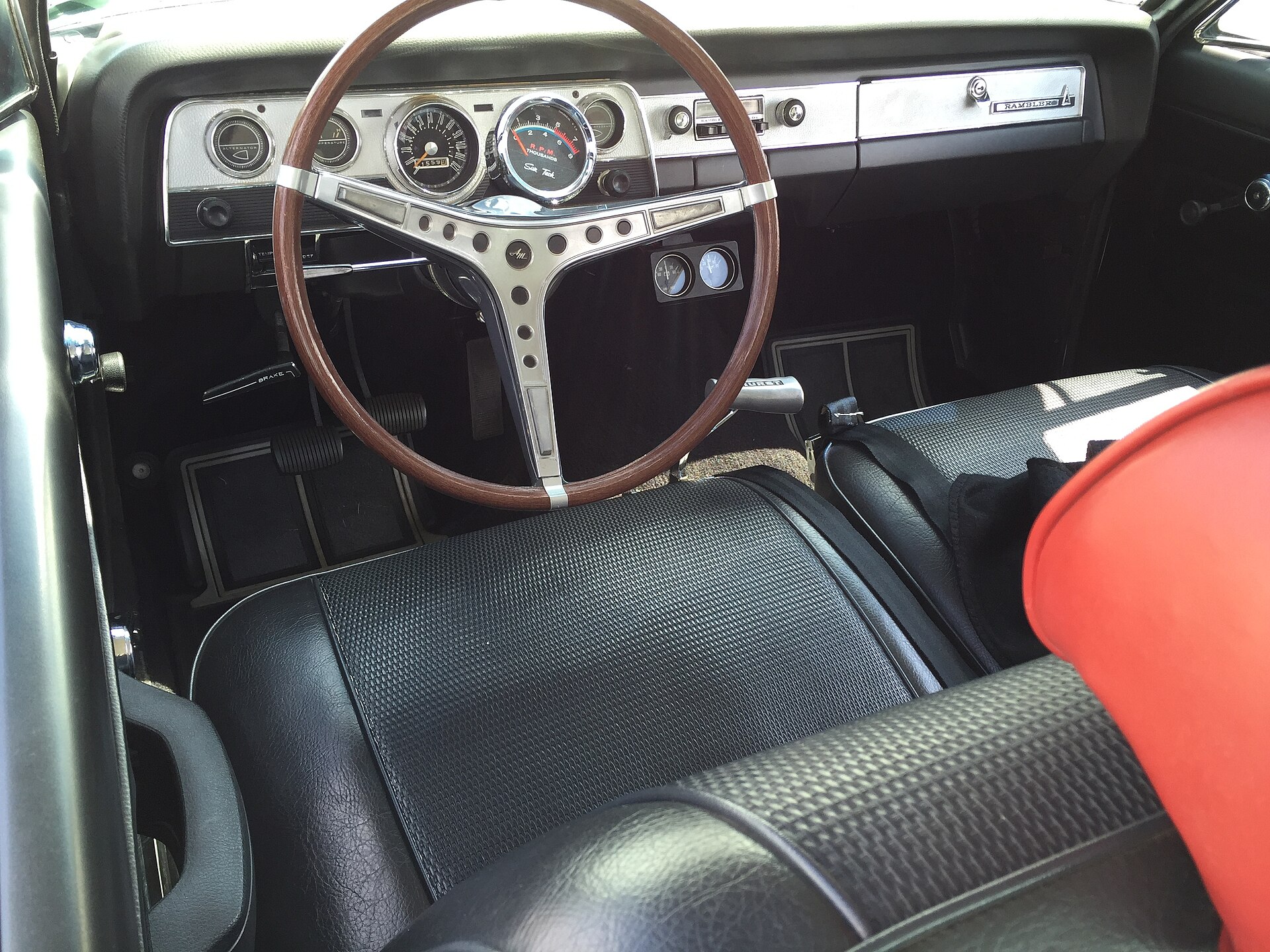
Romney bet the company on compact cars at a time when Detroit was building bigger and bigger models. He mocked the Big Three's products as "gas-guzzling dinosaurs", and by the end of 1957 the Nash and Hudson names had gone. AMC sold only compacts, centred on the Rambler, launched in its new form as the 1956 Rambler Six and V8.
At first the strategy cost money: AMC lost US$31.7 million in 1956 and US$11.8 million in 1957. Then the 1958 recession turned buyers towards small cars. Rambler sales rose 58.7% in 1958, AMC made its first profit as a combined company (US$28 million) and it was the only car maker whose sales increased that year. Ramblers won the Mobil Economy Run, and the share of the Big Three fell from 93% of the American market in 1957 to 82% in 1959. The Rambler was the third most popular car in the United States in 1960 and 1961. AMC's share price rose from US$7 to US$90. In 1959 the company announced a US$10 million expansion at Kenosha to raise capacity from 300,000 to 440,000 cars a year.
Romney left in February 1962 to run for governor of Michigan, and Roy Abernethy took over. Sales of the larger Ambassador rose from 18,647 in 1964 to more than 71,000 in 1966, but losses grew and he was forced out on 9 January 1967.
Muscle cars: Javelin, AMX and the Trans-Am titles
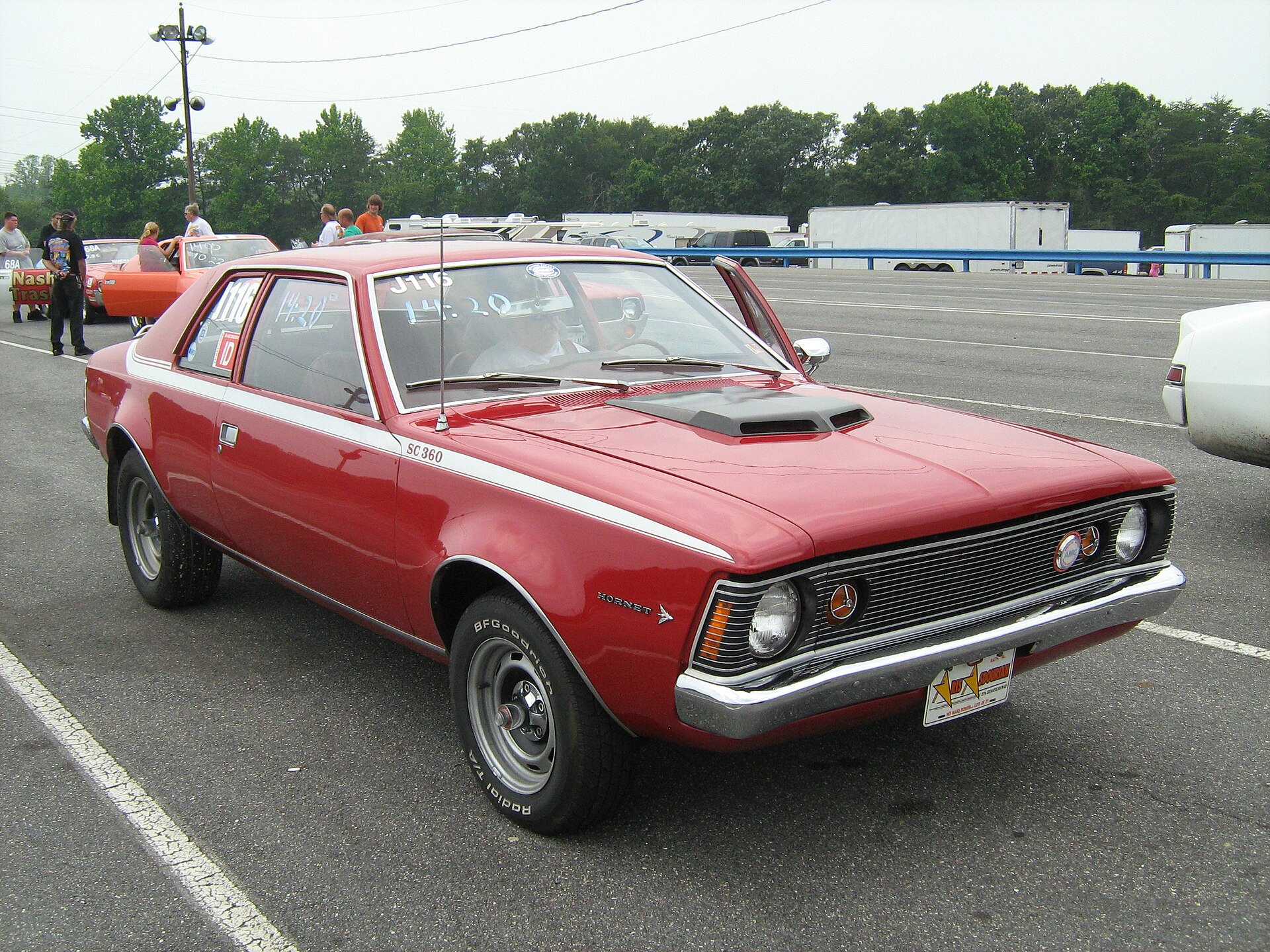
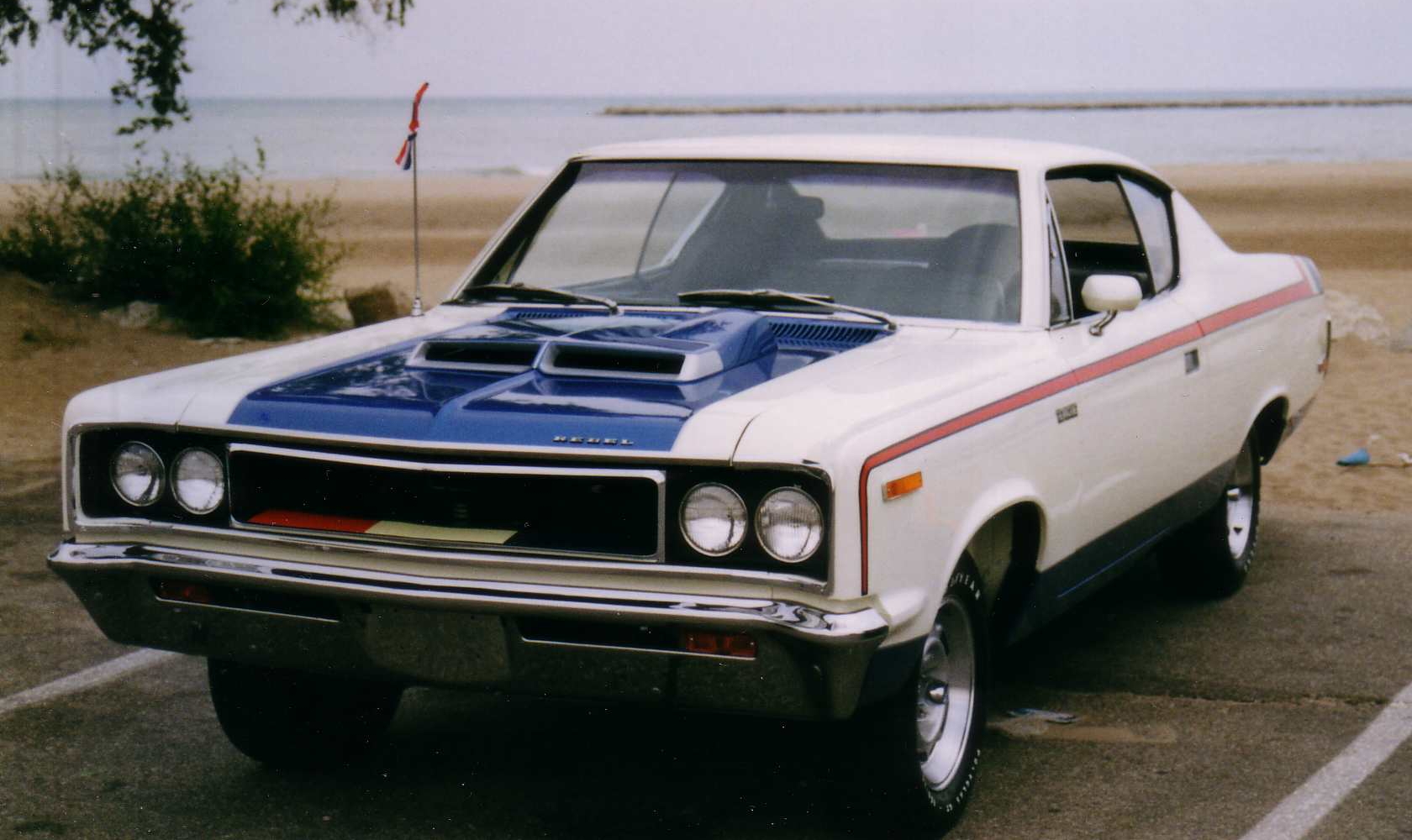
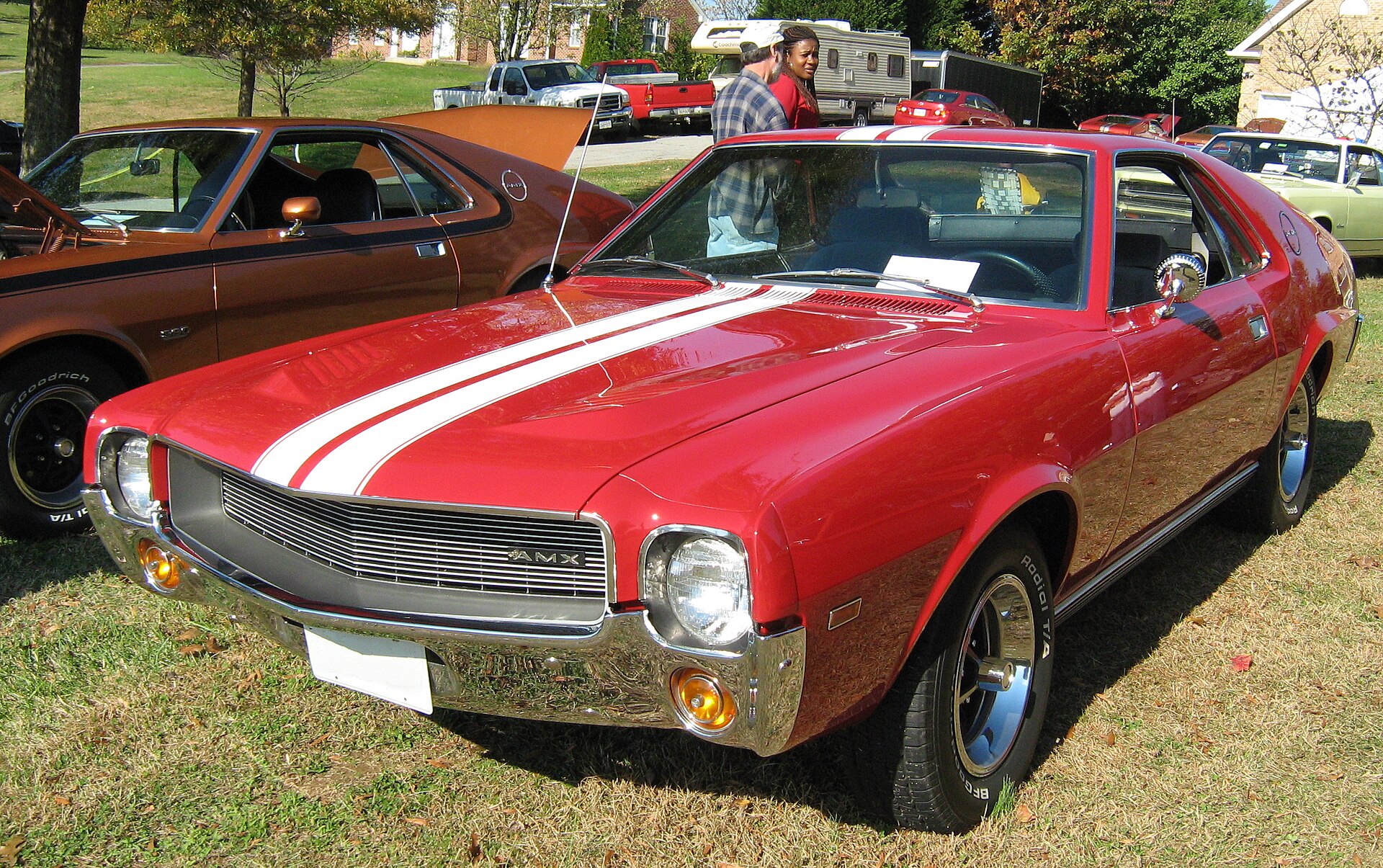
In the late 1960s AMC tried to change its image. Under design chief Dick Teague it built the Javelin, launched for the 1968 model year as AMC's entry in the pony-car class. The AMX grew out of a two-seat prototype of 1966. The biggest engine, the 390 cu in (6.4-litre) V8, produced 235 kW (315 hp) in 1968–1969; the later 401 cu in (6.6-litre) V8 reached 246 kW (330 hp) in 1971. AMC built 55,125 Javelins in 1968 and 40,675 in 1969. Other AMC performance models of the period, the Hurst SC/Rambler, the Rebel Machine and the Hornet SC/360, have their own pages.
On the track, Roger Penske's team ran the Javelin programme from 1970 with Mark Donohue driving, and the AMC Javelin won the Trans-Am championship in 1971, 1972 and 1976. From 1971 the AMX became the top version of the Javelin instead of a separate two-seater. The Alabama state police bought 132 Javelins with the 401 V8 in 1971–1972, described as the first pony cars used as regular highway patrol cars in the United States.

Gremlin, Hornet, Pacer and the Jeep purchase
AMC's most important deal of the decade came in February 1970: it bought Kaiser Jeep for US$70 million. With it came the Jeep brand and contracts for military (M151) and postal (DJ-series) vehicles; the AM General subsidiary also built 5,431 city buses between 1974 and 1979. By 1979 Jeeps accounted for about half of AMC's sales and most of its profit. The full story of the brand is in the history of Jeep.
The car range went its own way. The Gremlin, launched on 1 April 1970, was a Hornet shortened to a 96-inch (2,438 mm) wheelbase and drawn by Teague's team. AMC sold it as "America's first subcompact", although the Nash Metropolitan had come earlier, and built 671,475 before US production ended in 1978. The Hornet of the same year passed 860,000 by 1977 and became AMC's best-selling car since the Rambler Classic. The Matador replaced the Rebel in 1971. The wide, heavily glazed Pacer of 1975 sold 262,772 in the US in its first two years; production ended in December 1979. In fiscal 1979 AMC earned a record US$83.9 million on US$3.1 billion of sales, but its share of the US market was only 1.83%.

The Eagle, Renault and the Cherokee
AMC's final ideas were among its best. The Eagle, introduced in August 1979 for the 1980 model year, put the Concord body on permanent four-wheel drive with a viscous coupling, developed with FF Developments. It is widely described as the first crossover, ahead of models such as the Subaru Outback, and about 197,449 were made.
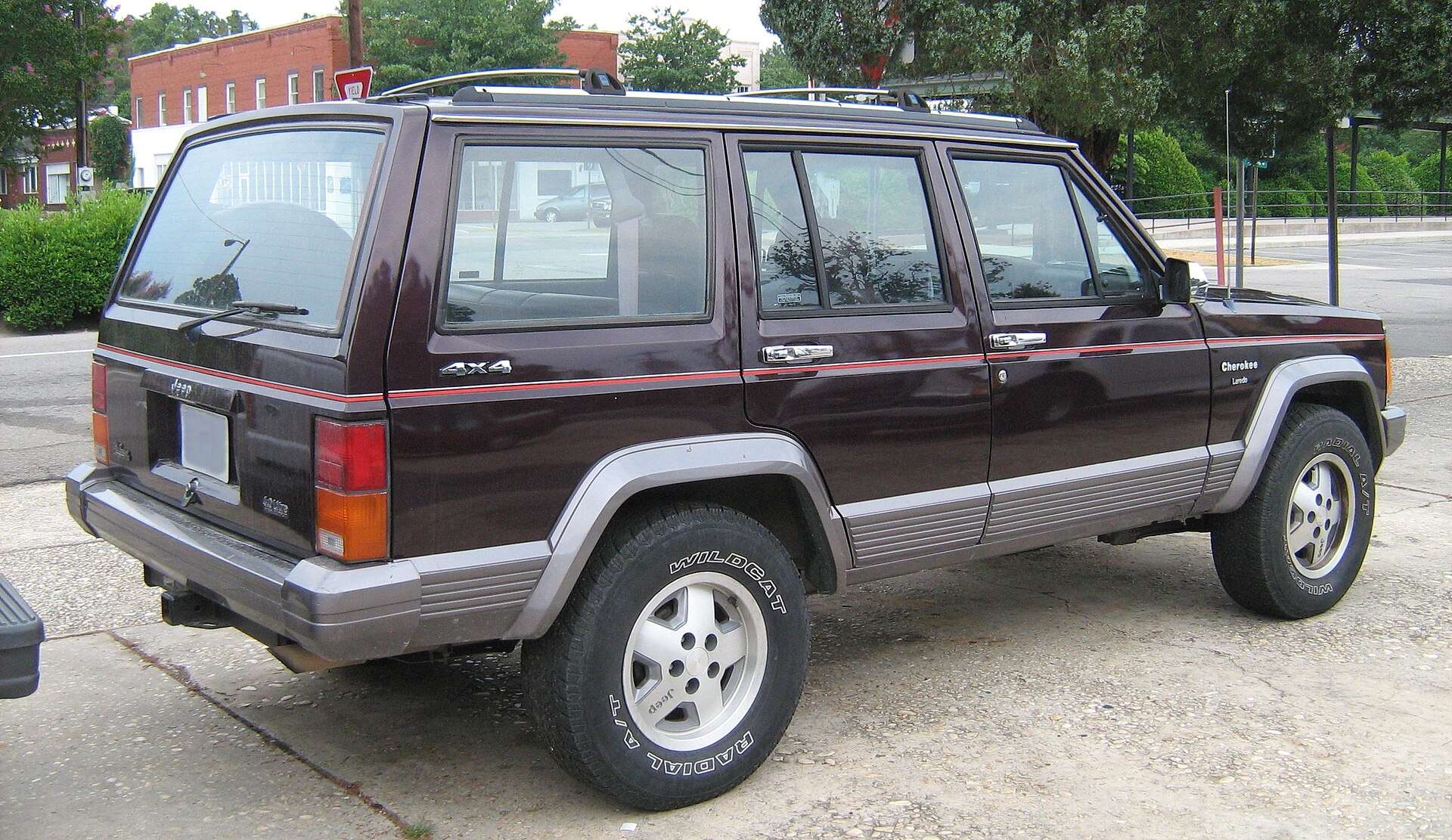
The money came from France. In October 1979 Renault took a 22.5% stake in exchange for US$150 million in cash and US$50 million in credits. On 16 December 1980 shareholders approved Renault as principal owner; its stake was 46% in 1982 and 49% in 1983. Kenosha began building the Renault Alliance, an American version of the Renault 9, which was Motor Trend Car of the Year for 1983. The Jeep Cherokee XJ, launched in autumn 1983 for the 1984 model year, weighed only 1,406 kg. AMC expected 40,000 Cherokee and Wagoneer sales in its first year and sold 75,000. The XJ helped pioneer the SUV segment.

Chrysler takes over
On 9 March 1987 Chrysler agreed to buy Renault's stake and all other shares for about US$1.5 billion, and the deal closed in August 1987. AMC lost US$91.3 million in 1986, its last full year. The last AMC Eagle car was built on 14 December 1987. The company became Chrysler's Jeep-Eagle division on 25 August 1988 and was fully merged on 29 March 1990. The Eagle name survived as a Chrysler brand until the 1998 model year, and Jeep continued under Chrysler. AMC's surviving cars are in the AMC catalogue. The Javelin and AMX sit alongside their rivals in the muscle cars section. The most powerful American cars of that decade are listed in the most powerful cars of the 1960s.
AMC timeline
| Year | Event |
|---|---|
| 1954 | Nash-Kelvinator and Hudson merge (1 May); Romney succeeds Mason in October |
| 1957 | Nash and Hudson names dropped; compact Ramblers only |
| 1958 | First profit as a combined company |
| 1960–1961 | Rambler is America's third best-selling car |
| 1962 | Romney leaves; Roy Abernethy president |
| 1968 | Javelin and AMX launched |
| 1970 | Kaiser Jeep bought for US$70 million; Gremlin and Hornet launched |
| 1971–1972 | Javelin wins the Trans-Am title |
| 1975 | Pacer launched |
| 1979 | Renault takes a stake; Eagle introduced |
| 1983 | Jeep Cherokee XJ for 1984; Renault Alliance |
| 1987 | Chrysler buys AMC |
| 1988 | AMC becomes Chrysler's Jeep-Eagle division |
Landmark AMC models
| Model | Years | Why it matters |
|---|---|---|
| Rambler | 1956–1969 | Compact that made AMC profitable; third in US sales in 1960–1961 |
| Javelin | 1968–1974 | Pony car, Trans-Am champion 1971, 1972 and 1976 |
| AMX | 1968–1970 | Rare American two-seat performance car of its time |
| Gremlin | 1970–1978 | Shortened Hornet sold as America's first subcompact, 671,475 built |
| Pacer | 1975–1980 | Wide, glassy small car with a short boom |
| Eagle | 1980–1988 | Full-time 4WD passenger car, often called the first crossover |
| Jeep Cherokee XJ | 1984 onward | Compact SUV launched by AMC |
FAQ
What does AMC stand for?
American Motors Corporation, formed on 1 May 1954 by the merger of Nash-Kelvinator and the Hudson Motor Car Company.
Who owned AMC?
AMC was a public company. Renault became its principal owner in 1980, and Chrysler bought the company in 1987.
What happened to AMC?
Chrysler bought it in 1987 mainly for Jeep. AMC became the Jeep-Eagle division in 1988 and was fully merged into Chrysler in 1990.
What was AMC's best-selling car?
In the 1950s and 1960s the Rambler; in the 1970s the Hornet, with more than 860,000 sold up to 1977.
Did AMC build Jeeps?
Yes. AMC bought Kaiser Jeep in 1970 and built Jeeps until 1987, including the Cherokee XJ of 1984.
Sources
- Wikipedia - American Motors Corporation (accessed 24 Oct 2026)
- Wikipedia - George W. Romney (accessed 24 Oct 2026)
- Wikipedia - AMC Javelin (accessed 24 Oct 2026)
- Wikipedia - AMC Eagle (accessed 24 Oct 2026)
- Wikipedia - AMC Gremlin (accessed 24 Oct 2026)
Found a mistake? Report an error