 AMC Javelin
All generations, specs and history
Published Sources (1) Report an error
By Sarah Whitmore, Senior Automotive Writer
- Built
- 1968–1974
- Generations
- 2
- Top power
- 246 kW (334 PS)
Timeline
Javelin generations
Click a generation for its own page
- Javelin I 1968–1970 · Coupe · 108–242 kW (147–329 PS)
- Javelin II 1971–1974 · Coupe · 246 kW (334 PS)
Newest first · 2 generations since 1968

All generations by year: Javelin II (1971–1974) · Javelin I (1968–1970)
Which one is mine?
Pick the year of first registration to see which generation it is.
- Javelin II 1971–1974
- Javelin I 1968–1970
The AMC Javelin was American Motors' pony car, sold from the 1968 to the 1974 model year as a rival to the Ford Mustang, the Chevrolet Camaro and the Plymouth Barracuda. It was introduced on 22 August 1967, and sales began on 26 September. With engines from a 232 cu in six to a 401 cu in V8, two generations and championship titles in the SCCA Trans-Am series, the Javelin became the best-known car of the smallest American maker.
In short
- Two generations: 1968–1970 and 1971–1974, styled under Dick Teague.
- Engines from a 108 kW (145 hp) six to the 390 V8 with 242 kW (325 hp) in 1970 and the 401 V8 with 246 kW (330 hp, SAE gross) in 1971.
- Trans-Am champion in 1971 and 1972 with Penske Racing, Mark Donohue and George Follmer, and again in 1976.
- From 1971 the AMX name moved to the top Javelin, with a spoiler and a mesh grille.
AMC Javelin at a glance
| Specification | AMC Javelin |
|---|---|
| Production | 1968–1974 model years |
| Body | two-door hardtop, semi-fastback |
| Wheelbase | 109 in (1968–1970), 110 in (1971–1974) |
| Engines | 232 and 258 I6; 290, 304, 343, 360, 390 and 401 V8 |
| Most powerful | 401 V8, 246 kW (330 hp gross) and 583 Nm (1971) |
| Racing | SCCA Trans-Am titles 1971, 1972 and 1976 |
| Assembly abroad | Germany (Karmann), Mexico (VAM), Australia, Venezuela, Philippines |
The Javelin belongs to the golden age of our American muscle car guide; its V8 figures are compared with its rivals in the muscle car rankings.
A pony car from Kenosha
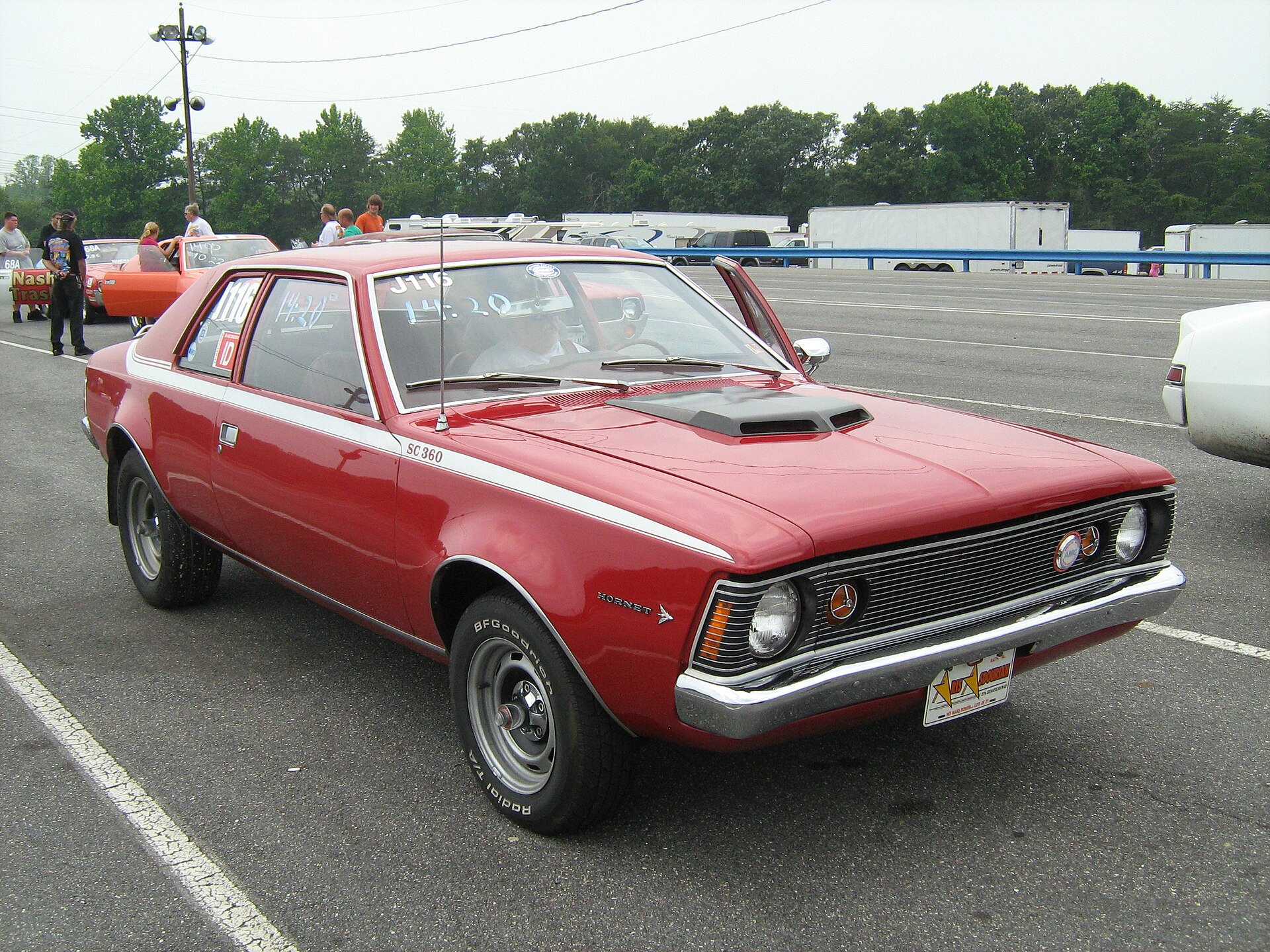
The Javelin grew out of the "Project IV" show cars of 1966 and was meant to change AMC's image as a builder of economical family cars. It used the platform of the compact Rambler American. AMC did not have the money for separate fastback and notchback bodies, so Teague's team drew a single two-door hardtop with a smooth semi-fastback roofline. The 1968 car already had padded windscreen pillars, flush door handles and three-point seat belts in front.
The base engine was the 232 cu in six with 108 kW (145 hp) or 116 kW (155 hp). The V8 range began with the 290, rated 168 kW (225 hp), and continued with the 343 at 175 or 209 kW (235 or 280 hp). In the middle of 1968 the 390 arrived with 235 kW (315 hp) and 576 Nm as part of the "Go Package", which also brought front disc brakes, heavy-duty suspension and Magnum 500 wheels. The SST version added reclining seats and wood-grain trim. Motor Trend placed the Javelin first in its "sports-personal" category in its 1968 Car of the Year issue.
For 1970 the 304 and 360 replaced the 290 and the 343, and the 390 received new heads: 242 kW (325 hp) at 5,000 rpm. A Popular Science test of a manual 360 Javelin recorded 0–60 mph in 6.8 seconds.
Trans-Am racing and the special editions
AMC's Trans-Am programme began in 1968 with Kaplan Engineering. Its two Javelins finished third in the over-2-litre class and were the only factory team to finish every race. In 1970 Penske Racing took over, with Mark Donohue as lead driver, and the team finished second.
Two street versions were linked to the racing effort in 1970. The Mark Donohue Javelin homologated his ducktail rear spoiler; the rules required 2,500 cars, and AMC built 2,501 SSTs with his signature on the spoiler. The Trans-Am Javelin, about 100 cars in the red, white and blue racing colours, came with the 390 V8 and front and rear spoilers. At 2,850 lb (1,293 kg) it was lighter than the Camaro and the Mustang. In 1971 and 1972 the Javelin won the Trans-Am championship, with Donohue and George Follmer among its drivers.

The second generation (1971–1974)
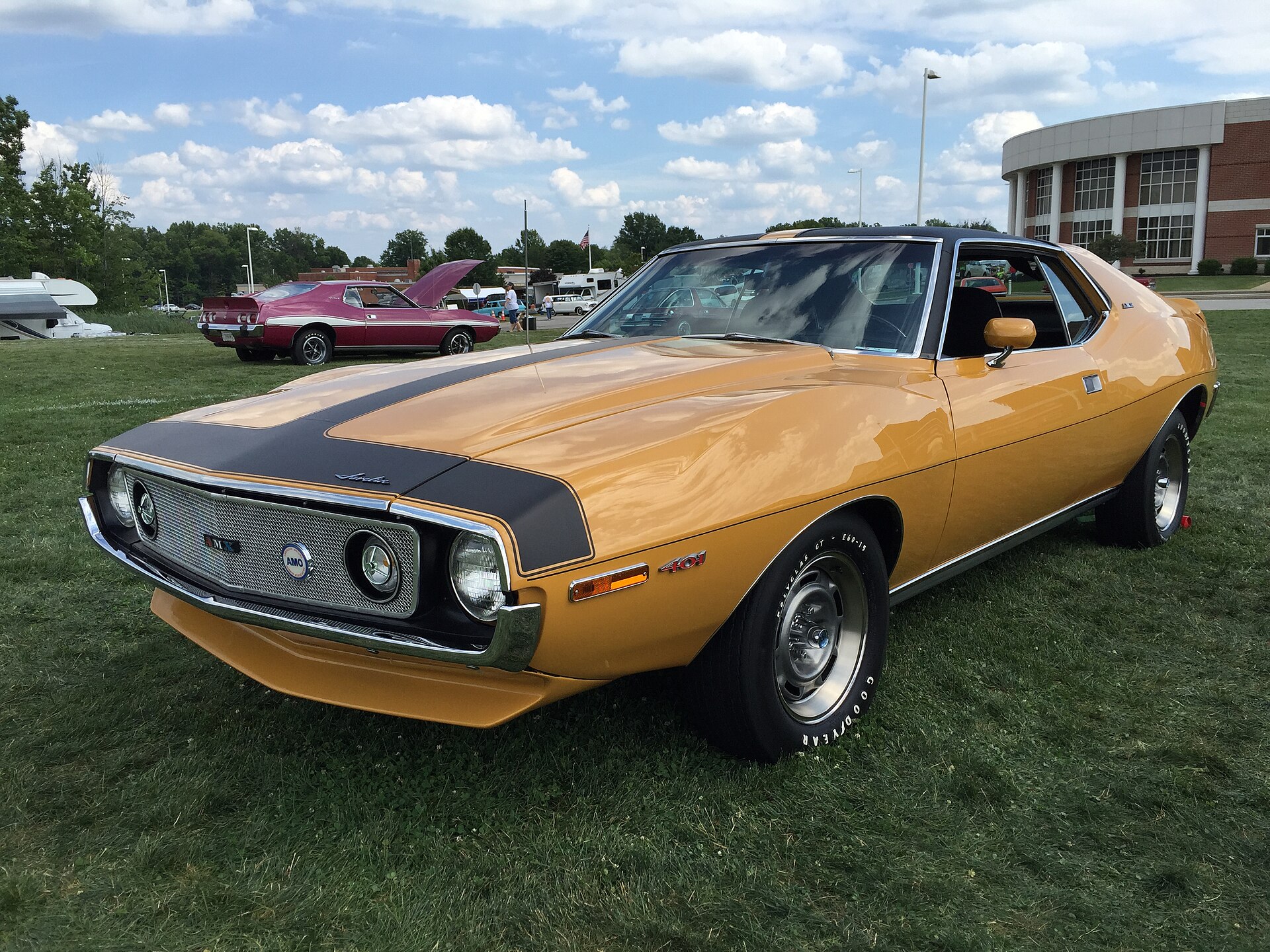
The 1971 Javelin was a larger car under Chuck Mashigan: a long bonnet, raised front wing bulges, flared rear wheel arches and a "twin canopy" roof. The wheelbase grew by one inch to 110 in. The wing bulges had been designed for wide racing tyres. The two-seat AMX was gone, and its name now marked the top Javelin with a standard 360 V8, a rear spoiler and a flush stainless-steel mesh grille recommended by Donohue.
| Engine | 1971 (SAE gross) | 1972 (SAE net) |
|---|---|---|
| 232 I6 | 101 kW (135 hp) | 75 kW (100 hp) |
| 258 I6 | 112 kW (150 hp) | 82 kW (110 hp) |
| 304 V8 | 157 kW (210 hp) | 112 kW (150 hp) |
| 360 V8, four-barrel | 213 kW (285 hp) | 145 kW (195 hp) |
| 401 V8 | 246 kW (330 hp), 583 Nm | 190 kW (255 hp) |
The table shows how the switch from gross to net ratings for 1972 lowered the published figures although the engines had not changed. A 1971 Javelin AMX with the 401 ran the quarter mile in the mid-14-second range at 93 mph on low-lead fuel. A 1973 SST with the 401 reached 60 mph in 7.7 seconds and 115.5 mph (186 km/h).
In 1972 and 1973 AMC offered a Pierre Cardin interior with pleated stripes in red, plum, white and silver on black cloth; 4,152 cars were built with it. The Alabama Highway Patrol bought 1971–1972 Javelins and became the first American police force to use pony cars as regular patrol cars. One test car, an AMX with the 401, was called "the most abused police car in the history of Alabama".

Production and the end
AMC built 55,125 Javelins in 1968 and 40,675 in 1969. Later years were smaller: 30,902 in 1973, of which 5,707 were AMXs. For 1974 the source gives 22,556 Javelins and 4,980 AMXs. The oil crisis, the 55 mph speed limit and higher insurance premiums ended the series in late 1974, and AMC needed the assembly line for the new Pacer.
Which Javelin to look for
Collectors value the V8 cars, especially the 390 and the 401, and the Go Package and special editions. A documented Donohue Javelin is hard to verify because AMC gave these cars no special VIN or door tag. The first-generation shape is the cleaner design; the 1971–1974 cars with the 401 are the most powerful. For the two-seat car built from the same parts, see the AMC AMX in our muscle car section, and compare the pony cars of the era in the car rankings.
AMC Javelin: first vs latest generation
| Spec | Javelin I | Javelin II | Change |
|---|---|---|---|
| Years | 1968–1970 | 1971–1974 | 3 years apart |
| Most powerful version | 242 kW (329 PS) | 246 kW (334 PS) | +4 kW (+2%) |
Oldest and newest generation in the 1cars catalog. Power is the strongest version of each; other rows are shown only when both generations have the figure.
Image credits · Photos from Wikimedia Commons under free licences
- AMC Javelin I · Photo: Missvain / Wikimedia Commons, CC BY 4.0
AMC Javelin in our rankings
- No. 30 of 88 · Most powerful cars of the 1970s (246 kW · top 36%)
- No. 375 of 859 · Most powerful cars (246 kW · top 44%)
- No. 88 of 154 · Most powerful American cars (246 kW · top 58%)
- No. 202 of 313 · Most powerful coupes (246 kW · top 65%)
- No. 554 of 912 · Longest-running car nameplates (6 years · top 69%)
- No. 246 of 345 · Cars with the most generations (2 generations)
More powerful than 64% of ranked cars of the 1970s in the 1CARS catalog (No. 30 of 88).
FAQ
Was the AMC Javelin a muscle car?
With the 343, 390 or 401 V8 it is counted as one; the six-cylinder and small V8 versions were ordinary pony cars.
What was the most powerful Javelin?
The 1971 Javelin with the 401 V8: 246 kW (330 hp, SAE gross) and 583 Nm.
Did the Javelin win the Trans-Am?
Yes. The Javelin won the SCCA Trans-Am championship in 1971 and 1972, and again in 1976.
What is a Javelin AMX?
From 1971 to 1974 the AMX was the top performance version of the Javelin, with a 360 V8 as standard, a rear spoiler and a mesh grille.
Data sources
Data checked by an editor against the sources below.