 AMC AMX
Specs, engines and history
Published Sources (1) Report an error
By Sarah Whitmore, Senior Automotive Writer
- Built
- 1968–1970
- Top power
- 242 kW (329 PS)
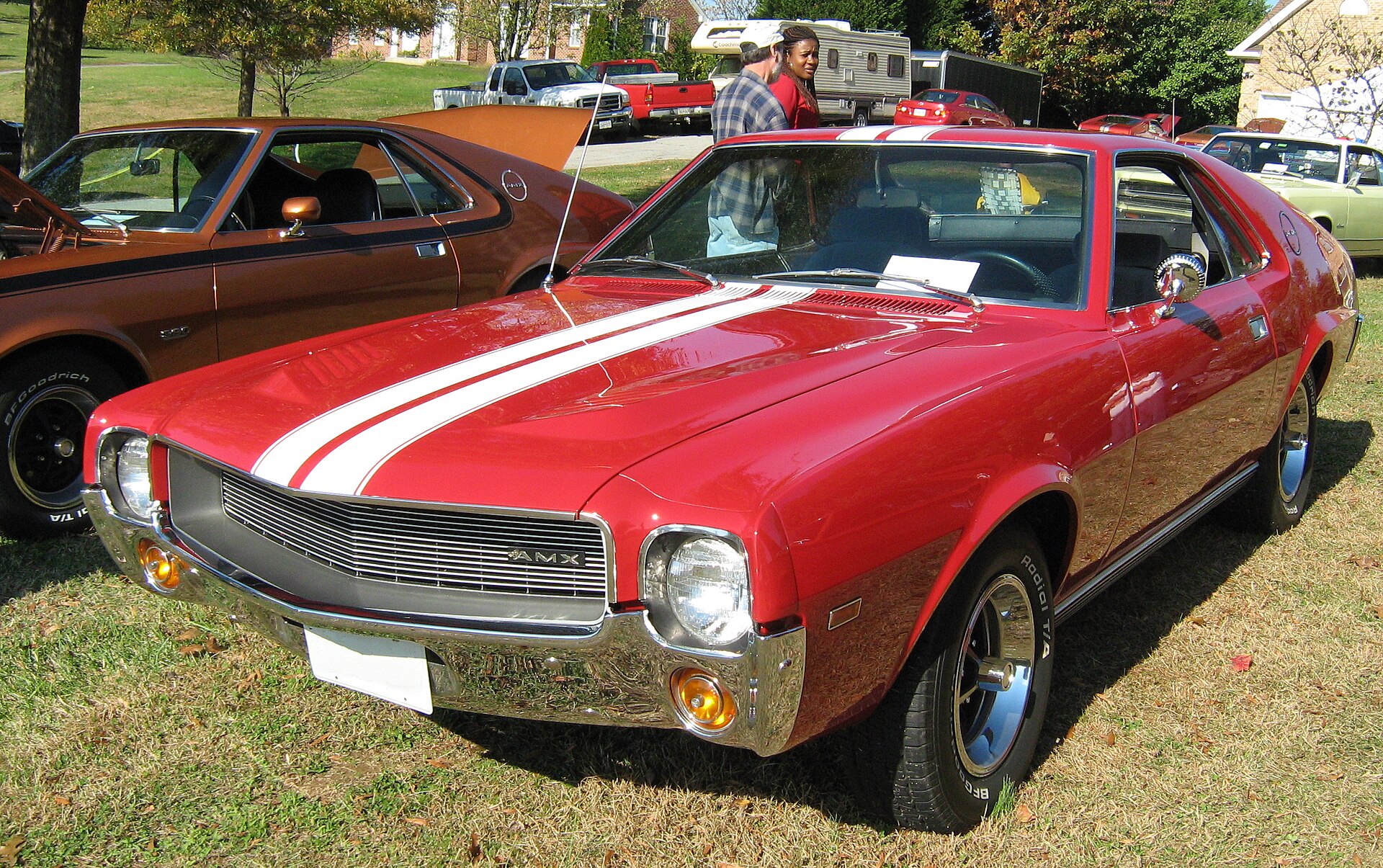
The AMC AMX was a two-seat muscle car that American Motors built for the 1968, 1969 and 1970 model years. It was a shortened version of the new Javelin pony car with the rear seat taken out, and its biggest engine was a 390 cu in V8. The name stood for "American Motors experimental". In three years 19,134 were built, and the car turned a maker of economy cars into a brand that young buyers looked at.
In short
- 1968–1970, two-seat coupé on a 97 in (2,464 mm) wheelbase, 12 inches shorter than the Javelin.
- V8 engines only: 290, 343 and 390 cu in; the 390 had 235 kW (315 hp, SAE gross) and 576 Nm, and 242 kW (325 hp) in 1970.
- In early 1968 two prepared AMXs set 106 speed and endurance records in Texas with Craig Breedlove at the wheel.
- 6,725 built in 1968, 8,293 in 1969 and 4,116 in 1970.
AMC AMX at a glance
| Specification | AMC AMX |
|---|---|
| Production | 1968–1970 model years |
| Built | 19,134 |
| Body | two-door, two-seat coupé |
| Platform | shortened Javelin, 97 in (2,464 mm) wheelbase |
| Length | 177 in (1968–1969), 179 in (1970) |
| Weight | about 3,000 lb (1,360 kg) |
| Engines | 290, 343, 360 and 390 cu in V8 |
| Most powerful | 390 V8, 242 kW (325 hp gross) and 583 Nm (1970) |
| Gearbox | BorgWarner T-10 four-speed manual; three-speed automatic optional |
The AMX is part of the golden age in our American muscle car guide, and all its figures are in the muscle car rankings.
From Project IV to the showroom
The name first appeared in 1966 on the "Project IV" show tour. AMC presented a fibreglass two-seat AMX and a four-seat AMX II there; the two-seater even had a fold-out "Ramble seat" in the boot lid. The company decided against a fibreglass production car: steel bodies could be made in large numbers, and the new Javelin already offered a suitable base.
The engineers shortened the Javelin platform to a 97 in wheelbase and removed the rear seat. Unlike the Javelin hardtop, the AMX had fixed rear side windows. Dick Teague was responsible for the styling, and Vic Raviolo for the engineering. The press saw the car at Daytona International Speedway on 15 February 1968, the public on 24 February, and the first cars were due in showrooms on 19 March 1968.
AMC priced it directly against the Chevrolet Corvette, the only other American two-seater, and undercut it by nearly 25 percent. Advertising presented the AMX as the most affordable American sports car.

106 records before the launch
Before the car went on sale, AMC wanted proof of its durability. In January 1968 two specially prepared AMXs ran at Goodyear's test track in Texas, driven by Craig Breedlove, Lee Breedlove and Ron Dykes. The cars had exhaust headers, oil coolers, racing camshafts, a 37 US gallon safety tank and magnesium wheels. They set 106 world speed and endurance records. Breedlove later reached 189 mph (304 km/h) at Bonneville in a USAC-sanctioned run.
Engines and performance
| Engine | Years | Power (SAE gross) | Torque |
|---|---|---|---|
| 290 V8, four-barrel | 1968–1969 | 168 kW (225 hp) | — |
| 343 V8, four-barrel | 1968–1969 | 209 kW (280 hp) | — |
| 390 V8, four-barrel | 1968–1969 | 235 kW (315 hp) | 576 Nm |
| 360 V8, four-barrel | 1970 | 213 kW (285 hp) | — |
| 390 V8, four-barrel | 1970 | 242 kW (325 hp) at 4,800 rpm | 583 Nm at 3,200 rpm |
Sources differ on the 343: the infobox lists 209 kW (280 hp), the text 216 kW (290 hp). A four-speed manual BorgWarner T-10 was standard, and a Hurst floor shifter came with it from January 1969; the "Shift-Command" automatic was an option.
Contemporary road tests confirmed the performance of the 390. Car and Driver measured 0–60 mph in 6.6 seconds, a quarter mile in 14.8 seconds at 95 mph and a top speed of 122 mph (196 km/h) in 1968. Motor Trend timed a 390 AMX at 6.56 seconds to 60 mph and 14.68 seconds over the quarter mile in December 1969.

1969: Big Bad colours and the Super Stock AMX
The second year brought few technical changes and only a small price increase. As a cheap option buyers could order the "Big Bad" paint: neon blue, orange or green. 195 cars were painted Big Bad Blue, 285 Big Bad Orange and 283 Big Bad Green. Southern California dealers sold a green pace-car replica called the California 500 Special, and white AMXs paced the Pikes Peak hill climb.
The most extreme version was built for drag racing. The Super Stock AMX had two four-barrel carburettors, 12.3:1 compression and headers, and Hurst carried out the conversion. AMC rated its engine at 254 kW (340 hp), while the NHRA classed it with 313 kW (420 hp). The best recorded quarter mile was 10.73 seconds at 128 mph. Only 52 were built, and each cost almost half as much again as a fully loaded regular AMX.
1970: new nose, more power
The final two-seater got a longer bonnet with a functional ram-air "power blister", a full-width grille and new tail lamps. The front suspension now used double wishbones. The 360 replaced the 343, and new cylinder heads raised the 390 to 242 kW (325 hp). Inside, clamshell bucket seats and a Rim Blow steering wheel arrived. The "Go Package" was offered with either the 360 or the 390.
The Society of Automotive Engineers named the AMX the best-engineered car of the year in 1969 and 1970. Sales, however, never reached the targets. Insurance surcharges on powerful cars and the move to smaller models ended the two-seater after 1970. The AMX name lived on as the top version of the AMC Javelin from 1971 to 1974, and later on the Hornet, Concord and Spirit.
The AMX today
Interest in the two-seat AMX rose in the 2000s, and Hemmings listed it among the "21 hottest cars" of 2007. Parts, including reproductions, are available through AMC clubs, although fewer than for cars from the big three Detroit makers. The rarest variants are the Super Stock cars, the Big Bad colours and the California 500 Special. Its rivals from the same years are in our golden-age muscle car list, together with the American muscle car rankings.
Photo gallery


AMC AMX in our rankings
- No. 381 of 859 · Most powerful cars (242 kW · top 46%)
- No. 90 of 154 · Most powerful American cars (242 kW · top 59%)
- No. 207 of 313 · Most powerful coupes (242 kW · top 68%)
- No. 826 of 912 · Longest-running car nameplates (2 years · top 96%)
More powerful than 54% of ranked cars in the 1CARS catalog (No. 381 of 859).
FAQ
Is the AMC AMX a muscle car or a sports car?
Both descriptions are used. It has two seats like a sports car, but it was built from a mass-production pony car with a big V8, which is why it is counted among the muscle cars.
How many AMC AMX were made?
19,134 two-seat AMXs were built from 1968 to 1970: 6,725, 8,293 and 4,116 per year.
What was the most powerful AMX engine?
The 390 V8 of 1970 with 242 kW (325 hp gross) and 583 Nm. The Super Stock drag-racing car was rated at 254 kW (340 hp) by AMC.
What does AMX stand for?
"American Motors experimental", the name of the 1966 concept car.
Data sources
Data checked by an editor against the sources below.