Ford v Ferrari: How a Failed Takeover Led to Four Le Mans Wins
In 1963 Ford tried to buy Ferrari, and the deal collapsed in May because Enzo Ferrari refused to give up control of his racing team. Henry Ford II answered by ordering a car that could beat Ferrari at Le Mans. The resulting Ford GT40 took the top three places at Le Mans in 1966 and won there four years running.
Key takeaways
- Ford's offer was reported at between 10 and 18 million US dollars; Enzo would sell the road-car business, but not the racing team.
- Ford set up Ford Advanced Vehicles in England and later handed the programme to Carroll Shelby.
- GT40 wins at Le Mans: 1966 (Mk II), 1967 (Mk IV), 1968 and 1969 (Gulf-backed Mk I).
- Ferrari sold 50 % to Fiat in June 1969 and kept his freedom to run the racing team.

The Ford–Ferrari feud: timeline

| Year | Event |
|---|---|
| Early 1963 | Ford learns through an intermediary that Enzo Ferrari may sell |
| Spring 1963 | Ford sends a team to Modena and audits the company |
| May 1963 | Talks collapse over control of racing |
| End of 1963 | Ford Advanced Vehicles is set up in Slough, England |
| 1 April 1964 | First GT40, chassis GT/101, is unveiled |
| June 1964 | All three Ford entries retire at Le Mans; Ferrari wins |
| December 1964 | The racing programme moves to Shelby American |
| June 1965 | No Ford finishes at Le Mans; Ferrari wins again |
| June 1966 | GT40 Mk IIs finish 1-2-3 at Le Mans |
| June 1967 | Mk IV wins with Dan Gurney and A.J. Foyt |
| 1968–1969 | Privately run Gulf GT40s win twice more |
| June 1969 | Fiat buys 50 % of Ferrari |
Ferrari in 1963: a company looking for a partner
In the early 1960s Ferrari was famous but small. The company had become a public company (S.p.A.) in 1960, and a large share of its road cars was sold in North America. In 1961 several senior engineers left after a dispute with Enzo, a crisis that weakened the firm. According to the old 1cars text, Enzo was also dealing with family troubles, health worries and an uncertain financial position, and wanted to concentrate on racing.
Size at a glance
| Dimensions | Ferrari Enzo |
|---|---|
| Length | 4,702 mm185.1 in |
| Width | 2,035 mm80.1 in |
| Height | 1,147 mm45.2 in |
| Wheelbase | 2,650 mm104.3 in |

That made a sale attractive, as long as the racing team stayed his. The Enzo Ferrari profile covers his life and character in more detail.
Why Ford wanted Ferrari
Henry Ford II, grandson of the company's founder, was Ford's president and chief executive. In 1963 he decided that Ford should go racing, and that year he watched Ferraris win the 12 Hours of Sebring in Florida. Buying Ferrari, which had won Le Mans in 1960, 1961 and 1962, looked like the quickest route to success.

The deal that collapsed in May 1963
Early in 1963 Ford heard through an intermediary that Enzo Ferrari was interested in selling. A Ford team travelled to Modena, and the company reportedly spent several million dollars on an audit of the factory and on legal work. The reported offer varies between sources: one account gives 10 million US dollars, while the old 1cars text gave 18 million US dollars for 90 % of the shares.

The plan was for Ford to take the road-car business while Enzo kept running the racing team. The draft contract, however, limited his freedom. According to the old 1cars text, spending on the racing team above 250,000 US dollars a year would have needed Ford's approval. A second issue was Indianapolis: Ford was supplying V8 engines to Lotus for the Indianapolis 500, and under the deal Ferrari would have been kept out of that race.
Enzo ended the talks late in the process, in May 1963. The old 1cars text dates the final meeting to 20 May 1963 and says Enzo left with his adviser Franco Gozzi. Henry Ford II is reported to have been furious, and he told his racing division to find a way to beat Ferrari on the track.
Building the GT40 in England
Ford looked at Lotus, Lola and Cooper as partners and chose Lola, because its Mk6 already used a Ford V8. Eric Broadley of Lola joined the project, Roy Lunn came from Dearborn, and John Wyer became team manager. At the end of 1963 the work moved to Slough, near London, where Ford Advanced Vehicles was set up.

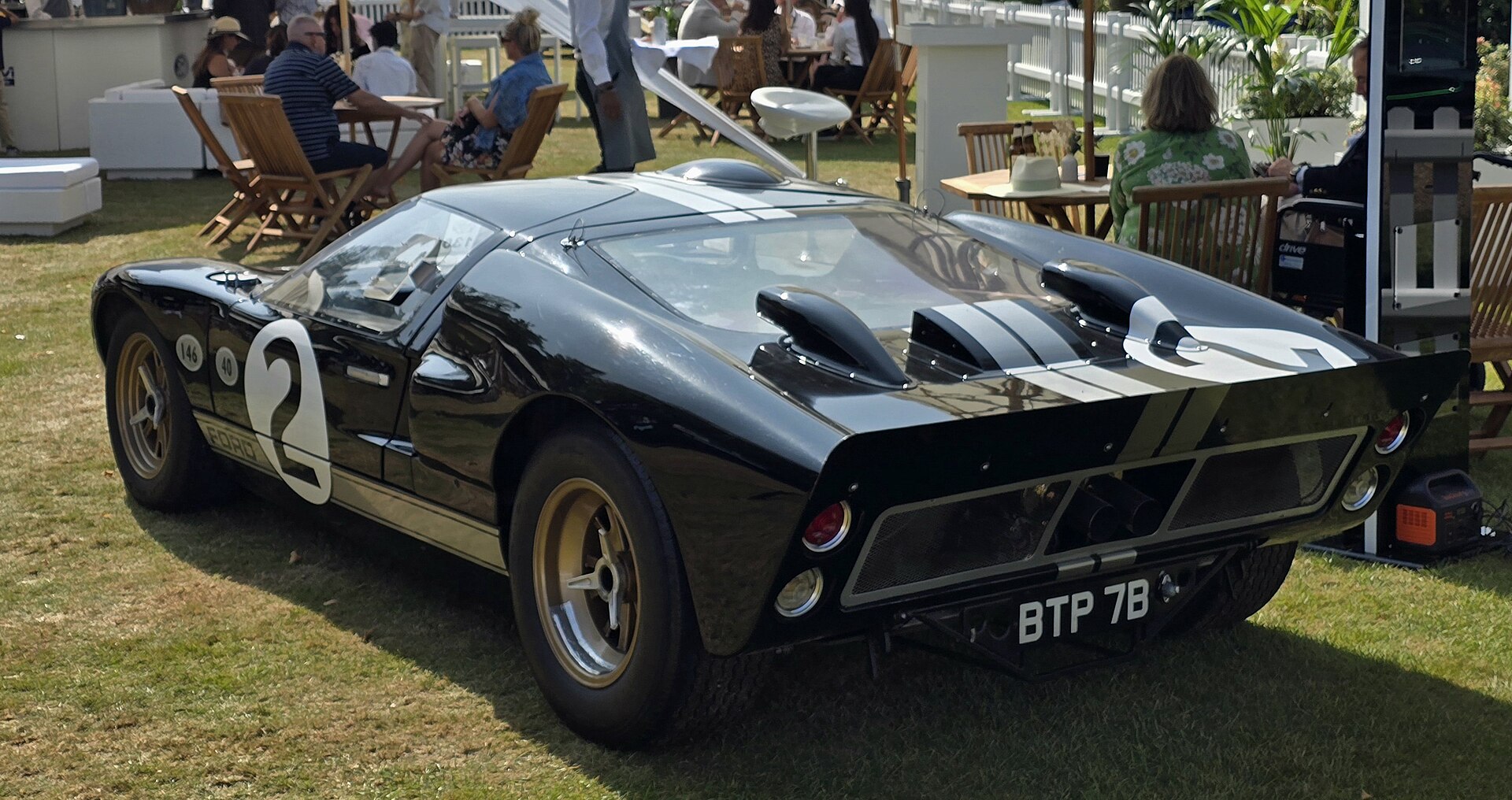
The first chassis was delivered on 16 March 1964, and the first car, GT/101, was unveiled on 1 April 1964. The name came from its height: "GT" for grand touring and "40" for about 40 inches, or 1.02 m, to the top of the windscreen.
| Parameter | Metric | Imperial |
|---|---|---|
| Wheelbase | 2,413 mm | 95 in |
| Length | 4,064 mm | 160 in |
| Width | 1,778 mm | 70 in |
| Height | 1,029 mm | 40.5 in |
| Weight (1966 Mk IIA entry) | 816–1,043 kg | 1,800–2,300 lb |
| Engines | 4.2, 4.7, 4.9 and 7.0-litre Ford V8s | 255–427 cu in |
| Built | 105 (1964–1969) | - |
Two failures and the move to Shelby, 1964–1965
The first season was hard. The GT40 retired from its first race, the Nürburgring 1000 km in May 1964, with suspension failure. At Le Mans in June all three entries retired, and Ferraris took the top three places.

In December 1964 Ford handed the programme to Carroll Shelby's team, Shelby American, which was already known for the Shelby Cobra. Results improved quickly: Ken Miles and Lloyd Ruby won the Daytona 2000 km in February 1965. Le Mans, however, ended without a Ford finish, and Ferrari won the race for the sixth year running. At least 50 Mk I road and race cars were built in 1965 for homologation.
Le Mans 1966: the 1-2-3 finish
For 1966 Ford used the GT40 Mk II with a 7.0-litre (427 cu in) V8 and a four-speed gearbox. It won the Daytona 24 Hours with a 1-2-3 in February and took the top three places at Sebring in March.

At Le Mans in June the Fords finished first, second and third. Bruce McLaren and Chris Amon won in car number 2, covering 4,843.09 km at an average of 201.80 km/h. Ken Miles and Denny Hulme were second after Ford arranged a staged photo finish, and the officials ruled that McLaren and Amon had covered more distance from their starting position. No Ferrari reached the finish.
Ken Miles never got another chance at Le Mans. He was killed in August 1966 while testing the J-car, the next Ford prototype, at Riverside International Raceway in California.
Four wins in a row, 1966–1969
| Year | Winning car | Drivers | Note |
|---|---|---|---|
| 1966 | GT40 Mk II | Bruce McLaren / Chris Amon | Ford 1-2-3; 201.80 km/h average |
| 1967 | Ford Mk IV | Dan Gurney / A.J. Foyt | Built in the US by Kar Kraft; Ferrari second and third |
| 1968 | GT40 Mk I (chassis 1075) | Pedro Rodríguez / Lucien Bianchi | Run by JW Automotive with Gulf |
| 1969 | GT40 Mk I (chassis 1075) | Jacky Ickx / Jackie Oliver | Same car wins again |
In 1967 the Mk IV covered 5,232.9 km at 218.03 km/h. By our calculation, the 1967 winner covered 389.8 km, or 8 % more distance, than the 1966 winner in the same 24 hours. Ford ended official support after 1967, so the 1968 and 1969 wins came from John Wyer's private team with a 4.9-litre GT40. One estimate puts Ford's total spending on the Le Mans effort at 25 million US dollars or more.
Ferrari's answer: the Fiat deal of 1969
Ferrari did not stay independent for long. In June 1969 Enzo sold 50 % of the company to Fiat. Fiat's money paid for a larger Maranello factory, while Enzo kept control of the racing team, which was the point he had refused to give up to Ford. After his death in 1988, Fiat's stake rose to 90 %. The full story of the company is in the history of Ferrari.
Legacy: Ford GT, books and the 2019 film
The feud shaped both brands for decades. Ford brought the name back with the Ford GT, a retro-styled homage to the GT40 built from 2004–2005 to 2007. A second-generation Ford GT followed in 2017, priced at around 500,000 US dollars, and raced in the World Endurance Championship from 2016.
A.J. Baime told the story in his 2010 book Go Like Hell. The film Ford v Ferrari, released on 15 November 2019, starred Matt Damon as Carroll Shelby and Christian Bale as Ken Miles. For the wider story of the American company, read the history of Ford, or browse Ford's performance models in the 1cars muscle cars section.
Who won the feud: our verdict
On the track, Ford won: four Le Mans victories in a row after Ferrari had won six in a row. As a business, both sides came out well. Ford got the global racing image it wanted, and Ferrari found a partner in Fiat that left the racing team in Enzo's hands. To set the modern Ford GT against today's Ferraris, use the 1cars comparison tool or check the 1cars rankings of the fastest cars.
FAQ
Why did the Ford–Ferrari deal fall through?
Enzo Ferrari wanted to keep full control of his racing team. The draft contract limited his racing budget without Ford's approval and would have kept Ferrari out of the Indianapolis 500, so he ended the talks in May 1963.
How much did Ford offer for Ferrari?
Accounts differ. The lowest widely cited figure is 10 million dollars, and the earlier version of this article put it at 18 million for a 90 % stake.
Did the Ford GT40 beat Ferrari at Le Mans?
Yes. GT40s finished first, second and third in 1966, and Fords then won in 1967, 1968 and 1969. That ended Ferrari's run of six straight Le Mans wins from 1960 to 1965.
Who drove the winning Ford at Le Mans in 1966?
The winners were Bruce McLaren and Chris Amon, sharing the number 2 car. Ken Miles and Denny Hulme finished second after a staged formation finish that left Miles without the win.
What does GT40 stand for?
GT means grand touring, and 40 is the car's height in inches, about 1.02 m, measured to the top of the windscreen. The name was used from the first car of 1964.