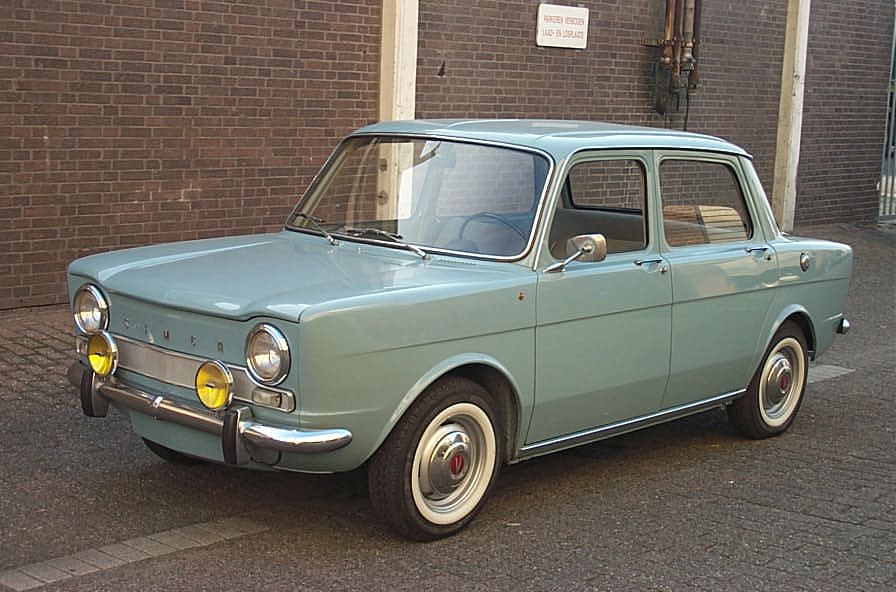
 Simca 1000
Specs, engines and history
Published Sources (1) Report an error
By Oleksandr Hnatiuk, Automotive Editor & Used Car Specialist
- Built
- 1961–1978
- Top power
- 76 kW (103 PS)
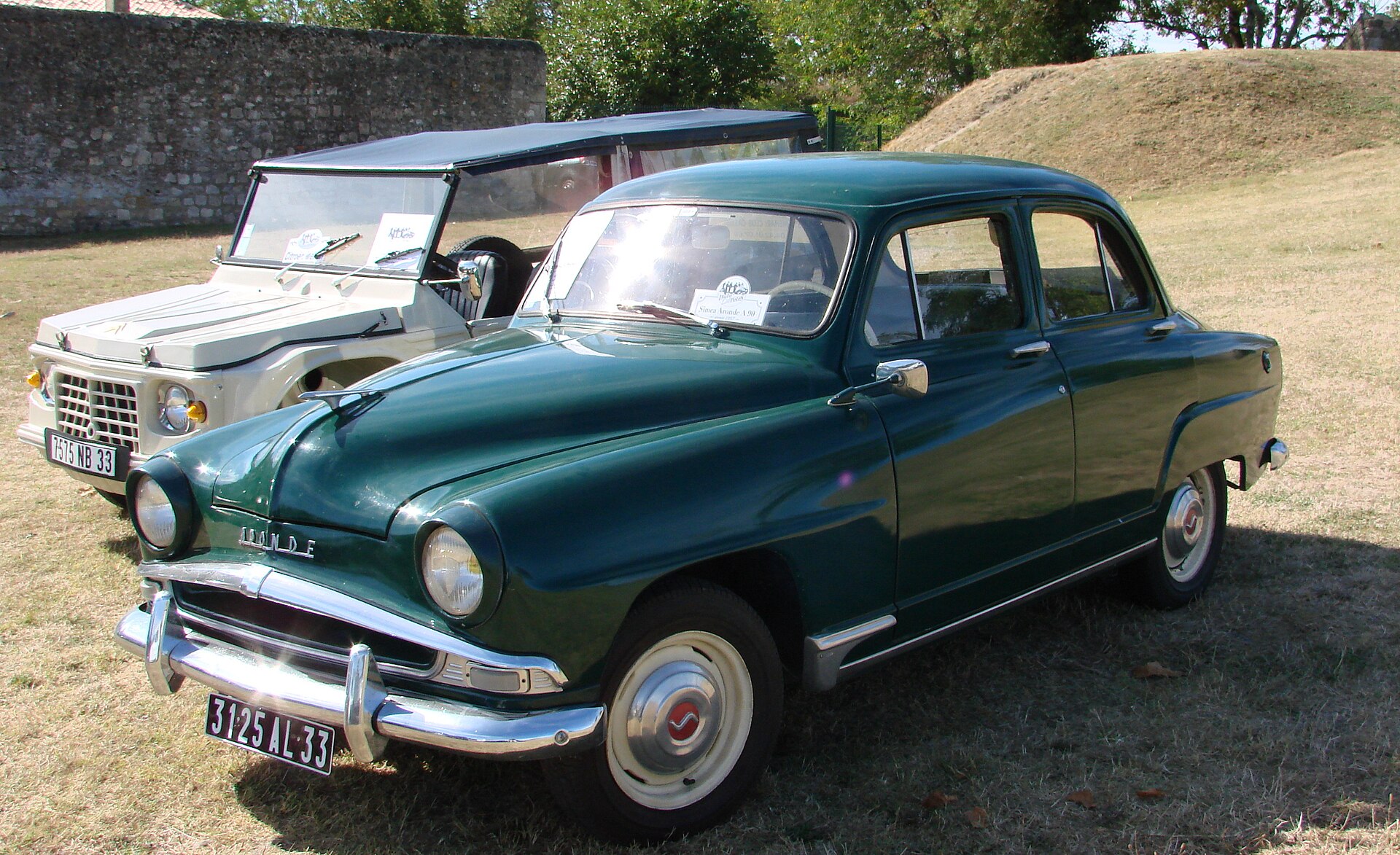
Simca was founded by Fiat as its French arm. The company dates from November 1934 by its infobox. The article text gives 1935, when Fiat bought the former Donnet factory in Nanterre, and it was directed from July 1935 to May 1963 by the Italian-born Henri Pigozzi. Its first cars, the Simca 5 and Simca 8, were French versions of Fiat models; the Aronde of 1951 was the first Simca not based on a Fiat design. In 1954 Simca bought the Poissy factory from Ford SAF, and in 1958 it bought the Talbot-Lago company. Chrysler took a 15 % stake in 1958, 64 % in 1963 and later 77 %.
The company became Chrysler France on 1 July 1970, and after PSA bought Chrysler's European business in 1978 the Simca brand gave way to Talbot.
Specs by version
| Version | Engine | Power | Gearbox | Drive | Production years |
|---|---|---|---|---|---|
| Sim'4 777 cc | 0.8 l · 4 cyl · Petrol 777 cc | 23 kW 31 PS31 hp | 4-sp Manual | Rear-wheel drive | 1968–1978 |
| Rallye 3 1294 cc | 1.3 l · 4 cyl · Petrol 1,294 cc | 76 kW 103 PS102 hp | 4-sp Manual | Rear-wheel drive | - |
Verified Manufacturer and type-approval data from our catalog · Sources and methodology
The 1000 is the rear-engined four-door saloon that Simca built from 1961 to 1978. It started from one of Fiat's design studies, used a water-cooled four-cylinder "Poissy" engine in the tail and grew from a modest family car into the Rallye series that built its motorsport reputation. Almost 2 million were sold.
In short
- Production from 27 July 1961; unveiled at the Paris Motor Show on 10 October 1961; built until 1978.
- Almost 2 million sold; 154,282 in 1962 alone, and more than 100,000 a year until 1974.
- Rear-mounted inline four from 777 cc (23 kW, 31 PS) to 1,294 cc (76 kW, 103 PS in the 1978 Rallye 3).
- Assembled in Poissy, Villaverde (Spain), Bogotá, Arica (Chile) and Casablanca.
Simca 1000 at a glance
| Parameter | Metric | Imperial |
|---|---|---|
| Maker | Simca, Poissy; from 1970 Chrysler France | - |
| Production | July 1961 – 1978 | - |
| Built | almost 2 million | - |
| Design | Fiat studio study; brought to production by Mario Revelli de Beaumont with Felice Mario Boano | - |
| Body | four-door saloon | - |
| Layout | rear engine, rear-wheel drive; 35/65 weight distribution | - |
| Engines | water-cooled inline four, 777 to 1,294 cc | 47.4 to 79.0 cu in |
| Power | 23–76 kW (31–103 PS) | - |
| Gearbox | four-speed all-synchromesh manual; Ferodo three-speed semi-automatic optional | - |
| Wheelbase | 2,220 mm | 87.4 in |
| Length × width × height | 3,785 × 1,473 × 1,335 mm | 149.0 × 58.0 × 52.6 in |
| Kerb weight | 730 kg | 1,609 lb |
From a Fiat study to Poissy
The design came from Fiat. Henri Pigozzi chose one of six clay models from Fiat's "Project 122", which studied a more distinct four-door successor for its small cars. Mario Revelli de Beaumont, Simca's head of styling, worked with Felice Mario Boano from 1959 to 1961 to bring the car to production; the infobox credits Boano as the designer. Poissy, where the car was built, also housed Simca's styling centre.
The engine sat at the rear and the fuel tank behind the rear seat, giving a weight distribution of 35 % front and 65 % rear.
| Year | Event |
|---|---|
| 27 July 1961 | production starts |
| 10 October 1961 | public debut at the Paris Motor Show |
| November 1961 | 50 cars enter service as Paris taxis |
| 1962 | first full year: 154,282 built |
| 1963 | low-cost Simca 900 |
| 1964 | Simca 1000 GL |
| 1965 | production in Spain by Barreiros |
| 1968 | Sim'4 with 777 cc |
| 1970 | Simca 1000 Rallye |
| 1972 | Rallye 1 with 1,294 cc |
| 1973 | Rallye 2 |
| 1977 | Simca 1005 LS and 1006 GLS |
| 1978 | Rallye 3; production ends |

Engines from 777 to 1,294 cc
The first engine was a 944 cc water-cooled four, part of the Poissy family, rated at 33 kW (45 PS) in 1962. It reached 37 kW (50 PS) in 1963 and 40 kW (54 PS) in the 1966 GLA. In October 1968 the Sim'4 brought a small 777 cc version for the French 4 CV tax class, with 23 kW (31 PS) DIN, raised to 24 kW (33 PS) a year later. For 1969 the 1,118 cc engine of the Simca 1100 arrived with 37 kW (50 PS), and 39 kW (53 PS) in 1970.
| Engine | Introduced | Power |
|---|---|---|
| 944 cc | 1961 | 33 kW (45 PS) in 1962; 37 kW (50 PS) in 1963; 40 kW (54 PS) GLA, 1966 |
| 777 cc (Sim'4) | October 1968 | 23 kW (31 PS) DIN; 24 kW (33 PS) a year later |
| 1,118 cc | 1969 | 37 kW (50 PS); 39 kW (53 PS) in 1970 |
| 1,294 cc | 1972 | 44 kW (60 PS); 60 kW (82 PS) Rallye 2, 1973; 63 kW (86 PS) in 1977; 76 kW (103 PS) Rallye 3, 1978 |
The standard gearbox was a four-speed manual with synchromesh on all forward gears. A three-speed semi-automatic developed by Ferodo was offered as an option.
Versions and prices in francs
| Version | Year | Engine | Power | Price (France) |
|---|---|---|---|---|
| Simca 1000 | 1962 | 944 cc | 33 kW (45 PS) | 6,490 F (1962) |
| Simca 900 | 1963 | - | - | 5,950 F (1963) |
| 1000 GL | 1964 | 944 cc | 38 kW (52 PS) | 6,750 F (1964) |
| 1000 GLA | 1966 | 944 cc | 40 kW (54 PS) | 7,350 F (1966) |
| 1000 Rallye | 1970 | 1,118 cc | 39 kW (53 PS) | 8,695 F (1970) |
| 1005 LS | 1977 | - | - | 15,100 F (1977); 23,800 F (1978) |
| 1006 GLS | 1977 | - | - | 17,420 F (1977); 29,700 F (1978) |
The 1977 1005 and 1006 versions had rectangular headlamps. A Simca 1000 Coupé, later the 1200 S Coupé with a 1,204 cc engine, used the same platform.


The Rallye cars
The tuner Abarth offered modified versions early on, among them the Simca-Abarth 1150 rated at 40 kW (55 PS). Simca then created its own Rallye line. The first 1000 Rallye of 1970 used the 1,118 cc engine; the Spanish-market 1000 Rallye GT followed in spring 1971 with 54 kW (74 PS SAE). The Rallye 1 of 1972 had the 1,294 cc engine with 44 kW (60 PS), and the Rallye 2 of 1973 gave 60 kW (82 PS). The Rallye 3 of 1978 reached 76 kW (103 PS); only about 1,000 Rallye 3s were built.
The Rallye line helped the model's motorsport reputation, and Sim'4 bodies later became a popular base for Rallye replicas built by enthusiasts. With 76 kW in a body weighing about 730 kg in standard form, a Rallye 3 approaches 100 kW per tonne; the power-to-weight calculator shows the effect of each version's engine.

Sales, rivals and production abroad
The 1000 sold in large numbers from the start: 154,282 in 1962, its first full year. The class leader in France that year was still the Renault Dauphine with 266,767 sales, a rivalry that runs through the history of Renault. Annual sales of the Simca stayed above 100,000 until 1974, then fell to 49,190 in 1977 and 12,893 in 1978.
Production spread abroad. In Spain, Barreiros Diesel began building the car in late 1965, and the business became Chrysler España in 1970; Spanish production ended in May 1977. Chrysler Colmotores built the car in Colombia from 1969 to 1977, and further assembly took place in Arica, Chile, and Casablanca, Morocco. The car was also a familiar sight in Paris as a taxi after 50 entered service in November 1961.
End of production and the 1000 today
Production ended in 1978 without a direct replacement in the English Wikipedia account. By then the larger front-wheel-drive Simca 1100 had been, for a time, the best-selling car in France. The Simca 1307 had been voted European Car of the Year for 1976, and the Horizon, which arrived in 1978 as the replacement for the Simca 1100, won the same title for 1979. The 1000 lasted 17 years and almost 2 million cars, and a 1988 song by the Spanish band Los Inhumanos still referred to it.
When looking at a 1000 today:
- Version: the Rallye 1, 2 and 3 are the most sought-after; many Rallye-looking cars began as a Sim'4 or a standard 1000.
- Engine: four sizes were used, 777, 944, 1,118 and 1,294 cc, so check which one the car has and which it was built with.
- Gearbox: cars with the Ferodo semi-automatic are less common than manuals.
- Origin: cars were built in France, Spain, Colombia, Chile and Morocco; the build plant is part of the history.
Other small saloons of the decade are in the 1960s classics section.
Photo gallery


Simca 1000 in our rankings
- No. 206 of 912 · Longest-running car nameplates (17 years · top 25%)
- No. 122 of 149 · Most powerful sedans (76 kW · top 82%)
- No. 81 of 94 · Most powerful cars of the 1960s (76 kW · top 87%)
- No. 50 of 56 · Most powerful French cars (76 kW · top 90%)
- No. 789 of 859 · Most powerful cars (76 kW · top 92%)
- No. 122 of 131 · Biggest engines: sedans (1,294 cc · top 94%)
In production longer than 75% of ranked nameplates in the 1CARS catalog (No. 206 of 912).
FAQ
How many Simca 1000s were built?
Almost 2 million between 1961 and 1978.
Where is the engine in the Simca 1000?
At the rear, driving the rear wheels; the fuel tank sits behind the rear seat, and the weight distribution is 35/65 front to rear.
What engines did the Simca 1000 have?
Water-cooled fours of 777, 944, 1,118 and 1,294 cc, from 23 kW (31 PS) to 76 kW (103 PS).
What is the Simca 1000 Rallye?
A sporty line from 1970: the Rallye (1,118 cc), Rallye 1 (1,294 cc, 1972), Rallye 2 (1973) and Rallye 3 (1978, about 1,000 built).
Who designed the Simca 1000?
The shape came from a Fiat clay model chosen by Henri Pigozzi; Mario Revelli de Beaumont and Felice Mario Boano developed it for production.
Data sources
Data checked by an editor against the sources below.