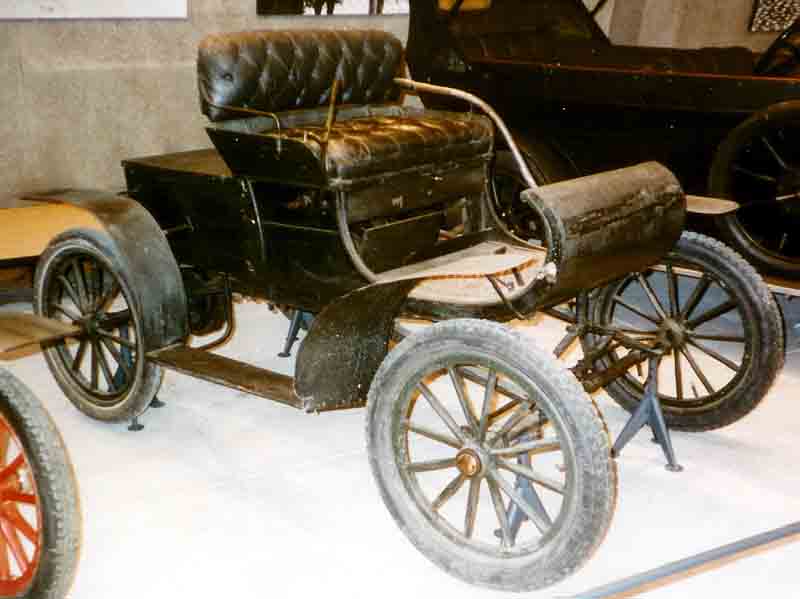
 Oldsmobile Curved Dash
Specs, engines and history
Published Sources (1) Report an error
By Sarah Whitmore, Senior Automotive Writer
- Built
- 1901–1907
- Top power
- 5 kW (7 PS)
Which Curved Dash to choose
Our verdict · Sarah Whitmore
- For originality: a Model R of 1901–1903, with the wire wheels and the true curved dash, is the car people picture.
- For easier use: a 6C or Model B, with the larger 1.9-litre engine and better brakes.
- For rarity: a Straight Dash Model B, which looks different but shares the mechanics.
The Curved Dash is light and simple, but the tiller steering and the planetary gearbox take practice. Compare it with the much larger production of the Ford Model T, which started in 1908. Other Oldsmobiles are listed in the Oldsmobile catalogue.
The Oldsmobile Curved Dash was a light two-seat runabout built by Olds Motor Works from 1901 to 1907, named after its sleigh-like curved front panel. It is credited as the first mass-produced automobile, built on an assembly line with interchangeable parts, and was for a time the best-selling car in the world. More than 19,000 were made, several years before the Ford Model T took the idea much further.
In short
- Built in Lansing, Michigan, from 1901 to 1907; output grew from 425 cars in 1901 to 5,000 in 1904.
- Horizontal water-cooled single-cylinder engine of about 1.6 litres with 3.7 kW (5 hp); 1.9 litres and 5.2 kW (7 bhp) from 1904.
- Two-speed planetary gearbox, single chain drive and a weight of only 390 kg (850 lb).
- The only prototype to survive the factory fire of 9 March 1901 became the production car.
Curved Dash at a glance
| Parameter | Metric | Imperial |
|---|---|---|
| Maker | Olds Motor Works | - |
| Production | 1901–1907 | - |
| Built | over 19,000 | - |
| Assembly | Lansing, Michigan | - |
| Model series | R (1901–1903), 6C (1904), B (1905–1906), F (1907) | - |
| Engine (Model R) | 1,560 cc horizontal single, water-cooled | 95 cu in |
| Power (Model R) | 3.7 kW (5 hp); German Wikipedia: 3.3 kW (4.5 bhp) at 600 rpm | - |
| Engine (6C, B, F) | 1,931 cc single, 5.2 kW (7 bhp) at 600 rpm | - |
| Gearbox | two forward speeds and reverse, planetary | - |
| Final drive | single chain to the rear-axle differential | - |
| Track | 1,423 mm | 56 in |
| Weight | 390 kg | 850 lb |
| Top speed | 32 km/h | 20 mph |
| Successor | Oldsmobile Series 40 (English Wikipedia); no direct successor (German Wikipedia) | - |
Ransom E. Olds and the fire of 1901
Oldsmobile cars had been built in Lansing since 1897. The Olds Motor Vehicle Company was founded on 21 August 1897 and built about a dozen vehicles by 1898; Olds Motor Works followed on 8 May 1899. In 1899 and 1900 the company built eleven more prototypes, among them electric cars, without settling on one design.
The decision was made for it. On 9 March 1901 a fire destroyed the prototypes; workers saved only one small single-cylinder runabout, the Model R. Once the plant was repaired, that car went into production in summer 1901. It was the brand's only model until 1904.

Building a car in volume
English Wikipedia credits the Curved Dash as the first mass-produced automobile, meaning it was built on an assembly line from interchangeable parts. The numbers show how quickly output rose:
| Year | Event |
|---|---|
| 9 March 1901 | fire destroys all prototypes except the Model R |
| 1901 | production starts; 425 cars built |
| 1902 | 2,500 cars (the output table in the same source gives 2,100) |
| 1903 | 3,750 cars |
| April 1904 | Model 6C with a larger engine |
| 1904 | 5,000 cars; Model 6C ends in December after 2,234 cars |
| January 1905 | Model B with better cooling |
| 1906 | celluloid side curtains become standard |
| 1907 | Model F, the last series; Oldsmobile builds 1,200 cars in all |
The two sources do not always agree on yearly figures, so treat them as approximate. Olds Motor Works was among the first car makers to advertise nationally in magazines, and it demonstrated the car at county fairs across the Midwest.

Engine, gearbox and controls
The engine lay flat in the middle of the car, under the seat. It was a water-cooled single-cylinder four-stroke fed by a brass gravity-feed carburettor. English Wikipedia lists 1,560 cc and 3.7 kW (5 hp); German Wikipedia gives 1,564 cc and 3.3 kW (4.5 bhp) at 600 rpm. The crankshaft ran in two bearings, with the flywheel and the clutch for the high gear on it.
The gearbox was a semi-automatic planetary unit with two forward speeds and reverse; low gear and reverse used epicyclic gears. A single chain took drive to the differential. The car weighed 390 kg (850 lb), and with 3.7 kW it had about 9.5 kW per tonne, enough for 32 km/h (20 mph). Our power-to-weight calculator does the same sum for a modern car.
The controls differed from many cars of the day. The driver steered with a tiller from the seat, and the throttle was a foot pedal next to the brake pedal at a time when most rivals used a hand lever. The chassis was simple: long leaf springs on each side, called Concord springs, doubled as frame members, and the axles were mounted rigidly to them.

Model R, 6C, B and F
| Variant | Years | Body / purpose | Engine | Notes |
|---|---|---|---|---|
| Model R | 1901–1903 | two-seat runabout, optional rear-facing third seat | 1,560 cc, 3.7 kW (5 hp) | about 6,850 built, single band brake |
| Model 6C | 1904 | slightly larger runabout | 1,931 cc, 5.2 kW (7 bhp), Holley carburettor | 2,234 built, drum brakes from mid-year |
| Model B | 1905–1906 | runabout; Straight Dash option | 1,931 cc | better cooling, new flywheel, handbrake on the differential |
| Model F | 1907 | runabout | 1,931 cc | further mechanical changes |
| Side Entrance Touring | 1905–1906 | larger touring car | 4,257 cc horizontally opposed twin | poor sales, dropped by 1906 |
The Model R came only in black with cherry-red trim and gold pinstripes. Its standard wheels were 28 × 3-inch wire wheels with pneumatic tyres, and buyers could choose from seven wheel options; a top, lamps and wings were extras. On the Model R a single band brake acted on the transmission. The 6C of April 1904 brought wooden-spoke wheels and wings as standard, and two brakes on the rear wheels that soon became drums. The Model B of January 1905 received stronger axles and springs. An upright "Straight Dash" version followed, from 1905 according to English Wikipedia and from 1906 according to German Wikipedia, at the same price as the Curved Dash.

The Pirate and early records
In 1902 Ransom Olds stripped a Model R down to the engine, one seat and a radiator, with solid axles on semi-elliptic leaf springs. The result, called the "Pirate", ran on the sand at Ormond Beach, Florida, in 1902 and 1903. Driver Horace Thomas set a record of 87.5 km/h (54.38 mph); German Wikipedia adds that the car covered 8 km in 6.5 minutes. A 1951 Popular Science article also described a coast-to-coast trip by a 1904 Olds.
Curved Dash and Model T compared
| Figure | Oldsmobile Curved Dash | Ford Model T |
|---|---|---|
| Production | 1901–1907 | 1908–1927 |
| Built | over 19,000 | about 15 million |
| Engine | 1.6–1.9 l single | 2.9 l four |
| Power | 3.7–5.2 kW | 15 kW |
| Gearbox | two-speed planetary | two-speed planetary |
| Weight | 390 kg | 540–750 kg |
| Top speed | 32 km/h | about 68 km/h |
Both cars used a two-speed planetary gearbox, but the Model T had four times the power and more than twice the speed. The Curved Dash showed that a light car could be built in thousands; the Model T showed it could be built in millions.
The end of the Curved Dash
Production ended in 1907. German Wikipedia links the end to a dispute over the next model between Ransom E. Olds and the financier Samuel L. Smith and his sons Frederick and Angus; Olds left the company, which then moved to larger and dearer cars. In 1908 the cheapest Oldsmobile cost about three times as much as the Curved Dash, and the new policy caused financial difficulties. General Motors took over Oldsmobile on 12 November 1908. The brand's later history, up to the last Alero, is in our Oldsmobile history, and the wider group story in our history of General Motors.
Photo gallery


Oldsmobile Curved Dash in our rankings
- No. 544 of 912 · Longest-running car nameplates (6 years · top 69%)
- No. 154 of 154 · Most powerful American cars (5 kW)
- No. 79 of 79 · Most powerful convertibles and roadsters (5 kW)
- No. 859 of 859 · Most powerful cars (5 kW)
In production longer than 31% of ranked nameplates in the 1CARS catalog (No. 544 of 912).
FAQ
Why is the Oldsmobile Curved Dash important?
It is credited as the first mass-produced car, built on an assembly line with interchangeable parts, and was the best-selling car in the world for a time.
How many Curved Dash Oldsmobiles were built?
More than 19,000 between 1901 and 1907, including about 6,850 Model R and 2,234 Model 6C cars.
What engine did the Curved Dash have?
A horizontal water-cooled single-cylinder engine: 1,560 cc and 3.7 kW (5 hp) at first, 1,931 cc and 5.2 kW (7 bhp) from 1904.
How fast was the Curved Dash?
About 32 km/h (20 mph). The stripped-down "Pirate" racer reached 87.5 km/h (54.38 mph) at Ormond Beach.
Why is it called the Curved Dash?
The name comes from the curved, sleigh-like front panel, or dashboard, of the body.
Data sources
Data checked by an editor against the sources below.