 Eagle Talon
Specs, engines and history
Published Sources (1) Report an error
By Sarah Whitmore, Senior Automotive Writer
- Built
- 1989–1998
- Top power
- 145 kW (197 PS)
Which Eagle Talon to choose
Our verdict · Sarah Whitmore
- TSi AWD: the version that built the Talon's name, with the turbo 4G63, permanent all-wheel drive and the most equipment.
- TSi front-drive: the same turbo engine with less weight and complexity, but lower output in first-generation form.
- ESi, ES, DL and base: naturally aspirated cars for buyers who want the shape without turbo upkeep.
- 1GB versus 2G: the 1992–1994 car has the stronger "7-bolt" engine and fixed headlamps; the 2G has the newer double-wishbone chassis and up to 157 kW.
Eagle was a Chrysler brand created after the purchase of American Motors (AMC) in 1987 and sold until the 1998 model year. The name came from the four-wheel-drive AMC Eagle of 1980. Chrysler mainly wanted Jeep, but Renault's terms obliged it to take over AMC's passenger-car contracts as well, and the Jeep-Eagle division kept the former AMC dealers busy. Eagle cars did not wear Chrysler's Pentastar; they carried an eagle-head badge instead. The range mixed the Renault-based Medallion and Premier, Mitsubishi-based Summit, Vista and 2000GTX models and the Vision of 1993–1997.
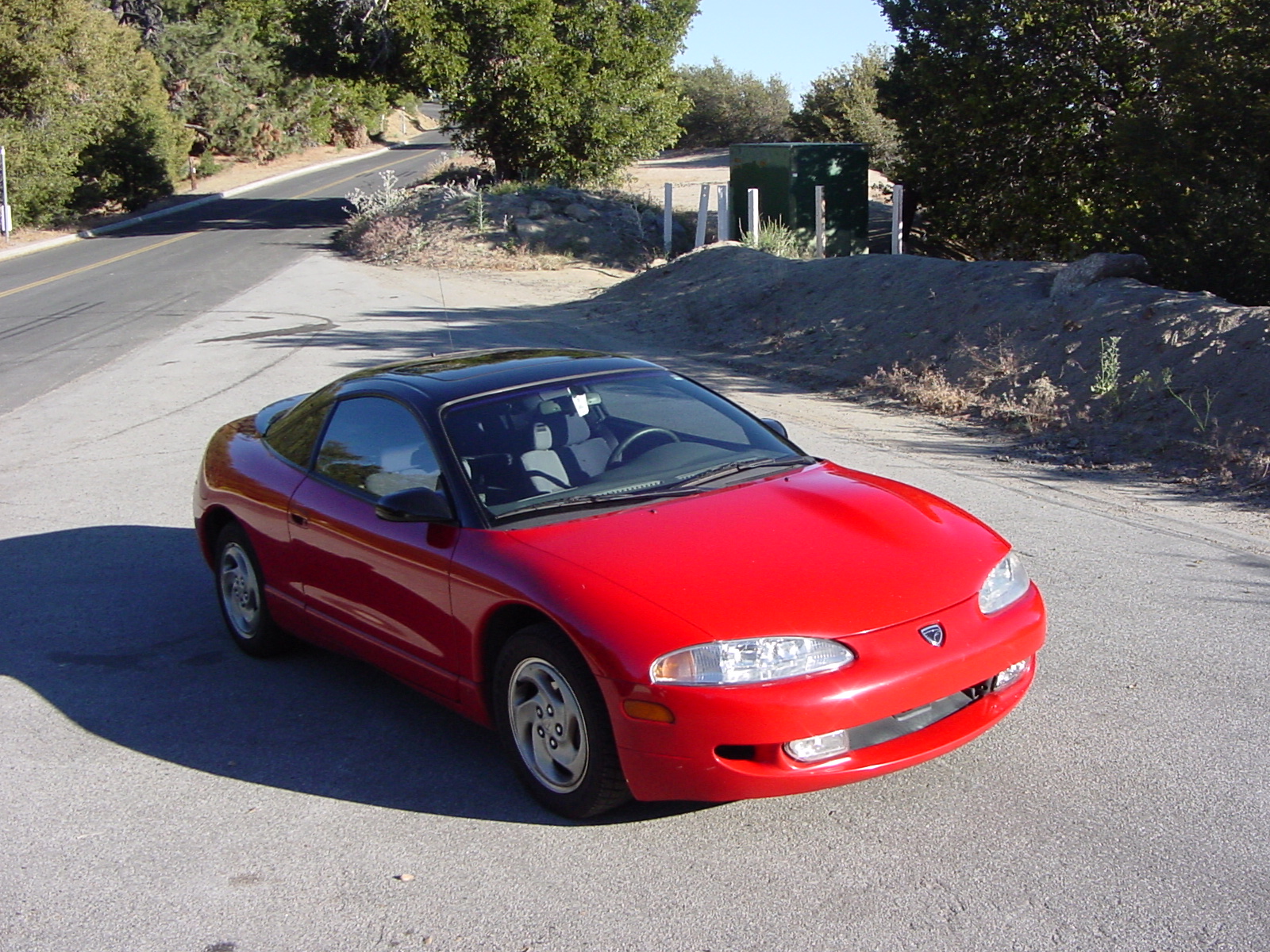
The Eagle Talon was the brand's halo car and its last model. It was a three-door sports coupé built from 1989 to 1998 by Diamond-Star Motors, the Chrysler–Mitsubishi plant in Normal, Illinois, alongside the Mitsubishi Eclipse and Plymouth Laser. The TSi AWD, with a turbocharged 2.0-litre engine and permanent all-wheel drive, made it a favourite of tuners and racers, and the Talon outsold its Plymouth twin.
Specs by version
Verified Manufacturer and type-approval data from our catalog · Sources and methodology
In short
- Two generations: 1G for the 1990–1994 model years and 2G for 1995–1998; the last Talon left the line on 10 February 1998.
- Engines: Mitsubishi 1.8 l 4G37, 2.0 l 4G63 with and without turbo, and Chrysler's 2.0 l 420A in the 2G ESi.
- The 2G TSi with a manual gearbox had 157 kW (210 hp) and 278 Nm; the 1G TSi AWD had 145 kW (195 hp).
- Production by model year: 144,970 first-generation and 54,262 second-generation cars, 199,232 in all.
Eagle Talon at a glance
| Specification | Value |
|---|---|
| Maker | Diamond-Star Motors for Chrysler's Eagle division (1990–1998), then DaimlerChrysler (1998) |
| Production | mid-1989 to 10 February 1998; model years 1990–1998 |
| Plant | Diamond-Star Motors, Normal, Illinois, USA |
| Body | three-door hatchback coupé |
| Platform | Chrysler D platform, shared with the Mitsubishi Eclipse and Plymouth Laser |
| Layout | transverse front engine, front-wheel or all-wheel drive |
| Engines | 1.8 l 4G37; 2.0 l 4G63 (naturally aspirated or turbo); 2.0 l Chrysler 420A |
| Power | 69 kW (92 hp) to 157 kW (210 hp) |
| Gearboxes | five-speed manual or four-speed automatic |
| Length | 4,379–4,440 mm, depending on year |
| Successors | Chrysler Sebring coupé and Dodge Stratus coupé |
Eagle Talon generations
| Generation | Model years | Main changes | Trims | Built |
|---|---|---|---|---|
| 1GA | 1990–1991 | pop-up headlamps, "6-bolt" 4G63 | base, TSi, TSi AWD | 66,245 |
| 1GB | 1992–1994 | fixed composite headlamps, "7-bolt" 4G63 | base (to 1992), DL and ES (1993–1994), TSi, TSi AWD | 78,725 |
| 2G | 1995–1996 | new body, double-wishbone front suspension | ESi, TSi, TSi AWD | 40,166 |
| 2Gb | 1997–1998 | larger air intake, new rear spoiler, 17 in wheels on turbo cars | ESi, TSi, TSi AWD | 14,096 |
The production figures are sums of English Wikipedia's model-year table. The first generation peaked in 1991 with 33,537 cars; the second fell from 25,066 in 1995 to only 4,308 in 1998, which makes the 1998 car the rarest Talon.
First generation (1990–1994)
The Talon appeared in mid-1989 as a 1990 model. On the Chrysler D platform it shared almost everything with the Mitsubishi Eclipse and the Plymouth Laser. At the same option level the three were mechanically identical and differed only in wheels, colours, tail lamps, bumpers and spoilers. The front suspension used MacPherson struts.
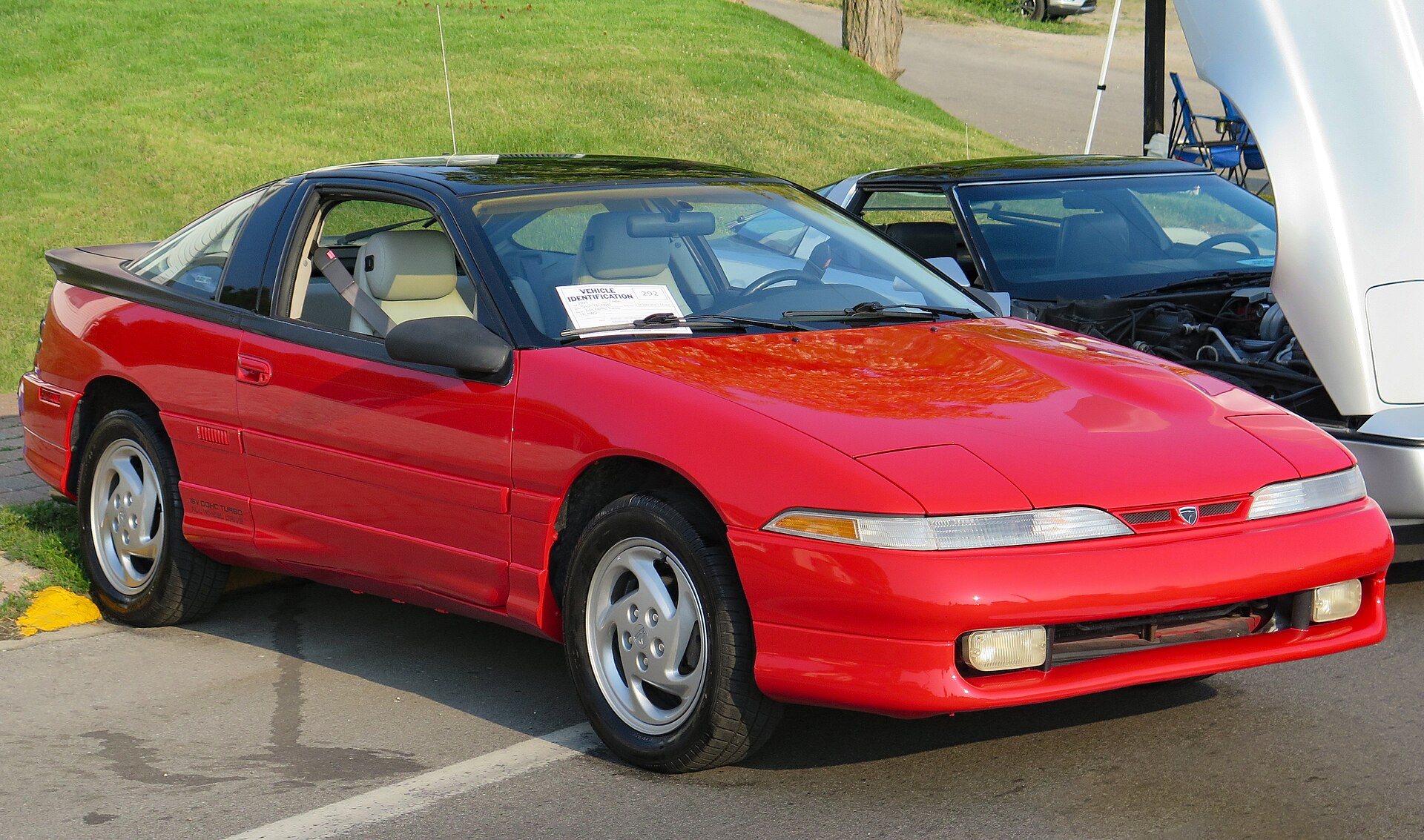
The early cars (1GA) had pop-up headlamps. For 1992 they gave way to fixed composite lamps with integrated indicators. From May 1992 the turbo engine changed too. The "7-bolt" 4G63 had lighter connecting rods, a lighter crankshaft and a larger one-piece crankshaft girdle; the 1992 Mitsubishi Lancer Evolution used the same engine. The TSi and TSi AWD were on Car and Driver's 10 Best list for 1990, 1991 and 1992.

Second generation (1995–1998)
The second Talon arrived for 1995 alongside a new Eclipse, while the Plymouth Laser was dropped. The front suspension switched to double wishbones with a better roll-camber curve, and a multi-link axle sat at the rear. The turbo engine's compression rose from 7.8:1 to 8.5:1. A Garrett T25 turbocharger gave a peak boost of 14 psi (1.0 bar) and spooled up faster than the first generation's Mitsubishi 14b.
The Talon and Eclipse were still almost identical underneath, but now looked more different:
- the Talon had amber rear indicators, the Eclipse red ones;
- the Talon had a black roof, the Eclipse a body-coloured one;
- the Talon's "sickle" spoiler sat at the rear window, while the Eclipse had a "basket handle" spoiler on the deck;
- the Talon's badges were embossed in the body colour, the Eclipse used stickers.
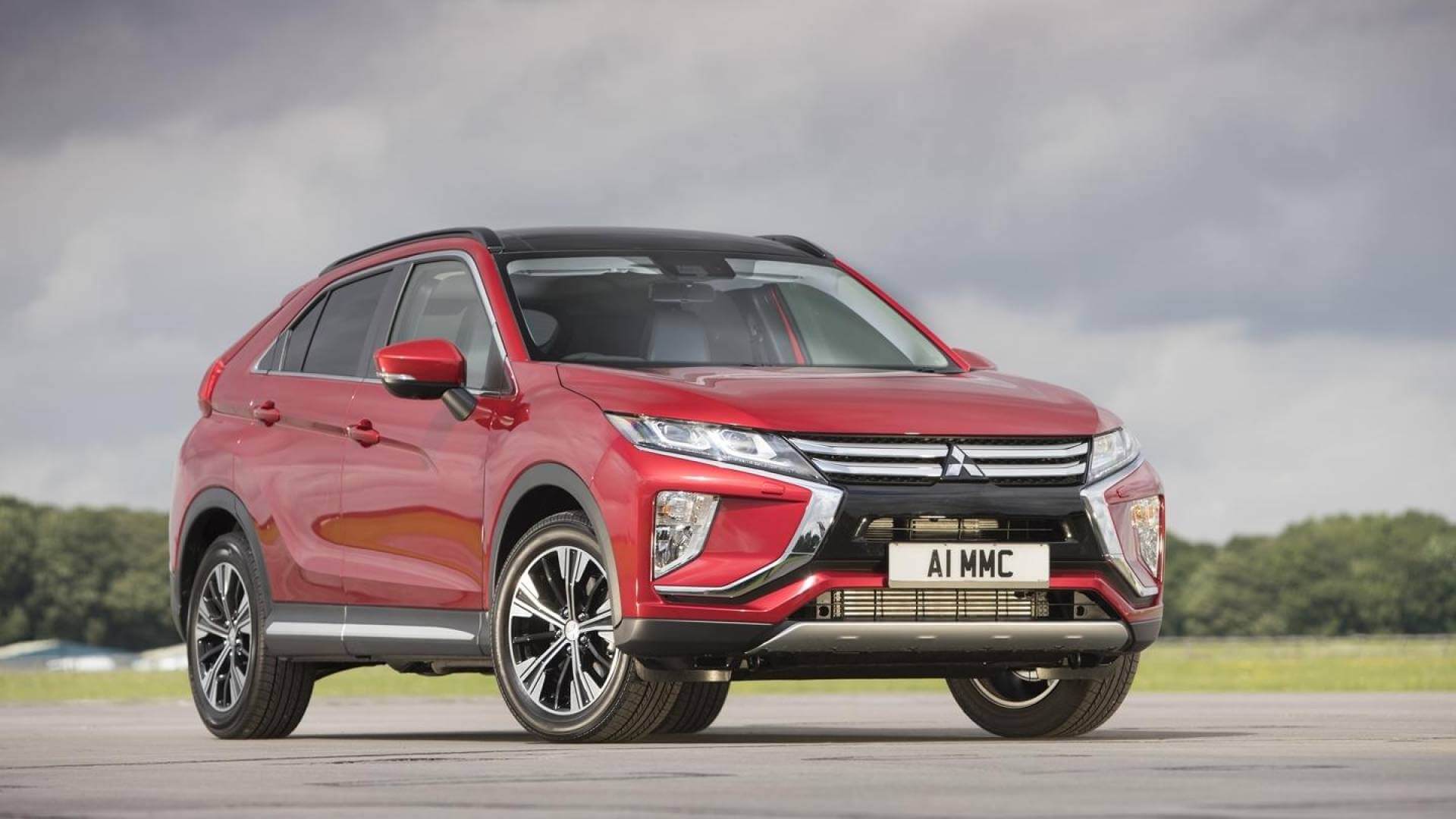
For 1997 the Talon gained a larger front air intake, a bigger "Eagle" emblem in the bumper and a high-mounted rear spoiler instead of the flush one. The turbo cars lost their side skirts, gained "16V DOHC TURBO" lettering and moved from 16 in to 17 in wheels. The Mitsubishi side of the family is covered in our article on the Mitsubishi Eclipse generations.

Engines, transmissions and performance
| Version | Years | Engine | Power | Torque |
|---|---|---|---|---|
| DL | 1993–1994 | 1.8 l 4G37 I4, FWD | 69 kW (92 hp) | — |
| base / ES | to 1992 / 1993–1994 | 2.0 l 4G63 I4, naturally aspirated | 101 kW (135 hp) | — |
| TSi FWD, automatic | 1990–1994 | 2.0 l 4G63 turbo, smaller 13g turbo | 134 kW (180 hp) | — |
| TSi FWD | 1990–1994 | 2.0 l 4G63 turbo | 142 kW (190 hp) | — |
| TSi AWD | 1990–1994 | 2.0 l 4G63 turbo, Mitsubishi 14b at 0.8 bar | 145 kW (195 hp) | — |
| ESi | 1995–1998 | 2.0 l Chrysler 420A DOHC I4 | 110 kW (140 hp) at 6,000 rpm | 180 Nm at 4,800 rpm |
| TSi / TSi AWD, automatic | 1995–1998 | 2.0 l 4G63 turbo | 153 kW (205 hp) at 6,000 rpm | 298 Nm at 3,000 rpm |
| TSi / TSi AWD, manual | 1995–1998 | 2.0 l 4G63 turbo | 157 kW (210 hp) at 6,000 rpm | 278 Nm at 3,000 rpm |
All Talons used a five-speed manual or a four-speed automatic; the 1990 turbo models came only with the manual. The first-generation front-drive TSi was held to 142 kW by a restrictive exhaust. English Wikipedia gives no acceleration or top-speed figures. Its account of the T25 turbo is also unclear, as it places the change under both 1995 and 1997.

Dimensions and body
| Dimension | 1G | 2G |
|---|---|---|
| Length | 4,379 mm (1990–1991 TSi); 4,389 mm (1992–1994) | 4,374 mm (1995–1996); 4,440 mm (1997–1998) |
| Width | 1,699 mm (TSi and AWD); 1,694 mm (1992–1994) | 1,745 mm (1995–1996); 1,775 mm (1997–1998); 1,735 mm (ESi) |
| Height | 1,321 mm (AWD and 1990–1991 TSi) | 1,265 mm; 1,283 mm (AWD) |
English Wikipedia lists these figures without full labels, so some assignments are approximate. To see how the Talon's 4.4 m body compares with a current coupé or hatchback, use the car size comparison tool.
Trims and equipment
The second-generation ESi came with the 2.0-litre engine, a five-speed manual, four-wheel disc brakes, driver and passenger airbags, variable-assist power steering, cloth bucket seats and 195/70R14 tyres. The TSi added the turbo engine, a sport exhaust, firmer suspension, a leather-wrapped wheel and gear knob and power mirrors. It also had boost and oil-pressure gauges, a cassette player, fog lamps and 205/55R16 tyres on alloy wheels. The TSi AWD added permanent all-wheel drive, cruise control, power locks and windows and 215/55VR16 tyres.
Options included the automatic, anti-lock brakes, a limited-slip differential for the TSi AWD, air conditioning and leather. Buyers could also order a power sunroof, a CD player with graphic equaliser and HomeLink, offered for 1996–1998 only.
Racing
The Talon was a winner in American production-car racing. It took the SCCA World Challenge touring car title in 1990 and 1991 and the GT Touring title from 1993 to 1995. Eagle and Oldsmobile are the only American brands to win the TC title in the 1990s. In the Escort series, Talons won classes every year from 1989 to 1993, including the 1989 Class A Endurance title for Bobby and Tommy Archer in an AWD Turbo. English Wikipedia credits the car with seven straight SCCA Pro Racing championships, with HKS and Archer Racing dominant.
The end of the Talon and of Eagle
Chrysler announced the end of Eagle in September 1997, and the Talon was the brand's last model. English Wikipedia names the reasons. Chrysler had no clear marketing plan for Eagle and spent its money on the more profitable Jeep. Dealers preferred Jeeps, and many Eagles were rebadged Chrysler or Mitsubishi cars that confused buyers. A planned 1999 Vision became the Chrysler 300M instead. The Talon's place went to the Chrysler Sebring coupé and Dodge Stratus coupé; the Sebring family is covered in our article on the Chrysler Sebring. Other models of the brand are in the Eagle catalogue.
Photo gallery

Eagle Talon in our rankings
- No. 32 of 59 · Most powerful cars of the 1980s (145 kW · top 55%)
- No. 592 of 859 · Most powerful cars (145 kW · top 70%)
- No. 642 of 912 · Longest-running car nameplates (5 years · top 77%)
- No. 127 of 154 · Most powerful American cars (145 kW · top 83%)
- No. 277 of 313 · Most powerful coupes (145 kW · top 89%)
More powerful than 45% of ranked cars of the 1980s in the 1CARS catalog (No. 32 of 59).
FAQ
What engine is in the Eagle Talon TSi?
A 2.0-litre Mitsubishi 4G63 turbo four. It gave 142–145 kW (190–195 hp) in the first generation and 153–157 kW (205–210 hp) in the second.
Is the Eagle Talon the same as the Mitsubishi Eclipse?
Almost. Both were built at Diamond-Star Motors in Normal, Illinois, on the same platform. The first-generation cars were mechanically identical at the same option level; the second generation differed more in styling details.
How many Eagle Talons were made?
English Wikipedia's model-year table gives 144,970 first-generation and 54,262 second-generation cars, 199,232 in total; the 1998 model year, with 4,308 cars, is the rarest.
What is the difference between a 6-bolt and a 7-bolt Talon?
The 7-bolt 4G63 arrived in May 1992 with lighter connecting rods, a lighter crankshaft and a larger crankshaft girdle; earlier first-generation cars have the 6-bolt engine.
When did Eagle stop making the Talon?
The last Eagle Talon left the line on 10 February 1998, and the brand ended with the 1998 model year.
Data sources
Data checked by an editor against the sources below.