Eagle — The Brand Chrysler Built From American Motors
Eagle was a car brand of the Chrysler Corporation, sold in North America from the 1988 to the 1998 model year. Chrysler created it after buying American Motors (AMC) in 1987, mainly for Jeep, and named it after the four-wheel-drive AMC Eagle of 1980. The brand gave former AMC dealers a range of their own: the Premier saloon developed by AMC and Renault, Mitsubishi-built imports, the Talon sports coupé from the Diamond-Star plant in Illinois and the Vision, one of Chrysler's LH cars. Weak marketing and a mostly rebadged range ended it in February 1998.
Key takeaways
- The name came from the AMC Eagle, launched in August 1979 as a 1980 model and often called one of the first crossovers; 197,449 were built.
- Chrysler acquired AMC effective 5 August 1987 and set up the Jeep-Eagle division for the former AMC dealers.
- The Eagle Premier's design, by Giugiaro's Italdesign on a Renault 25 base, became the starting point for Chrysler's LH saloons.
- Chrysler announced the end of the brand in September 1997; the last Eagle Talon left the line on 10 February 1998.
Eagle at a glance
| Fact | Value |
|---|---|
| Brand | Eagle, part of Chrysler's Jeep-Eagle division |
| Model years | 1988–1998 |
| Origin of the name | AMC Eagle four-wheel-drive car (1980–1988) |
| Markets | United States and Canada |
| Main plants | Brampton Assembly, Ontario (Premier, Vision); Diamond-Star Motors, Normal, Illinois (Talon) |
| Models | Eagle Wagon, Premier, Medallion, Vista, Summit, Talon, 2000GTX, Vision |
| Partners | Renault (Premier, Medallion), Mitsubishi (Summit, Vista, 2000GTX, Talon) |
| Last car | Eagle Talon, 10 February 1998 |
The AMC Eagle
The name began with American Motors. The AMC Eagle was presented in August 1979 as a 1980 model, built on the Concord platform. Its concept came from Roy Lunn, chief engineer of AMC's Jeep operations, and FF Developments built the 1977 prototype. It combined a passenger-car body with permanent four-wheel drive through a viscous coupling, and Wikipedia describes it as the first mass-produced American four-wheel-drive car with independent front suspension. It is widely seen as an early crossover, a forerunner of today's all-wheel-drive estates and SUVs.
The Eagle came as a two-door and four-door saloon and an estate, later also as the shorter SX/4 and Kammback and as a Sundancer convertible conversion. It used AMC's 4.2-litre six and, from 1981, a 2.5-litre four. Production peaked at 45,379 in 1980 and had fallen to 2,306 in its last year; 197,449 were built in all. After the Chrysler takeover the estate was sold for 1988 as the Eagle Wagon, and the last one left the Brampton plant in Ontario on 14 December 1987. Its six then had 84 kW (112 hp).

Chrysler buys AMC
In 1987 Chrysler, led by chairman Lee Iacocca, bought American Motors. Its main interest was Jeep. Renault, AMC's partner and owner of 46.4% of its shares, required Chrysler to take over AMC's obligations for passenger cars as well, and state franchise laws meant that Jeeps could not simply be moved to Chrysler dealers. Chrysler's answer was a new brand: AMC's dealers would sell Jeep and a separate car range under the Eagle name, through a Jeep-Eagle division. The deal took effect on 5 August 1987, and the Renault Alliance and Encore were dropped. The history of the parent group is in the Chrysler Corporation history, and the Jeep side of the story is in the history of Jeep.
Premier, Medallion and the Mitsubishi cars
The first new Eagle was the Premier, a large front-wheel-drive saloon that AMC had developed with Renault on the structure of the Renault 25, with an exterior by Giorgetto Giugiaro's Italdesign. It was built from September 1987 at the new Brampton Assembly plant in Ontario. The engines were a 2.5-litre AMC four with 83 kW (111 hp) and a 3.0-litre PRV V6 with 112 kW (150 hp), which became the only engine for 1990. Plans called for 150,000 cars a year, but calendar-year 1989 output was only 32,720, and 117,502 Premiers were built up to December 1991. A rebadged twin, the Dodge Monaco, was added from 1990, partly because Chrysler had a contract to buy 260,000 PRV engines from Renault over five years.
The rest of the early range came from partners. The Medallion of the 1989 model year was a Renault 21 imported from France. The Summit of 1989–1996, offered as a coupé, saloon and estate, was mostly based on Mitsubishi designs. The Vista, sold only in Canada, was a rebadged Mitsubishi Mirage and Chariot. The 2000GTX of 1991–1992 was a Mitsubishi Galant.

Talon and Vision
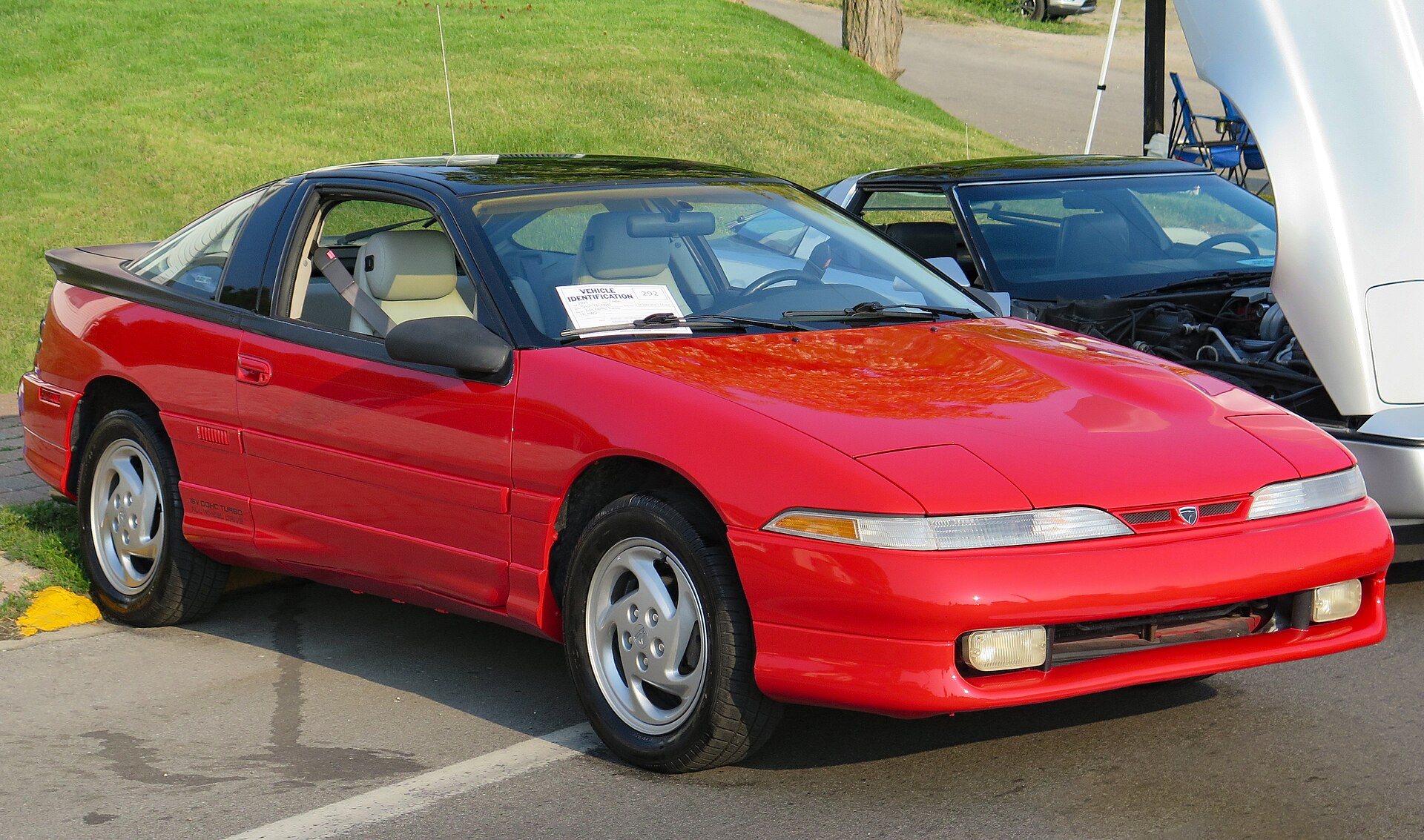
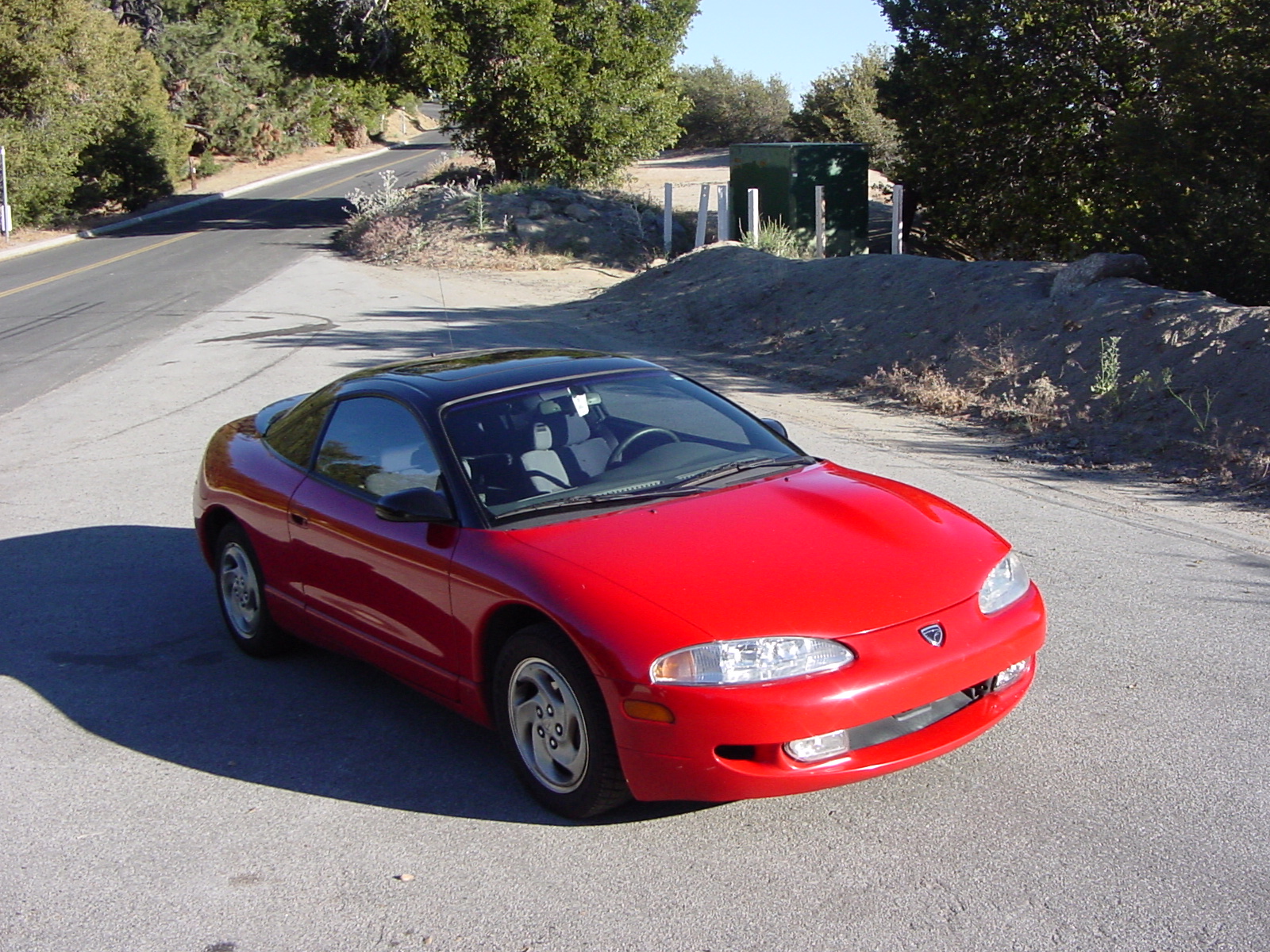
The Talon of 1990 became the brand's halo car. It was built by Diamond-Star Motors, a Chrysler and Mitsubishi joint venture in Normal, Illinois, alongside the Mitsubishi Eclipse and Plymouth Laser. The top TSi AWD version had a 2.0-litre Mitsubishi 4G63 turbo engine with 145 kW (195 hp) in the first generation and 157 kW (210 hp) with a manual gearbox in the second. The first generation of 1990–1994 sold 144,970 and the second of 1995–1998 sold 54,262. The models and engines are covered in the Eagle Talon guide.
The Premier's layout lived on. Former AMC engineer François Castaing carried over its longitudinal engine position and a similar transmission design to Chrysler's LH saloons, and Premier bodies were used for LH prototype development cars. The Eagle Vision, shown at the Detroit auto show in 1992 and built at Brampton for the 1993–1997 model years, was one of the three LH cars and the only Eagle designed and built entirely by Chrysler. Its "cab forward" design traced back to the Lamborghini Portofino concept, and its drag coefficient was 0.31. The TSi had a 3.5-litre V6 with 160 kW (214 bhp) and 300 Nm. Automobile Magazine named it Automobile of the Year for 1993, and it made Car and Driver's Ten Best list in 1994. Production figures differ: the Eagle article gives 115,699, the Vision article's table 94,550 and its text about 105,000. In Europe the car was sold as the Chrysler Vision.

Why the brand ended
Eagle never became a clear brand. Most of its cars were rebadged models from Renault, Mitsubishi or Chrysler, buyers were unsure what an Eagle was, and its models competed with Chrysler and Plymouth cars. Jeep-Eagle dealers concentrated on the more profitable Jeeps, which also received most of the marketing budget, and Chrysler was in financial trouble at the end of the 1980s. The Summit ended in 1996, the last Vision was built on 5 September 1997, and in September 1997 Chrysler announced the end of the brand. The planned successor to the Vision was released as the Chrysler 300M. The last Eagle, a 1998 Talon, left Diamond-Star Motors on 10 February 1998. Eagle models on 1cars are listed in the Eagle catalogue.
Eagle timeline
| Year | Event |
|---|---|
| 1979 | AMC Eagle presented (August) as a 1980 model |
| 1987 | Chrysler acquires AMC (5 August); Eagle brand created; Premier production begins (September); last AMC Eagle built (14 December) |
| 1988 | First Eagle model year: Eagle Wagon, Premier, Vista |
| 1989 | Medallion and Summit |
| 1990 | Talon launched |
| 1991 | Last Premier built (17 December); 2000GTX |
| 1992 | Eagle Vision shown in Detroit |
| 1993 | Vision named Automobile of the Year |
| 1995 | Second-generation Talon |
| 1996 | Summit ends |
| 1997 | Last Vision (5 September); end of brand announced |
| 1998 | Last Talon built (10 February) |
Landmark Eagle models
| Model | Years | Why it matters |
|---|---|---|
| AMC Eagle / Eagle Wagon | 1980–1988 | Four-wheel-drive car that gave the brand its name |
| Premier | 1988–1992 | AMC–Renault saloon, base for Chrysler's LH cars |
| Summit | 1989–1996 | Mitsubishi-based small car range |
| Talon | 1990–1998 | Diamond-Star sports coupé with AWD turbo |
| Vision | 1993–1997 | LH saloon, Automobile of the Year 1993 |
Photo gallery

FAQ
Who made Eagle cars?
Chrysler Corporation, through its Jeep-Eagle division, from the 1988 to the 1998 model year.
Where did the Eagle name come from?
From the AMC Eagle, American Motors' four-wheel-drive car of 1980, which Chrysler took over with AMC in 1987.
Why was the Eagle brand discontinued?
Its range was mostly rebadged cars, marketing money went to Jeep, and its models competed with Chrysler and Plymouth. Chrysler announced the end in September 1997.
What was the last Eagle?
A 1998 Eagle Talon, built at Diamond-Star Motors on 10 February 1998.
Sources
- Wikipedia — Eagle (automobile) (accessed 24 Oct 2026)
- Wikipedia — AMC Eagle (accessed 24 Oct 2026)
- Wikipedia — Eagle Premier (accessed 24 Oct 2026)
- Wikipedia — Eagle Talon (accessed 24 Oct 2026)
- Wikipedia — Eagle Vision (accessed 24 Oct 2026)
Found a mistake? Report an error