 Duesenberg Model J
Specs, engines and history
Published Sources (1) Report an error
By Sarah Whitmore, Senior Automotive Writer
- Built
- 1928–1937
- Top power
- 239 kW (325 PS)
Which Model J to choose
Our verdict · Sarah Whitmore
- For the classic Duesenberg: a Model J with a LaGrande body designed by Gordon Buehrig, the most common style.
- For performance: one of the 36 supercharged SJ cars, with the external exhaust pipes.
- For coachwork: a car by Rollston, Murphy, Derham or a European builder such as Saoutchik.
- For a driving car: expect a heavy car and an unsynchronised gearbox that needs skill.
Of the 481 cars built, about 378 survive. Values have risen with time: in 2018 Gary Cooper's SSJ became the most expensive American car ever sold, according to English Wikipedia. The rival British flagship of the period is covered in our Rolls-Royce Phantom guide, and other pre-war cars appear in our classic cars section.
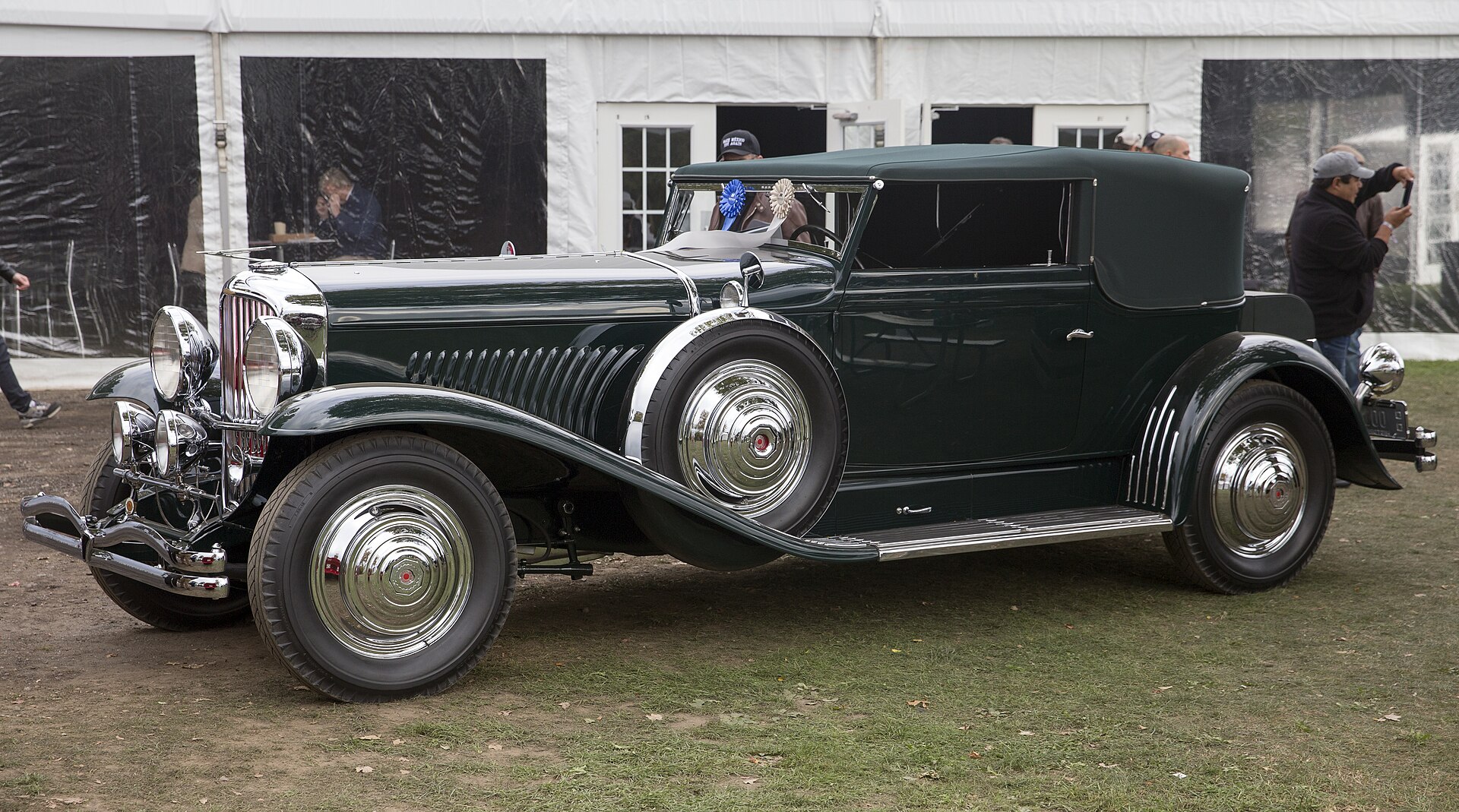
The Duesenberg Model J was the American ultra-luxury car that Duesenberg built in Indianapolis from 1928 to 1937, aimed at the best European cars from Hispano-Suiza and Rolls-Royce. Its 6.9-litre straight-eight with two overhead camshafts and four valves per cylinder gave 198 kW (265 hp), far more than any rival, and the supercharged SJ raised that to about 239 kW (320 hp). Only 481 were built, each with a body made to the owner's order, and about 378 survive.
In short
- Shown at the New York car show on 1 December 1928; production ran until 1937.
- 481 built: 445 Model J and 36 supercharged SJ, plus two short-wheelbase SSJ roadsters.
- 420 cu in (6.9-litre) DOHC straight-eight built by Lycoming: 198 kW (265 hp) at 4,250 rpm.
- Top speed of the standard car 187 km/h (116 mph); in 1935 a special J-based car set a 24-hour record that stood until 1961.
Duesenberg Model J at a glance
| Parameter | Metric | Imperial |
|---|---|---|
| Maker | Duesenberg, Inc., Indianapolis | — |
| Production | 1928–1937 | — |
| Built | 481 (445 J, 36 SJ) | — |
| Engine | straight-eight, DOHC, four valves per cylinder, built by Lycoming | 420 cu in (6.9 l) |
| Power (J) | 198 kW (265 hp) at 4,250 rpm | — |
| Power (SJ) | about 239 kW (320 hp) at 4,200 rpm | — |
| Gearbox | three-speed manual, no synchromesh | — |
| Wheelbase | 3,620 mm standard, 3,900 mm long | 142.5 / 153.5 in |
| Weight | about two and a half tons, up to three | — |
| Top speed (J) | 187 km/h; 143 km/h in second gear | 116 / 89 mph |
| Bodies | coachbuilt to the owner's order | — |
| Predecessor | Duesenberg Model X | — |
E. L. Cord buys Duesenberg
August and Fred Duesenberg founded their company in Indianapolis in 1920 and made their name in racing: Jimmy Murphy won the 1921 French Grand Prix in a Duesenberg, the first American car to do so, and Duesenbergs won the Indianapolis 500 in 1924, 1925 and 1927. In 1926 E. L. Cord bought the company for its engineering talent and its name, and renamed it Duesenberg, Inc.
The new car was meant to rival the best European makes. Fred Duesenberg stayed on as vice president of engineering; his brother August did not work on the original design but later led engineering and built racing cars in a separate unit. The first car, J-101, a LeBaron dual-cowl phaeton in silver and black, was shown at the New York car show on 1 December 1928 and then at the 1929 Paris motor show.
The Lycoming straight-eight
The engine came from Lycoming, another Cord company, built to Duesenberg's racing designs. It was a straight-eight of 420 cu in (6.9 litres) with two overhead camshafts and four valves per cylinder. In standard form it produced 198 kW (265 hp) at 4,250 rpm. That is about 29 kW per litre of displacement. Compared with Cadillac's first V8 of 1915, with 52 kW from 5.1 litres, the J had almost four times the power and roughly three times the output per litre. Our power converter gives the same figures in PS.
English Wikipedia describes the J as both the fastest and the most expensive American car on the market. The standard car reached 187 km/h (116 mph) and 143 km/h (89 mph) in second gear. Early cars had a four-speed gearbox, later replaced by an unsynchronised three-speed; Duesenberg never adopted synchromesh, which made the later cars harder to drive. The dashboard carried mechanically timed lights that reminded the driver to change the oil and check the battery.


J, SJ, SSJ and the special-bodied cars
| Variant | Years | Body / purpose | Engine | Notes |
|---|---|---|---|---|
| Model J | 1928–1937 | coachbuilt, 142.5 or 153.5 in wheelbase | 6.9 l DOHC eight, 198 kW (265 hp) | 445 built |
| Model SJ | from May 1932 | coachbuilt | supercharged, about 239 kW (320 hp) at 4,200 rpm | 36 built |
| SSJ | 1935–1936 | lightweight roadster, 125 in wheelbase | supercharged, about 298 kW (400 hp) | 2 built, for Gary Cooper and Clark Gable |
| JN / SJN | 1935 | Rollston bodies, 17-inch wheels | J or SJ engine | about 10 built |
| Duesenberg Special (Mormon Meteor) | 1935 | record car for Ab Jenkins | supercharged J engine tuned by August Duesenberg | 24-hour record until 1961 |
The SJ placed its supercharger beside the engine. Its exhaust left through four pipes in flexible metal tubing, a style Cord trademarked, instead of the single Monel manifold of the J. English Wikipedia gives the SJ about 167 km/h (104 mph) in second gear, around 209 km/h (130 mph) in third, 0–100 mph (161 km/h) in 17 seconds and 0–60 mph in about eight seconds.
The SSJ roadsters were built by Central Manufacturing, an Auburn subsidiary in Connersville, Indiana, with an external spare wheel and round tail lights. Gary Cooper received the first in 1935 and Clark Gable the second, on loan from the company, in 1936; the two reportedly raced each other in the Hollywood Hills. The JN of 1935 had Rollston bodies, 17-inch wheels, skirted wings and bullet-shaped tail lights. At the other extreme, the last chassis for Father Divine had a 178 in (4,520 mm) wheelbase, weighed 3,500 kg and seated ten; Bohman & Schwartz delivered it in October 1937.

Coachbuilders and famous owners
Duesenberg supplied the chassis, engine and wings; the body came from a coachbuilder of the buyer's choice. About half were designed by Gordon Buehrig and built as LaGrande bodies by company branches in several US cities. Other builders included Derham, Holbrook, Judkins, LeBaron, Murphy, Rollston, Walker, Weymann and Willoughby in the United States, and Fernandez et Darrin, Franay, Gurney Nutting and Saoutchik in Europe. The 1933 Rollston Arlington torpedo-bodied SJ, the "Twenty Grand", now in the Nethercutt Collection, is widely seen as the most beautiful Duesenberg.
Owners included Al Capone, Greta Garbo, Howard Hughes, Mae West, Clark Gable, William Randolph Hearst and the Duke of Windsor, as well as King Alfonso XIII of Spain. When New York's wealth faded after 1929, Hollywood kept demand alive. The company's slogan held that "the only car that could pass a Duesenberg was another Duesenberg".

The Mormon Meteor and the end in 1937
In 1935 Ab Jenkins had a Duesenberg Special built on a supercharged J chassis, with an engine tuned by August Duesenberg. In October 1935, at Bonneville, it set a one-hour record of 247.79 km/h (153.97 mph) and a 24-hour record of 218.18 km/h (135.57 mph), which stood until 1961. The car later received a Curtiss Conqueror aircraft engine and the name "Mormon Meteor".
| Year | Event |
|---|---|
| 1926 | E. L. Cord buys the company |
| 1 December 1928 | Model J shown in New York |
| October 1929 | about 200 cars built by the stock market crash |
| 1930 | about 100 more orders filled |
| May 1932 | supercharged SJ introduced |
| 26 July 1932 | Fred Duesenberg dies after an accident in an SJ |
| October 1935 | Bonneville one-hour and 24-hour records |
| 1937 | Cord's group collapses; production ends |
| April 1940 | last car completed, for the artist Rudolf Bauer |
Sales never reached the target of 500 cars a year. Fred Duesenberg died of pneumonia on 26 July 1932 after an accident in a Murphy-bodied SJ convertible he was driving; August Duesenberg became chief engineer and Harold T. Ames president. When Cord's financial empire collapsed in 1937, Duesenberg went bankrupt. Two more cars were completed between 1937 and 1940; the last, for Rudolf Bauer, is the longest Duesenberg built.
Photo gallery

Duesenberg Model J in our rankings
- No. 394 of 859 · Most powerful cars (239 kW · top 46%)
- No. 392 of 912 · Longest-running car nameplates (9 years · top 49%)
- No. 91 of 154 · Most powerful American cars (239 kW · top 60%)
More powerful than 54% of ranked cars in the 1CARS catalog (No. 394 of 859).
FAQ
How many Duesenberg Model J were made?
481: 445 Model J and 36 Model SJ, built from 1928 to 1937. About 378 survive.
What engine does the Duesenberg Model J have?
A 420 cu in (6.9-litre) straight-eight with two overhead camshafts and four valves per cylinder, built by Lycoming: 198 kW (265 hp) at 4,250 rpm, or about 239 kW (320 hp) with the SJ supercharger.
How fast is a Duesenberg Model J?
The standard car reached 187 km/h (116 mph); the SJ was credited with around 209 km/h (130 mph) in third gear.
Who designed the Duesenberg Model J?
Fred Duesenberg led the engineering as vice president. English Wikipedia names Gordon Buehrig as the designer, and about half of all bodies were his LaGrande designs.
What is the Mormon Meteor?
A record car built in 1935 for Ab Jenkins on a supercharged Model J chassis. It set a 24-hour record of 218.18 km/h at Bonneville that stood until 1961.
Data sources
Data checked by an editor against the sources below.