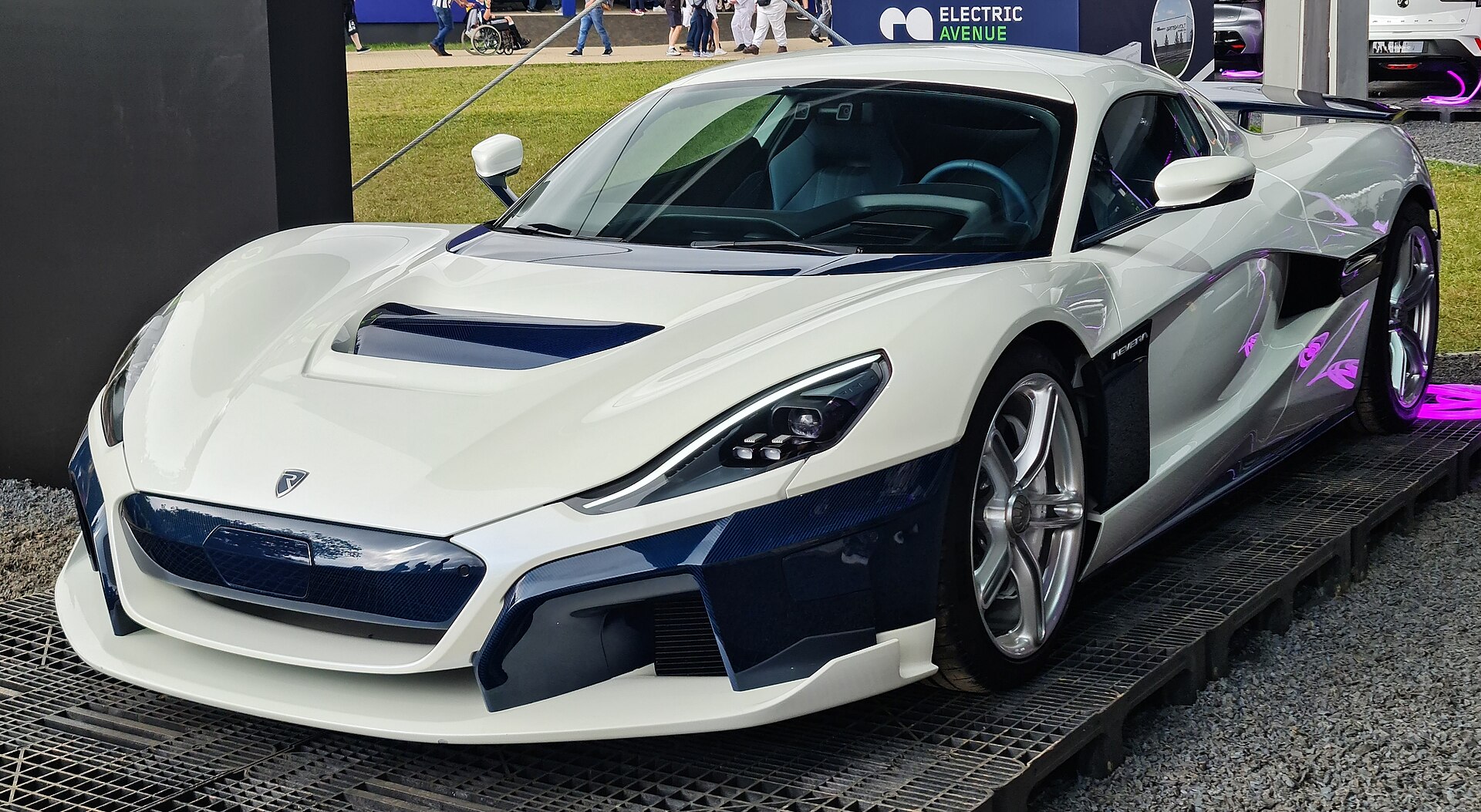
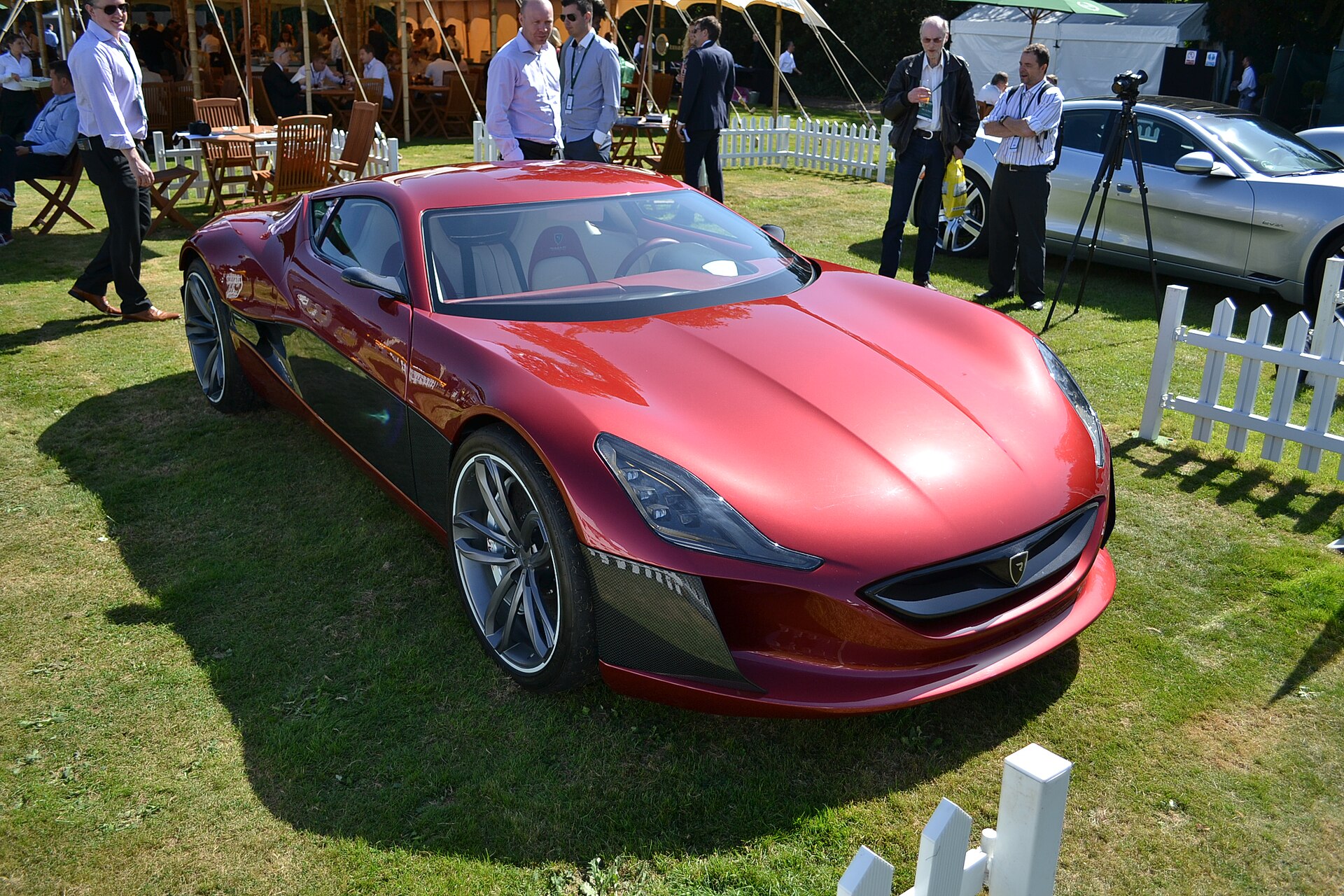
 Rimac Concept One
Specs, engines and history
Published Sources (1) Report an error
By Felix Hartmann, Automotive Technology & EV Contributor
- Built
- 2013–2014
- Top power
- 913 kW (1,241 PS)
The Rimac Concept One is an electric hypercar built by the Croatian company Rimac Automobili from 2013 to 2014. First shown at the Frankfurt motor show in 2011, it uses four electric motors — one for each wheel — with a combined 913 kW (1,241 PS) and 1,600 Nm. Only eight cars were built, but the Concept One made Rimac known internationally and led to the Nevera.
In short
- Shown at Frankfurt in 2011; production from January 2013 to November 2014; 8 cars built, 6 still exist.
- Four liquid-cooled permanent-magnet motors: 913 kW (1,241 PS) and 1,600 Nm, with torque vectoring at each wheel.
- 92 kWh lithium iron phosphate battery; range of 330 to 350 km depending on source and version.
- 0–100 km/h in about 2.5 seconds, 0–300 km/h in 14 seconds (2017 figure), top speed 356 km/h.
Rimac Concept One at a glance
| Specification | Rimac Concept One |
|---|---|
| Production | January 2013 – November 2014, Croatia |
| Cars built | 8 (6 survive); 88 originally planned |
| Body | two-door, two-seat coupé; carbon-fibre body; individual-wheel drive |
| Motors | four liquid-cooled permanent-magnet synchronous motors |
| Power | 913 kW (1,241 PS) |
| Torque | 1,600 Nm |
| Battery | 92 kWh, lithium iron phosphate |
| Kerb weight | 1,850 kg |
| Dimensions | 4,548 × 1,854 × 1,198 mm, wheelbase 2,750 mm |
| Successor | Nevera |
The Concept One is the first Rimac road car; its successor is described in our article on the Rimac Concept Two, and the company's early days in Rimac Automobili presents a promising electric car. All models are listed in the Rimac catalogue.
History: from a garage to Frankfurt
Rimac Automobili was founded in 2009 in Sveta Nedelja, growing out of Mate Rimac's hobby of converting cars in his garage. High-performance electric components were not available on the market, so the company developed and built most parts itself and patented 24 innovations along the way.
The first test car was a 1984 BMW 3 Series with an electric drivetrain of 442 kW (601 PS). In April 2011 it set five FIA-sanctioned acceleration records. Later that year the Concept One made its debut at the Frankfurt motor show, and in 2012 it was shown at the Paris Concours d'Elegance.
The first car was delivered in January 2013 to a customer in Spain who remained anonymous. Rimac had originally planned 88 cars, but only eight were built before production ended in November 2014. The final version of the car was presented at the Geneva motor show in March 2016.
Electric powertrain
Each wheel has its own liquid-cooled permanent-magnet synchronous motor. Together the four motors produce 913 kW (1,241 PS) and 1,600 Nm. Because every wheel is driven separately, Rimac's "All Wheel Torque Vectoring System" can distribute power precisely between them, and the car can be set to drive the front wheels, the rear wheels or all four equally.
The battery has a capacity of 92 kWh and uses lithium iron phosphate cells. The infobox on Wikipedia gives a range of 330 km; the text cites 349 km, and the 2017 update lists 350 km.
| Figure | Original | 2016 version | 2017 update |
|---|---|---|---|
| 0–100 km/h | 2.5 s | 2.6 s | 2.5 s |
| 0–200 km/h | — | 6.2 s | 6.0 s |
| 0–300 km/h | — | 14.2 s | 14.0 s |
| Top speed (limited) | 340 km/h | 356 km/h | 356 km/h |
The figures changed as Rimac developed the car between the Frankfurt show car of 2011 and the final version shown at Geneva in 2016, so the table lists them by version; the speed limit, for example, rose from 340 to 356 km/h. The best recorded quarter-mile time is 9.9 seconds. In 2017 the car set an electric-car speed record at the Goodwood Festival of Speed.

Design and chassis
The exterior was designed by Adriano Mudri and the interior by Goran Popović. The body is carbon fibre, and the car stops with carbon-ceramic brakes. With a length of 4,548 mm, a width of 1,854 mm and a height of only 1,198 mm, it is a compact two-seater. It weighs 1,850 kg.

Concept S and other versions
Concept S (2016). A sharper version limited to two cars, with 1,032 kW (1,384 hp), 50 kg less weight and an aerodynamic package giving 34% more downforce. It reaches 100 km/h in 2.5 seconds and has a top speed of 365 km/h. Inside, it has racing bucket seats with four-point harnesses and Alcantara trim.
E-Runner Concept One. A special version for the Pikes Peak hill climb, with 1,100 kW (1,500 PS), finished second overall in 2015 driven by Nobuhiro Tajima.
The Concept One technology was also used elsewhere: in 2014 a car served as the director's car in the first season of Formula E, and the Volar-e, built with Applus+ IDIADA at the end of 2014, used a 38 kWh battery for about 200 km of range.
The Grand Tour crash
On 10 June 2017 a Concept One crashed while being filmed for the second series of The Grand Tour at the Hemberg hill climb in Switzerland. Driven by Richard Hammond, the car left the road, rolled 110 m down a slope and caught fire. Hammond survived with a broken leg.
Timeline
| Year | Event |
|---|---|
| 2009 | Rimac Automobili founded in Sveta Nedelja, Croatia |
| 2011 | Electric BMW test car sets five FIA records (April); Concept One shown at Frankfurt |
| 2012 | Concept One at the Paris Concours d'Elegance |
| 2013 | First customer car delivered in January |
| 2014 | Director's car in Formula E's first season; production ends in November after 8 cars |
| 2015 | E-Runner Concept One second overall at Pikes Peak |
| 2016 | Final version and Concept S shown at Geneva |
| 2017 | Electric speed record at Goodwood; dealer partnerships with PACE Germany, Manhattan Motorcars and Al Marooni Group |
| 2018 | Named one of IEEE's Top 10 Tech Cars |
Reception and legacy
Reviews were mixed but impressed by the performance. Evo gave the car three and a half stars out of five in 2016, Road & Track praised its rigidity and quietness, and Jeremy Clarkson said it was faster than anything he had driven "by a huge, huge margin". In 2018 the IEEE included it among its Top 10 Tech Cars.
The Concept One proved that a small Croatian start-up could build an electric hypercar. Its successor, first shown as the C Two and produced as the Nevera, took the idea much further. For the wider context of electric hypercars, see the Lotus Evija.

Photo gallery

Rimac Concept One in our rankings
- No. 3 of 312 · Most powerful cars of the 2010s (913 kW)
- No. 5 of 97 · Most powerful electric cars (913 kW)
- No. 17 of 859 · Most powerful cars (913 kW · top 2%)
- No. 14 of 313 · Most powerful coupes (913 kW · top 5%)
- No. 895 of 912 · Longest-running car nameplates (1 year)
More powerful than 99% of ranked cars of the 2010s in the 1CARS catalog (No. 3 of 312).
FAQ
How many Rimac Concept Ones were built?
Eight cars were built between January 2013 and November 2014; six still exist. Rimac had originally planned 88.
How powerful is the Rimac Concept One?
Its four electric motors produce a combined 913 kW (1,241 PS) and 1,600 Nm.
How fast is the Rimac Concept One?
It accelerates from 0 to 100 km/h in about 2.5 seconds and is electronically limited to 356 km/h after the 2016 update.
What battery does the Concept One use?
A 92 kWh lithium iron phosphate battery, giving a range of about 330–350 km depending on source and version.
Which Concept One did Richard Hammond crash?
A car used for filming The Grand Tour at the Hemberg hill climb in Switzerland on 10 June 2017; it rolled down a slope and caught fire, and Hammond broke his leg.
Data sources
Data checked by an editor against the sources below.