 Maserati Indy
Specs, engines and history
Published Sources (1) Report an error
By Felix Hartmann, Automotive Technology & EV Contributor
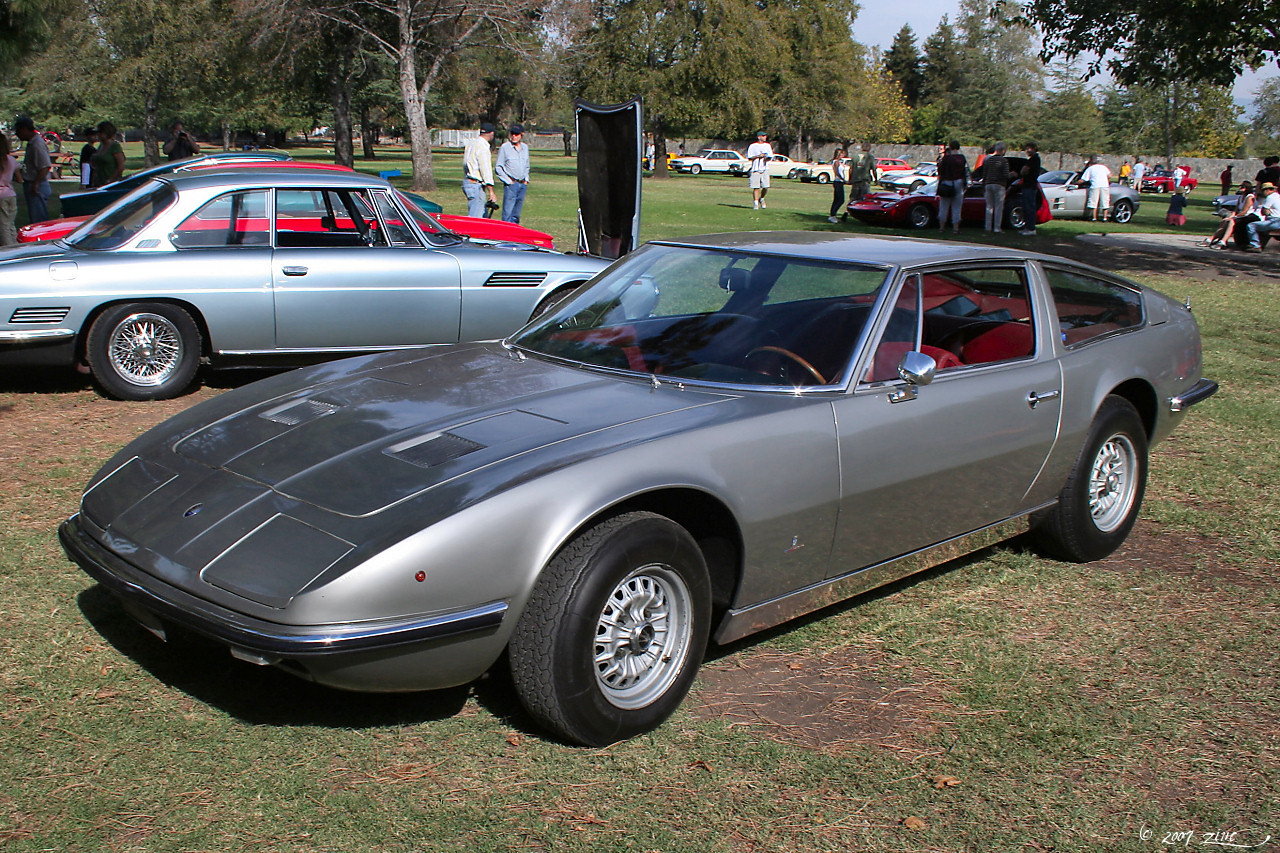
The Maserati Indy is a four-seat V8 grand tourer that Maserati built in Modena from 1969 to 1975. Designed by Carrozzeria Vignale, it combined the practicality of four seats with the performance of a Maserati four-cam V8, offered in three sizes from 4.1 to 4.9 litres. Its name honours Maserati's two victories at the Indianapolis 500. About 1,100 were built.
In short
- Shown on the Vignale stand at the Turin motor show in 1968, launched on the Maserati stand at Geneva in 1969; built until 1975.
- 1,102 cars according to Maserati (Wikipedia: 1,104 — 440 Indy 4200, 364 Indy 4700 and 300 Indy 4900).
- Four-cam V8: 194 kW (260 hp) as a 4.1 in 1969, 216 kW (290 hp) as a 4.7 from 1970 and 224 kW (300 hp) as a 4.9 from 1971.
- Five-speed manual or, on request, a three-speed Borg-Warner automatic; top speed up to 280 km/h.
At a glance: Maserati Indy
| Specification | Maserati Indy (AM116) |
|---|---|
| Production | 1969–1975, Modena (Italy) |
| Cars built | 1,102 (Maserati); 1,104 (Wikipedia) |
| Body | four-seat fastback coupé by Vignale |
| Engines | 90° V8, four overhead camshafts: 4,136, 4,719 and 4,930 cc |
| Power | 194 kW (260 hp) to 224 kW (300 hp) |
| Gearbox | five-speed manual; three-speed Borg-Warner automatic on request |
| Weight | 1,500–1,650 kg (Maserati) |
| Dimensions | 4,740 mm long, 1,760 mm wide, 1,220 mm high, 2,600 mm wheelbase |
| Predecessor | Maserati Sebring |
The Indy followed the line of Maserati grand tourers that began with cars such as the Maserati 3500 GT. The range is listed in the Maserati catalogue.
History of the Maserati Indy
The Indy was first shown as a Vignale prototype at the Turin motor show in November 1968 and made its official debut on the Maserati stand at the Geneva motor show in March 1969. According to Maserati, the first customer car left the Modena factory on 1 July 1969, bound for a Swiss businessman.
The car arrived at a good moment for the company. Maserati built about 700 cars in 1968, its best result since the Modena plant opened, and held a 43% share of the Italian market for cars over 3.5 litres. Wikipedia describes the Indy as the first Maserati of the Citroën ownership era. Production lasted until 1975, and Maserati counts 1,102 cars.
The name refers to the Indianapolis 500 victories of the Maserati 8CTF in 1939 and 1940.
From the Sebring to the Indy
The Indy replaced the Maserati Sebring, a 2+2 coupé built from 1962 to 1968 on the mechanical base of the 3500 GT. The Sebring had been designed by Giovanni Michelotti with coachwork by Vignale and was named after Maserati's victory at the 12 Hours of Sebring in 1957. It used Maserati's straight-six of 3.5, 3.7 and 4.0 litres, with up to 195 kW (265 PS) in the 4000 version. Production figures differ: one estimate gives about 446 cars, while another source counts 593.
The Indy kept the idea of a four-seat Maserati coupé built with Vignale, but changed almost everything else. Instead of the Sebring's six-cylinder engine it brought a four-cam V8, together with unibody construction and a fastback shape.
Design by Vignale
The body was designed by Carrozzeria Vignale under the internal project name AM116; Wikipedia credits Virginio Vairo's technical office at Vignale, with Elio Mainardi. The Indy is a four-seat fastback coupé with large windows, pop-up headlights and a cut-off tail designed for better aerodynamics. It is 4,740 mm long, 1,760 mm wide and 1,220 mm high, on a wheelbase of 2,600 mm.
The Indy has unibody construction, which Maserati describes as a semi-monocoque with a front subframe.

Engines and performance
The Indy used Maserati's all-aluminium 90° V8 with four overhead camshafts, two valves per cylinder, wet-sump lubrication and four Weber 42 DCNF twin-choke carburettors. It was offered in three sizes:
| Version | From | Displacement | Power | Top speed | Built (Wikipedia) |
|---|---|---|---|---|---|
| Indy 4200 | 1969 | 4,136 cc | 194 kW (260 hp) | 250 km/h | 440 |
| Indy 4700 | 1970 | 4,719 cc | 216 kW (290 hp) | 280 km/h | 364 |
| Indy 4900 | 1971 | 4,930 cc | 224 kW (300 hp) | not stated | 300 |
The 4.7-litre engine introduced Bosch electronic ignition. From 1973 the 4.9-litre was the only engine offered. A five-speed manual gearbox was standard, and a three-speed Borg-Warner automatic was available on request.


Chassis and equipment
The front suspension uses double wishbones with coil springs and an anti-roll bar; at the rear there is a live axle with semi-elliptic springs and a single torque arm. Ventilated disc brakes with servo assistance are fitted at all four wheels. Maserati gives a weight of 1,500 to 1,650 kg depending on version; Wikipedia lists 1,680 kg. Air conditioning became standard in 1973.
Legacy
The Indy gave Maserati a four-seat V8 grand tourer at the end of the 1960s, and about 1,100 were built in seven years. For the company's history, see our history of Maserati.
Photo gallery

Maserati Indy in our rankings
In production longer than 31% of ranked nameplates in the 1CARS catalog (No. 555 of 912).
FAQ
How many Maserati Indys were built?
Maserati gives 1,102 cars from 1969 to 1975; Wikipedia gives 1,104 (440 Indy 4200, 364 Indy 4700, 300 Indy 4900).
Why is it called Indy?
To honour the Indianapolis 500 victories of the Maserati 8CTF racing car, which won the race in 1939 and again in 1940.
What engines does the Indy have?
Four-cam V8s of 4.1, 4.7 and 4.9 litres, with 194 kW (260 hp), 216 kW (290 hp) and 224 kW (300 hp).
How fast is the Maserati Indy?
Maserati quotes 250 km/h for the first 4.1-litre version and 280 km/h for the 4.7. No official figure is given in the sources for the 4.9.
Who designed the Indy?
Carrozzeria Vignale, which showed the first car on its stand at the Turin motor show in 1968. Wikipedia credits Virginio Vairo's technical office at Vignale, working with Elio Mainardi, under the internal project name AM116.
Data sources
Data checked by an editor against the sources below.