 Maserati Bora
Specs, engines and history
Published Sources (1) Report an error
By Felix Hartmann, Automotive Technology & EV Contributor
- Built
- 1971–1978
- Top power
- 243 kW (330 PS)
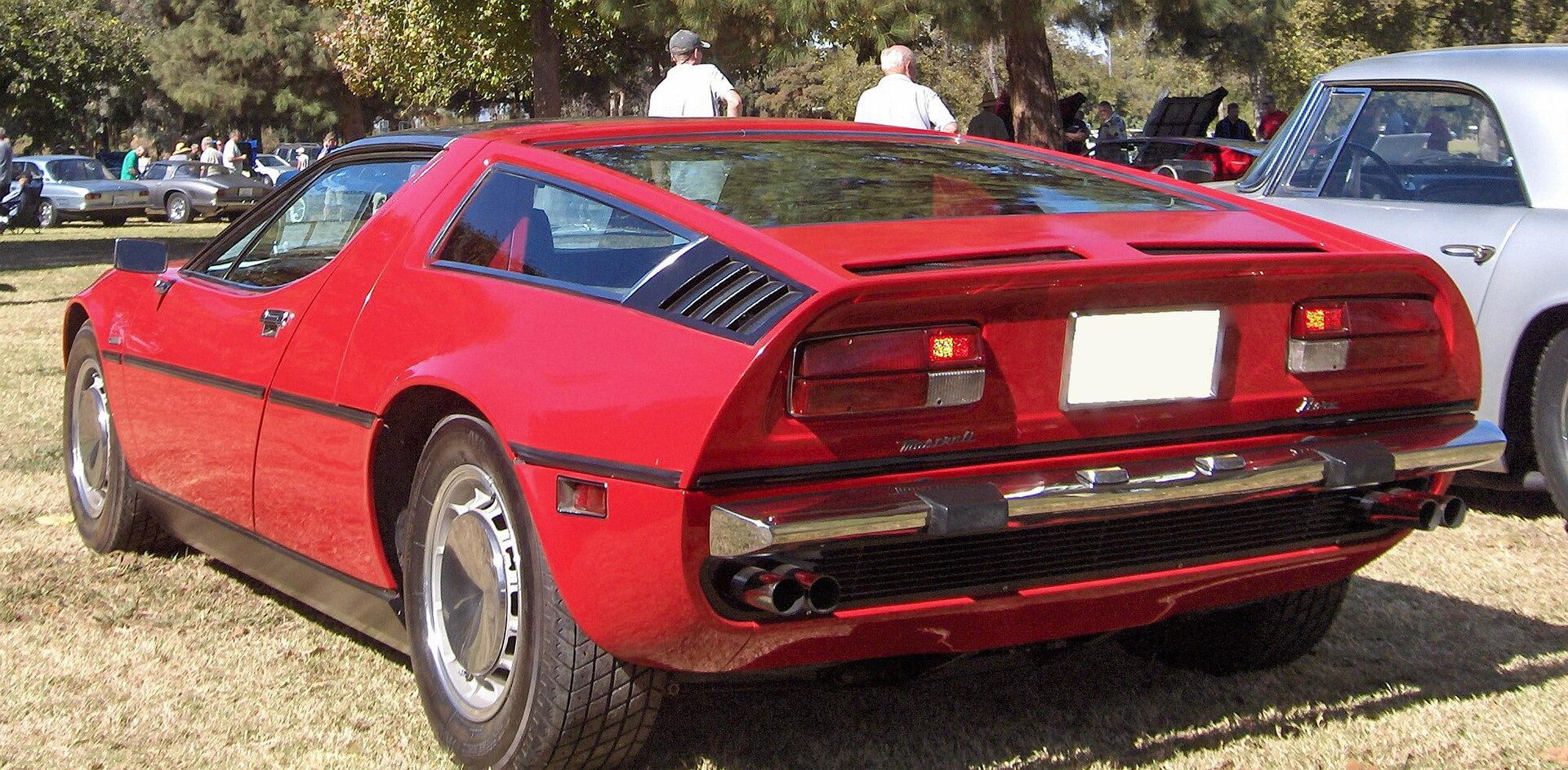
The Maserati Bora is a two-seat, mid-engined V8 grand tourer that Maserati built in Modena from 1971 to 1978. It was the first mid-engined road car in the company's history and also its first car with independent suspension on all four wheels. Developed shortly after Citroën took control of Maserati, it combined an Italian V8 and a body by Giorgetto Giugiaro with the French company's high-pressure hydraulics. Only 564 were made.
In short
- Project started in October 1968 as Tipo 117; shown in final form at the Geneva motor show in March 1971 and built until 1978.
- 564 cars: 289 with the 4.7-litre V8 and 275 with the 4.9-litre V8.
- Four-cam V8 with four Weber carburettors: 228 kW (310 PS) as a 4.7 and up to 243 kW (330 PS) as a European 4.9 from 1976; five-speed ZF transaxle.
- Citroën hydraulics for the brakes, the adjustable pedal box, the driver's seat height and the pop-up headlights; official top speed 270–285 km/h.
At a glance: Maserati Bora
| Specification | Maserati Bora |
|---|---|
| Production | 1971–1978, Modena (Italy) |
| Cars built | 564 (289 × 4.7, 275 × 4.9) |
| Body | two-seat fastback coupé, steel panels by Officine Padane |
| Design | Giorgetto Giugiaro, Italdesign |
| Layout | mid-engine, rear-wheel drive |
| Engines | 4,719 cc and 4,930 cc V8, four overhead camshafts |
| Power | 228 kW (310 PS) to 243 kW (330 PS) |
| Torque | 461 Nm (4.7) to 481 Nm (European 4.9) |
| Gearbox | five-speed ZF transaxle |
| Kerb weight | 1,535 kg |
| Dimensions | 4,335 mm long, 1,768 mm wide, 1,134 mm high, 2,600 mm wheelbase |
The Bora appeared between Maserati's front-engined grand tourers, such as the Maserati 3500 GT, and the company's later road cars. All models are listed in the Maserati catalogue.
History: a mid-engined Maserati
Work on the project started in October 1968 under the code name Tipo 117. In the same year Citroën had taken a controlling interest in Maserati, which shaped many of the car's technical details. A running prototype was on the road by the middle of 1969.
The final car was presented at the Geneva motor show in March 1971, and the first deliveries took place before the end of that year. Following Maserati's custom of naming cars after winds, it was called Bora, after the strong wind that blows over Trieste on the Adriatic coast.
The Bora was a technical milestone for the company. It was Maserati's first mid-engined street car and the first with independent suspension on all four wheels. It was also lighter than the front-engined Ghibli: Wikipedia gives 1,535 kg for the Bora against 1,650 kg for the Ghibli, although the original weight target had been only 1,400 kg.

Design by Giugiaro
The body was designed by Giorgetto Giugiaro at Italdesign, and the steel panels were made by Officine Padane in Modena. The shape is a low two-seat fastback, and the drag coefficient is 0.30, a low figure for a car of the early 1970s.
The steering column can be adjusted by hand for reach and rake.
Small changes were made around early 1974: the front lid was now hinged, the inner corners of the headlights were rounded, and a rectangular black grille was added on the bonnet to let hot air out.

Citroën hydraulics
Citroën's influence is most visible in the hydraulic system. Like Citroën's own cars of the time, the Bora used high-pressure LHM fluid, split into two circuits. The main circuit operated the brakes. The auxiliary circuit moved three things: the pedal box, which slides about 76 mm forwards or backwards to suit the driver; the height of the driver's seat; and the pop-up headlights.
The result was unusual: instead of moving the seat to reach the pedals, the driver moved the pedals to fit the seat. The brakes use ventilated discs.

Engines
The Bora used Maserati's four-cam V8, an aluminium alloy engine with 16 valves, four chain-driven camshafts, four Weber 42 DCNF/14 carburettors and Bosch electronic ignition. It was mounted lengthwise behind the cabin and drove the rear wheels through a five-speed ZF transaxle.
| Version | Engine | Power | Torque |
|---|---|---|---|
| Bora 4.7 (1971) | Tipo AM 107.07, 4,719 cc | 228 kW (310 PS) at 6,000 rpm | 461 Nm at 4,200 rpm |
| Bora 4.9 (US) | Tipo AM 107.16, 4,930 cc | 209 kW (284 PS) at 6,000 rpm | 460 Nm at 4,200 rpm |
| Bora 4.9 (US, from 1973) | 4,930 cc, with air pump | 224 kW (304 PS) at 6,000 rpm | not stated |
| Bora 4.9 (Europe, from 1976) | 4,930 cc | 243 kW (330 PS) at 5,500 rpm | 481 Nm at 4,000 rpm |
The 4.9-litre engine was used first for cars sold in the United States. From 1973 the US engine had an air pump for emissions control. From 1976 European cars also switched to the 4.9-litre unit, now with 243 kW (330 PS).
The official top speeds were 270 km/h for the 4.7 and 285 km/h for the 4.9. Wikipedia notes that other sources give different figures.
Chassis and suspension
The structure combines a steel monocoque for the cabin and front section with a tubular steel subframe at the rear that carries the engine and gearbox. The subframe is attached to the floor pan with four flexible mounts.
The suspension is independent at all four corners, with coil springs, telescopic dampers and anti-roll bars. The prototypes used MacPherson struts at the front, but production cars went back to wishbones because the struts caused kickback through the steering. The car rides on 7.5 × 15-inch Campagnolo alloy wheels, originally with Michelin XWX 205/70 tyres and later with 215/70 VR15 tyres at the rear.
Racing and the Merak
Maserati prepared two Bora cars for Group 4 racing for the French Maserati dealer Thepenier, with engines tuned to about 316 kW (430 PS). The project was shelved: homologation required 500 road cars, and Maserati could not build that many.
The Bora also gave birth to a smaller sister. The Maserati Merak used the front part of the Bora's body shell but had a 2+2 cabin, an open rear engine cover and a smaller, lighter V6 engine that was also used in the Citroën SM. The Merak continued into the 1980s, with the Merak SS introduced in 1981.
Legacy
After 564 cars the Bora went out of production in 1978. It remains a landmark in the company's history as the first mid-engined Maserati road car and the first with independent suspension all round. The story of the company is told in our history of Maserati, and an earlier Maserati sports car is described in our article on the Maserati 450S.
Photo gallery

Maserati Bora in our rankings
- No. 32 of 88 · Most powerful cars of the 1970s (243 kW · top 37%)
- No. 380 of 859 · Most powerful cars (243 kW · top 45%)
- No. 75 of 127 · Most powerful Italian cars (243 kW · top 60%)
- No. 492 of 912 · Longest-running car nameplates (7 years · top 60%)
- No. 205 of 313 · Most powerful coupes (243 kW · top 66%)
More powerful than 63% of ranked cars of the 1970s in the 1CARS catalog (No. 32 of 88).
FAQ
How many Maserati Boras were built?
564 cars between 1971 and 1978: 289 with the 4.7-litre engine and 275 with the 4.9-litre engine.
What engine does the Bora have?
A four-cam V8 with four Weber carburettors, mounted behind the cabin. The 4.7 produces 228 kW (310 PS); the European 4.9 from 1976 produces 243 kW (330 PS).
What is special about the Bora's hydraulics?
Citroën's high-pressure system operates the brakes, the adjustable pedal box, the driver's seat height and the pop-up headlights.
Why is it called Bora?
Like many Maseratis it is named after a wind - the Bora is the strong wind of Trieste.
How fast is the Maserati Bora?
The official top speed is 270 km/h for the 4.7 and 285 km/h for the 4.9; other sources give different figures.
Data sources
Data checked by an editor against the sources below.