 Koenigsegg Regera
Specs, engines and history
Published Sources (3) Report an error
By Felix Hartmann, Automotive Technology & EV Contributor
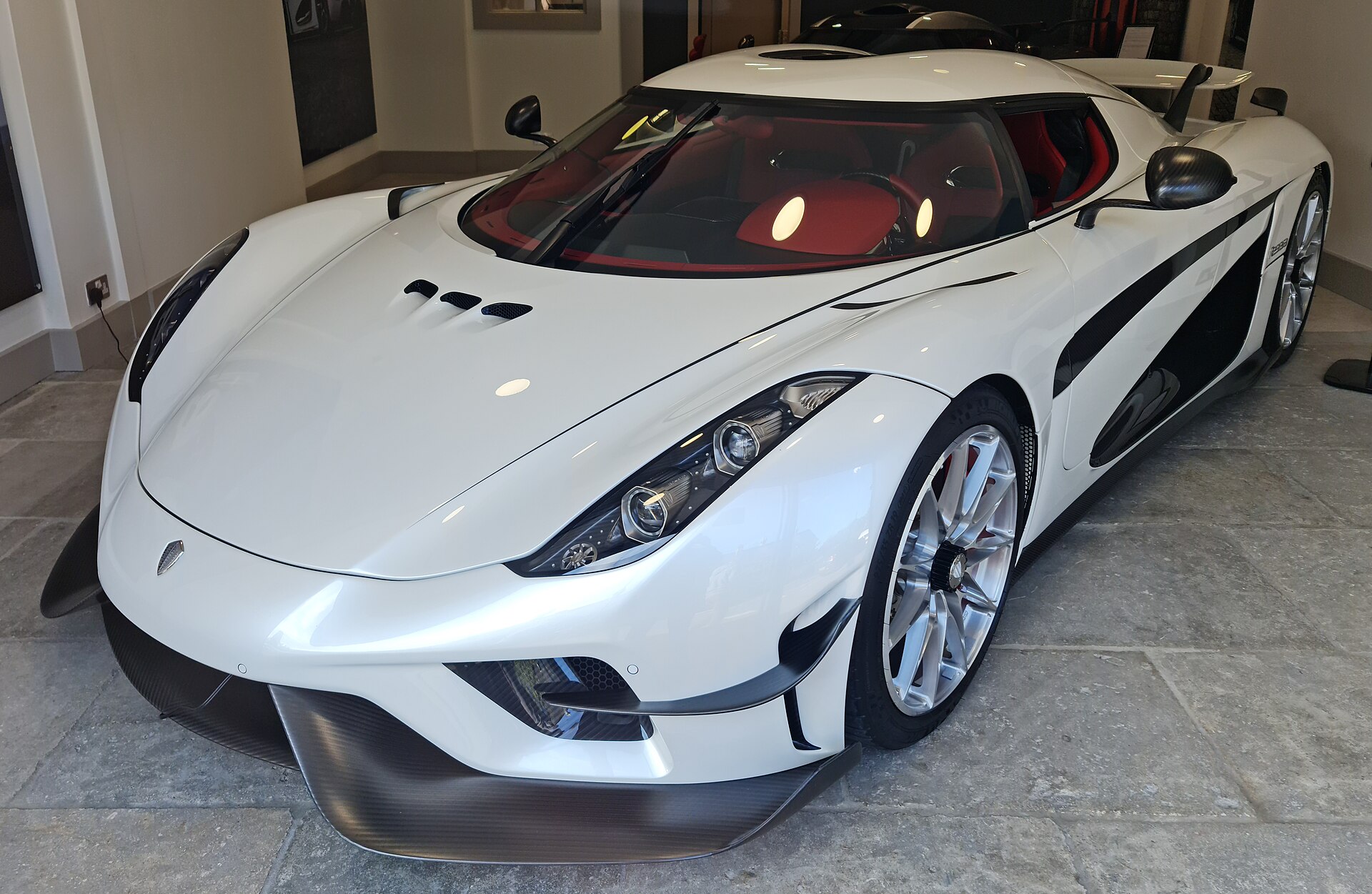
The Koenigsegg Regera is the plug-in hybrid hypercar that Koenigsegg built in Ängelholm, Sweden, from 2016 to 2022. Its name is a Swedish verb meaning "to reign". Instead of a gearbox it uses Koenigsegg Direct Drive: a twin-turbo V8 and three electric motors drive the rear wheels through a single fixed ratio. With a maximum combined output of 1,119 kW (1,521 PS), it was conceived as a more comfortable grand tourer than the track-focused Agera, and it later set a 0–400–0 km/h record.
In short
- Unveiled at the Geneva motor show in March 2015; built from 2016 to 2022. Koenigsegg says 80 cars were made, and all were sold by June 2017.
- 5.0-litre twin-turbo V8 plus three YASA electric motors and an 800-volt, 4.5 kWh battery; 1,119 kW (1,521 PS) combined maximum output.
- No multi-speed gearbox: one fixed ratio of 2.73:1 and a hydraulic coupling; about 35 km of electric-only range.
- Claimed 0–100 km/h in 2.8 s and 0–400 km/h in 20 s; 0–400–0 km/h in 28.81 s in 2023.
Running cost
Fuel · Regera 5 L 8 cyl Automatic (A1) · 2020 (EPA)
about 5,600 EUR fuel a year at 15,000 km
21.4 l/100 km · petrol at 1.75 EUR/l · change mileage, fuel price or version
Specs by version
Engines
| Version | Engine | Gearbox | Drive | Production years |
|---|---|---|---|---|
| 5 L 8 cyl Automatic (A1) · 2020 (EPA) | 5.0 l · 8 cyl · Hybrid 5,000 cc | 1-sp Automatic | Rear-wheel drive | 2020 |
| 5 L 8 cyl Automatic (A1) · 2019 (EPA) | 5.0 l · 8 cyl · Hybrid 5,000 cc | 1-sp Automatic | Rear-wheel drive | 2019 |
Performance
Show all 2 versions
| Version | Fuel consumption |
|---|---|
| 5 L 8 cyl Automatic (A1) · 2020 (EPA) | 21.4 l/100 km11.0 mpg US · 13.2 mpg UK |
| 5 L 8 cyl Automatic (A1) · 2019 (EPA) | 21.4 l/100 km11.0 mpg US · 13.2 mpg UK |
Verified Manufacturer and type-approval data from our catalog · Sources and methodology
Regera at a glance
| Specification | Koenigsegg Regera |
|---|---|
| Production | 2016–2022, Ängelholm (Sweden) |
| Cars built | 80 (Koenigsegg); some sources give 85 |
| Body | two-door targa with removable roof, dihedral synchro-helix doors |
| Engine | Koenigsegg 5.0-litre 90° V8, two turbochargers |
| Engine output | 820 kW (1,115 PS) at 7,800 rpm, 1,280 Nm at 4,100 rpm (95 RON fuel) |
| Electric motors | three YASA axial-flux motors, 520 kW (707 PS) together |
| Combined | 1,119 kW (1,521 PS); 2,000 Nm (Wikipedia) |
| Transmission | Koenigsegg Direct Drive, single ratio 2.73:1 |
| Weight | 1,470 kg dry; 1,590 kg kerb |
| Dimensions | 4,560 mm long, 2,050 mm wide, 1,110 mm high, 2,662 mm wheelbase |
Koenigsegg's earlier models - the Koenigsegg CCX and the Koenigsegg Agera R - and the full range are in the Koenigsegg catalogue.
Concept and development
The Regera was Koenigsegg's first hybrid and the first car with its Direct Drive system. According to Wikipedia, the idea grew after Christian von Koenigsegg bought a Tesla Model S P85+ in 2013 and was impressed by the instant response of the electric drive. He wanted a car that would combine that feeling with the power of a large combustion engine - and do it without the weight and complexity of a conventional gearbox.
The car was designed by Christian von Koenigsegg and Joachim Nordwall and unveiled at the Geneva motor show in March 2015. It was positioned as a more practical and luxurious grand tourer than the Agera (and later the Jesko), with more sound insulation, softer engine mounts at low speed and a comfortable interior. Most build slots were taken at the unveiling, and Koenigsegg announced on 13 June 2017 that all cars had been sold. Production started in 2016 and ended in 2022; from late 2021 the Regera shared the assembly line with the Jesko.
Koenigsegg Direct Drive explained
The heart of the Regera is the drivetrain. The seven-speed dual-clutch gearbox of the Agera was removed. In its place the engine drives the rear axle through a single fixed ratio: the crankshaft turns 2.73 times for every turn of the output shaft. Three electric motors fill the gaps that a single gear would otherwise leave:
- a 160 kW YASA motor-generator on the crankshaft works as starter, generator and torque filler;
- two 180 kW YASA motors, one on each rear wheel shaft, provide drive at low speed, torque vectoring and traction control.
Below about 48 km/h the wheel motors do most of the work, and a hydraulic coupling - called HydraCoup by Koenigsegg - lets the engine slip. Reverse uses the electric motors only. Above about 48 km/h the coupling locks, and engine speed then follows road speed directly. A paddle on the steering wheel simulates a downshift: the coupling slips, the engine revs rise and more power becomes available at lower speeds. The car can also be driven as a pure electric vehicle for about 35 km.
The battery was developed by Rimac. It is a liquid-cooled 4.5 kWh lithium-ion pack running at 800 volts; Koenigsegg says the Regera was the world's first production car with an 800-volt system when it was presented in 2015. Koenigsegg gives the pack weight as 66 kg including coolant (Wikipedia gives 75 kg), with a discharge rate of 525 kW and a recharge rate of up to 200 kW. According to the company, the motors, battery and Direct Drive together added only 88 kg compared with a version using a dual-clutch gearbox and no electric system.


Engine and performance
The combustion engine is Koenigsegg's own 5.0-litre V8 with a 90° bank angle, two overhead camshafts per bank, four valves per cylinder, dry-sump lubrication and two 3D-printed variable-geometry turbochargers. On 95 RON petrol it produces 820 kW (1,115 PS) at 7,800 rpm and 1,280 Nm at 4,100 rpm, and it revs to 8,250 rpm. A flex-fuel sensor recognises E85 biofuel and allows more power.
| Output | Power | Torque |
|---|---|---|
| V8 engine (95 RON) | 820 kW (1,115 PS) at 7,800 rpm | 1,280 Nm at 4,100 rpm |
| Electric motors (three) | 520 kW (707 PS) combined | 900 Nm |
| System maximum | 1,119 kW (1,521 PS) | 2,000 Nm (Wikipedia) |
The combined maximum is lower than the simple sum of the engine and motor figures; neither source gives a breakdown of how it is calculated. Koenigsegg's own model page lists 1,280 Nm as the maximum torque, which is the engine figure; Wikipedia gives 2,000 Nm for the combined system.
Koenigsegg's claims are 0–100 km/h in 2.8 seconds, 0–200 km/h in 6.6 seconds, 0–300 km/h in 10.9 seconds and 0–400 km/h in about 20 seconds, as well as 150–250 km/h in 3.9 seconds.
Records
On 23 September 2019 at the Råda military airfield in Sweden, driver Sonny Persson took the Regera from 0 to 400 km/h and back to a stop in 31.49 seconds, a record at the time. On 16 June 2023, after the Rimac Nevera had lowered the mark to 29.93 seconds, Koenigsegg returned to Örebro airport with driver Markus Lundh and set 28.81 seconds: 0–400 km/h in 20.68 seconds over 1,483 m and the stop in 8.13 seconds, a total distance of 1,905 m.
Design and robotised body
The body is a two-door targa with a roof panel that can be stored in the boot. Koenigsegg called the Regera "fully robotised": hydraulic pumps, accumulators and lifters open and close all the body panels, move the rear wing and raise the chassis, and they can be operated remotely. Proximity sensors on the doors and mirrors stop them hitting obstacles.
The hydraulic rear wing folds away when it is not needed, and active flaps under the nose change the airflow beneath the car. Koenigsegg gives 450 kg of downforce at 250 km/h. Details include headlamps with small fans to clear condensation, daytime running lights arranged like a constellation of stars on a carbon-fibre background, and a fishtail exhaust by Akrapovič; the large central outlet vents cooling air from the battery and electronics, not engine exhaust.
Suspension uses double wishbones with chrome-molybdenum steel arms and Koenigsegg's "Triplex" damper system with a third rear Öhlins damper that resists squat under acceleration. Carbon-ceramic brakes measure 397 mm at the front and 380 mm at the rear. Inside, the Regera has electrically adjustable memory-foam seats, a 9-inch touchscreen with Apple CarPlay, 4G and Wi-Fi, cameras and over-the-air updates.

Ghost Package and special cars
Shortly before the Geneva motor show in 2018 Koenigsegg revealed an optional Ghost Package. It adds a longer front splitter and side sills, canards on the front wings and fixed winglets on the rear quarters, and Koenigsegg claims more than 20% extra downforce. Cars with the package run on Michelin Pilot Sport Cup 2 tyres.
Many Regeras were finished to individual specifications and given names, including the KNC (Koenigsegg Naked Carbon), Raven, Kejsare, d'Elegance, Golden Knight and Gotham. More about the company is in our Koenigsegg history.

Photo gallery


Koenigsegg Regera in our rankings
- No. 142 of 557 · Biggest engines: cars (5,000 cc · top 27%)
- No. 82 of 173 · Biggest engines: coupes (5,000 cc · top 48%)
- No. 595 of 912 · Longest-running car nameplates (6 years · top 69%)
- No. 48 of 51 · Most economical coupes (21.4 l/100 km · top 97%)
- No. 252 of 256 · Most economical cars (21.4 l/100 km · top 99%)
Bigger engine than 73% of ranked cars in the 1CARS catalog (No. 142 of 557).
FAQ
Does the Koenigsegg Regera have a gearbox?
No. Koenigsegg Direct Drive uses a single fixed ratio of 2.73:1 and a hydraulic coupling. Electric motors on the crankshaft and on each rear wheel provide drive at low speed and fill the gaps that gears would normally cover.
How powerful is the Regera?
The maximum combined output is 1,119 kW (1,521 PS). The V8 alone produces 820 kW (1,115 PS) and the three electric motors 520 kW (707 PS).
How many Regeras were built?
Koenigsegg says 80 cars were produced between 2016 and 2022. Some sources give 85.
What record does the Regera hold?
In June 2023 it completed 0–400–0 km/h in 28.81 seconds, improving on its own 2019 time of 31.49 seconds.
Can the Regera drive on electricity alone?
Yes, for about 35 km, using the 4.5 kWh, 800-volt battery and the two rear-wheel motors.
Data sources
Data checked by an editor against the sources below.
- Wikipedia - Koenigsegg Regera
- US EPA fueleconomy.gov - 44225.shtml
- US EPA fueleconomy.gov - 44224.shtml