 Koenigsegg Jesko
Specs, engines and history
Published Sources (1) Report an error
By Felix Hartmann, Automotive Technology & EV Contributor
- Built
- 2021–present
- Top power
- 1,193 kW (1,622 PS)
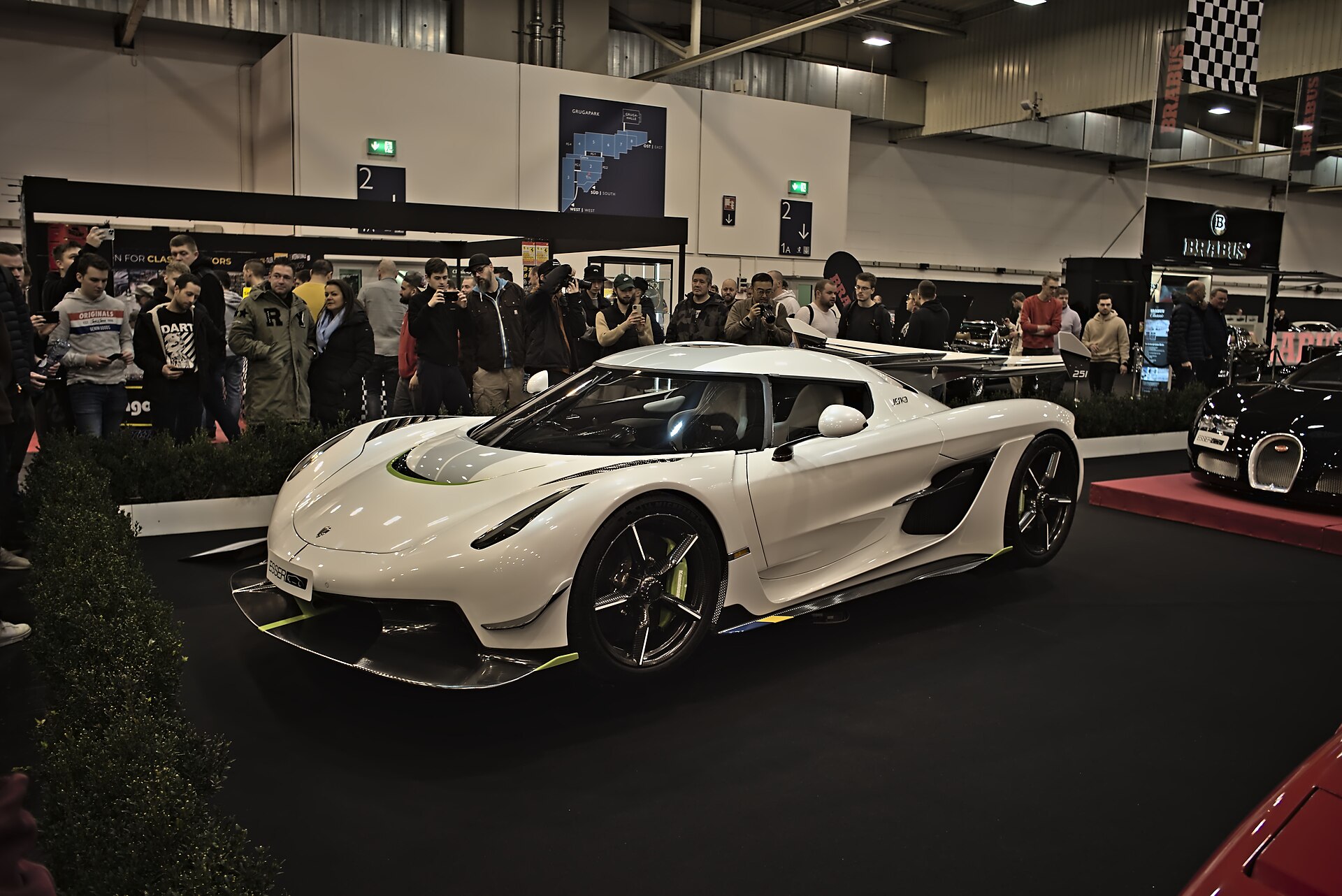
The Koenigsegg Jesko is the twin-turbo V8 hypercar that replaced the Agera in Koenigsegg's line-up. Revealed at the Geneva Motor Show in March 2019 and delivered to customers from June 2023, it is built in Ängelholm, Sweden, in a run of 125 cars. It comes in two main forms — the high-downforce Jesko Attack and the low-drag Jesko Absolut — and its nine-speed Light Speed Transmission is one of the most unusual gearboxes in any road car.
In short
- Revealed in Geneva in 2019 and sold out during the show; 125 cars planned, first customer delivery in June 2023.
- 5,065 cc twin-turbo V8 with a flat-plane crankshaft: 954 kW (1,298 PS) on petrol and 1,193 kW (1,622 PS) on E85; up to 1,500 Nm.
- Nine-speed Light Speed Transmission with seven wet clutches, weighing 90 kg.
- In August 2025 a Jesko Absolut accelerated from 0 to 400 km/h in 16.77 s and completed 0–400–0 km/h in 25.21 s.
Koenigsegg Jesko at a glance
| Specification | Koenigsegg Jesko |
|---|---|
| Production | from 2021 (pre-series), customer deliveries from June 2023; 125 cars planned |
| Versions | Jesko Attack, Jesko Absolut, Jesko Sadair's Spear (30 cars) |
| Body | two-door targa with dihedral synchro-helix doors |
| Chassis | carbon fibre monocoque |
| Engine | 5,065 cc V8, two turbochargers, flat-plane crankshaft, mid-mounted |
| Power | 954 kW (1,298 PS) on petrol; 1,193 kW (1,622 PS) on E85 |
| Torque | 1,000 Nm on petrol; 1,500 Nm on E85 |
| Gearbox | nine-speed Light Speed Transmission (LST), rear-wheel drive |
| Kerb weight | 1,420 kg (Attack), 1,390 kg (Absolut) |
| Predecessor | Koenigsegg Agera |
The Jesko follows the CC, CCX and Agera cars that made the Swedish company famous; see our Koenigsegg Agera R and Koenigsegg CCX articles and all models in the Koenigsegg catalogue.
Development and reveal
The Jesko was designed by Christian von Koenigsegg and Joachim Nordwall and named after Jesko von Koenigsegg, the founder's father. It was shown at the 2019 Geneva Motor Show, and all planned build slots were sold before the show ended. Koenigsegg planned to build 40 to 50 cars per year.
Unlike earlier Koenigseggs, the Jesko was developed for homologation worldwide. A pre-series car was presented in July 2021, with customer deliveries first expected in spring 2022; the first car finally reached its owner in June 2023. The low-drag Jesko Absolut was revealed online on 3 March 2020, together with the four-seat Gemera.
The carbon fibre tub is 40 mm longer and 22 mm wider than that of the Agera, giving more leg and head room. The Jesko keeps typical Koenigsegg features: dihedral synchro-helix doors that swing up and out, a removable roof panel, and the "Autoskin" system that opens the doors and bonnet by remote control. A hydraulic lift raises both axles for extra ground clearance.

Engine: twin-turbo V8 on petrol or E85
The engine was developed from the Agera's twin-turbo V8. It has a displacement of 5,065 cc (bore 92 mm, stroke 95.25 mm), four valves per cylinder and a compression ratio of 8.6:1. A new 180-degree flat-plane crankshaft saved 5 kg and allowed the rev limit to rise from 8,250 to 8,500 rpm. Active engine mounts taken from the Regera reduce vibration in the cabin.
To reduce turbo lag, Koenigsegg added a 20-litre carbon fibre air tank and an electric compressor that supplies air at 20 bar to the turbochargers. Pressure sensors in each cylinder monitor combustion in real time.
| Fuel | Power | Torque |
|---|---|---|
| Petrol | 954 kW (1,298 PS) at 7,800 rpm | 1,000 Nm from 2,700 to 6,170 rpm |
| E85 | 1,193 kW (1,622 PS) | 1,500 Nm at 5,100 rpm |
Koenigsegg itself quotes the outputs in brake horsepower (954 kW = 1,280 bhp; 1,193 kW = 1,600 bhp). As with earlier Koenigseggs, the engine gives its full output only on E85 bioethanol fuel.
The Light Speed Transmission
The Jesko's gearbox, developed in-house, is called the Light Speed Transmission (LST). It has nine forward gears and seven wet multi-plate clutches: three on the input shaft and four on the output shaft. Instead of moving from one gear to the next in sequence, it can jump directly to any gear — Koenigsegg calls this "Ultimate Power on Demand". Gear changes take 20 to 30 milliseconds.
The LST weighs 90 kg and is at least 50 per cent shorter than the seven-speed dual-clutch gearbox of the Agera. Because the rotating mass of the gearbox is large enough, the engine does not need a conventional flywheel. The driver changes gear with paddles on the steering column or with the selector.
Jesko Attack and aerodynamics
The Jesko Attack is the standard, track-oriented version. It has a large rear wing and a big carbon front splitter. Koenigsegg claims 800 kg of downforce at 249 km/h, 1,000 kg at 275 km/h and 1,400 kg at top speed. To control the car under such loads, the Attack uses Koenigsegg's Triplex dampers at both ends together with Öhlins dampers: the horizontal third damper at the rear stops the car from squatting under hard acceleration, and the front one stabilises the car at high speed. Active rear-wheel steering adds stability.
Standard wheels are forged aluminium centre-lock rims, 20 inches at the front and 21 inches at the rear, with Michelin Pilot Sport Cup 2 tyres; carbon fibre wheels and Cup 2 R tyres are options. Brakes are ventilated carbon-ceramic discs. The Attack set a lap of 2:56.97 at the Gotland Ring in Sweden and 1:24.86 at Laguna Seca.

Jesko Absolut: the low-drag version
The Absolut is built for top speed. The rear wing is replaced by two vertical fins, the front splitter and side winglets are removed and the rear is extended, making the car 85 mm longer. Downforce falls from 1,400 kg to 150 kg, and the drag coefficient is 0.278 with a frontal area of 1.88 m². According to Koenigsegg, the work took more than 3,000 hours of aerodynamic analysis and more than 5,000 hours of design and engineering.
Engine and gearbox are the same as in the Attack. The Absolut is 30 kg lighter, at 1,390 kg kerb weight. Koenigsegg says it is destined to be faster than any of its earlier cars; Wikipedia quotes an estimated top speed of about 500 km/h and higher theoretical values, but no official top speed run had been published by the time of writing.
A third version, the Jesko Sadair's Spear, is limited to 30 cars. It is named after the horse that Jesko von Koenigsegg rode in his last race as a jockey. It has a more extreme aero package, slightly more power and a lap time at the Gotland Ring 1.1 seconds faster than the Attack.

Records
The Absolut has set acceleration and braking records. On 26 June 2024 at Örebro Airport in Sweden, with Markus Lundh at the wheel, it accelerated from 0 to 400 km/h in 18.82 seconds and completed the 0–400–0 km/h sprint in 27.83 seconds. On 7 August 2025 it improved these times:
| Record | 26 June 2024 | 7 August 2025 |
|---|---|---|
| 0–400 km/h | 18.82 s | 16.77 s |
| 0–400–0 km/h | 27.83 s | 25.21 s |
The Jesko was also named Hypercar of the Year at the BBC Top Gear Awards for 2022. The history of the company is told in our Koenigsegg history.

Photo gallery


Koenigsegg Jesko in our rankings
- No. 6 of 239 · Most powerful cars of the 2020s (1,193 kW)
- No. 7 of 313 · Most powerful coupes (1,193 kW)
- No. 7 of 859 · Most powerful cars (1,193 kW)
- No. 687 of 912 · Longest-running car nameplates (5 years · top 77%)
- No. 239 of 305 · Oldest car models still on sale (5 years · top 82%)
More powerful than 99% of ranked cars in the 1CARS catalog (No. 7 of 859).
FAQ
How much power does the Koenigsegg Jesko have?
954 kW (1,298 PS) on petrol and 1,193 kW (1,622 PS) on E85 fuel, from a 5.1-litre twin-turbo V8.
What is the difference between the Jesko Attack and the Jesko Absolut?
The Attack has a big rear wing and up to 1,400 kg of downforce for the track; the Absolut has low-drag bodywork (Cd 0.278) for top speed.
How many Koenigsegg Jeskos are built?
Koenigsegg planned 125 cars; the Sadair's Spear edition is limited to 30.
What is the Jesko's 0–400–0 km/h time?
25.21 seconds, set by a Jesko Absolut on 7 August 2025.
Who is the Jesko named after?
Jesko von Koenigsegg, the father of company founder Christian von Koenigsegg.
Data sources
Data checked by an editor against the sources below.