 Koenigsegg CCR
Specs, engines and history
Published Sources (1) Report an error
By Felix Hartmann, Automotive Technology & EV Contributor
- Built
- 2004–2006
- Top power
- 601 kW (817 PS)
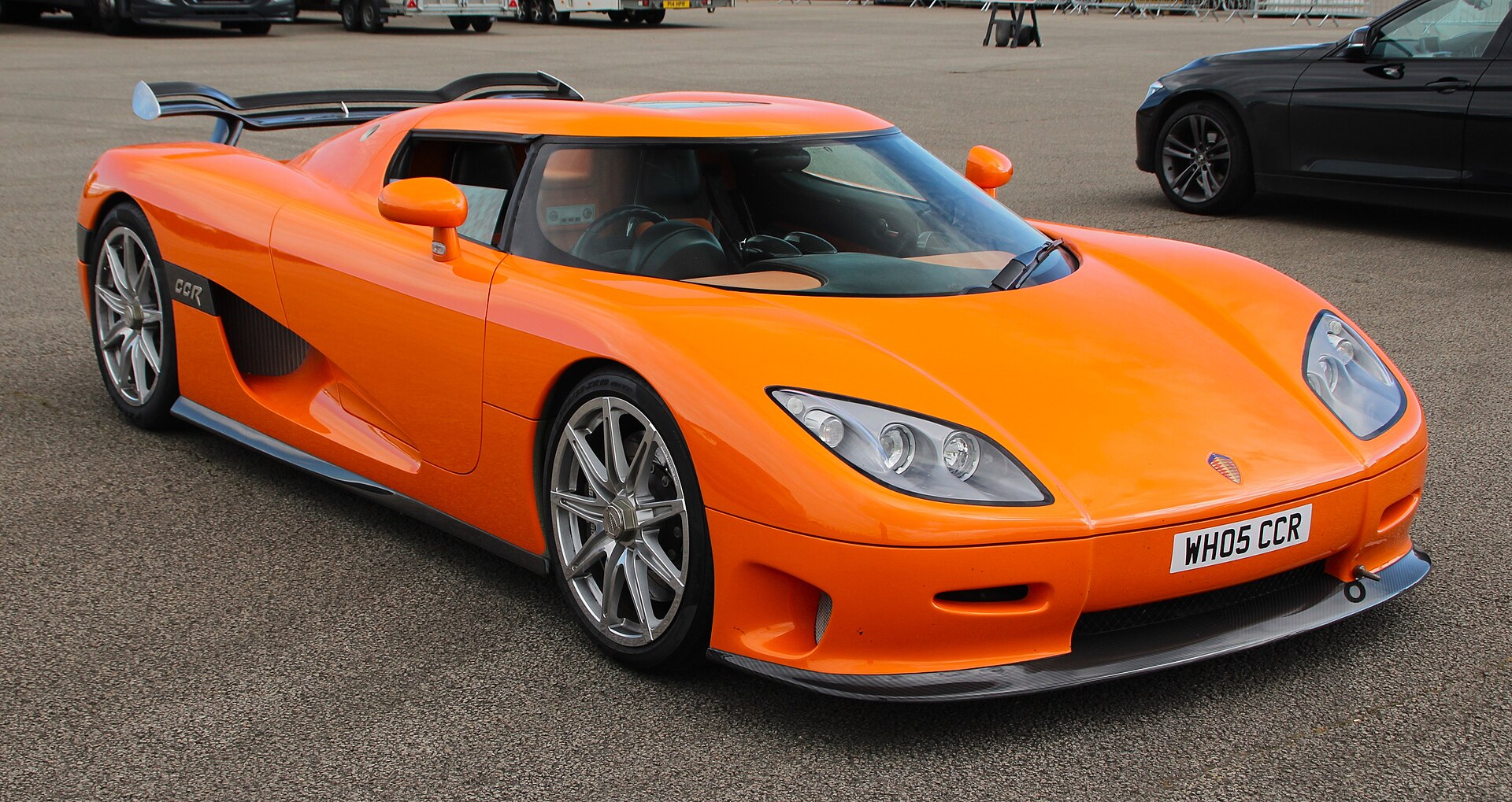
The Koenigsegg CCR is the mid-engined supercar that Koenigsegg built in Ängelholm, Sweden, from 2004 to 2006. It was a more powerful development of the company's first production car, the CC8S. In February 2005 it took the title of the fastest production car in the world with a run of 387.87 km/h at the Nardò test track in Italy. Only 14 were built before the CCX replaced it.
In short
- Shown at the Geneva motor show in March 2004; built 2004–2006; 14 cars according to Wikipedia.
- 4.7-litre V8 based on the Ford Modular engine, with two Rotrex superchargers: 601 kW (817 PS) at 6,900 rpm and 920 Nm at 5,700 rpm.
- Six-speed manual gearbox, rear-wheel drive, dry weight 1,180 kg, kerb weight 1,230 kg.
- 387.87 km/h at Nardò on 28 February 2005, driven by Loris Bicocchi — a record until the Bugatti Veyron surpassed it later that year.
At a glance: Koenigsegg CCR
| Specification | Koenigsegg CCR |
|---|---|
| Production | 2004–2006, Ängelholm (Sweden) |
| Cars built | 14 (chassis list shows 15 entries) |
| Body | two-door targa, dihedral synchro-helix doors |
| Layout | rear mid-engine, rear-wheel drive |
| Engine | 4,700 cc V8, two Rotrex superchargers |
| Power | 601 kW (817 PS) at 6,900 rpm |
| Torque | 920 Nm at 5,700 rpm |
| Gearbox | six-speed manual |
| Weight | 1,180 kg dry, 1,230 kg kerb |
| Predecessor / successor | CC8S / CCX |
The CCR was followed by the Koenigsegg CCX and later by the Koenigsegg Agera R. The full range is in the Koenigsegg catalogue.
History of the Koenigsegg CCR
The CCR was presented at the Geneva motor show in March 2004 as the successor of the CC8S, Koenigsegg's first production model. Both cars share the Koenigsegg CC platform, and the CCR was designed by Sven-Harry Åkesson, Christian von Koenigsegg and David Crafoord. Production ran from 2004 to 2006 and remained a very small series of 14 cars.
From the CC8S to the CCR
The CCR's predecessor, the CC8S, was Koenigsegg's first production car. A pre-production example was shown at the Paris motor show in 2000, and only six were built in 2002 and 2003 — four with left-hand drive and two with right-hand drive. It was also the first production car with dihedral synchro-helix doors. Its 4.7-litre twin-supercharged V8, again based on the Ford Modular design but cast in aluminium, produced 488 kW (664 PS) and 750 Nm, and it earned a Guinness World Record as the most powerful production engine of its time.
The CCR raised the stakes considerably: 601 kW (817 PS) and 920 Nm, about 113 kW and 170 Nm more than the CC8S. Less than a year after its Geneva debut, a CCR set the production-car speed record at Nardò.
Design and chassis
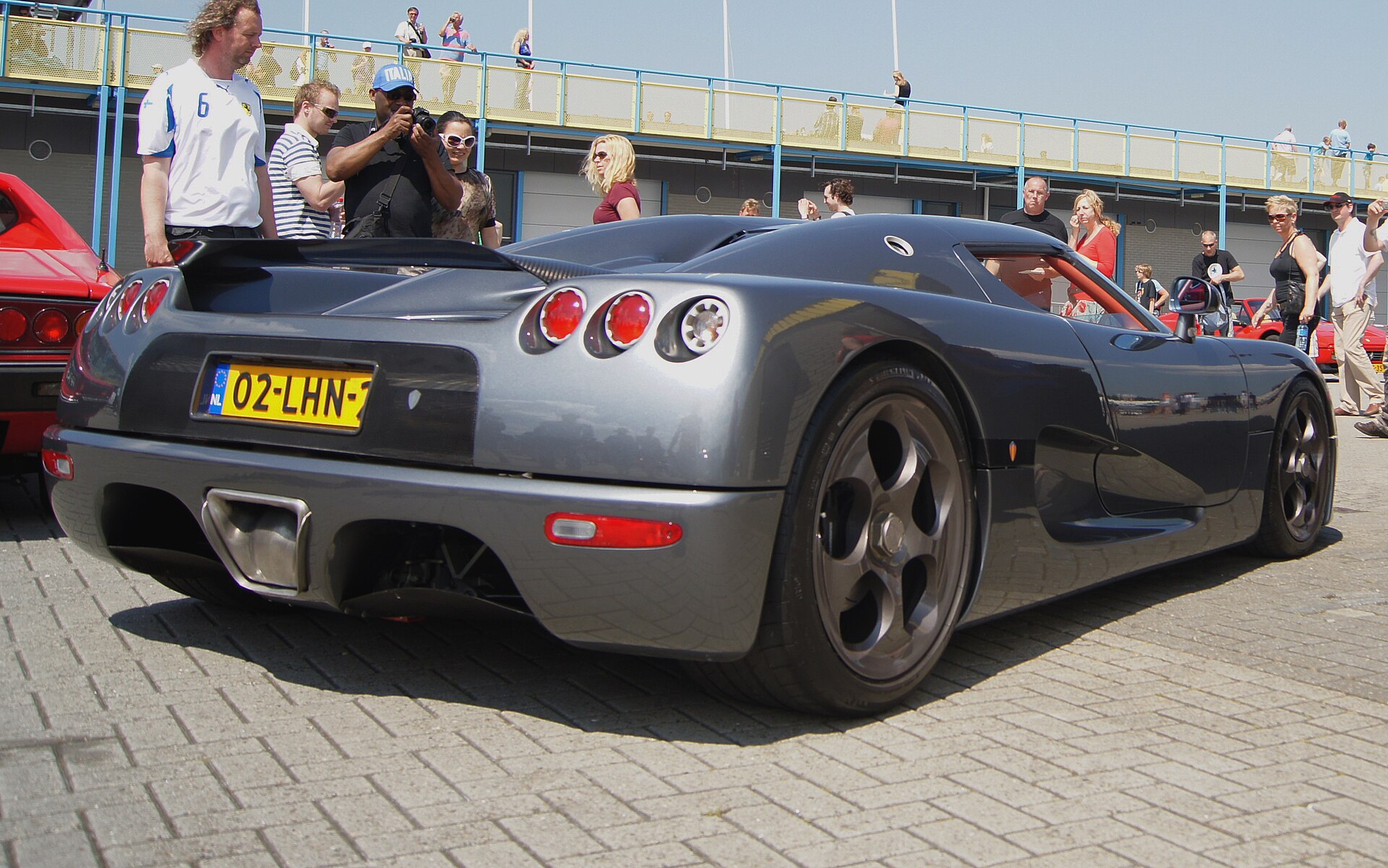
Compared with the CC8S, the CCR received a larger front splitter, a rear wing and revised headlights. It also has larger wheels and tyres, larger brakes and upgraded suspension. The car is a two-door targa with a removable roof panel and keeps Koenigsegg's dihedral synchro-helix doors.
The CCR is compact and very low: 4,191 mm long, 1,989 mm wide and only 1,069 mm high, on a 2,659 mm wheelbase. The dry weight is 1,180 kg and the kerb weight 1,230 kg.
On the car is a ghost emblem. It honours Swedish Fighter Squadron No. 1, which once occupied the site of the Koenigsegg factory in Ängelholm.

Engine and performance
The engine is a 4.7-litre V8 based on the Ford Modular engine and developed by Koenigsegg. Bore and stroke are 90.6 × 92 mm, and two Rotrex centrifugal superchargers provide the boost. It produces 601 kW (817 PS) at 6,900 rpm and 920 Nm at 5,700 rpm, and it drives the rear wheels through a six-speed manual gearbox.
| Item | Figure |
|---|---|
| Power | 601 kW (817 PS) at 6,900 rpm |
| Torque | 920 Nm at 5,700 rpm |
| 0–100 km/h | 3.2 s (some data: 3.7 s) |
| 0–200 km/h | 9.3 s |
| 0–300 km/h | 24.9 s |
| Standing quarter mile | 11.2 s at 224 km/h |
| Top speed | 388 km/h |
Wikipedia gives 0–100 km/h in 3.2 seconds in its overview and 3.7 seconds in its specification list.
The 2005 speed record
On 28 February 2005 a standard CCR, driven by Loris Bicocchi, reached 387.87 km/h on the Nardò Ring in Italy. At the time this made the CCR the fastest production car in the world. The record did not last long: in April 2005 a prototype of the Bugatti Veyron went faster, and the production Veyron later reached 408.47 km/h.

Individual cars and tuning
Several CCRs were later modified. The car with chassis number 009, nicknamed "Revo", was originally sky blue with a white and blue interior. In 2012 it was rebuilt with carbon-fibre bodywork, a red and black interior, parts from the CCX, a CCXR-style rear wing and changes to the engine management and superchargers.
The tuner EDO Competition offered an "Evolution" package with a remapped engine control unit, different gearing and a higher rev limit of 7,200 rpm. Power rose to 664 kW (903 PS), and EDO quoted 0–100 km/h in 3.2 seconds, 0–200 km/h in 9.7 seconds and 0–300 km/h in 23 seconds.
Photo gallery

Koenigsegg CCR in our rankings
- No. 2 of 170 · Most powerful cars of the 2000s (601 kW)
- No. 52 of 859 · Most powerful cars (601 kW · top 7%)
- No. 42 of 313 · Most powerful coupes (601 kW · top 14%)
- No. 838 of 912 · Longest-running car nameplates (2 years · top 96%)
More powerful than 98% of ranked cars of the 2000s in the 1CARS catalog (No. 2 of 170).
FAQ
How many Koenigsegg CCRs were built?
14 according to Wikipedia's text, although its chassis list shows 15 entries.
How fast is the Koenigsegg CCR?
It reached 387.87 km/h at Nardò in February 2005, briefly the record for a production car.
What engine does the CCR have?
A 4.7-litre V8 based on the Ford Modular engine, with two Rotrex superchargers, producing 601 kW (817 PS) and 920 Nm.
Which car beat the CCR's record?
A Bugatti Veyron prototype in April 2005; the production Veyron later reached 408.47 km/h.
What replaced the CCR?
The Koenigsegg CCX followed the CCR after production ended in 2006.
Data sources
Data checked by an editor against the sources below.