 Koenigsegg CC8S
Specs, engines and history
Published Sources (1) Report an error
By Felix Hartmann, Automotive Technology & EV Contributor
- Built
- 2002–2003
- Top power
- 488 kW (663 PS)
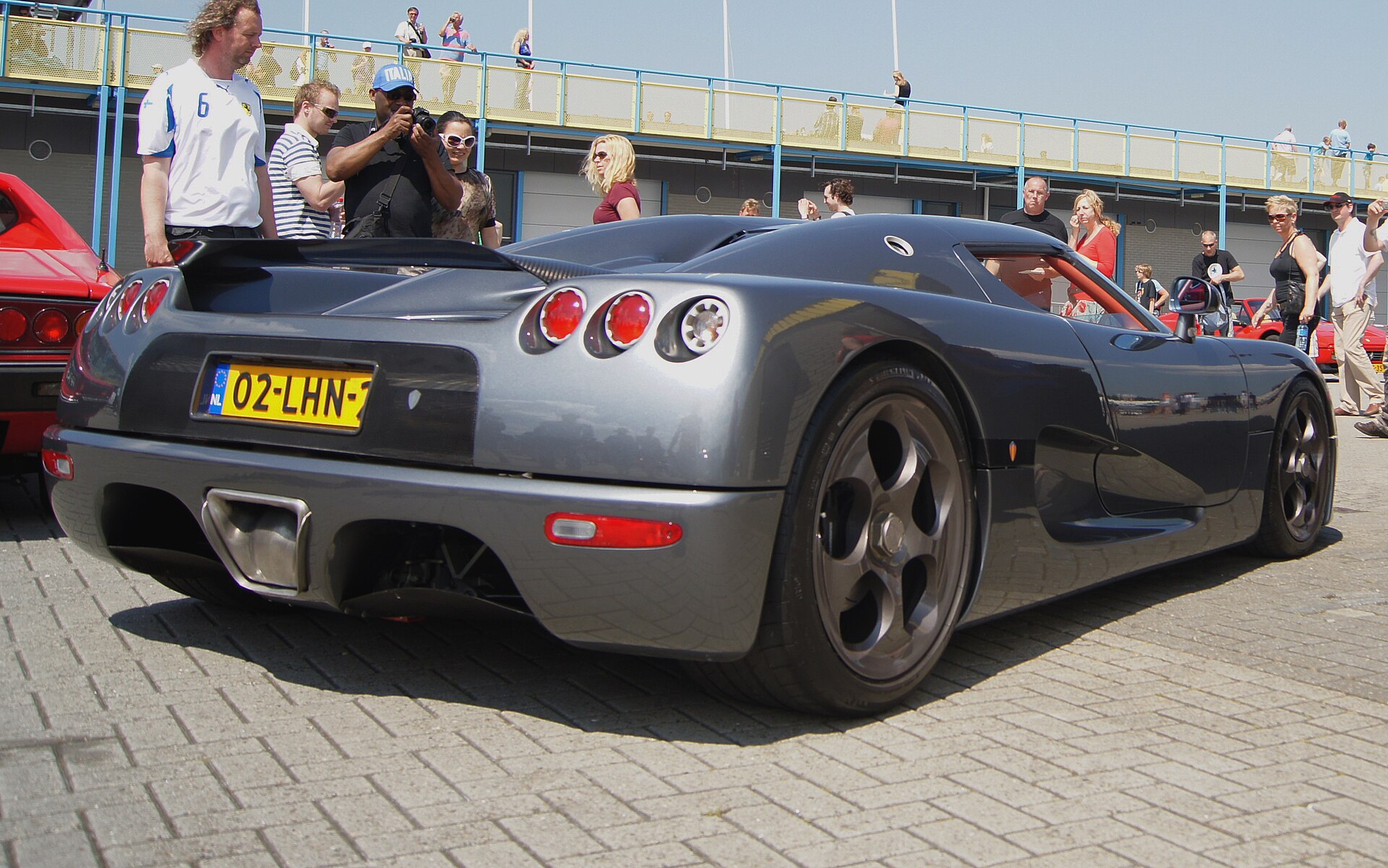
The Koenigsegg CC8S is the first production car of the Swedish manufacturer Koenigsegg. It grew out of the CC prototype, made its first public appearance in pre-production form at Paris in 2000 and was assembled in Ängelholm in 2002 and 2003. Only six were made. Yet the CC8S already had the features that still define the brand: a carbon fibre chassis, a roof panel that stows under the bonnet and doors that swing outwards and upwards.
In short
- Six cars assembled in Ängelholm, Sweden, in 2002–2003; two of them have right-hand drive.
- Supercharged 4.7-litre V8 developed from Ford's Modular design: 488 kW (664 PS) at 6,800 rpm and 750 Nm at 5,000 rpm.
- Kevlar-reinforced carbon fibre semi-monocoque, all-carbon body and a dry weight of 1,175 kg.
- First production car with "dihedral synchro-helix" doors; Guinness recognised its V8 as the strongest engine in any series car of the day.
Koenigsegg CC8S at a glance
| Specification | Koenigsegg CC8S |
|---|---|
| Production | 2002–2003, Ängelholm (Sweden) |
| Cars built | 6 (4 left-hand drive, 2 right-hand drive) |
| Designers | Christian von Koenigsegg, David Crafoord |
| Body | two-seat, two-door targa, removable roof |
| Chassis | carbon fibre semi-monocoque with Kevlar; steel front and aluminium rear subframes |
| Engine | 4.7-litre DOHC V8, 32 valves, supercharged, mid-mounted |
| Power | 488 kW (664 PS) at 6,800 rpm |
| Torque | 750 Nm at 5,000 rpm |
| Gearbox | six-speed manual by CIMA, rear-wheel drive |
| Dry weight | 1,175 kg |
| Dimensions | 4,191 mm long, 1,989 mm wide, 1,069 mm high, 2,659 mm wheelbase |
| Successor | CCR (2004) |
The line that the CC8S began later included the Koenigsegg CCX and the Koenigsegg Agera R. Every model of the marque appears in the Koenigsegg catalogue.
Eight years from idea to car
Wikipedia describes the CC8S as the result of eight years of research and development that began with the CC prototype. The car was designed by the founder, Christian von Koenigsegg, together with David Crafoord. For a company of its size the project was ambitious. Despite limited resources, Koenigsegg designed the chassis, the suspension, the brakes and several other parts itself instead of buying them in.
The decisive moment came at the Paris motor show in 2000, where the pre-production car made its public debut. The reaction was favourable, and the show brought the young company international contacts and orders. Turning those orders into cars proved harder. Production costs were high, and despite the demand Koenigsegg finished only six cars in 2002 and 2003.
Body, doors and targa roof
Every body panel of the CC8S is made of carbon fibre. The car is low and wide: 4,191 mm long, nearly two metres across and just 1,069 mm high. Venturi tunnels and diffusers under the floor work together with a rear spoiler to create downforce. Wikipedia gives a drag coefficient of 0.30 and a CdA value of 1.825 m², which takes the frontal area into account.
Two details became Koenigsegg trademarks. The doors do not open forwards like scissor doors or upwards like gullwings. Instead they rotate outwards and upwards in a single movement, a mechanism that Koenigsegg calls "dihedral synchro-helix actuation". The CC8S was the first production car with this design. The second detail is the roof: the targa panel lifts off and fits under the front bonnet, so the car can be driven open without leaving the roof at home.
The design was recognised outside the car world as well. The CC8S received the Red Dot award in Germany and the Utmärkt Svensk Form award in Sweden.
The supercharged V8
The engine is based on Ford's Modular V8, but little of the original remained. Koenigsegg used a cast aluminium block, four valves per cylinder and two overhead camshafts per bank, and fitted carbon fibre covers. With these covers the complete unit weighs 210 kg. The compression ratio is 8.6:1.
| Figure | Koenigsegg CC8S |
|---|---|
| Displacement | 4.7 litres |
| Power | 488 kW (664 PS) at 6,800 rpm |
| Torque | 750 Nm at 5,000 rpm |
| Redline | 7,250 rpm |
| Compression ratio | 8.6:1 |
| Engine weight | 210 kg with carbon covers |
When the car was launched, Guinness World Records listed this V8 as the most powerful engine in any production car. The six-speed manual gearbox was developed for the car by the Italian specialist CIMA. Exhaust gases leave through a central system built on a principle that Koenigsegg patented under the name "Rocket Cat".

Chassis, wheels and brakes
The core of the car is a semi-monocoque of carbon fibre, reinforced with Kevlar. A steel subframe is bolted to the front. At the rear an aluminium subframe carries the engine, the gearbox and the rear suspension. With a dry weight of 1,175 kg, each kilowatt of the V8 had to move only about 2.4 kg.
The magnesium alloy wheels have centre-lock hubs. Michelin Pilot Sport 2 tyres are fitted, 225/40 ZR18 at the front and much wider 335/40 ZR20 at the rear. The cross-drilled brake discs measure 340 mm at the front and 315 mm at the rear. Six-piston calipers work on the front discs and four-piston calipers on the rear ones, with power assistance from the Koenigsegg Advanced Control System.
The six cars
With so few cars, each CC8S has its own history. Wikipedia lists the chassis based on manufacturer estimates:
| Chassis | Colour | Notes |
|---|---|---|
| 001 | red | kept by Koenigsegg, later heavily modified |
| 002 | blue, later silver | first customer car |
| 003 | black | later converted into CCR chassis 026 |
| 004 | Nordic Ice Green, later black | - |
| 005 | Blue Scuro | right-hand drive |
| 006 | silver, later grey | - |
Several owners have repainted their cars over the years. The conversion of chassis 003 into a CCR shows how closely related the two models are.
From CC8S to CCR
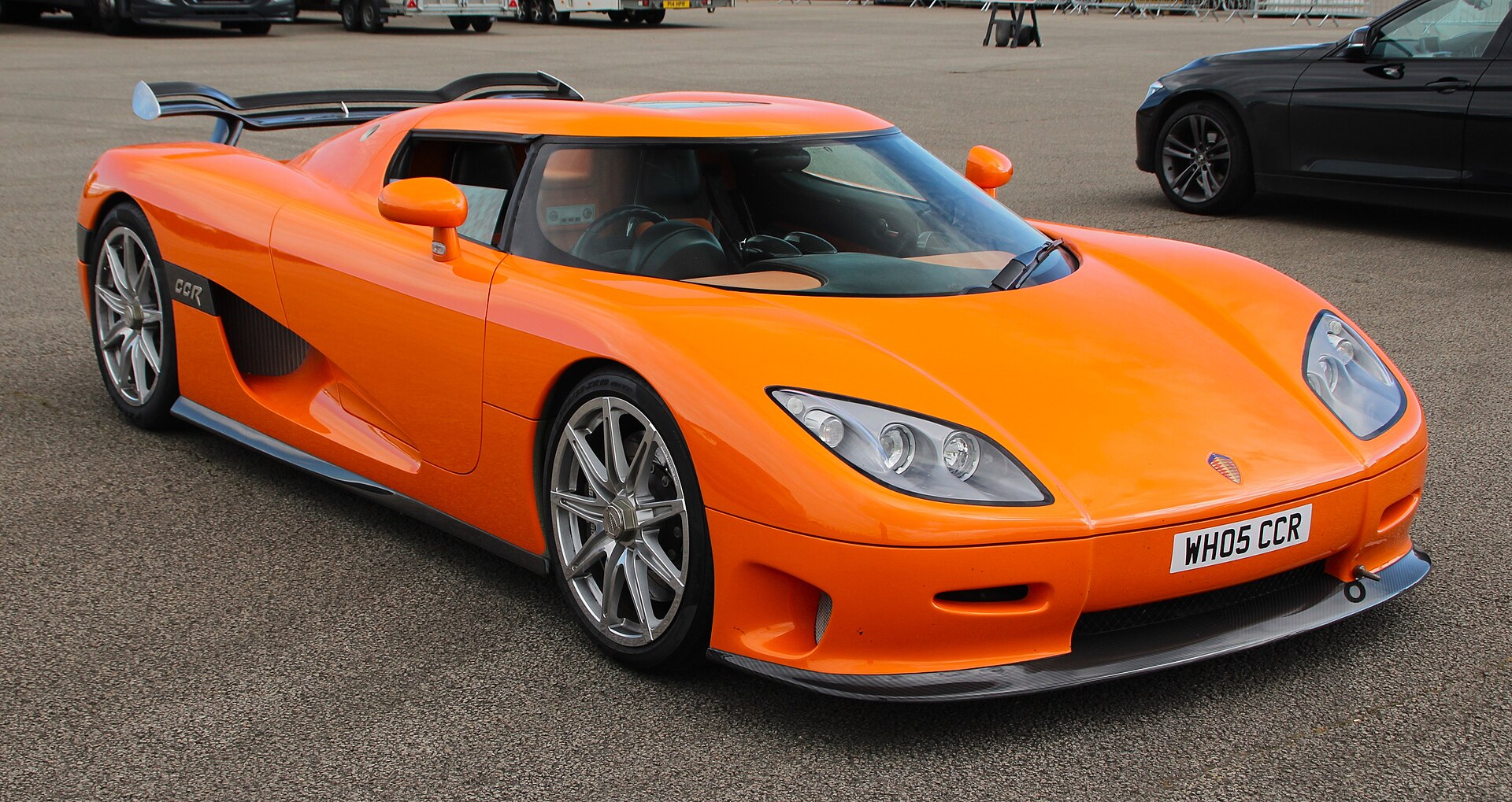
In 2004 the CC8S was replaced by the CCR, which Wikipedia lists as its direct successor. It kept the CC platform but raised the output of the V8 to 601 kW (817 PS) and 920 Nm. The CCR was built until 2006, and 14 were made.
| Specification | CC8S | CCR |
|---|---|---|
| Years | 2002–2003 | 2004–2006 |
| Power | 488 kW (664 PS) | 601 kW (817 PS) |
| Torque | 750 Nm | 920 Nm |
| Cars built | 6 | 14 |
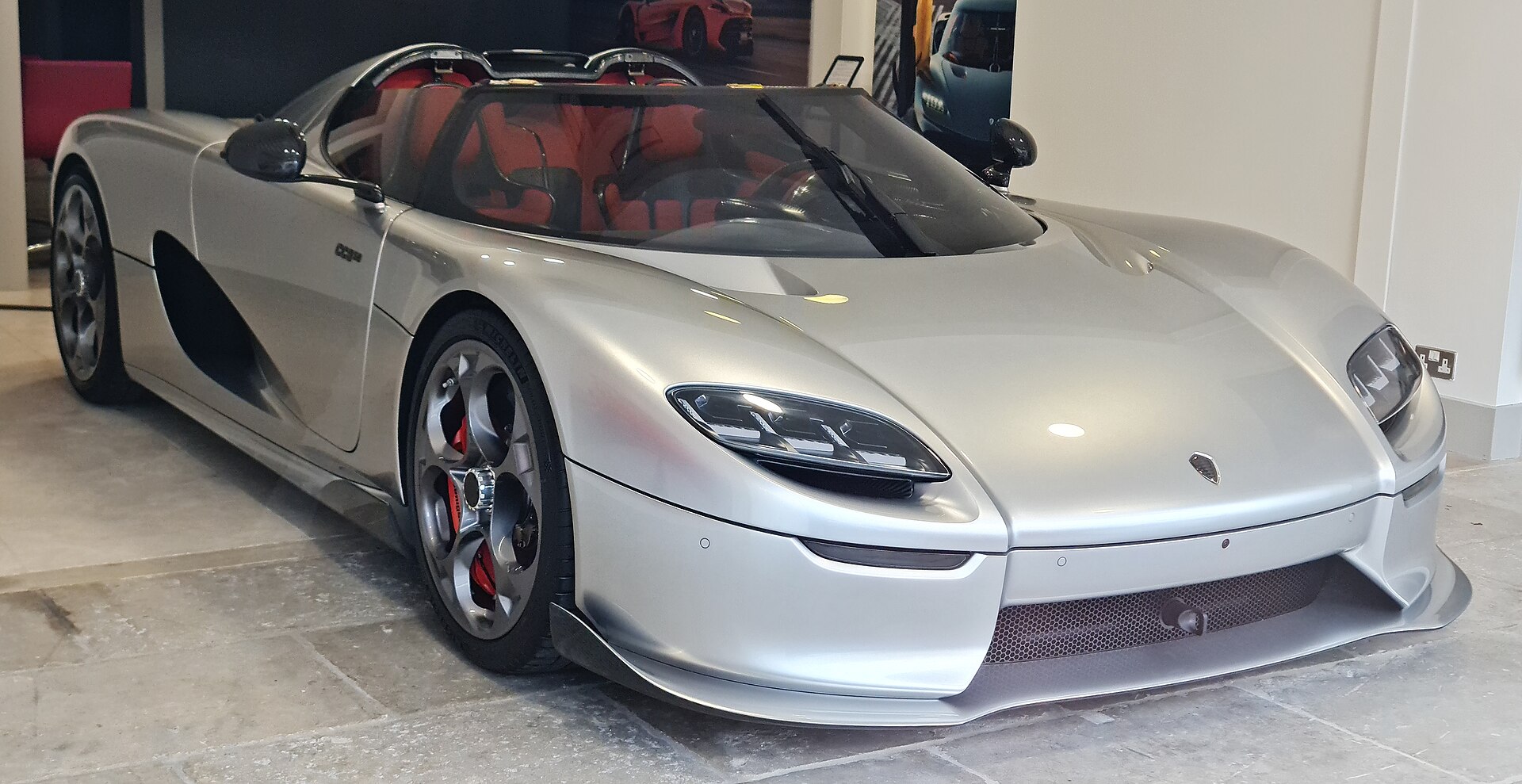
Wikipedia also names the CC850 of the 2020s as the "spiritual successor" of the CC8S. The name links the two cars across two decades.

Legacy
The CC8S was a small first step, but it fixed the principles of the company. Koenigsegg kept developing its own chassis and many of its components, it kept carbon fibre construction, the removable roof and the unusual doors, and it kept raising engine output. For the story of how the firm grew, see our history of Koenigsegg.
Koenigsegg CC8S in our rankings
- No. 7 of 170 · Most powerful cars of the 2000s (488 kW)
- No. 103 of 859 · Most powerful cars (488 kW · top 12%)
- No. 76 of 313 · Most powerful coupes (488 kW · top 25%)
- No. 887 of 912 · Longest-running car nameplates (1 year)
More powerful than 95% of ranked cars of the 2000s in the 1CARS catalog (No. 7 of 170).
FAQ
How many Koenigsegg CC8S were built?
Koenigsegg completed only six, in 2002 and 2003. Four have left-hand drive and two right-hand drive.
What engine does the CC8S use?
A supercharged 4.7-litre V8 developed from Ford's Modular design, with 488 kW (664 PS) and 750 Nm.
What record did the CC8S hold?
Guinness World Records named its V8 the most powerful engine of any production car at the time the CC8S was new.
What replaced the CC8S?
The CCR of 2004, which raised power to 601 kW (817 PS). Wikipedia calls the modern CC850 its spiritual successor.
Data sources
Data checked by an editor against the sources below.