 Mazda CX-9
All generations, specs and history
Published Sources (2) Report an error
By Sarah Whitmore, Senior Automotive Writer
- Built
- 2006–2023
- Generations
- 2
Timeline
CX-9 generations
Click a generation for its own page


Newest first · 2 generations since 2006
-
2016
-
2006
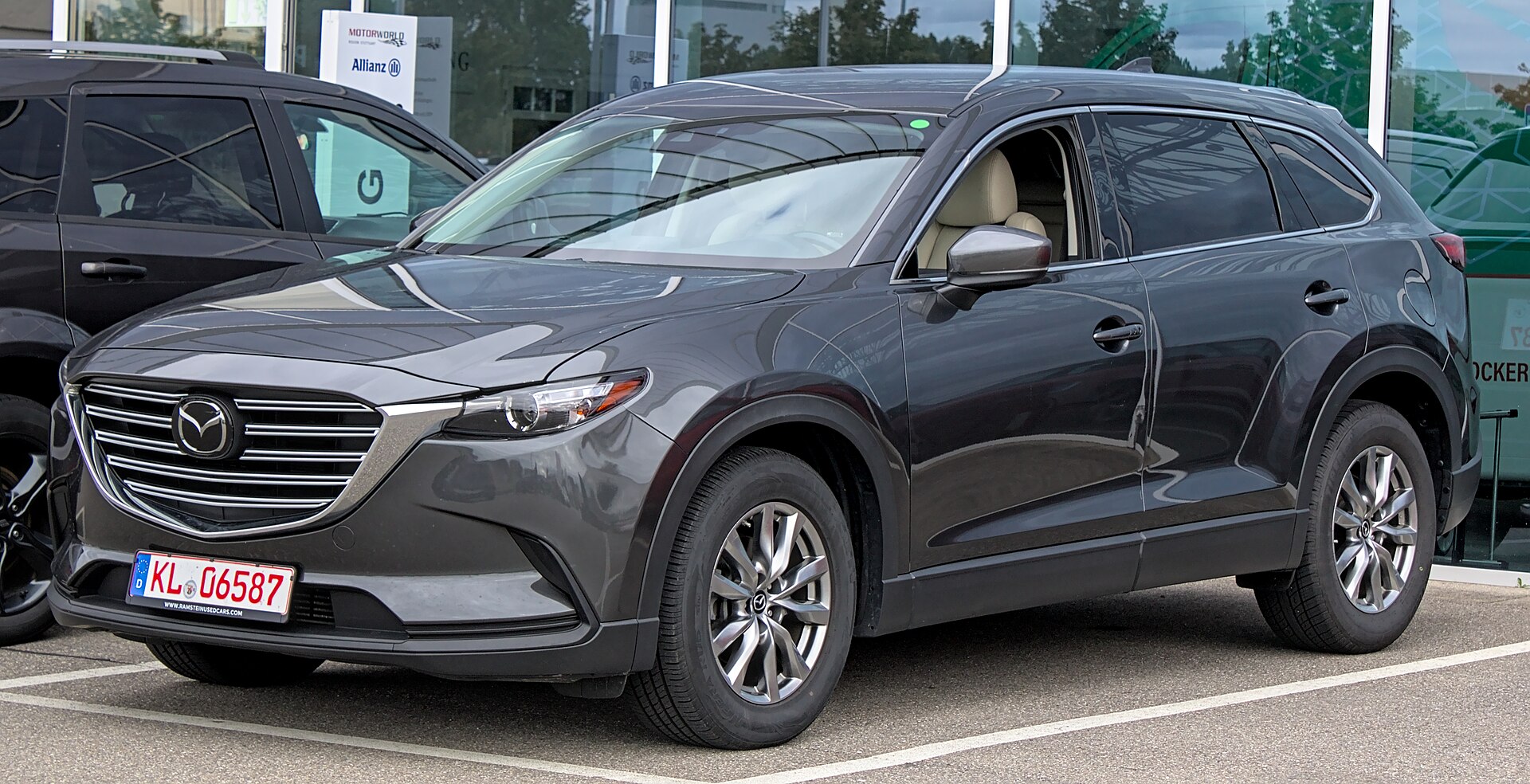
All generations by year: CX-9 II (2016–2023) · CX-9 I (2006–2016)
Which one is mine?
Pick the year of first registration to see which generation it is.
Check by VINThe Mazda CX-9 is a seven-seat crossover with front- or all-wheel drive that served as the flagship of Mazda's line-up. Designed mainly for North America, it was Mazda's first three-row crossover. Two generations were built: the first made its world debut at the New York motor show in April 2006, and the second was revealed at the Los Angeles motor show in November 2015, with production starting in February 2016. Sales in the United States ended after the 2023 model year, when the larger CX-90 took over, although production continued for some other markets.
In short
- First generation (2006–2015): Ford CD3 platform shared with the Ford Edge, 3.5 and later 3.7 V6 with up to 204 kW (273 hp).
- Second generation (2016–2023): Skyactiv architecture and a 2.5-litre Skyactiv-G turbo four with 169–186 kW (227–250 hp) and 420 Nm.
- Six-speed automatic in both generations; i-Activ AWD in the second.
- Seven seats in three rows and up to 2,016 litres of luggage space.
Safety
-
CX-9 II · NHTSA 2023
US NCAP (NHTSA)
-
CX-9 I · NHTSA 2015
US NCAP (NHTSA)
Stars from different years and organisations are not directly comparable: test protocols change every few years.
Mazda CX-9 at a glance
The CX-9 is a monocoque crossover with a transverse front engine and three rows of seats. It competed in the large family SUV class against cars such as the Toyota Highlander, Honda Pilot and Chevrolet Traverse. More Mazda models are listed in our Mazda catalogue.
Mazda CX-9 generations
| Generation | Years | Platform | Engines |
|---|---|---|---|
| First (TB) | 2006–2015 | Ford CD3 | 3.5 V6, 196 kW (263 hp); 3.7 V6, 204 kW (273 hp) |
| Second (TC) | 2016–2023 | Mazda Skyactiv | 2.5 Skyactiv-G turbo, 169–186 kW (227–250 hp) |
First generation (2006–2015)
The first CX-9 shared its CD3 platform with the Ford Edge and was about 5.07 metres long on a 2,875 mm wheelbase. It initially used a Ford-sourced 3.5-litre V6; from the 2008 model year a Mazda-built 3.7-litre V6 with 204 kW (273 hp) and 366 Nm took over. Both drove through a six-speed automatic. Facelifts for the 2010 and 2013 model years brought a new front end and tail lights, and the 2013 update adopted Mazda's newer grille design. The first generation was named Motor Trend SUV of the Year and North American Truck of the Year for 2008.
Second generation (2016–2023)
The second CX-9 moved to Mazda's own Skyactiv architecture. It is about 5.07 metres long, with a longer wheelbase of 2,930 mm, and is 90 to 135 kg lighter than its predecessor. The model received updates in 2019 and for 2021 that refined the cabin and added equipment rather than changing the concept. It was the first vehicle awarded IIHS Top Safety Pick+ for 2017, won the 2017 Wheels Car of the Year award in Australia and was a finalist for the 2017 World Car Design of the Year.
Exterior
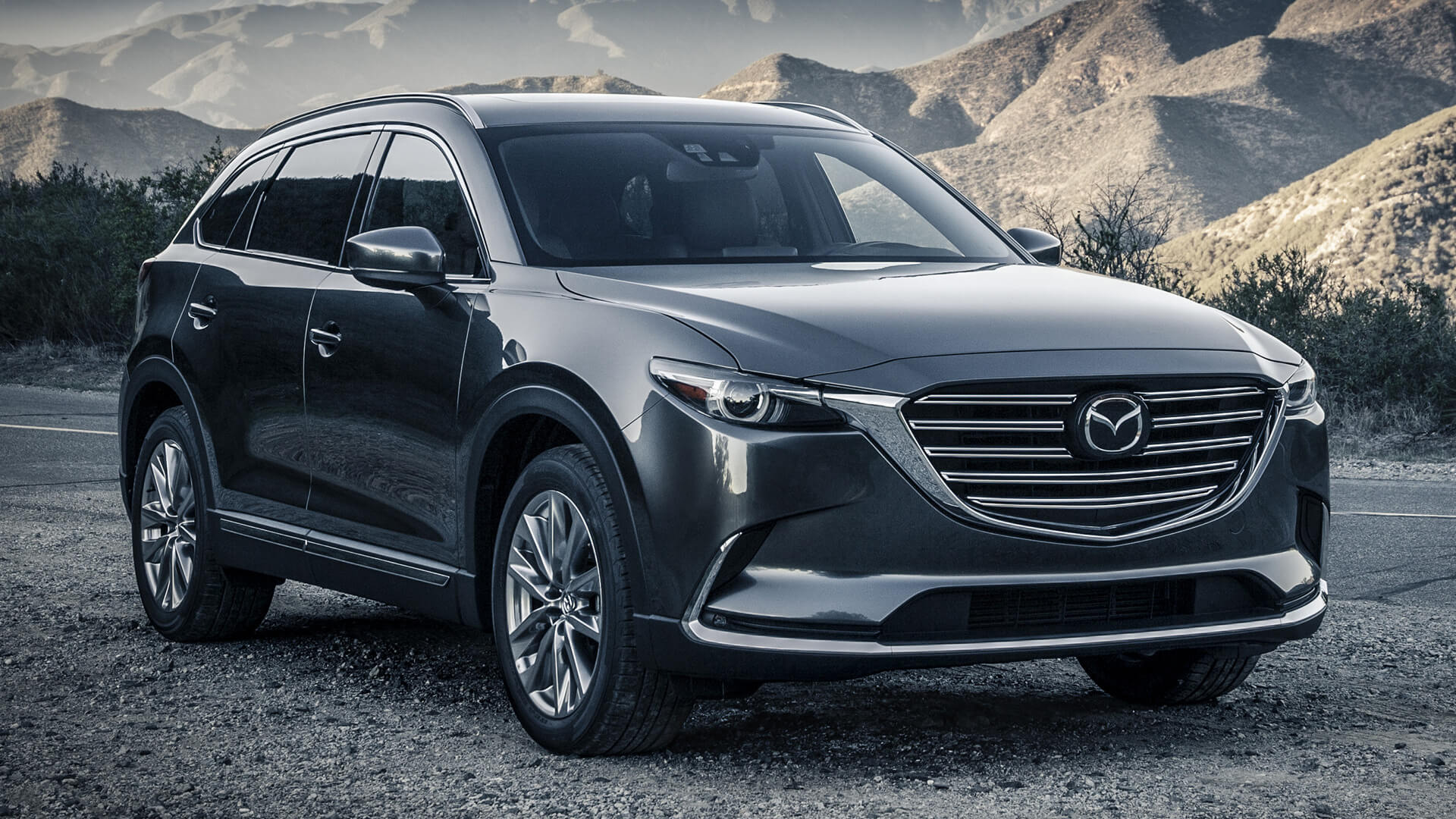
The second generation follows Mazda's Kodo design language. The large, slightly raked front gives a commanding view, and the long bonnet has a raised central section with slightly recessed sides. The grille sits a little back in the body with a chrome frame and horizontal chrome bars that form a mesh around the badge. Small but aggressive headlights sit level with the top of the grille, and every version has LED lighting. The bumper has a central strip-shaped intake, side recesses with grilles that channel air to cool the brakes, chrome highlights and a lower band of unpainted protective plastic.
In profile the CX-9 is calm, with gentle changes in height, chrome roof rails, a long, narrow window line with a chrome strip and gloss-black pillars. Almost triangular gloss-black mirrors carry indicator repeaters. Prominent sills, flared wheel arches and plastic cladding around the lower body suit occasional rough roads, and ground clearance is about 220 mm according to published figures. Wheels are 18 or 20 inches depending on version. At the rear are a short spoiler with a brake light, a raked tailgate window, a chrome strip linking the tail lights, a sculpted bumper with fog lights and two compact exhaust outlets.
Interior
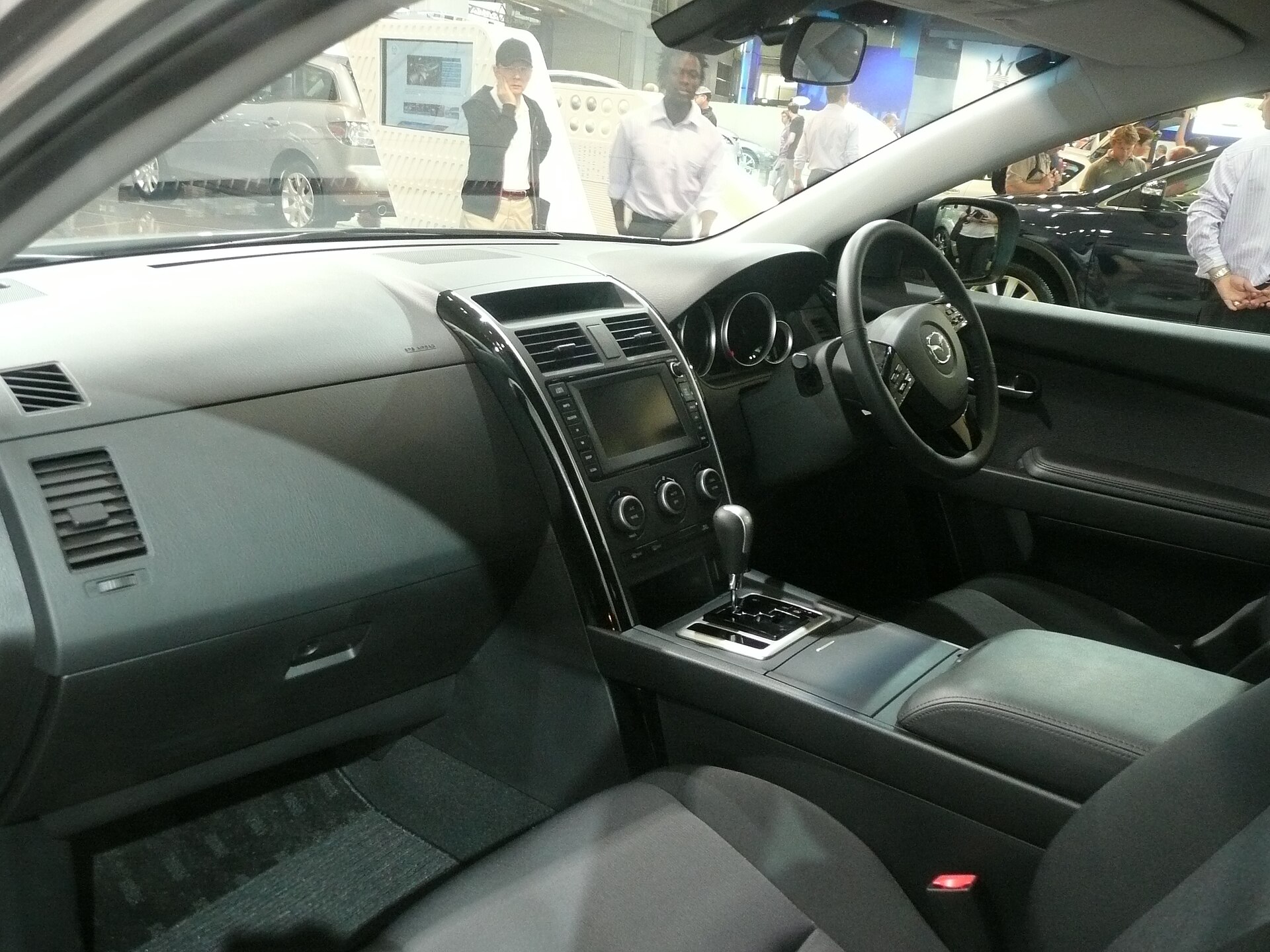
The cabin follows the Kodo theme too, with several types of leather, soft plastics, polished aluminium and wood trim. Later models have thicker sound insulation in the floor and roof, although tyre noise is still audible at medium and high speeds on asphalt. The two-tier dashboard holds a digital instrument display with analogue-style dials; a 7-inch trip-computer screen sits in the right-hand dial. The front seats can be heated and ventilated, and the driver faces a three-spoke steering wheel with a slim rim and many buttons. The centre console carries a 10.25-inch infotainment screen in later versions, which works with the surround-view cameras and supports wireless Apple CarPlay. A Bose audio system with 12 speakers is available, as is wireless phone charging on higher trims.
All three rows are comfortable for adults, and second-row passengers have their own climate controls. Luggage space is 408 litres behind the third row, 1,082 litres with it folded and 2,016 litres with both rear rows folded in a 60:40 split, always with a flat floor.
Engines and transmissions (second generation)
| Engine | Fuel | Power (kW / hp) | Torque |
|---|---|---|---|
| 2.5 Skyactiv-G turbo | Regular | 169 kW / 227 hp | 420 Nm |
| 2.5 Skyactiv-G turbo | Premium | 186 kW / 250 hp | 420 Nm |
The turbocharged 2.5-litre four has direct injection, cooled exhaust gas recirculation and a valve in the exhaust manifold that narrows the gas passage at low revs to spin up the turbocharger faster and reduce lag. Peak torque arrives at just 2,000 rpm. It is paired with a six-speed automatic and front-wheel drive or the predictive i-Activ AWD system, which uses an electronically controlled multi-plate clutch and data from many sensors to send torque to the rear before wheelspin starts. Published figures give 0–100 km/h in 8.6 seconds, a top speed of 208 km/h and combined consumption of about 9.6–10 l/100 km for the all-wheel-drive version.
Chassis
The second CX-9 uses high-strength steels extensively in its body. Suspension is independent, with MacPherson struts at the front and a multi-link rear. Rack-and-pinion steering has electric assistance, and G-Vectoring Control fine-tunes engine torque in corners to improve stability. All four brakes are discs: 320 mm at the front and 325 mm at the rear according to published figures, with ABS, EBD and brake assist.
Safety and equipment
Mazda placed great emphasis on safety for its family crossover. Equipment includes adaptive LED headlights, traffic-sign recognition, blind-spot monitoring, a low-speed city braking assistant, lane-keep assist, driver fatigue monitoring, traction and stability control, rear cross-traffic alert, front and side airbags and curtain airbags, an immobiliser, ISOFIX child-seat anchors and designed crumple zones. Typical equipment includes six airbags, front and rear parking sensors, tri-zone climate control, rain and light sensors, cruise control, a rear camera, full-LED lights and 18-inch alloys; higher trims add Nappa leather, keyless entry and start, heated and ventilated power front seats, a power tailgate, a head-up display, heated rear seats and steering wheel, surround-view cameras, 20-inch wheels and the 12-speaker Bose system.
Key specifications by generation
| Parameter | First generation | Second generation |
|---|---|---|
| Years | 2006–2015 | 2016–2023 |
| Length | about 5,074–5,100 mm | about 5,065–5,075 mm |
| Wheelbase | 2,875 mm | 2,930 mm |
| Engine | 3.5 / 3.7 V6 | 2.5 turbo four |
| Power | 196–204 kW (263–273 hp) | 169–186 kW (227–250 hp) |
| Gearbox | 6-speed automatic | 6-speed automatic |
| Seats | 7 | 7 |
Strengths and weaknesses
Owners are generally pleased with the CX-9, highlighting its attractive styling, good performance and ground clearance, enough power for motorway overtaking, well-sorted suspension, plenty of interior space, capable infotainment, good ergonomics and high build and material quality. Drawbacks include expensive parts that sometimes have to be ordered, tyre noise and the sheer size of the car, which makes manoeuvring in tight spaces difficult. Rivals include the Volkswagen Atlas (Teramont), Kia Sorento, Hyundai Santa Fe, Audi Q7, BMW X5, Volvo XC90, Honda Pilot, Chevrolet Traverse and Toyota Highlander.
Image credits · Photos from Wikimedia Commons under free licences
- Mazda CX-9 I · Photo: OSX / Wikimedia Commons, Public domain
- Mazda CX-9 II · Photo: Alexander Migl / Wikimedia Commons, CC BY-SA 4.0
Mazda CX-9 in our rankings
- No. 217 of 912 · Longest-running car nameplates (17 years · top 25%)
- No. 280 of 345 · Cars with the most generations (2 generations)
In production longer than 75% of ranked nameplates in the 1CARS catalog (No. 217 of 912).
FAQ
How many seats does the Mazda CX-9 have?
Seven, in three rows, in both generations.
What engine does the Mazda CX-9 have?
The first generation used a 3.5 or 3.7 V6; the second uses a 2.5-litre turbo four with 169–186 kW (227–250 hp) and 420 Nm.
Does the Mazda CX-9 have all-wheel drive?
Yes, all-wheel drive was available; the second generation uses the predictive i-Activ AWD system.
What replaced the Mazda CX-9?
In the United States it was replaced by the Mazda CX-90 after the 2023 model year.
Data sources
Data checked by an editor against the sources below.
- Wikipedia — Mazda CX 9
- NHTSA 5-Star Safety Ratings (US NCAP) — U.S. Government work, public domain