 Volkswagen Phaeton
Specs, engines and history
Published Sources (1) Report an error
By Felix Hartmann, Automotive Technology & EV Contributor
Verdict
Our verdict · Felix Hartmann
Lovers of high-quality, technically sophisticated cars will appreciate the Phaeton. It has everything needed for comfortable long-distance travel, an advanced infotainment system for its time, four-zone climate control and the latest safety systems of its day. Fuel consumption is moderate for such large engines, and the cabin is exceptionally well made, expensive and comfortable. It may lose out in some respects to its German rivals from Mercedes-Benz, BMW and Audi, but it earned its place in the luxury class.
The Volkswagen Phaeton was the first full-size luxury saloon in Volkswagen's history — an F-segment car in European terms. It was unveiled at the Geneva motor show in March 2002 and was hand-assembled in a dedicated plant in Dresden, Germany. Volkswagen had previewed it with the Concept D at the Frankfurt motor show in 1999. The Phaeton was updated several times and built until March 2016; in total 84,253 cars were made.
In short
- Luxury saloon built from 2002 to 2016 at the glass-walled Transparent Factory in Dresden.
- Engines from a 3.0 V6 TDI with 177 kW (240 PS) to a 6.0 W12 with 331 kW (450 PS) and a 5.0 V10 TDI with 750 Nm.
- 4Motion all-wheel drive with a Torsen centre differential and adaptive air suspension as standard.
- Standard and long-wheelbase versions; about 500 litres of boot space.
Volkswagen Phaeton at a glance
The Phaeton was built on Volkswagen's D1 platform, shared with the Bentley Continental GT and Flying Spur. Unlike the aluminium Audi A8, it has an all-steel body. More Volkswagen models are listed in our Volkswagen catalogue, and the brand's SUV flagship of the same era is covered in our Volkswagen Touareg article.
| Year | Event |
|---|---|
| 1999 | Concept D shown at the Frankfurt motor show |
| 2002 | Production Phaeton revealed in Geneva |
| 2007 | Update shown in Geneva: LED daytime running lights, revised centre console; V6 TDI diesel added |
| 2010 | Facelift revealed at the Beijing motor show |
| 2014 | Minor update: new fog lights, darker tail lights, removable rear touchscreen |
| March 2016 | End of production |
The Transparent Factory
The Phaeton was hand-assembled at the Gläserne Manufaktur, a glass-walled factory in the centre of Dresden designed for a capacity of 20,000 cars a year. Bodies were built and painted at Zwickau and transported about 100 km to Dresden for assembly. After the Phaeton ended, the plant switched to the electric e-Golf in 2017.
Exterior
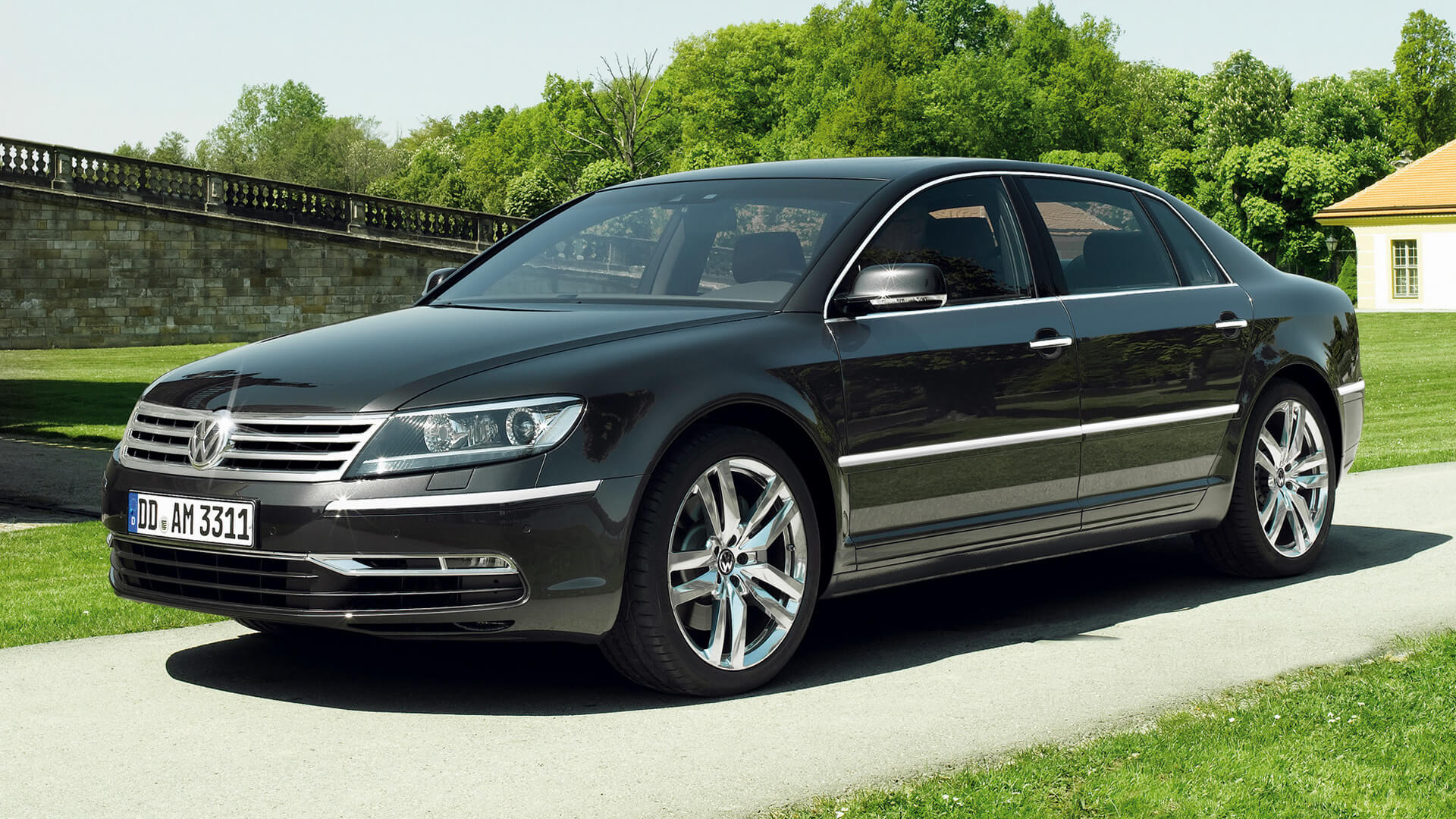
The Phaeton's appearance meets every expectation of a luxury saloon, and even today it looks good next to its rivals. The front has a sculpted bonnet that flows smoothly into narrow projector headlights. Between them is a large chrome grille with a big VW badge, and the large front bumper has chrome inserts and small fog lamps.
The side is fairly simple, which is normal in this class. Large wheel arches house 18-inch alloy wheels, and a slim chrome strip decorates the doors. Ground clearance varies from 113 to 153 mm thanks to the air suspension.
At the rear are large, attractive tail lights with LED elements and a big boot lid, which adds practicality. The massive rear bumper has a stylish chrome strip that runs around the car, and two or four integrated exhaust outlets, depending on the engine.
Interior
The cabin is the Phaeton's strongest point and makes its luxury status obvious at once. The updated car has high-quality plastics, soft leather and wood and metal trim, and a sophisticated infotainment system with seemingly endless capabilities.
The driver faces a huge centre console. At the top is a wood-trimmed panel with an elegant analogue clock; on either side of it, motorised covers open automatically to reveal the air vents — a detail that looks expensive and stylish. The middle of the dashboard is taken up by a large touchscreen for the infotainment system, yet classic knobs, levers and switches remain, so Volkswagen tried to please everyone: touch control for those who like it, physical controls for traditionalists. Below the buttons, a wooden panel hides sockets for connecting external devices.
The four-spoke steering wheel is unusual but practical, with fine leather trim, generous size and straight, almost futuristic spokes with function buttons. The instrument panel is interesting too: with so many gauges showing the car's status, it can feel like the cockpit of an aircraft, although the trip-computer display looks rather simple among all the splendour. The large tunnel carries many buttons, knobs, switches for the chassis settings and the gear selector, plus covered cupholders and a cooled storage compartment. Instead of one central armrest, the driver and front passenger each have their own.
The seats are superb, upholstered in genuine leather with very soft padding that makes any journey comfortable. The front seats offer excellent side support, electric adjustment, ventilation, heating and, on higher trims, massage. The rear has a large three-seat bench with a generous centre armrest, or two individual seats with the same functions as those in the front. Rear passengers have their own climate control and screens built into the front seatbacks.
The boot holds about 500 litres. The rear seat does not fold, so the volume cannot be increased. A full-size spare wheel and tools are stored under the floor.
Engines and transmissions
| Engine | Fuel | Power (kW / PS) | Torque | Years |
|---|---|---|---|---|
| 3.2 V6 | Petrol | 177 kW / 241 PS | 315 Nm | Early years |
| 3.6 V6 FSI | Petrol | 206 kW / 280 PS | 370 Nm | Later years |
| 4.2 V8 | Petrol | 246 kW / 335 PS | 430 Nm | Whole production |
| 6.0 W12 | Petrol | 331 kW / 450 PS | 560 Nm | 2004–2011 (later China only) |
| 3.0 V6 TDI | Diesel | 177 kW / 240 PS | 500 Nm | 2008–2013 |
| 5.0 V10 TDI | Diesel | 230 kW / 313 PS | 750 Nm | 2003–2007 |
The 3.6-litre V6 uses about 11.4 l/100 km on the combined cycle. Paired with a six-speed tiptronic automatic, it takes the large saloon to 100 km/h in 8.9 seconds, with a top speed of 250 km/h. The naturally aspirated 4.2 V8 with multi-point injection uses about 12.5 l/100 km and cuts the 0–100 km/h time to 6.9 seconds; top speed is again limited to 250 km/h. The 3.0 V6 TDI, with turbocharging and common-rail injection, uses about 8.5 l/100 km, reaches 100 km/h in 8.6 seconds and also reaches 250 km/h.
Depending on engine and year, the Phaeton used a ZF five-speed or six-speed automatic with tiptronic manual mode; early 3.2 V6 cars could also be ordered with a six-speed manual. Every Phaeton has 4Motion all-wheel drive with a Torsen centre differential that varies the torque split according to road conditions.
Chassis
The suspension is independent at both ends, with double wishbones at the front and a multi-link rear axle. Every Phaeton has electronically controlled adaptive air suspension with continuous damping control. Despite its size, the car is easy to drive thanks to rack-and-pinion steering with speed-sensitive electromechanical assistance. All four wheels have ventilated disc brakes, supported by ABS, EBD, brake assist and other systems.
Equipment
Even the standard Phaeton has eight airbags, 18-inch alloy wheels, four-zone climate control, cruise control, an advanced infotainment system, a premium audio system with ten speakers, full electric equipment, air suspension and ABS, EBD, brake assist and ESP. A long-wheelbase version was offered alongside the standard car.
Rivals
The Phaeton was cheaper than comparable cars from Mercedes-Benz, BMW and Audi, but even corporate customers never bought it in large numbers. Its natural rivals were the Mercedes-Benz S-Class, BMW 7 Series and Audi A8, along with cars such as the Lexus LS and Jaguar XJ.
Volkswagen Phaeton in our rankings
In production longer than 72% of ranked nameplates in the 1CARS catalog (No. 246 of 912).
FAQ
Where was the Volkswagen Phaeton built?
It was hand-assembled at Volkswagen's Transparent Factory (Gläserne Manufaktur) in Dresden, with bodies made in Zwickau.
When was the Volkswagen Phaeton made?
From 2002, when it debuted in Geneva, until March 2016. A total of 84,253 cars were built.
What was the most powerful Volkswagen Phaeton?
The 6.0 W12 with 331 kW (450 PS). The 5.0 V10 TDI diesel had the most torque, 750 Nm.
Is the Volkswagen Phaeton related to Bentley?
Yes. Its D1 platform was shared with the Bentley Continental GT and Flying Spur.
Data sources
Data checked by an editor against the sources below.