 Land Rover Defender
All generations, specs and history
Published Sources (3) Report an error
By Felix Hartmann, Automotive Technology & EV Contributor
- Built
- 1983–present
- Generations
- 2
- Top power
- 467 kW (635 PS)
- Euro NCAP
- 5 stars · L663
Timeline
Defender generations
Click a generation for its own page


- Defender I 1983–2016 · SUV, Pickup · 51–143 kW (69–194 PS)
- Defender L663 Current 2020–now · SUV · 147–467 kW (200–635 PS)
Newest first · 2 generations since 1983
-
2020
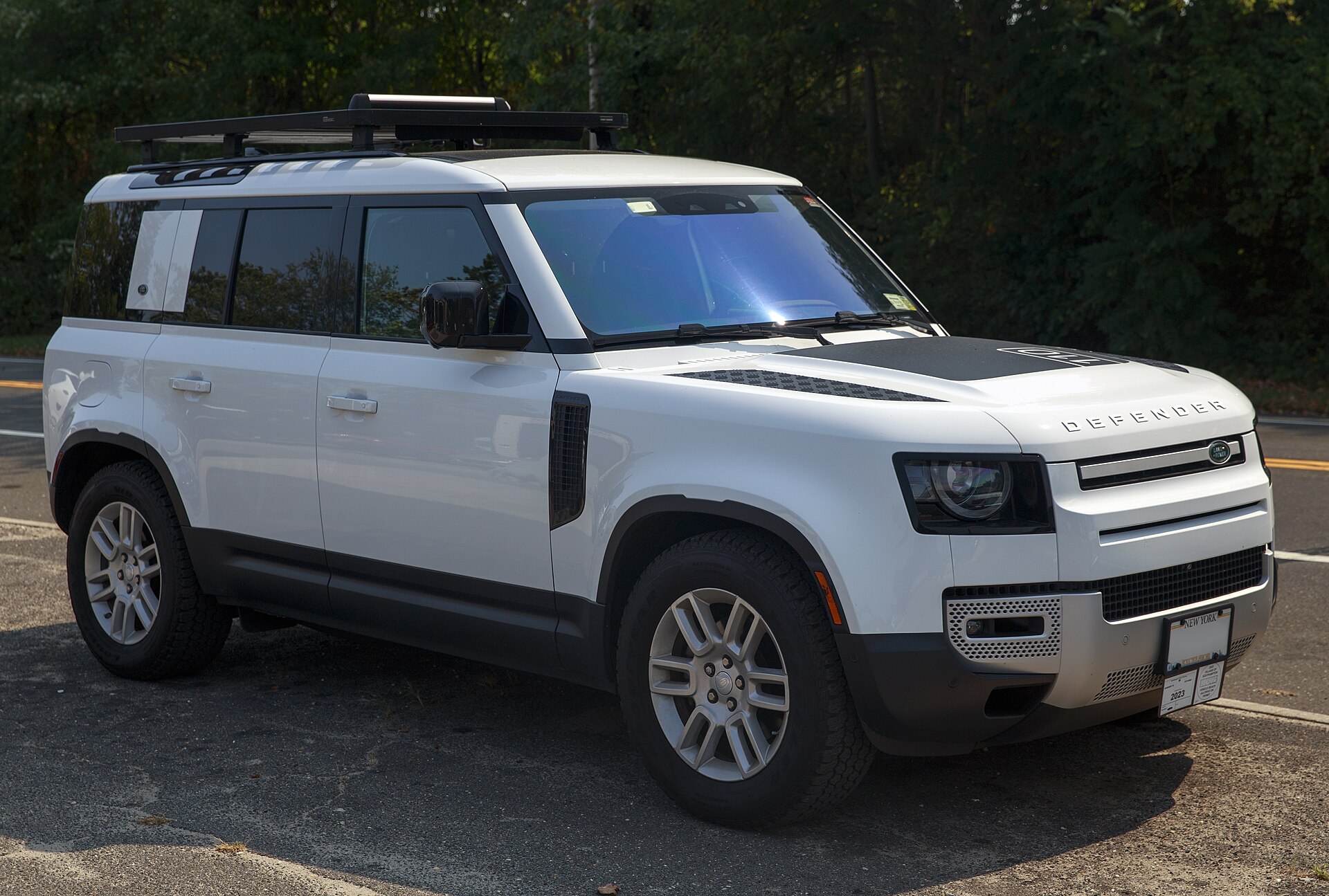
-
1983
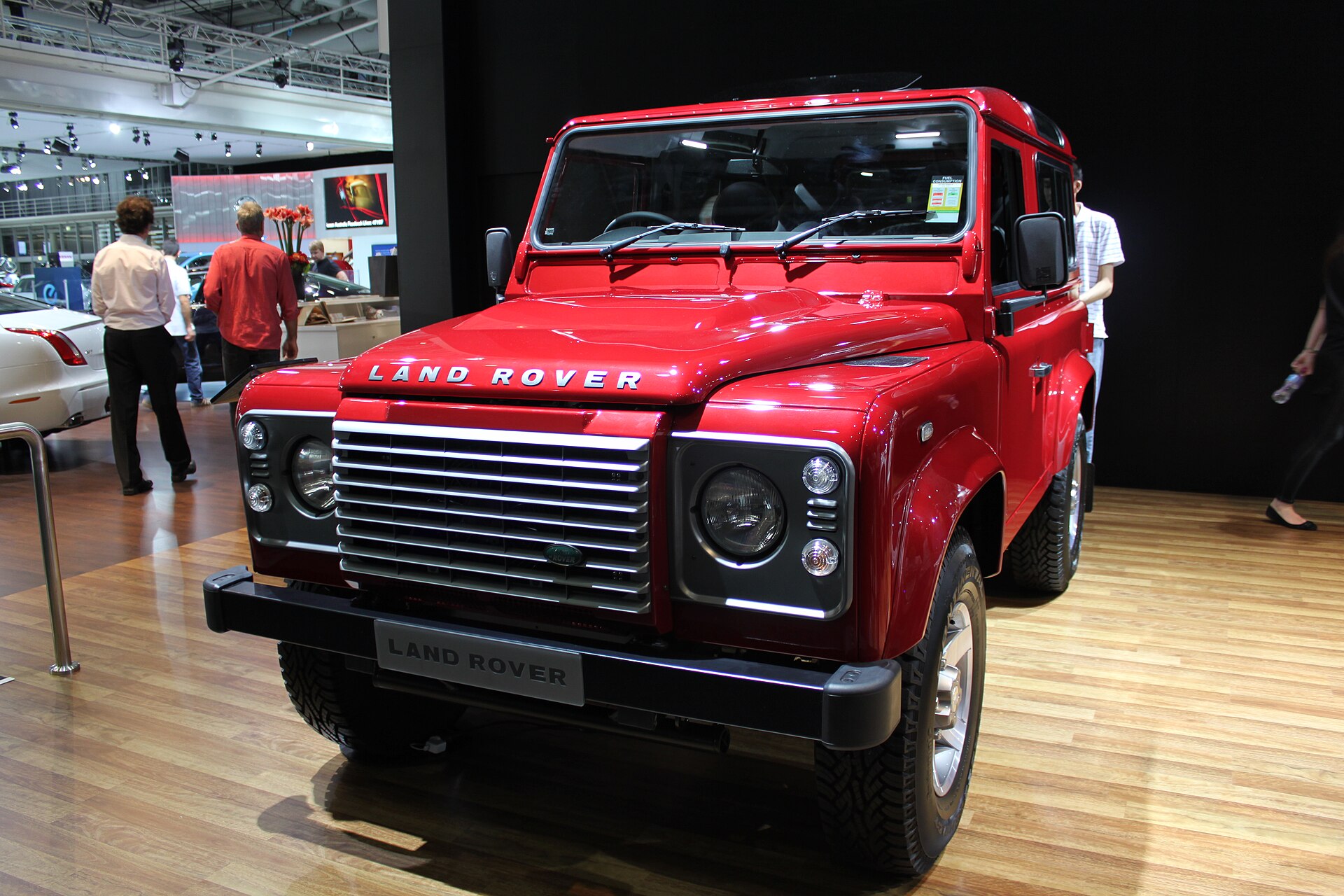
All generations by year: Defender L663 (2020–now) · Defender I (1983–2016)
Which one is mine?
Pick the year of first registration to see which generation it is.
- L663 2020–present
- Defender I 1983–2016
The Land Rover Defender is a four-wheel-drive off-roader from the British brand Land Rover. The original Defender, whose lineage goes back to the first Land Rover of 1948 and which carried the Defender name from 1990, went out of production in January 2016, to the dismay of many fans. Land Rover finally revealed an all-new Defender on 10 September 2019 at the Frankfurt motor show, built in Nitra, Slovakia, and offered with three- and five-door bodies, later joined by a long 130 version.
In short
- The new Defender (L663) was revealed at Frankfurt in September 2019; it was previewed by the DC100 concept shown at the same show in 2011.
- It abandons the old ladder frame for the aluminium D7x monocoque, which Land Rover says is three times stiffer than a traditional body-on-frame design.
- Engines range from a 147 kW (200 PS) 2.0 diesel to the 386 kW (525 PS) V8, all with an eight-speed automatic, permanent four-wheel drive and a two-speed transfer case.
- With air suspension, ground clearance reaches 291 mm and the wading depth is 900 mm.
Size at a glance
| Dimensions | Land Rover Defender L663 |
|---|---|
| Length | 4,758 mm187.3 in |
| Width | 2,008 mm79.1 in |
| Height | 1,967 mm77.4 in |
| Wheelbase | 3,022 mm119.0 in |
Running cost
Fuel · Defender L663 P300 2.0
about 2,950 EUR fuel a year at 15,000 km
11.2 l/100 km · petrol at 1.75 EUR/l · change mileage, fuel price or version
Specs by version
Engines
| Version | Engine | Power | Torque | Gearbox | Drive | Production years |
|---|---|---|---|---|---|---|
| Plug-in hybrid · 1 version | ||||||
| L663 · P400e 2.0 PHEV | 4 cyl · Plug-in hybrid | 297 kW 404 PS398 hp | 640 Nm472 lb-ft | 8-sp Automatic | Four-wheel drive (4×4) | - |
| Diesel · 9 versions | ||||||
| Defender I · 200Tdi 2.5 | 2.5 l · 4 cyl · Diesel 2,495 cc | 80 kW 109 PS107 hp | 264 Nm195 lb-ft | - | Four-wheel drive (4×4) | 1990 |
| Defender I · 300Tdi 2.5 | 2.5 l · 4 cyl · Diesel 2,495 cc | 83 kW 113 PS111 hp | 264 Nm195 lb-ft | - | Four-wheel drive (4×4) | 1994 |
| Defender I · Td5 2.5 | 5 cyl · Diesel | 91 kW 124 PS122 hp | 300 Nm221 lb-ft | - | Four-wheel drive (4×4) | 1998 |
| Defender I · 2.4 TDCi Duratorq | 4 cyl · Diesel | 91 kW 124 PS122 hp | 359 Nm265 lb-ft | 6-sp Manual | Four-wheel drive (4×4) | 2007–2011 |
| Defender I · 2.2 TDCi | 4 cyl · Diesel | 91 kW 124 PS122 hp | 359 Nm265 lb-ft | 6-sp Manual | Four-wheel drive (4×4) | 2012–2016 |
| L663 · D200 3.0 MHEV | 6 cyl · Diesel | 147 kW 200 PS197 hp | 500 Nm369 lb-ft | 8-sp Automatic | Four-wheel drive (4×4) | 2020 |
| L663 · D250 3.0 MHEV | 6 cyl · Diesel | 183 kW 249 PS245 hp | 570 Nm420 lb-ft | 8-sp Automatic | Four-wheel drive (4×4) | 2020 |
| L663 · D300 3.0 MHEV | 6 cyl · Diesel | 221 kW 300 PS296 hp | 650 Nm479 lb-ft | 8-sp Automatic | Four-wheel drive (4×4) | 2020 |
| L663 · D350 3.0 MHEV | 6 cyl · Diesel | 257 kW 349 PS345 hp | 700 Nm516 lb-ft | 8-sp Automatic | Four-wheel drive (4×4) | 2024 |
| Petrol · 5 versions | ||||||
| Defender I · 2.8i (South Africa) | 2.8 l · 6 cyl · Petrol 2,793 cc | 143 kW 194 PS192 hp | 280 Nm207 lb-ft | - | Four-wheel drive (4×4) | 1997–2001 |
| L663 · P300 2.0 | 4 cyl · Petrol | 221 kW 300 PS296 hp | 400 Nm295 lb-ft | 8-sp Automatic | Four-wheel drive (4×4) | - |
| L663 · P400 3.0 MHEV | 6 cyl · Petrol | 294 kW 400 PS394 hp | 550 Nm406 lb-ft | 8-sp Automatic | Four-wheel drive (4×4) | - |
| L663 · P525 V8 | 5.0 l · 8 cyl · Petrol 5,000 cc | 386 kW 525 PS518 hp | 625 Nm461 lb-ft | 8-sp Automatic | Four-wheel drive (4×4) | - |
| L663 · OCTA 4.4 V8 MHEV | 8 cyl · Petrol | 467 kW 635 PS626 hp | 750 Nm553 lb-ft | 8-sp Automatic | Four-wheel drive (4×4) | 2024 |
Performance
Show all 7 versions
| Version | 0–100 km/h | Fuel consumption | CO₂ |
|---|---|---|---|
| Plug-in hybrid · 1 version | |||
| L663 · P400e 2.0 PHEV | 5.4 s 0–62 mph | - | - |
| Diesel · 2 versions | |||
| L663 · D300 3.0 MHEV | - | 9.0 l/100 km26.1 mpg US · 31.4 mpg UK | 237 g/km |
| L663 · D350 3.0 MHEV | 6.4 s 0–62 mph | - | - |
| Petrol · 4 versions | |||
| L663 · P300 2.0 | 8.0 s 0–62 mph | 11.2 l/100 km21.0 mpg US · 25.2 mpg UK | 253 g/km |
| L663 · P400 3.0 MHEV | 6.0 s 0–62 mph | 11.5 l/100 km20.5 mpg US · 24.6 mpg UK | 261 g/km |
| L663 · P525 V8 | 5.2 s 0–62 mph | 14.2 l/100 km16.6 mpg US · 19.9 mpg UK | 321 g/km |
| L663 · OCTA 4.4 V8 MHEV | - | - | - |
Dimensions and weight
Show all 6 versions
| Version | Kerb weight |
|---|---|
| Plug-in hybrid · 1 version | |
| L663 · P400e 2.0 PHEV | - |
| Diesel · 2 versions | |
| L663 · D200 3.0 MHEV | - |
| L663 · D300 3.0 MHEV | 2,520 kg5,556 lb |
| Petrol · 3 versions | |
| L663 · P300 2.0 | 2,275 kg5,016 lb |
| L663 · P400 3.0 MHEV | 2,423 kg5,342 lb |
| L663 · P525 V8 | 2,546 kg5,613 lb |
Verified Manufacturer and type-approval data from our catalog · Sources and methodology
Safety
-
L663 · Euro NCAP 2020
Stars from different years and organisations are not directly comparable: test protocols change every few years.
Land Rover Defender at a glance
The DC100 (Defender Concept 100) first appeared at the Frankfurt motor show in autumn 2011, and eight years later the production model arrived. Deliveries of the five-door 110 began in early 2020, the three-door 90 followed later that year, and the 130 added an extended rear overhang and three rows of seats. The Defender is built at Jaguar Land Rover's plant in Nitra, Slovakia, which opened in October 2018. More of the brand's range is in our Land Rover catalogue, and its story is told in the history of the British Land Rover brand.
Exterior
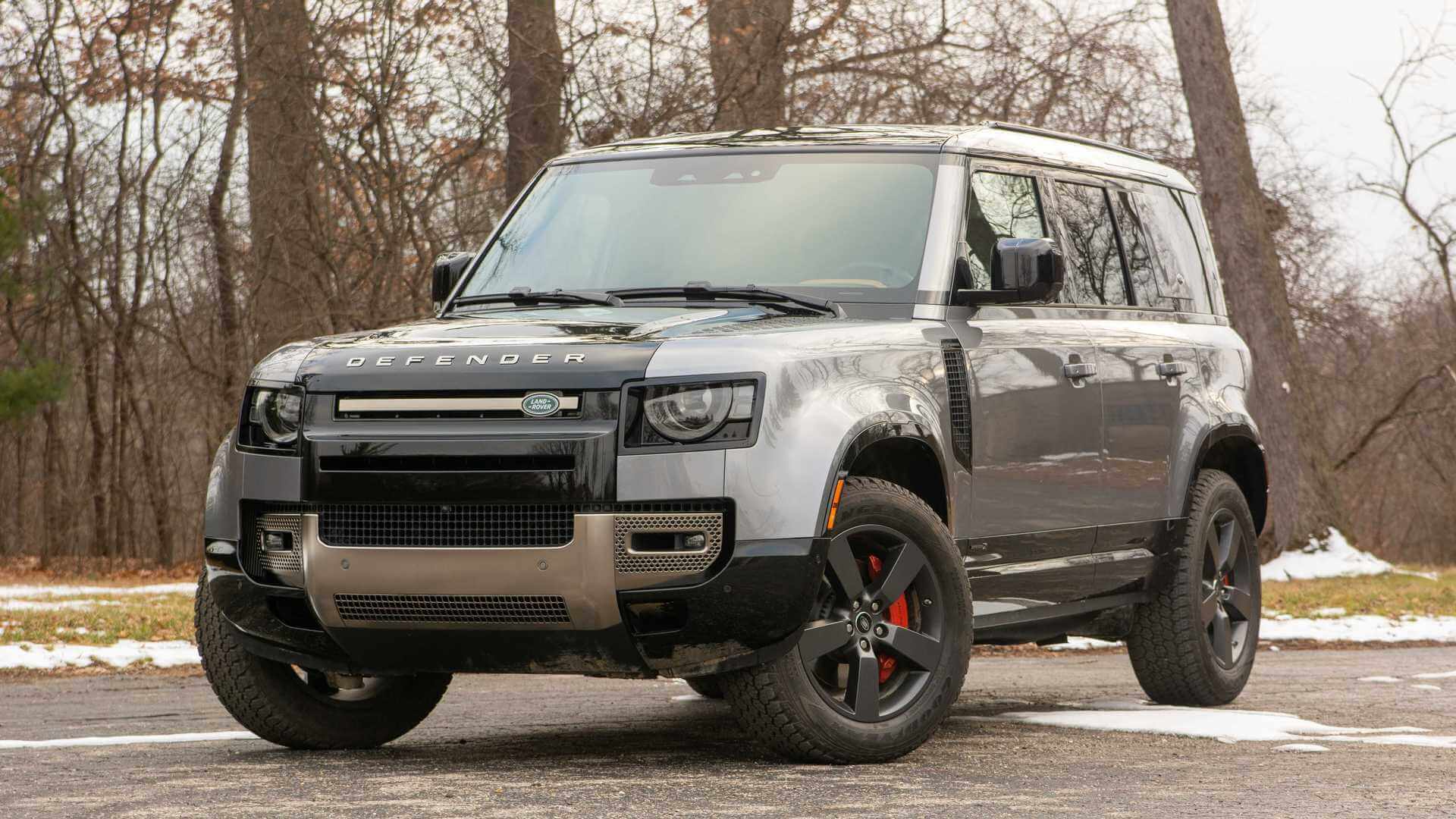
Many people know the old Defender for its rugged, boxy shape. The new generation looks completely different and thoroughly modern, with far fewer of its predecessor's details. The 90 and 110 differ only in their side view; front and rear are identical.
The front has little in common with other Land Rover models. The designers deliberately cut off the top of the headlights to give the car a sterner look. Every version has LED lights with large round daytime running-light signatures, and higher trims get matrix LED headlights. Two square elements beside each headlight act as indicators. The grille is either body-coloured or black plastic depending on the version, with fog lights at the corners of the bumper and the traditional badge on the right of the grille. The bonnet has a raised central section with textured inserts and the Defender name on its leading edge, and gas struts hold it in any position. The rounded windscreen replaces the old flat one and has a reinforcing film designed to withstand impacts from heavy objects at up to 100 km/h.
From the side, a lot depends on the body and version. An optional side-mounted gear carrier can be fitted on one side and an aluminium ladder on the other, and all the mounting points are built in even if the accessories are not ordered. A raised air intake on the driver's side draws air from high up and filters it before it reaches the engine. Black plastic cladding, mesh vents in the front wings, aluminium side steps and the traditional "Alpine" windows along the roof edges complete the look. The square mirrors have heating, electric adjustment, power folding and memory, and can be set to dip when reversing. Wheels range from 18-inch steel wheels to 18- to 22-inch alloys, in around ten designs.
At the rear sits a full-size spare wheel on a side-hinged tailgate, which is very practical off-road. The tailgate is made of aluminium and has a position lock like the bonnet, solving the old problem of the door sagging under the weight of the spare. The square LED tail lights are set into the body for protection.
Interior and practicality
Although the Defender is built for rough terrain, the cabin is far from basic, with quality fabrics, two types of plastic, real leather and metal trim. The driver has a four-spoke steering wheel with a thin rim and many buttons, behind which sits a 12.3-inch digital instrument display. The centre console is clean, with two large vents at the top, a 10-inch Pivi Pro touchscreen with all modern functions and the climate controls, which flow into the structural cross-beam of the dashboard. The large tunnel has many storage pockets, an accessory and charging panel, cupholders and a big armrest with a cool box inside.
The Defender can carry five or seven people (the 110 can even have a front centre seat), with comfortable seats in fabric or leather; heating, extra side support and electric adjustment are available. There are four USB ports and plenty of power sockets. Load space is 1,075 litres in the 110 and 397 litres in the 90, rising to 2,380 and 1,563 litres respectively with the rear seats folded, and the floor is flat. Because the tailgate opens sideways, it is not power-operated.
Engines and transmission
| Version | Engine | Power (kW / PS) | Torque |
|---|---|---|---|
| D200 | 2.0 inline-4 turbodiesel | 147 kW / 200 PS | 430 Nm |
| D250 | 3.0 inline-6 turbodiesel MHEV | 183 kW / 249 PS | 570 Nm |
| D300 | 3.0 inline-6 turbodiesel MHEV | 221 kW / 300 PS | 650 Nm |
| P300 | 2.0 inline-4 turbo petrol | 221 kW / 300 PS | 400 Nm |
| P400 | 3.0 inline-6 turbo petrol MHEV | 294 kW / 400 PS | 550 Nm |
| P400e | 2.0 petrol plug-in hybrid | 297 kW / 404 PS | 640 Nm |
| P525 | 5.0 supercharged V8 | 386 kW / 525 PS | 625 Nm |
The Ingenium diesels use turbocharging and common-rail injection. Diesel versions use about 7.7–9.5 l/100 km on the combined cycle. The P400 has an electric supercharger, direct injection and variable valve timing on both camshafts, plus a 48-volt mild-hybrid system with a starter-generator and a separate battery for energy recovery; it uses at least 9.9 l/100 km.
Every version uses a ZF eight-speed automatic - there is no manual any more - and permanent four-wheel drive with a lockable centre differential and a two-speed transfer case. An active locking rear differential is optional. Terrain Response 2 offers modes for sand, mud and ruts, snow, rocks and wading. Depending on the engine, 0–100 km/h takes 6.1 to 10.3 seconds and top speed is 175–208 km/h depending on version.
Chassis and off-road ability
There is no separate chassis any more, but the Defender has lost none of its strength. The all-aluminium D7x architecture uses a monocoque body with a longitudinal engine, and Land Rover says it is three times stiffer in torsion than traditional body-on-frame designs. Suspension is independent all round, with double wishbones at the front and a multi-link rear; the 110 has air suspension as standard, while the 90 can have coil springs or air. Steering is rack-and-pinion with electric assistance and a variable ratio.
Four-cylinder versions have twin-piston front calipers with 349 mm ventilated discs and 325 mm rear discs; six-cylinder versions have opposed-piston front calipers with 363 mm discs and 350 mm rear discs.
With air suspension, ground clearance is 218 mm in the normal setting and 291 mm in off-road mode, with up to 70 mm more available briefly in an emergency, while the body drops to 168 mm for loading. The 110 has an approach angle of 38°, a breakover angle of 28° and a departure angle of 40°, and it can wade through 900 mm of water. Wade Sensing uses sensors to show the water depth on the screen and dries the brakes afterwards.
Safety and equipment
Standard and optional systems include six airbags, the ClearSight rear-view mirror that uses a camera image, Wi-Fi with 4G LTE, adaptive Terrain Response, adjustable suspension, hill descent control, low-speed adaptive cruise control, a head-up display, digital instruments, navigation, wireless charging, remote smartphone functions, SOS calling, matrix headlights, emergency braking, parking sensors, lane-keeping assist, driver-fatigue monitoring, traffic-sign recognition, a surround-view camera and blind-spot monitoring. Depending on the market, the basic Defender 110 already has six airbags, 18-inch steel wheels, LED lights, heated front seats, air suspension, dual-zone climate control and the 10-inch infotainment system, while higher trims add a sliding panoramic roof, 20-inch wheels, adaptive cruise control, matrix headlights, leather, ventilated massage front seats, a Meridian audio system and the active rear differential.
Strengths and weaknesses
The new Defender looks tough and modern, has a comfortable, high-tech cabin, strong engines and serious four-wheel-drive hardware, and is far more pleasant in town than the old model. Some traditionalists criticised the radical departure from the original concept, but its off-road ability is not in question. Rivals include the Mercedes-Benz G-Class, Jeep Wrangler, Toyota Land Cruiser and Nissan Patrol.
Land Rover Defender: first vs latest generation
| Spec | Defender I | Defender L663 | Change |
|---|---|---|---|
| Years | 1983–2016 | 2020–present | 37 years apart |
| Most powerful version | 143 kW (194 PS) | 467 kW (635 PS) | +324 kW (+227%) |
Oldest and newest generation in the 1cars catalog. Power is the strongest version of each; other rows are shown only when both generations have the figure.
Image credits · Photos from Wikimedia Commons under free licences
- Land Rover Defender I · Photo: Jeremy from Sydney, Australia / Wikimedia Commons, CC BY 2.0
- Land Rover Defender L663 · Photo: Mr.choppers / Wikimedia Commons, CC BY-SA 3.0
Popular comparisons
Land Rover Defender in our rankings
- No. 5 of 143 · Most powerful diesel cars (257 kW)
- No. 8 of 81 · Most torque: diesel cars (700 Nm)
- No. 8 of 51 · Quickest diesel cars, 0–100 (6.4 s)
- No. 15 of 304 · Heaviest cars (2,546 kg · top 5%)
- No. 12 of 197 · Most powerful SUVs and crossovers (467 kW · top 7%)
- No. 32 of 403 · Widest cars (2,008 mm · top 8%)
Heavier than 95% of ranked cars in the 1CARS catalog (No. 15 of 304).
FAQ
When was the new Land Rover Defender revealed?
On 10 September 2019 at the Frankfurt motor show. The previous Defender went out of production in January 2016.
Does the new Defender have a ladder frame?
No. It uses the aluminium D7x monocoque, which Land Rover says is three times stiffer than a body-on-frame design.
How deep can the Land Rover Defender wade?
Up to 900 mm, and Wade Sensing shows the water depth on the screen.
What is the difference between the Defender 90, 110 and 130?
The 90 has three doors, the 110 five doors, and the 130 is a five-door with a longer rear overhang and three rows of seats.
Where is the new Defender built?
At Jaguar Land Rover's plant in Nitra, Slovakia.
Data sources
Data checked by an editor against the sources below.
- Wikipedia - Land Rover Defender
- Wikipedia - Land Rover Defender (L663)
- EEA CO₂ monitoring (European Environment Agency, CC BY 4.0)