
 Land Rover Discovery Sport
Specs, engines and history
Updated Published Sources (7) Report an error
By Felix Hartmann, Automotive Technology & EV Contributor Reviewed by Oleksandr Hnatiuk
- Built
- 2014–present
- Top power
- 177 kW (241 PS)
- New price
- from about €34,400 (2015)
- Used price today
- about €9,000–18,000 (AutoScout24, Nov 2026)
Reliability and buying advice
Our verdict · Felix Hartmann
The Discovery Sport sold in large numbers: 122,460 in 2016 and 126,078 in 2017, and 413,642 from 2014 to 2018. On used cars, check the service history and software updates, especially on early Ingenium diesels, the condition of the diesel particulate filter on cars used for short trips, the infotainment system and, on P300e versions, the charging equipment and battery warning messages. Make sure the third-row seats, if fitted, fold and lock correctly.
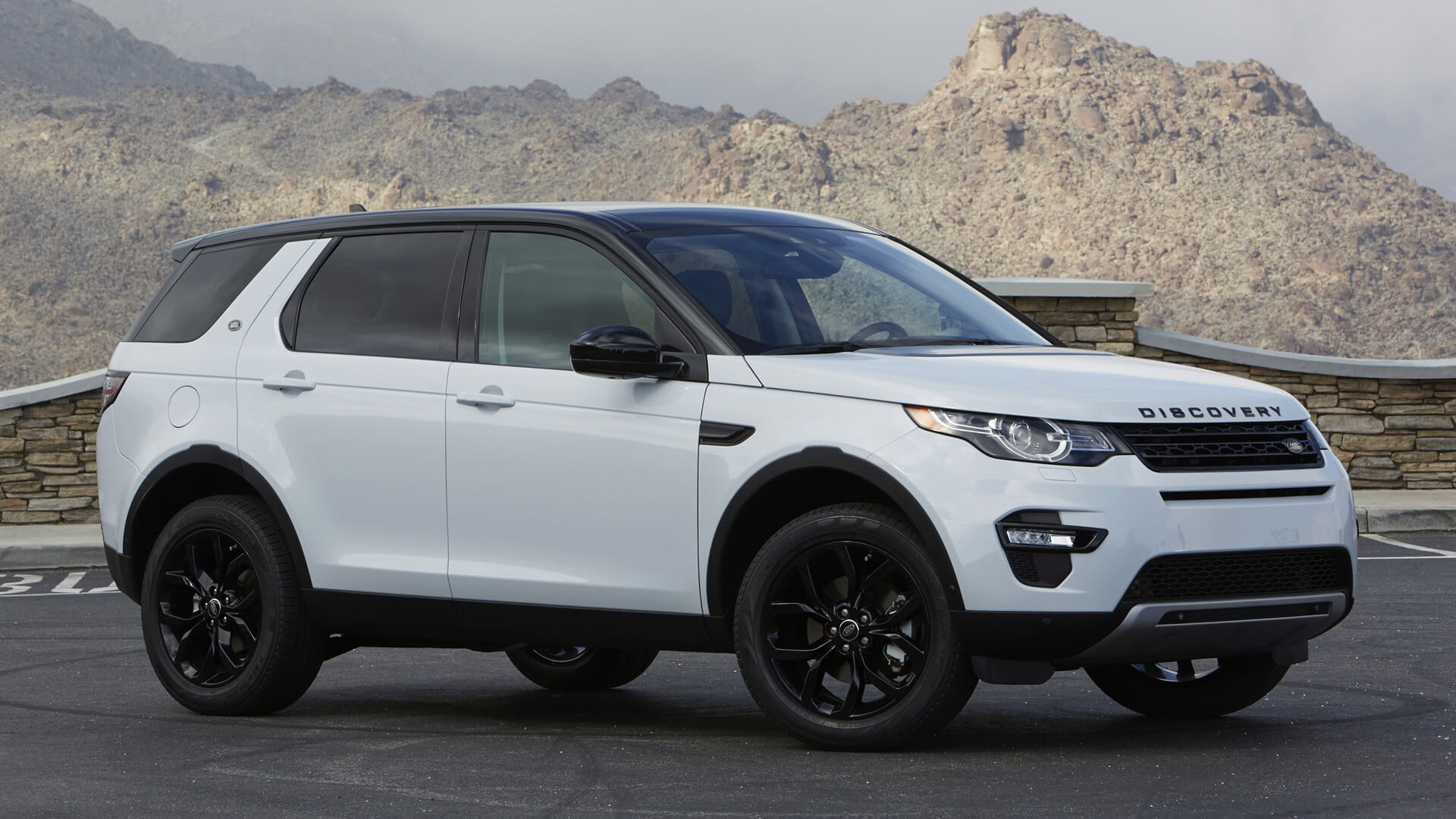
The Land Rover Discovery Sport (code L550) is a compact premium SUV launched in late 2014 as the successor to the Freelander. It offers an optional 5+2 seat layout, 212 mm of ground clearance and 600 mm of wading depth. Since the 2019 update it has used the PTA platform with mild-hybrid engines and the P300e plug-in hybrid.
In short
- Revealed in September 2014, built at Halewood in England and also in China, India and Brazil; still in production in 2026.
- Engines: early 2.0 petrol and 2.2 diesel, Ingenium petrol and diesel from late 2015, 48 V mild hybrids and the P300e plug-in from 2019.
- Euro NCAP: five stars in 2014 (93% adult occupant); re-tested in 2022 with 84% adult and 89% child occupant scores.
- About 413,600 sold worldwide from 2014 to 2018, making it one of Land Rover's best-sellers.

Size at a glance
| Dimensions | Land Rover Discovery Sport |
|---|---|
| Length | 4,590 mm180.7 in |
| Width | 1,895 mm74.6 in |
| Height | 1,724 mm67.9 in |
| Wheelbase | 2,741 mm107.9 in |
Running cost
Fuel · Discovery Sport 110 kW (150 PS) SUV
about 1,750 EUR fuel a year at 15,000 km
7.1 l/100 km · diesel at 1.65 EUR/l · change mileage, fuel price or version
Specs by version
Engines
| Version | Engine | Gearbox | Drive | Production years |
|---|---|---|---|---|
| Diesel · 1 version | ||||
| 110 kW (150 PS) SUV | Diesel | - | - | - |
| Petrol · 1 version | ||||
| 177 kW (241 PS) SUV | Petrol | - | - | - |
| Other · 8 versions | ||||
| 2 L 4 cyl Automatic (S9) · 2026 (EPA) | 2.0 l · 4 cyl 2,000 cc | 9-sp Automatic | All-wheel drive | 2026 |
| 2 L 4 cyl Automatic (S9) · 2025 (EPA) | 2.0 l · 4 cyl 2,000 cc | 9-sp Automatic | All-wheel drive | 2025 |
| 2 L 4 cyl Automatic (S9) · 2024 (EPA) | 2.0 l · 4 cyl 2,000 cc | 9-sp Automatic | All-wheel drive | 2024 |
| 2 L 4 cyl Automatic (S9) · 2023 (EPA) | 2.0 l · 4 cyl 2,000 cc | 9-sp Automatic | All-wheel drive | 2023 |
| 2 L 4 cyl Automatic (S9) · 2022 (EPA) | 2.0 l · 4 cyl 2,000 cc | 9-sp Automatic | All-wheel drive | 2022 |
| 2 L 4 cyl Automatic (S9) · 2021 (EPA) | 2.0 l · 4 cyl 2,000 cc | 9-sp Automatic | All-wheel drive | 2021 |
| 2 L 4 cyl Automatic (S9) · 2020 (EPA) | 2.0 l · 4 cyl 2,000 cc | 9-sp Automatic | All-wheel drive | 2020 |
| 2 L 4 cyl Automatic (S9) · 2019 (EPA) | 2.0 l · 4 cyl 2,000 cc | 9-sp Automatic | All-wheel drive | 2019 |
Performance
Show all 9 versions
| Version | Fuel consumption |
|---|---|
| 2 L 4 cyl Automatic (S9) · 2026 (EPA) | 11.8 l/100 km19.9 mpg US · 23.9 mpg UK |
| 2 L 4 cyl Automatic (S9) · 2025 (EPA) | 11.8 l/100 km19.9 mpg US · 23.9 mpg UK |
| 2 L 4 cyl Automatic (S9) · 2024 (EPA) | 11.8 l/100 km19.9 mpg US · 23.9 mpg UK |
| 2 L 4 cyl Automatic (S9) · 2023 (EPA) | 11.8 l/100 km19.9 mpg US · 23.9 mpg UK |
| 2 L 4 cyl Automatic (S9) · 2022 (EPA) | 11.8 l/100 km19.9 mpg US · 23.9 mpg UK |
| 2 L 4 cyl Automatic (S9) · 2021 (EPA) | 11.8 l/100 km19.9 mpg US · 23.9 mpg UK |
| 2 L 4 cyl Automatic (S9) · 2020 (EPA) | 11.2 l/100 km21.0 mpg US · 25.2 mpg UK |
| 2 L 4 cyl Automatic (S9) · 2019 (EPA) | 10.7 l/100 km22.0 mpg US · 26.4 mpg UK |
| 110 kW (150 PS) SUV | 7.1 l/100 km33.1 mpg US · 39.8 mpg UK |
Dimensions and weight
Show all 2 versions
| Version | Length | Width | Height | Wheelbase | Kerb weight |
|---|---|---|---|---|---|
| Diesel · 1 version | |||||
| 110 kW (150 PS) SUV | 4,590 mm180.7 in | 1,895 mm74.6 in | 1,724 mm67.9 in | 2,741 mm107.9 in | 2,006 kg4,422 lb |
| Petrol · 1 version | |||||
| 177 kW (241 PS) SUV | 4,599 mm181.1 in | 2,069 mm81.5 in | - | - | - |
Verified Manufacturer and type-approval data from our catalog · Sources and methodology
Discovery Sport at a glance
Land Rover previewed the design with the Discovery Vision concept at the New York Auto Show in April 2014 and released the production car on 3 September 2014. The Discovery Sport replaced the Freelander 2 and became the entry point to the "Discovery" family, sitting below the full-size Discovery. It shares much of its engineering with the Range Rover Evoque.

The key selling point is space: within a length of about 4.6 metres it offers an optional third row, so the car can carry five adults and two children. The rear suspension uses a compact multi-link design with aluminium parts, which leaves room under the boot floor for the extra seats.
| Parameter | Pre-facelift (2014–2019) | Facelift (2019–) |
|---|---|---|
| Length | 4,590 mm (180.7 in) | 4,597 mm (181.0 in) |
| Width (without mirrors) | 1,895 mm (74.6 in) | 1,905 mm (75.0 in) |
| Height | 1,724 mm (67.9 in) | 1,727 mm (68.0 in) |
| Wheelbase | 2,741 mm (107.9 in) | 2,741 mm (107.9 in) |
| Kerb weight | 1,744–1,839 kg | – |
| Ground clearance | 212 mm (8.3 in) | 212 mm (8.3 in) |
| Wading depth | 600 mm (23.6 in) | 600 mm (23.6 in) |
| Platform | D8 / LR-MS | Premium Transverse Architecture (PTA) |
Si4, TD4, Ingenium and P300e engines
At launch the Discovery Sport used engines carried over from the Freelander 2: the 2.0-litre Si4 turbo petrol of 177 kW (240 PS) and the 2.2-litre diesel as the 110 kW (150 PS) TD4 and 140 kW (190 PS) SD4. From late 2015 they were replaced by JLR's own 2.0-litre Ingenium four-cylinder petrol and diesel engines. The 2019 update added a 48-volt mild-hybrid system, and the P300e plug-in hybrid combines a 1.5-litre Ingenium three-cylinder with an 80 kW electric motor at the rear axle, for a system output of about 227 kW (309 PS).
| Version (example) | Engine | Power | 0–100 km/h | Top speed |
|---|---|---|---|---|
| Si4 (2014–2015) | 2.0 turbo petrol | 177 kW (240 PS) | 8.2 s | 199 km/h |
| TD4 (2014–2015) | 2.2 diesel | 110 kW (150 PS) | 10.3 s | 180 km/h |
| SD4 (2014–2015) | 2.2 diesel | 140 kW (190 PS) | 8.9 s | 188 km/h |
| eD4 | 2.0 Ingenium diesel, FWD | 110 kW (150 PS) | – | – |
| P300e (2019–) | 1.5 I3 petrol + electric | about 227 kW (309 PS) | – | – |
Most versions use the nine-speed ZF 9HP automatic; a six-speed Getrag manual was available with some diesels, and the P300e has an eight-speed Aisin automatic. The early performance figures above are those quoted by Land Rover at launch. On our own power-to-weight calculation, the Si4 carries about 9.9 kg per kW, while the 150 PS diesel carries about 15.9 kg per kW, which explains the two-second gap to 100 km/h.
All-wheel drive and off-road ability
Most Discovery Sports have all-wheel drive with a fifth-generation Haldex coupling, and the optional Active Driveline from GKN can disconnect the rear axle for economy. There is no low-range transfer box, but the Terrain Response system adapts throttle, gearbox and traction control to grass, gravel, snow, mud and sand. The front-wheel-drive eD4 version does without Terrain Response.

With 212 mm of ground clearance, 600 mm of wading depth and long suspension travel, the Discovery Sport goes further off-road than most compact SUVs. For deep mud or rock, the larger Discovery and Defender remain the better tools.
Cabin, seats and boot
The cabin has a split dashboard with soft materials on top and leather trim on higher versions, a high driving position and good visibility. The second row slides and reclines, and there is enough room for three adults across the bench. The optional third row is best for children or short trips. The 2019 update brought a new dashboard with the Touch Pro infotainment system and a camera-based rear-view mirror on some versions. Trim levels at launch were S, SE, HSE and HSE Luxury.

Fuel use: diesel, petrol or plug-in
The diesels are the most economical conventional engines; Land Rover quoted about 5.3 l/100 km for the 150 PS TD4 at launch under the old NEDC test, which reflects ideal conditions more than daily use. The petrol engines use noticeably more. The P300e can cover short commutes on electricity if it is charged regularly. For a realistic estimate at your own mileage, use the fuel cost calculator.

Euro NCAP results and the pedestrian airbag
Euro NCAP awarded the Discovery Sport five stars in 2014, with 93% for adult occupant protection, 83% for child occupants, 69% for pedestrians and 82% for safety assist. It was also one of the first cars in its class with a pedestrian airbag, which deploys over the base of the windscreen. In 2022 Euro NCAP tested the updated car under its tougher protocol and recorded 84% for adult occupants, 89% for child occupants, 71% for vulnerable road users and 85% for safety assist.

Rivals: how the Discovery Sport compares
| Model | Seats | Notes |
|---|---|---|
| Land Rover Discovery Sport | 5+2 | Best off-road ability in the class |
| BMW X3 / X1 | 5 | Sportier drive, no third row |
| Audi Q5 | 5 | Higher-quality cabin, no third row |
| Mercedes-Benz GLB | 5+2 | Seven seats, less off-road ability |
| Volvo XC60 | 5 | Safety focus, plug-in hybrids |
Other Land Rover models include the stylish Range Rover Velar and the fast Range Rover Sport SVR. To compare dimensions with a rival or your garage, try the garage fit tool or the 1cars comparison tool.

Which Discovery Sport to buy
The best all-round choice is a post-2019 car on the PTA platform with a mild-hybrid diesel and all-wheel drive: it has the modern cabin and the newer safety equipment. The P300e suits drivers who can charge at home and make mostly short trips. Pre-facelift cars are good value if the service history is complete, with the SD4 or later Ingenium diesels the most sought after. The brand's story is in the history of Land Rover.

Land Rover Discovery Sport in our rankings
- No. 10 of 210 · Widest SUVs and crossovers (2,069 mm)
- No. 14 of 565 · Widest cars (2,069 mm · top 3%)
- No. 103 of 452 · Heaviest cars (2,006 kg · top 23%)
- No. 403 of 1178 · Longest-running car nameplates (12 years · top 35%)
- No. 174 of 402 · Oldest car models still on sale (12 years · top 45%)
- No. 74 of 158 · Heaviest SUVs and crossovers (2,006 kg · top 47%)
Wider than 97% of ranked cars in the 1CARS catalog (No. 14 of 565).
Land Rover Discovery Sport photos 15


Land Rover Discovery Sport videos 3

Crash test

Test drive

Video overview
FAQ
Is the Land Rover Discovery Sport a seven-seater?
It can be. A 5+2 layout with a third row of two seats was available, best suited to children or short trips. Many cars were sold as five-seaters, so check the specification of a used car.
What is the fuel consumption of the Discovery Sport?
At launch Land Rover quoted about 5.3 l/100 km for the 150 PS diesel in the old NEDC test. Petrol versions use more, and real-world figures are higher. The P300e plug-in hybrid is the most economical if charged often.
Is the Discovery Sport all-wheel drive?
Most versions are, using a Haldex coupling or the optional GKN Active Driveline, with Terrain Response. A front-wheel-drive eD4 diesel was also sold. There is no low-range gearbox.
How safe is the Discovery Sport?
Euro NCAP gave it five stars in 2014, with 93% for adult occupants, and it introduced a pedestrian airbag. A 2022 re-test under the newer protocol recorded 84% for adult and 89% for child occupant protection.
What replaced the Freelander?
The Discovery Sport replaced the Freelander 2 from late 2014. It is slightly larger, offers an optional third row and shares much of its engineering with the Range Rover Evoque.
Data sources
Data checked by an editor against the sources below.
- The text of this article (1cars archive)
- Wikipedia - Land Rover Discovery Sport
- Co
- US EPA fueleconomy.gov - 48988.shtml
- US EPA fueleconomy.gov - 48104.shtml
- US EPA fueleconomy.gov - 46453.shtml
- EEA CO₂ monitoring (European Environment Agency, CC BY 4.0)


