
Ford Bronco vs Land Rover Defender: off-roaders
Updated Report an error By Oleksandr Hnatiuk
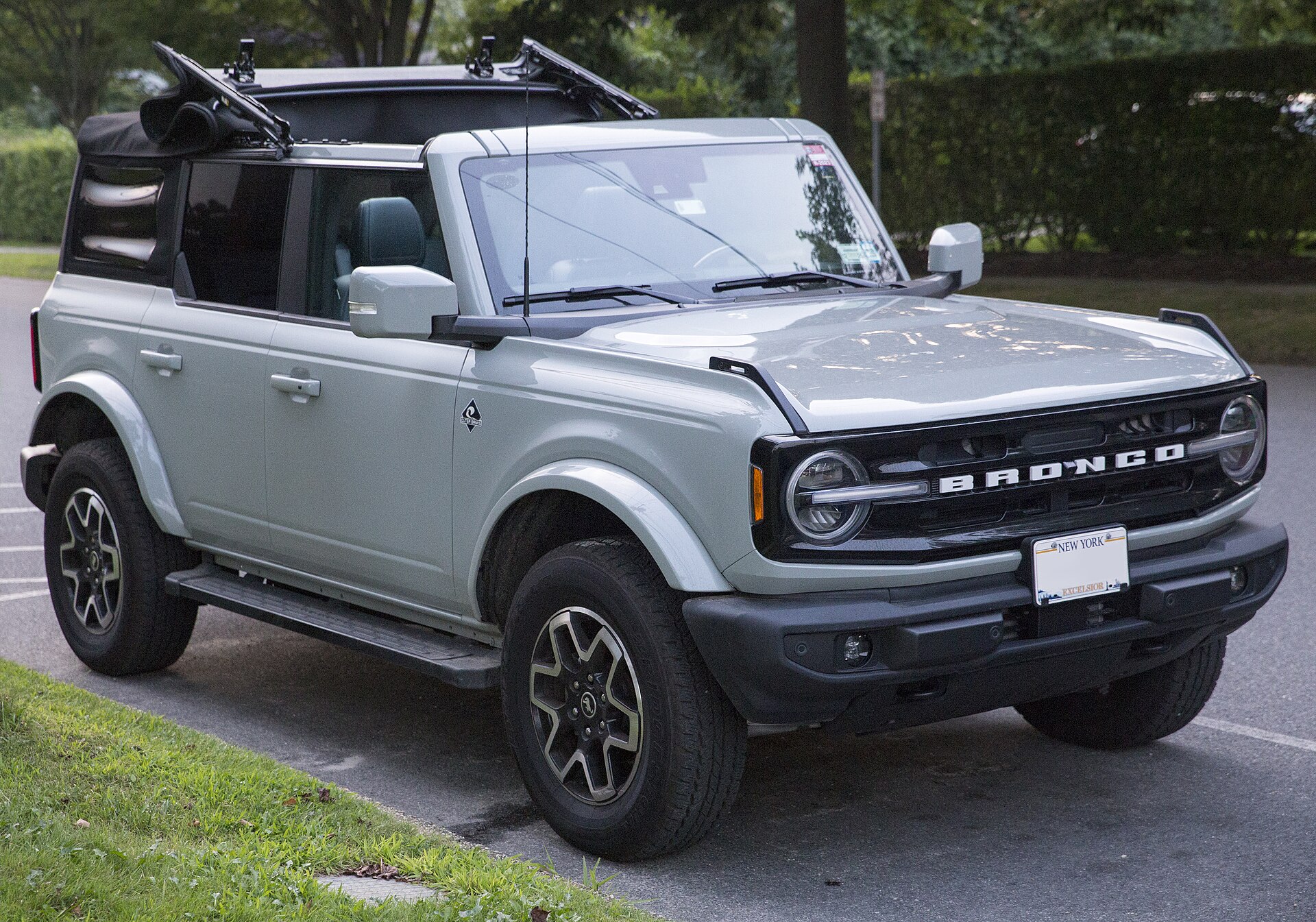
Ford · 2020–present
Bronco
- Power
- 246 kW334 PS
- 0–100 km/h
- -
- Kerb mass
- 2,289 kg
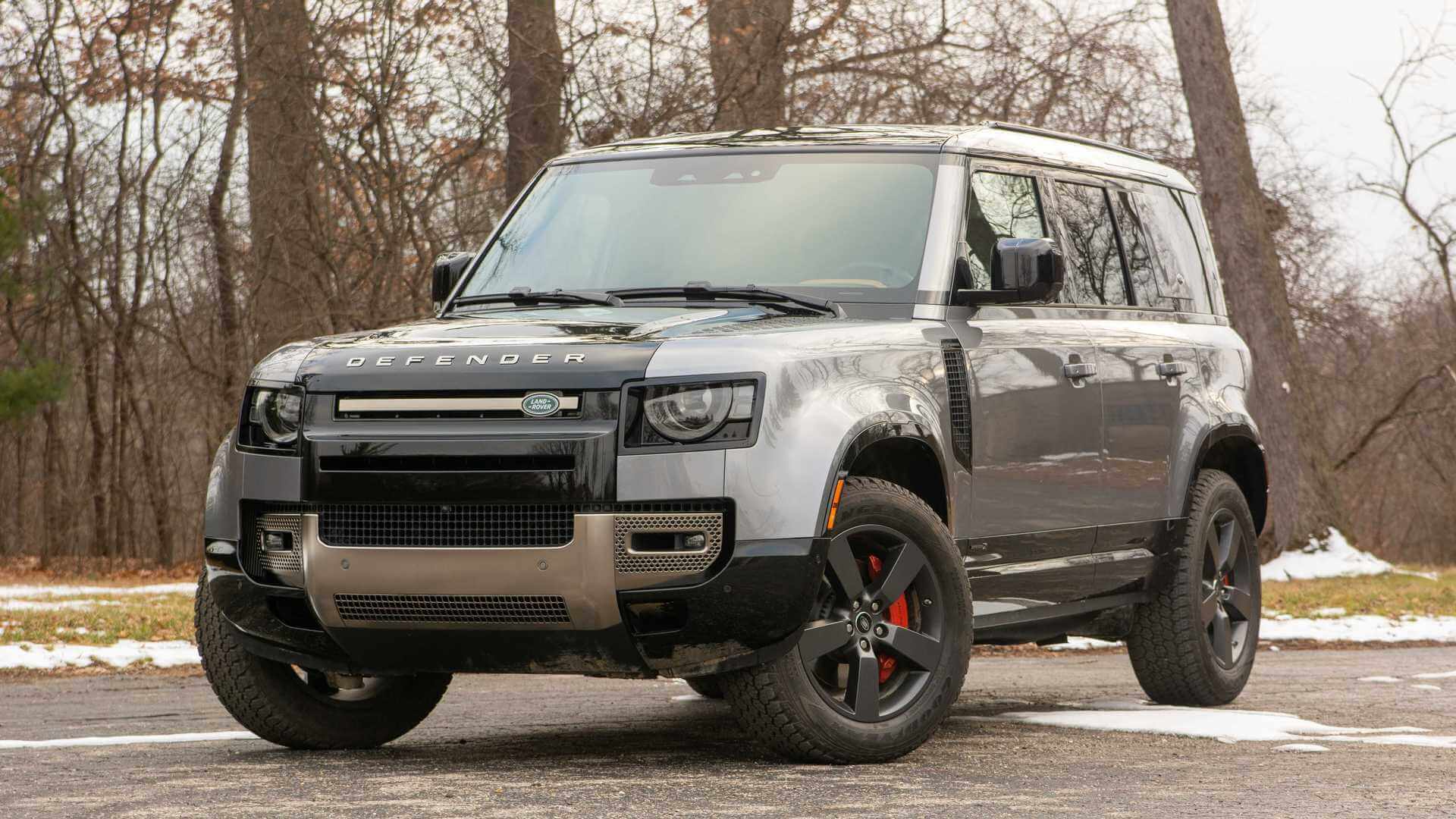
Land Rover · 2020–present
Defender L663
- Power
- 221 kW300 PS
- 0–100 km/h
- 8.0 s
- Kerb mass
- 2,275 kg
At a glance
Who suits what, worked out from the catalog figures of the versions above.
Categories won: Bronco 1 Defender L663 1
- City Defender L663 Width: 2,008 mm vs 2,177 mm
- Performance Bronco Power per tonne: 108 kW/t vs 97 kW/t
- Running costs Too close to call Fuel per year: €2,970 vs €2,940 (estimated)
- Off-road Too close to call Drive and body: Four-wheel drive (4×4) · SUV vs Four-wheel drive (4×4) · SUV
Verdict Opinion
The Bronco is the more playful and more honest off-roader. A separate frame, removable doors and roof, a manual gearbox with a crawler gear and factory 35- or 37-inch tyres make it a vehicle built around weekends in the dirt.
The Defender is the more complete car. It covers diesel, petrol, plug-in hybrid and V8 buyers, offers three body lengths including a third row, and combines serious off-road clearance with the comfort of air suspension and a five-star Euro NCAP result.
- Oleksandr Hnatiuk
Two famous off-road names returned within a year of each other. Land Rover launched the new Defender (L663) at the Frankfurt Motor Show on 10 September 2019 and builds it in Nitra, Slovakia. Ford unveiled the sixth-generation Bronco on 13 July 2020, and the first production cars left the Michigan Assembly Plant in Wayne on 14 June 2021. Both revived nameplates with a long history, but the engineering behind them is completely different.
In short: the Ford Bronco is the open-air, body-on-frame adventure vehicle with a manual gearbox and removable doors and roof. The Land Rover Defender is the premium all-rounder with a stiff aluminium body, air suspension, a diesel and plug-in range and a three-row 130. The model histories are on our Ford Bronco and Land Rover Defender pages.
Ford Bronco vs Land Rover Defender: different by design
Ladder frame against monocoque
The Bronco shares its body-on-frame construction with the Ford Ranger pickup. The Defender moved to an aluminium unibody on the D7x platform, a break with the separate chassis of its predecessor. The practical effect is clear. The Bronco is built to be stripped down, with frameless doors that can be stored in the cargo area and a detachable roof on both the two- and four-door versions. The Defender relies on its rigid body and, on the 110, standard air suspension.
EcoBoost petrol against diesel, hybrid and V8
Ford uses EcoBoost petrol engines only. The 2.3-litre four-cylinder has 224 kW (304 PS) and 441 Nm, the 2.7-litre twin-turbo V6 246 kW (335 PS) and 563 Nm, and the Raptor's 3.0-litre V6 312 kW (424 PS) and 597 Nm. Land Rover offers diesels from the D200 with 147 kW to the D350 with 257 kW. Petrol engines run from the 2.0-litre P300 with 221 kW to the 3.0-litre P400 mild hybrid with 294 kW, and the P400e plug-in hybrid has 297 kW. At the top sit the 5.0-litre supercharged P525 V8 with 386 kW and the OCTA, whose 4.4-litre twin-turbo V8 makes 467 kW (635 PS) and 750 Nm.
Gearboxes
The Bronco can be ordered with a manual: a seven-speed Getrag unit that is really a six-speed with an extra crawler gear. A ten-speed automatic is optional with the 2.3 and standard with the 2.7 V6. Every Defender engine in our catalogue uses an automatic.
Sizes
The two-door Bronco is 4,440 mm long on a 2,550 mm wheelbase, the four-door 4,811–4,839 mm on 2,949 mm. The Defender 90 has a 2,587 mm wheelbase and measures 4,323–4,583 mm; the Defender 110 is 4,758–5,018 mm long on 3,022 mm. The Defender 130 stretches the rear overhang to 5,170–5,358 mm for a third row, a size Ford does not offer.
Off-road hardware
The Bronco's Sasquatch package adds a mild lift and 35-inch tyres, and the Raptor runs on 37-inch tyres; Wikipedia gives a ground clearance of 295 mm. The Defender 110 and air-sprung 90 have 291 mm, coil-sprung 90s 226 mm. Air suspension is standard on every Defender 110, and the OCTA can wade through one metre of water.
Euro NCAP
The Defender 110 received five stars in 2020, with 85% for adult occupants, 85% for children and 71% for vulnerable road users.
Race Stats side by side
Each figure is a 0–100 score from the catalog numbers, the same as on the 1CARS Race cards. PI is the overall performance index (100–999) and its class D–S.
| Stat | Bronco | Defender L663 |
|---|---|---|
| PI | B · 558 | C · 472 |
| Power | 52 | 49 |
| Grip | 47 | 47 |
| Handling | 42 | 23 |
| Top speed | 57 | 39 |
| Launch | 57 | 42 |
Grip and handling are estimates from drive type, weight, height and body (hover a figure to see where it comes from). 1CARS Race
Who wins a race?
Quarter-mile (402 m) drag from a standing start, dry road, no reaction time - the 1CARS Race physics on the catalog figures of these versions.
- 1 Bronco2020–present · 2.7 EcoBoost V6 (4-door) · petrol · 246 kW (334 PS) 14.14 sat 156 km/h
- 2 Defender L663Defender L663 · P300 2.0 · petrol · 221 kW (300 PS) 15.74 sat 137 km/h · +1.60 s
Size and weight
| Bronco | Defender L663 | |
|---|---|---|
| Length | 4,811 mm189.4 in | 4,758 mm187.3 in † −53 mm −2.1 in −1.1% |
| Width | 2,177 mm85.7 in † | 2,008 mm79.1 in † −169 mm −6.7 in −7.8% |
| Wheelbase | 2,949 mm116.1 in | 3,022 mm119.0 in † +73 mm +2.9 in +2.5% |
| Kerb weight | 2,289 kg5,046 lb | 2,275 kg5,016 lb −14 kg −31 lb −0.6% |
| Fits a standard garage? | Too wide | Too wide |
Difference vs Bronco (±). Garage check: a standard single garage takes a car up to about 5.0 m (16 ft 5 in) long and 1.9 m (6 ft 3 in) wide (width as listed in the catalog; some makers include the mirrors). Leave about 0.6 m (2 ft) to open the doors. † from another version of this generation.
Full specifications
| Ford Bronco | Land Rover Defender | |
|---|---|---|
| General | ||
| Version | 2020–present · 2.7 EcoBoost V6 (4-door) · petrol · 246 kW (334 PS) | Defender L663 · P300 2.0 · petrol · 221 kW (300 PS) |
| Production years | 2020–present | 2020–present |
| Body | SUV | SUV |
| Class | No data | SUV / crossover |
| Country | United States | United Kingdom |
| Performance | ||
| Power Why it matters: More power means stronger acceleration and easier overtaking, especially with a full load. | 246 kW (334 PS) 330 hp Better | 221 kW (300 PS) 296 hp |
| Power, all versions | 78–312 kW (106–424 PS) 105–418 hp | 51–467 kW (69–635 PS) 68–626 hp |
| Torque Why it matters: Torque is the pulling force you feel when accelerating from low revs, towing or climbing hills. | 563 Nm 415 lb-ft Better | 400 Nm 295 lb-ft |
| 0–100 km/h Why it matters: A shorter 0–100 km/h time means quicker getaways and safer merging onto fast roads. | No data | 8.0 s |
| Power per tonne | 108 kW/t 131 hp/ton calculated Better | 97 kW/t 118 hp/ton calculated |
| Engine and transmission | ||
| Fuel | Petrol | Petrol |
| Engine | 2,700 cc · 6 cyl 2.7 l | 4 cyl |
| Gearbox | 10-speed automatic | 8-speed automatic |
| Drive | Four-wheel drive (4×4) | Four-wheel drive (4×4) |
| Dimensions and weight | ||
| Length | 4,811 mm 189.4 in | 4,758 mm 187.3 in † |
| Width | 2,177 mm 85.7 in † | 2,008 mm 79.1 in † |
| Height | No data | 1,967 mm 77.4 in † |
| Wheelbase | 2,949 mm 116.1 in | 3,022 mm 119.0 in † |
| Kerb weight Why it matters: A lighter car is usually more agile and uses less energy. | 2,289 kg 5,046 lb | 2,275 kg 5,016 lb |
| Economy and running costs | ||
| Fuel consumption Why it matters: Lower consumption cuts running costs and CO₂ emissions on every trip. | 11.3 l/100 km 20.8 mpg US | 11.2 l/100 km 21.0 mpg US |
| CO₂ | 324 g/km | 253 g/km Better |
| Fuel cost per year | €2,970/year estimated | €2,940/year estimated |
| Safety | ||
| Euro NCAP | No data | ★★★★★ (2020) |
These cars do not differ in the data we have.
Equal rows hidden (4): Production years, Body, Fuel, Drive.
Better marks the stronger figure - only for measurable specs (power, torque, 0–100 km/h, consumption, boot, weight).
Estimated at 15,000 km a year with fuel at €1.75/l petrol. † from another version of this generation.
In plain words
Ford Bronco has more power: 246 kW (334 PS) against 221 kW (300 PS) for Land Rover Defender. Ford Bronco is 53 mm longer than Land Rover Defender (4,811 mm vs 4,758 mm). Land Rover Defender is lighter by 14 kg (2,275 kg vs 2,289 kg). At 15,000 km a year, fuel would cost about €2,970 (Ford Bronco), €2,940 (Land Rover Defender) (estimated). Ford Bronco is the older design (from 1966); Land Rover Defender arrived in 1983. On the catalog figures, the Land Rover Defender is the pick for city; the Ford Bronco is the pick for performance. Our catalog has no 0–100 km/h for the Ford Bronco yet, so some checks above leave it out.
Which one to choose
Choose the Ford Bronco if you want open-air driving with the doors and roof off, a manual gearbox, or the Raptor's 312 kW and 37-inch tyres.
Choose the Land Rover Defender if you need a diesel or a plug-in hybrid, a third row in the 130, air suspension for long road trips, or a V8 up to the 467 kW OCTA.
Both meet the Jeep Wrangler on 1cars: Ford Bronco vs Jeep Wrangler and Jeep Wrangler vs Land Rover Defender.
Frequently asked questions
Is the Bronco body-on-frame like the old Defender?
Yes. The Bronco has a separate frame based on the Ford Ranger. The new Defender switched to an aluminium unibody, unlike the original Defender.
Can you get a manual Bronco or Defender?
Only the Bronco, with a seven-speed manual that includes a crawler gear, offered with the 2.3-litre engine. The Defender is automatic.
Which has more ground clearance?
Wikipedia gives 295 mm for the Bronco. The Defender 110 and air-sprung 90 have 291 mm, the coil-sprung 90 226 mm.
Which is bigger?
The four-door Bronco is 4,811–4,839 mm long on a 2,949 mm wheelbase; the Defender 110 is 4,758–5,018 mm on 3,022 mm, and the three-row Defender 130 reaches 5,358 mm.